Do you want to hear the audio recording of Senator Larry Craig’s arrest in an airport in Minneapolis? Of course you do!
My favorite moment — well, there are two.
First of all, Senator Craig is having a dissociative moment where he does not really understand what’s happening to him. He doesn’t really understand that a police officer is about to end his career, he doesn’t understand he’s been caught, literally with his pants down, soliciting sex in a public men’s room and his career is about to end. He mentions early on in the recording that he has to make his flight, meaning, “I am still a powerful, busy, important man — you are a small, insignificant man, why won’t you go away?” He’s acting like he’s getting a parking citation or talking about his cable options with the guy from Dish Network — “what do I have to say to make you go away?”
(Listening to the recording and hearing the disassociation in his voice, I begin to understand why he pleaded guilty — simply to make this stop, so he could get back to his previously-scheduled life as quickly as possible and pretend none of this ever happened.)
(Literally, pretend it never happened, both to protect his job and to make it that much easier the next time he wants to do it.)
Second, his sad, obvious, transparent denials of how long he was in the men’s room, what he was doing there, even the order of events is topped by his interjection, out of nowhere, “I am not gay.” The officer never uses that word, and it even seems inappropriate to the conversation. The officer never says anything like “Minneapolis has had it up to here with you gay men and your perversions,” he’s very straightforward, calm but firm, charging the senator with a specific crime, not even a very serious crime, that carries a specific penalty. Craig is like the guy who gets pulled over for a busted taillight and blurts out “I don’t know why you pulled me over, there’s nothing weird in my trunk, I’m not an axe murderer.”
Some thoughts on the anniversary of Katrina

Of all the horrifying images of Katrina, the one above is the one that sticks with me most. Bush, in the photo, is flying over New Orleans surveying the flood damage. He has turned to the camera to give what he thinks is his best “heavy is the crown” face, but all I can see in his expression is “can I go home now?” “I’ve flown over the destroyed city, I’ve looked out the window, I’ve ‘shown I care,’ can I go home now and get back to killing people, spying on Americans, crushing dissent, gutting the constitution and making all my friends wealthy?”
Katrina, for me, was when the mask finally came all the way off, revealing the administration of Bush II for what it was: an unfathomably brutal, cynical, uncaring cabal of monsters concerned only about accruing wealth and power. Karl Rove spoke often of building a “permanent Republican majority,” but time has shown that the Bush II people (who, let’s face it, are also the Bush I people, the Reagan people, the Nixon people) don’t even care about their party — they care only about themselves. They act as though they are the last people who will ever preside over the government of the United States. They believe this whole system of government was set up for them to loot the treasury for eight years and then leave town chortling.
But I was talking about Katrina.
First thing that happened two years ago today was that, for me anyway, the mainstream American news media became obsolete. The news out of New Orleans was coming too fast for outlets like the New York Times to keep up with, so I started looking elsewhere. News blogs like Eschaton, Crooks and Liars, Daily Kos and Americablog I had heard spoken of but never frequented, but during Katrina I sought them out because they were gathering information from all kinds of different places, giving me a much fuller, more truthful picture of what was going on on the ground than, say, CNN or Fox News were, including Anderson Cooper and Chuck Roberts and Geraldo and their efforts to convey the horrors of the flood.
I have not looked back since. I haven’t turned on the TV to watch an American news outlet since Katrina and I find that I am better informed for it. American TV news, it will surprise no one, is driven not by a search for journalistic truth but by advertising dollars. This formulation can only lead to networks promoting sensation over substance in their attempts to garner more viewers than their competition. The “liberal blogs,” I find, regardless of their openly-stated biases, to be more informative and ultimately more truthful than any money-driven corporate news organization.
The second thing that happened was that Katrina exposed America’s conservative movement for what it truly is. I saw a clip from The O’Reilly Factor where Bill O’Reilly, within days of the disaster, denounced the dead, the homeless and the doomed as lazy, shiftless losers who deserved exactly what they got. Now, I know that O’Reilly is a merely a heartless clown who believes in no ideology beyond the continued dominance of his little patch of media real estate, but I, who have seen a lot from these monsters in the past few years, was still struck by the sheer hatefulness of his response. I couldn’t find the clip on YouTube, but the quote I remember was O’Reilly saying something along the lines of “It is not the responsibility of the federal government to help the people of New Orleans, it was the responsibility of the people of New Orleans to get good jobs and good educations so that they would not have to live in poor neighborhoods below sea level.” His words were decidedly more snide and scabrous, but you get the idea.
Anyway, I got stuck on the first part of the statement and it rolled around in my head for days. It’s not the responsibility of the federal government to help the citizens of a major American city when it is struck by a natural disaster? I had heard a lot of denial of responsibility from conservatives over the previous five years, but this was a new one on me. If the federal government is not responsible for protecting its citizens, what, in God’s name, are they there for? Why should we pay federal taxes to a government who, literally, does not care if we live or die?
This concept bothered me so much that I went around reporting this to friends. One of those friends, not a poli-sci major but a regular, garden-variety college graduate, gave me a strange look, as though she suddenly realized that I was, in fact, only five years old, and said “But Todd, that’s the whole point of a conservative government — you give them all your money and they use it to fight wars forever.”
And so that weekend, not only Katrina but Iraq came into sharp focus for me. The Bush administration declared war on Iraq not because Iraq had weapons of mass destruction, or because they were linked to Al Qaeda, or because Saddam was a bad, bad man, but because it served their political ideal of always being at war so that nothing they do can be questioned and they can take all the money they want. I guess I always knew that on some level, but it took Katrina, and that quote from O’Reilly, and the above photograph to fully expose Bush and Cheney for what they are.
Because I realized, the reason Bush has that look on his face is because, for him, Katrina was not a disaster. When he told the lying, stupid, incompetent, crony head of FEMA he was doing “a heckuva job,” he wasn’t being clueless or idiotic, he was speaking honestly. Because for him, Katrina, far from being a disaster or tragedy of monumental, history-changing proportion, was the perfect fulfillment of his principles, namely, that in the perfect conservative world, the wealth of the nation is ever-concentrated upward from the poor to the middle class to the upper class to the ruling class, where it stays, and then the poor die, proving, by divine providence, that they were unfit to live in the first place. Bush, in his actions, said “I am your leader. Give me your money and then die, so that I and my friends in the military/industrial complex may flourish.” I remember one Republican politician surveying photos of the inundated 9th Ward and reasonably judging that “it looks like that could all just be bulldozed,” as though it was not actually a city, where thousands of people had homes, but simply another felicitous opportunity for gentrification for some lucky real-estate developer.
It was only when even Fox News was horrified by the scenes of unspeakable carnage and loss that Bush and company realized that they had to put on some kind of show of caring, which is exactly what they did — they put on a show. They put Bush in New Orleans, turned on the lights, put a camera on him, and as soon as he was off the air, turned off the lights again, and as far as I know, that’s the last time Bush ever thought about the destruction of New Orleans. Bush in that speech looked ridiculously uncomfortable and stiff, not because he was reeling from the loss of a major American city on his watch, but because he honestly had no idea what the hell it had to do with him.
UPDATE: Given the above, how appropriate it is that Bush chose the anniversary of Katrina to ask the American people for another $50 billion to continue his endless war in Iraq (which has, by the by, now killed more Iraqis in four years than Saddam Hussein managed to kill in thirty).
UPDATE UPDATE: Pam Spaulding of Americablog is on the ground in New Orleans today and efficiently outlines just how much caring has been done by the Bush administration on the behalf of the city.
The fault lies not in our stars

Stars: “I am not gay, I have never been gay.”
One of the major tenets of conservative thought, a perfectly legitimate one, is that people should be responsible for their own lives. And yet, one of the major tenets of the conservatives in Washington today is that nothing is their fault and they never do anything wrong, even when, especially when, there is overwhelming evidence that it is and they have. Pushing this example to its most absurd extreme, Senator Larry Craig (R-Idaho), a major opponent of gay-rights legislation, claims that an Idaho newspaper is to blame for his actions in a Minnesota airport men’s room.
How this works I’m not exactly sure. A newspaper devotes column space to trying to prove you’re gay, so you, understandably distracted and anxious about this crisis, proposition a cop in an airport men’s room? Then, when you’re arrested for this behavior, instead of saying “no, wait, this is all a misunderstanding, and it’s ironic that this has happened, because, oddly enough, there’s this newspaper in Idaho that keeps saying that I do things exactly like this all the time, and I’ve been very distracted and anxious about that,” instead of saying that, you say “I am guilty as charged and I hope this ends the matter.” Damn those Idaho newspapers! They get our highest elected officials into the most awkward situations! How do they do that?
Senator Craig

Crooks and Liars posts this video of Senator Larry Craig (R-Idaho) giving his statement regarding his arrest for and confession of propositioning an undercover cop in a Minnesota airport men’s room.
Aside from the obvious (yet another anti-gay Republican senator being revealed to be a closet case), I am interested in the piece for the senator’s opening remarks. He begins by saying “I’d like to thank you all for coming out today — ” and my pulse was momentarily raised by the possibility that he was then going to finish the sentence with ” — by doing the same myself.”
Alas, he didn’t. But that would certainly be something, would it not? Imagine if this were his statement instead of his blah-de-blah boilerplate, easily-dismissed denial (“denial” having multiple meanings here):
“You know, I’m glad this happened. I’m glad this happened, because it’s a perfect example of the kind of behavior people like me have been driven to by the repressive, inhumane laws that people like me have passed. Now that everyone knows I’m gay, that my personal life is a sham and that my professional life is a gigantic, brutal machine of self-hate, maybe now I can say “screw all that, I’m not going to be a politician any more, I’m going to finally try to make my life line up with the acts I spend my waking life performing, I can let my wife have some kind of normal existence for her remaining years, and I won’t have to proposition strange men in airport men’s rooms for my kicks. I’m 60, I’m fit, I’m rich, I’m ready for action — who wants me?”
Unless, of course, he’s afraid the answer would be “no one.”
Karl Rove one-liner

When Karl Rove dies, people will say he’s spinning in his grave and will mean it as a compliment.
Notes from a visit to the Metropolitan Museum of Art, NYC, part 2


The Met has a ginormous selection of Greek and Roman artifacts. What I don’t know about Greek and Roman artifacts would fill a museum, one even larger than this. But the stuff on display is intriguing so I wade in. Funeral urns, columns, lots of statues of soldiers and boys and ladies, all naked. Glass cases full of cups and bowls and signet rings and necklaces and stick-pins and cutlery and weapons and plates and all manner of stuff, going on forever. It’s a morass.
Read more
George W. Bush: worse than a William Morris agent.

Let me be the first to say it: this man is a dangerous retard.
Many years ago, I had an agent at William Morris. He was an idiot. Literally everything he did, and everything he advised me to do, was bad for my career. Oh the stories I could tell. He botched deals, angered producers, over-sold me, under-sold me, advised me against every good lead I found, actively sabotaged my projects, and once negotiated a deal on the behalf of the producer optioning my material instead of on the behalf of his client (me). Our partnership ended when I brought his behavior to the attention of his superiors in Los Angeles.
It took me a long time to figure out just how bad at his job he was (one of his tactics was to make me feel like I was a moron and a failure, and, being new to the business I had no reason to doubt his opinion), but I finally did.
And then one day he called and said there was a lady visiting New York from Hollywood and she wanted to have a general meeting with me.
ME. A “general meeting,” what does that mean exactly?
IDIOT. She just wants to sit down and get to know you a little bit.
ME. So, should I have a pitch ready for her or anything?
IDIOT. Oh, heavens no, that would be the absolute wrong thing to do, please don’t do that.
I hung up the phone, sat down and, straight-away, wrote out pitches for five movies.
A few days later, I went to meet the lady from Hollywood at the William Morris offices. We met, shook hands and were shown into a conference room. Before she had even sat down, she said “So. Tell me an idea for a movie.” Luckily, I had listened carefully to my idiot agent’s advice and so proceeded to do the exact opposite thing, so I was prepared to pitch a whole bunch of stuff to the lady from Hollywood. That lady was Nina Jacobson, and that meeting, probably the most productive and important business meeting of my life, ended with our friendship beginning, and thenceforth to me having a real career in motion pictures.
My point is, I think we’ve reached that point with president Bush.
I think we’ve reached the point, at least two years gone now, where all we really need to do is, when we read a headline like “Bush Insists Al Qaeda in Iraq Threatens U.S.”, we can just go ahead and assume that Al Qaeda in Iraq does not threaten the US. And yet, the New York Times runs the headline they do, rather than post the more accurate “Power-drunk Man-child Babbles Incoherently Regarding Things He Knows Nothing About.” Why give the man any respect at all? Why is it that I, with no journalistic or poli-sci background whatsoever, can better see what this administration is doing than the editorial staff of the New York Times?
It’s simply exhausting, with this administration, to keep one’s level of outrage going. Watching Z the other night with
![[info]](http://stat.livejournal.com/img/userinfo.gif)
, I kept thinking — “is this what it’s going to take, are Bush and Cheney going to have to actually murder their opposition leaders anyone says “Hey, what’s the deal with that President Bush guy?” before people will starting paying attention? Will Nancy Pelosi have to be clubbed to death by thugs hired by Cheney before people will begin to sense there is something going horribly wrong in this country? Will Al Gore have to be gagged and thrown into the back of a van and whisked off into the night before anyone notices that we’re not living in a democracy any more? (Note — the folks in Z, it should be noted, get away with murdering their opposition leaders, and a lot more other people too).
Here’s some headlines from just today:
Gee, somehow, no matter what, oil prices just keep going up. Funny how that works.
You know how we said the surge was “a last chance?” Well, we had our fingers crossed. Suckers!
And, finally:
Bush’s lawyer vigorously defends Bush’s right to crush boys’ testicles if he wants to.
Now there’s a real measure of scary. Just think: Bush is willing to go on public record insisting has the right to crush boys’ testicles. Now imagine the stuff he doesn’t want us to know about.
The saddest thing about the administration, of course, is that they don’t even have a plan for what happens after they’re gone. They don’t see how, for example, when their party inevitably falls from power, all their dismantling of the constitution will still be in effect, and will inevitably be used against them by their successors. They honestly haven’t thought that far, all their energy has been toward simply accruing as much power for themselves as possible, making a ton of money and screwing everyone.
I think the sooner we start treating Bush and his administration as I treated my idiot agent, the sooner we’ll all have the best, most productive meeting of our lives.
Movie Night With Urbaniak: Yukoku, Z
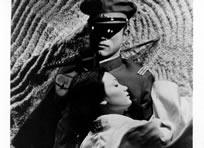

Two political thrillers of extremely different stripes this evening. The first, Yukio Mishima’s short 1966 film Yukoku and then Costa-Gavras’s 1969 political thriller Z. The two movies could not be more unalike: Yukoku is brief, stark, weird, highly stylized and almost freakishly intense, Z is naturalistic, frenetically shot and edited, alarming and intensely furious. The fact that they were made around the same time and come from polar opposites of the political spectrum make the evening that much more fun.
Yukoku is based on a short story published in the US as “Patriotism,” which is essentially a dry, clear-eyed, blow-by-blow account of an army officer committing seppuku. The movie is much more stylized, artsy even, with its abstract sets, lack of dialog and dramatic lighting. The officer comes home, greets his wife, explains the situation with her, she agrees to also kill herself, they have serious, intense, dramatically-lit sex, he gets dressed and kills himself, she goes and puts on fresh makeup, then comes back and kills herself too. A lot of Mishima’s key themes are distilled into this 25-minute movie — the changing nature of Japanese culture (which Mishima despised, being politically conservative in the extreme), the importance of dying while still beautiful, the tying together of sex and death and the compulsion to make one’s death a work of art. (Of course, most people these days watch Yukoku, if they watch it at all, because Mishima later killed himself in a manner startlingly similar to what he does in this movie.)
Mishima, surely one of the most egotistical men of his day, strangely declines to give himself a single close-up in this most personal of stories. Instead, he hides his face behind the bill of his army hat through the whole movie, giving all the close-up time to the actress playing his wife. She becomes, essentially, the protagonist of the movie — the army officer remains opaque and unknowable, while his wife (and by extension, we) are meant to fall desperately in love with his noble honor and tragic beauty. After her husband dies, the wife goes to freshen up and there is a terrific shot of her silk robe dragging through the pool of her husband’s blood on the floor. On the one hand, one says “ick,” but on the other hand, the shot drips (sorry) with symbolism and beauty, which kind of sums up my feelings about Mishima in general. On the whole, I’d rather he go on making experimental films instead of killing himself in a meaningless political gesture, but then I probably wouldn’t be sitting here thinking about him.
Z is a whole different kettle of fish.
Here in the US, we’re completely comfortable watching movies about Russia or Italy or Spain and seeing American actors speak English with cheesy accents — we don’t think a thing about it. But when watching Z, it’s disorienting for a while because it’s a movie set in Greece about Greek people but is shot, um, somewhere that’s not Greece (I think French Morocco), starring an all-French cast speaking French. On top of that, the filmmakers have made the decision to not try too hard to make their locations look authentic, which means that it feels like all you need to know is that it’s a political thriller that takes place in some sunny country. (At the time of course, the story was not only fresh but still going on, so none of this had to be explained to anyone.)
For the first half, it’s a political thriller par excellence, shot with such verisimilitude as to be startling and confusing. Nothing is explained, nothing is slowed down for the newcomers or Americans. There’s some kind of country, and it’s run by some kind of quasi-fascist regime, and an opposition leader is coming to town for a rally. We see the rally organizers trying to nail down the specifics of their upcoming event, we hear that there is a threat of assassination in the air, we see the general political unrest in the streets. We (at least we in 2007) don’t know which side anyone is on, who to root for, or even who the protagonist is. We’re just kind of plunked down in the middle of this situation and left to fend for ourselves. The shooting is all documentary style, handheld cameras and whipcrack pans, with a few artsy little flourishes, and then just when we’re getting oriented to who’s who and what’s at stake, the opposition leader gets assassinated and the movie changes gears.
53 minutes into the narrative, the protagonist shows up, the special prosecutor hired toinvestigate the assassination, and the movie becomes a detective thriller as we watch the prosecutor gather evidence, track down leads, and piece together the chain of events that led to the assassination. It’s almost unbearably thrilling, because we are in the exact same situation as the prosecutor — we just got here, we saw everything happen but we have little idea what any of it means. So as the scope of the conspiracy becomes clear and the stakes rise, our anger towards the people responsible gets greater and greater.
I first saw this movie in 1981 or so and thought “Wow, fascinating, what interesting places these horrible little tinpot dictatorships are,” and last night, of course, James and I could not help but be reminded of what our country is going through right now. We watch as government officials edit intelligence reports to fit a pre-decided outcome, twist and distort language to serve ideological ends, smear, intimidate and destroy their political opposition and finally kill anyone who disagrees with them, banning the use of language itself when it contradicts the official viewpoint, and it’s like being granted a backstage view at the White House. Halfway through the movie, I had a vision of the 28-year-old Dick Cheney watching this movie in 1969, watching how the fascists operate and whipping out a notebook, nodding along, saying “uh huh, got it, good, oh that’s a good one, yes, ah yes, indeed.”
Late in the movie the prosecutor is delivering his findings to his government superior, who grows increasingly upset as the story is accurately assembled before his eyes. The prosecutor, who has no agenda other than finding out who done it, turns up his palms, almost apologetically, and says “these are simply facts,” which is, of course, why his boss is so upset, and which is why the scene resonates with us so strongly today. We live in a country where the simple stating of facts is considered a dangerous left-wing attack on the government.
The fascists of Z despise modernism, long hair, rock music, liberalism and lack of respect for the government. One wonders whose side Mishima would have been on while watching the movie.
Happy Independence Day!
It is on this day that we celebrate the liberty of Scooter Libby.
Keith Olbermann states my feelings. Only I was here about five years ago. Still, it was nice to read.