Some thoughts on The Boys
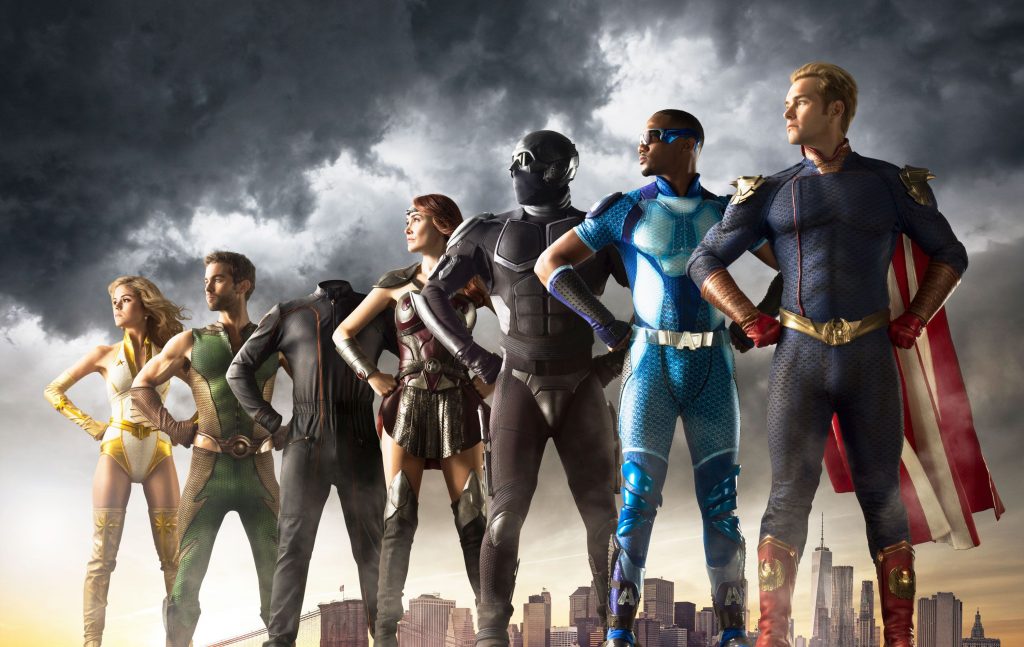
It’s a tough time for satire. The Trump Circus is so insane, so flamboyantly, egregiously stupid, that it’s impossible to address it head on. Saturday Night Live gave up a long time ago, it merely sums up the week’s events in a slightly more cartoonish delivery.
In order to satirize the unthinkable, you have to approach it from a different angle. Horror has always been good at this, allowing people to experience the terrors of everyday life through the lens of metaphor. The hellscape of 1968 was perfectly encapsulated in the movie that sprang from it, Night of the Living Dead, and They Live was, if anything, too blunt a metaphor for the Reagan era.
Amazon’s The Boys, based on a comic of the same name, has emerged as the most relevant show of the day, taking all the ugliness, greed, desperation and horror of our present moment and adding just one pop-culture ingredient to make it palatable: superheroes.
The premise, at first, sounds merely waggish: what if the Justice League were assholes? But, like, really, really, unredeemable assholes? But then it goes deeper, much deeper, as it presents a world where there are superheroes, but the superheroes are controlled by a REAL superpower, a gigantic multi-national corporation. This corporation promotes its superheroes as media stars, putting them into movies and TV shows, promoting their Instagram accounts, organizing Twitter armies to sway public opinion about them, creating their personas and origin stories, and, above all, keeping the public constantly entertained by their antics in order to cover up the many, many horrendous crimes they commit.
Does this sound familiar?
The show is not for everyone — it’s not just caustic in its satire, it’s positively scabrous, presenting a harsh, scorched-earth vision of a world where there is no real good, only different aspects of evil. There is nothing pure in its world, nothing is left untouched by its brackish, curdled moral sense. It’s pungently profane, and baroquely gory. People are routinely dismembered and beheaded, when they’re not exploding outright, but, for my money, that profanity and violence is the best mirror we currently have in a world where there really are people above the law, backed by moneyed interests with power beyond our imagining, who blithely circumnavigate the globe crushing the weak beneath their heels.
Batman on the Big Screen
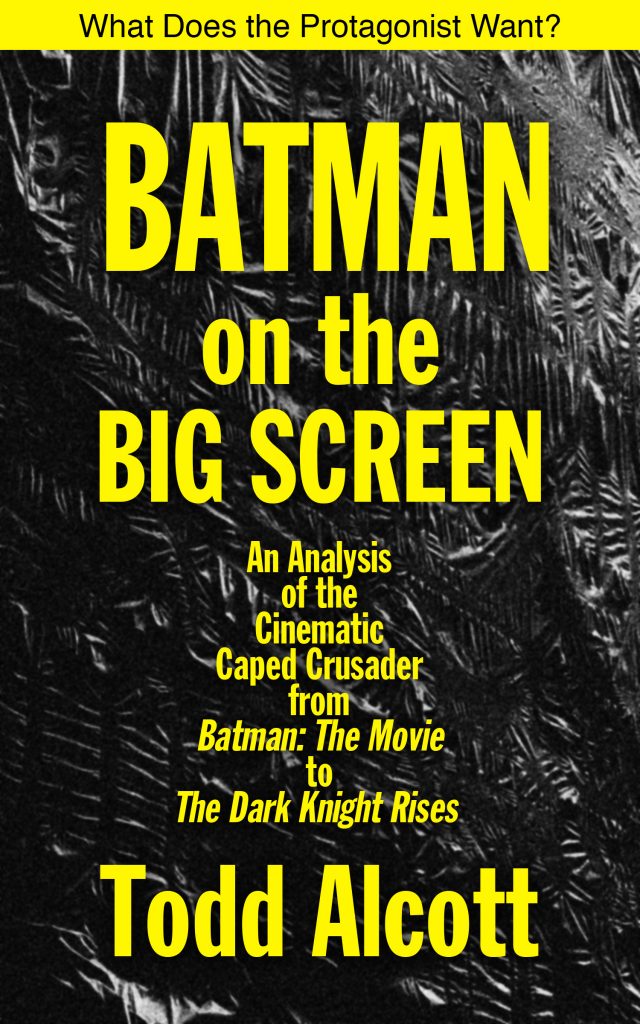
Batman on the Big Screen, a volume collecting everything I’ve written about the Caped Crusader, is now for sale at Amazon. It’s the first in what will be a long line of volumes under the What Does The Protagonist Want? banner. Having just finished editing it, I can tell you, it’s still highly addictive reading!
Guardians of the Galaxy part 11
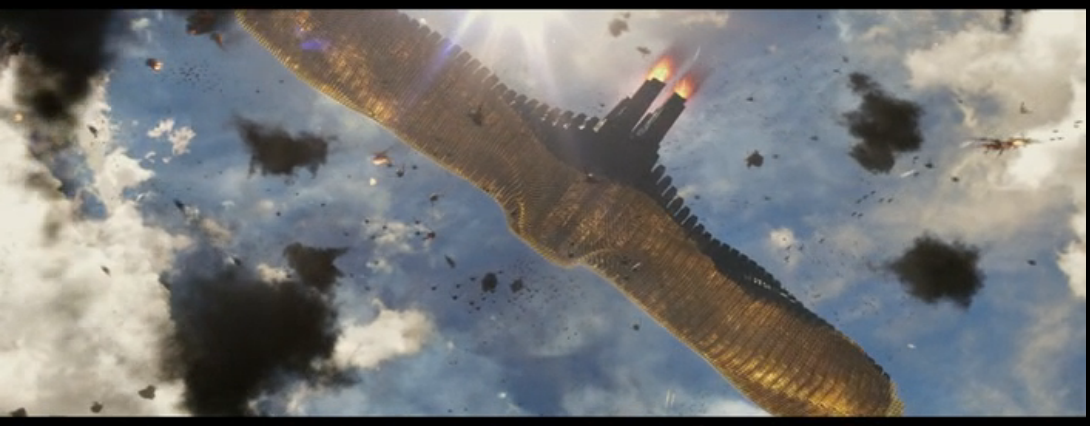
Peter’s, Drax’s and Groots victory in the innards of the Dark Aster gets a narrative comeuppance as Ronan decides to show his strength. He wields his mighty hammer, like Thor one might say, and blows a hole in the Nova Corps defenses. At the same moment, Rocket’s Ravagers become overwhelmed by Ronan’s kamikaze fighters. Mint-sucking Nova Corps dude, and thousands more, are killed as his team’s chain-of-fighters strategy crumples under Ronan’s wrath. The “first chapter” of Act III is complete, we’ve established that the goofballs can really fight once they’ve admitted that they’re in love, and now the opposition makes its case for hate.
Guardians of the Galaxy part 10
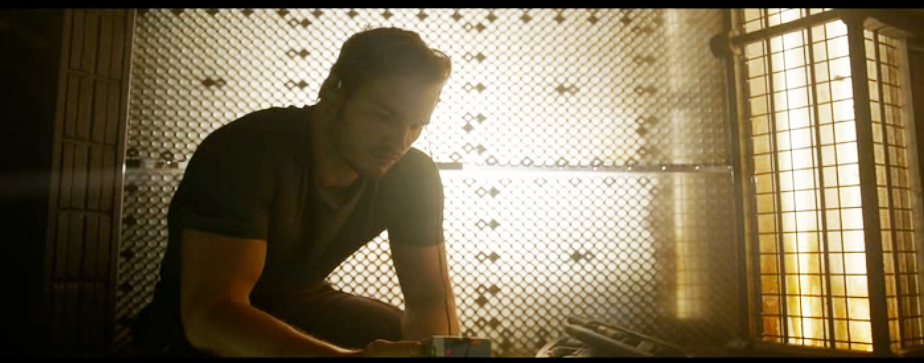
Act III of Guardians begins with an echo of the first shot of the movie: Peter, holding his Walkman, listening to his mother’s Awesome Mix. The director has changed the angle, but the camera is almost at the same height as it was in the opening. The earlier shot was softly lit, the new one is lit from behind. Everything is different, but everything is the same. Peter is grown up now, he can admit that he’s in love, and as he contemplates his mother’s gift, Joan Jett comes along to warm him up for his upcoming fight with the unambiguous “Cherry Bomb.” The operative line from this song would seem to be “Get down ladies, you’ve got nothing to lose.” What follows is a fairly routine battle-plan-explanation scene, not unlike the ones in Star Wars or Return of the Jedi, but cut together with a prep montage, giving us the best of both cliches and peppering them with humorous character beats, like Drax deciding which jacket not to wear and Groot doing the tree-equivalent of popping a zit. The prep-montage ends with a reference to Armageddon, or Reservoir Dogs, or The Wild Bunch, or any number of heroes-walking-toward-the-camera-in-slow-motion-looking-tough shots. In this case, the heroes include a yawning assassin and a raccoon adjusting his penis.
Guardians of the Galaxy part 9
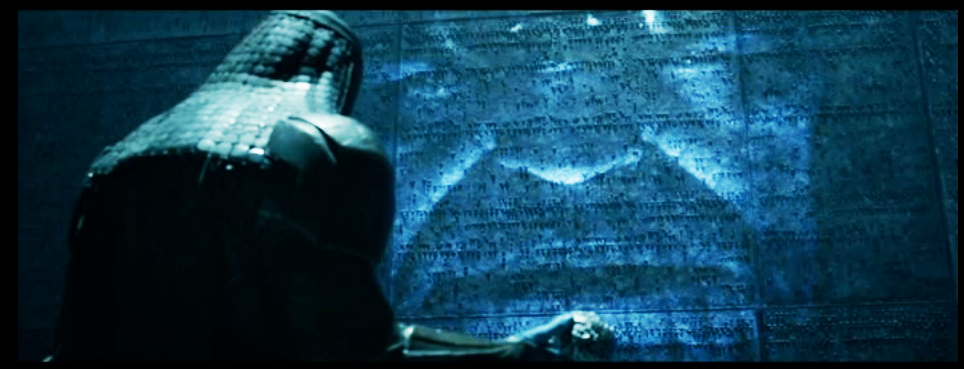
As the second half of Guardians gets underway, Ronan has the orb. Instead of getting it over to Thanos straight away though, he decides to keep it for himself — he did not know that it contained an infinity stone. Which begs the question, what on earth (so to speak) did Ronan think the orb was, if Thanos wanted it so badly? Did he think that Thanos had sent him across the galaxy to fetch the equivalent of his Awesome Mix? For that matter, if Thanos wanted it so badly, why didn’t he climb down off his floaty chair and get it himself? For that matter, why didn’t Ronan get it himself, instead of sending first Korath and then Gamora, both of whom were inadequate to the task? What is it with this galaxy’s megalomaniacs, that they won’t pursue the things they want more than anything? The answer, I think, is that, for them, power over others, respect, that is, is more important than the item itself. The fact that they’ve got dispensable minions means more to them than obtaining the tools of power themselves. In any case, Ronan’s interception of the orb gives him the golden opportunity to both destroy Xandar himself and, after that, kill Thanos himself. (This is another juncture where it’s made clear that the insertion of Thanos into the narrative of Guardians came late in the game; the story is much cleaner and more linear if Ronan knows from the beginning that the orb contains the stone and the stone will destroy the planet.)
Guardians of the Galaxy part 8
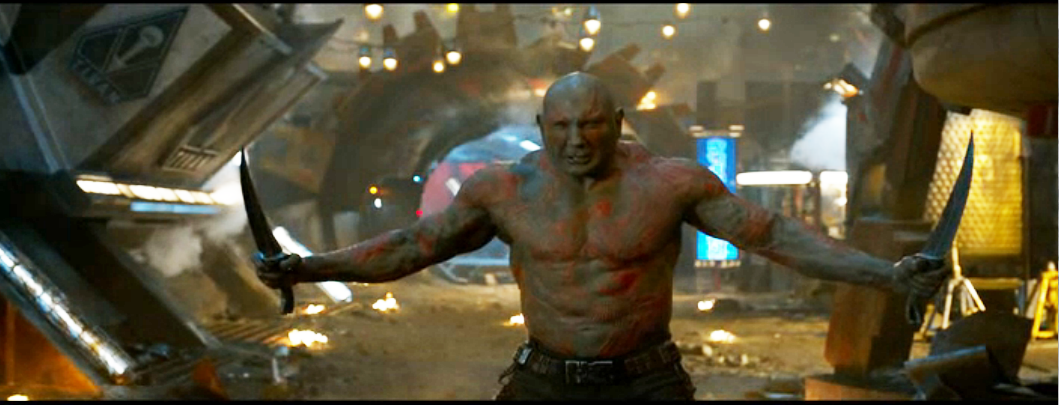
Now that Drax has put the lives of everyone in the galaxy at risk, it’s a good time to ask: What does Drax want?
Drax’s cinematic goal is “to kill Ronan,” that’s easy enough. But when he’s face to face with his nemesis and the moment of his fate is at hand, what happens is a repeat of the opening set-piece: the nemesis has no idea who the protagonist is. Drax’s goal, like Peter’s, is “to be taken seriously.” Or perhaps Drax would say “to be taken literally.” This, of course, is also Ronan’s goal, and, in his own way, Rocket’s (his brash anarchism, his lack of respect, masks [masks! Raccoon!] a deep despair and need for respect. A lot of characters in Guardians are just looking for a little respect, and you could even draw lines through the narrative, separating the characters looking for respect and the characters refusing to grant it. Even Nova Prime is granted little respect in the movie — the Kree ambassador hangs up on her, and her own underling is surprisingly blase as he sucks a mint or something while he reports to her. That makes a character like Yondu stand out, because he appears to neither grant nor need respect from anyone. Instead, he sees life as a series of conflicts, and an underling (like Peter) and a superior (like the Broker) are both mere obstacles for him. Again, the characters’ need and desire for respect links them to the movie’s meta-theme: the dumbest things (the shallow space-dude, the smart-mouth raccoon, the walking thesaurus) contain deep truths, which is why we love them the most.
Guardians of the Galaxy part 7

While Rocket, Groot and Drax drink and fight in the next room, Peter makes time with Gamora, seducing her with the power of cheap Earth pop music. The song he chooses is “Fooled Around and Fell in Love,” his wish being, of course, that Gamora will let her guard down, “fool around,” so to speak, and “fall in love” with Peter (or at least fall in bed). I bring up these kind of obvious points to link this scene to the opening of the movie, where Peter protected himself from the harsh reality of his mother’s illness by listening to “I’m Not in Love.” Both songs, for Peter, are types of lies, used to distract, either himself from his pain or a woman (well, alien female) from his young-male shenanigans. In the first case, he’s trying to toughen himself up, tell himself he does not feel. In the second case, he’s trying to loosen Gamora’s defenses, get her to feel something before she has a reason. Gamora, for her part, is almost, but not quite, seduced by Peter’s strange Earth music and accompanying “pelvic sorcery.”
Guardians of the Galaxy part 5

What are the stakes for Peter now? He’s not out of the game yet — he’s been arrested, but, as we’ll find out soon enough, he still has the orb. He and his pursuers have all been arrested and sent to the Kyln, a high-security space prison, seemingly the Riker’s Island of the galaxy. Rocket even makes a note of how this is not a Nova-Corps-run establishment, this is something else, maybe more like Angola, or Devil’s Island, the kind of prison for lost causes, where you’re sent to die. Apparently Xandar has no concept of a trial; if you get caught horsing around on their planet you get shipped off to the worst prison in the galaxy, no questions asked. So Peter’s situation hasn’t improved, and even though his direction has changed, he still isn’t quite to the end of his first act.
Guardians of the Galaxy part 4
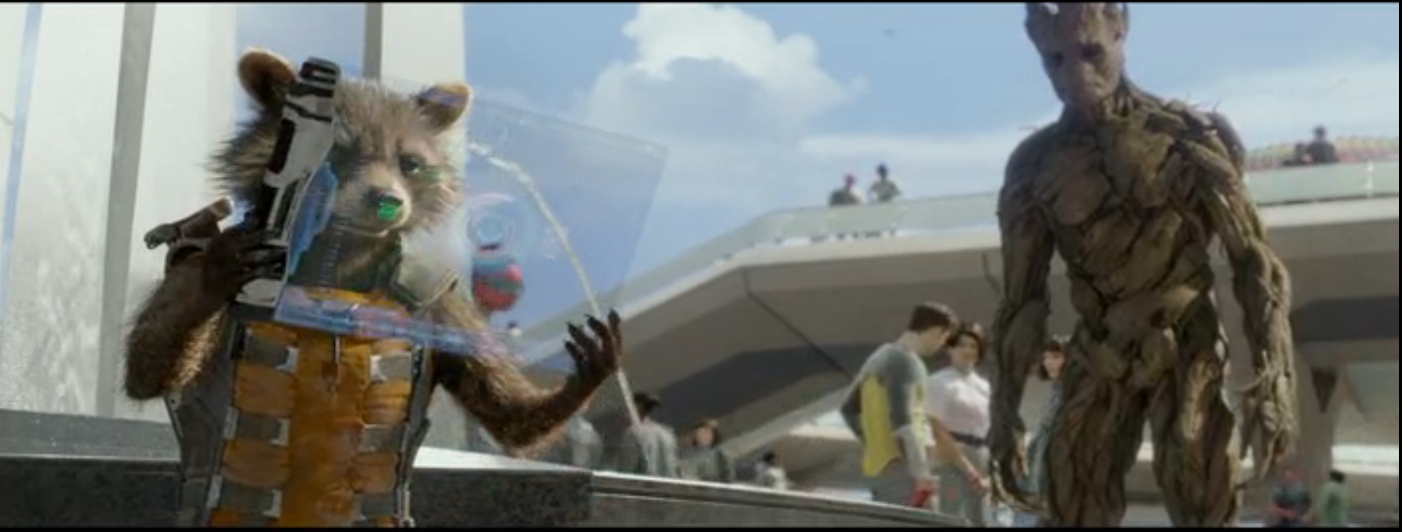
Seventeen minutes into Guardians, we see our very first ray of sunshine. It’s hard to believe that a summer blockbuster, and a movie held in people’s minds as a comedy, could be so dark for so much of its runtime. The sun in question shines on Xandar, a planet where it’s always daytime and blue-skies. Xandar is like the Washington DC of the Guardians universe, if Washington DC wasn’t a corruption-riddled sinkhole. It’s a cultural center, a government capital, a monument to liberty. Xandar’s streets are wide, its buildings low-rise and humane, its populace diverse (well, white folks and aliens) and affluent. There don’t seem to be any slums on Xandar, and a wisenheimer raccoon with a sidekick talking tree don’t merit even a raised eyebrow. In this cold, wet, stormy galaxy, Xandar is a paradise, a beacon of hope. It’s the flip side of Mos Eisley Spaceport, it’s a wretched hive of niceness and class.
The raccoon, Rocket, looks down on the Xandarians as “losers.” Happy people with money and leisure disgust him. Given the “I’m Not in Love” theme of Guardians, one is tempted to posit, right off the bat, that Rocket secretly longs to settle down and have a family, a “normal life.” His George-and-Lenny act with Groot (the tree) suggests that Rocket keeps Groot going by “telling him about the rabbits,” the life of ease they’re going to have once they get one last big score. Groot may be slow, or even stupid, but he’s all the family a genetically-modified raccoon can find in this cockeyed caravan.
What do Rocket and Groot want? To catch Peter for Yondu’s 40,000-credit bounty. That’s the end of the movie for them. What they don’t know is that their plot-lines are about to collide with at least two others. If Ronan’s want is planetary-sized, and Peter’s want is orb-sized, Rocket’s and Groot’s want is as flat as the bounty-wanted screen he looks at Xandar through.
Guardians of the Galaxy part 3
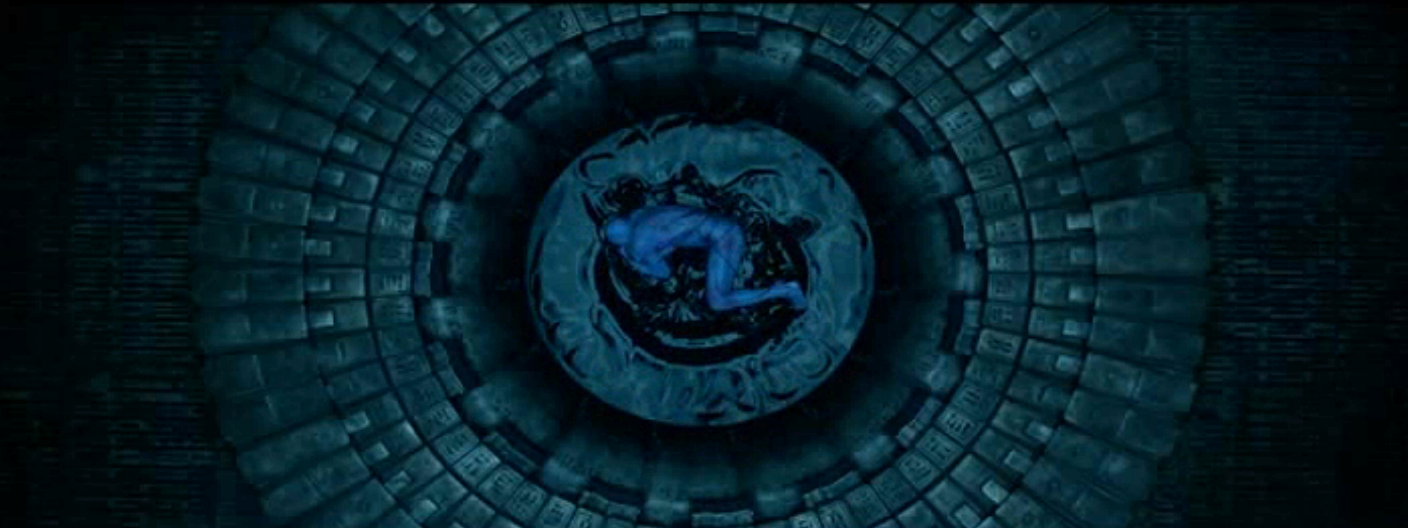
Thirteen minutes into the narrative, the chief antagonist is introduced, Ronan the Accuser. He lives in a tank of goo on a Kree spaceship called the Dark Aster (possibly a reference to the classic early John Carpenter movie Dark Star?)
What does Ronan want? His actable goal, his cinematic goal, is “to get the whatsit that Peter stole.” It was his goons who tried to get it from Peter already. But what will that get him? What does the antagonist want?