The Phantom Menace
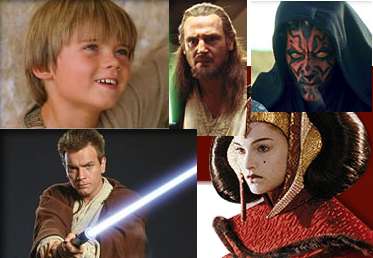
Everyone knows that The Phantom Menace doesn’t work. My 5-year-old Star Wars-obsessed son knows The Phantom Menace doesn’t work (two hours into the movie, he asks “Does Darth Maul ever actually fight anyone?”). But the question I must face as a screenwriter is why. And, after seeing the movie a half-dozen or so times, I believe I have an answer.
The problem is not Jar-Jar.
Let’s go back to first principles. What does the protagonist want? I thought about this for a long time, and then I realized something — I wasn’t sure who the protagonist was.
So I thought, as a public service, I would run down the most obvious characters and examine their motivations.
It is a silly place
Esoteric 3 1/2-hour Art Film Disappoints at Box Office: Experts Baffled

All Hollywood is a-twitter about Grindhouse failing to meet expectations.
Why did it fail? Critics loved it. Audiences, such as they are, loved it. I loved it (I want to see it again before I write anything about it — it’s quite an experience, but I can almost guarantee you it is not what you expect it will be).
(I got a phone call from a female friend, no fan of violence against women or cinematic esoterica, on opening night, imploring me to run, don’t walk, to see it immediately.)
Rodriguez, Tarantino and the Weinsteins offered audiences a feast: two full-length features, plus fake previews, for the price of a single ticket (I saw it at a matinee for six dollars. Six dollars!) The package is a cinematic marvel, the movies are great, there are all kinds of extra gewgaws that come with it (fake trailers, fake scratches on the prints, all manner of filmic in-jokes). Why did people stay away?
And I, there in the audience, who love both Rodriguez and Tarantino, should be the ideal audience for this movie, and indeed I have been waiting anxiously to see it, and yet by the time the trailer is done, I’m completely confused. Is it a movie? Is it two movies? Is it three movies? Is it some kind of anthology film, made up of several short movies? Did Rodriguez and Tarantino collaborate on the movie, or did they each direct separate movies? What the hell is it? And you could feel it all around in the audience too, five hundred young filmgoers wanting to see this movie, but being utterly confused as to what the hell was just advertised. And any time an audience sees an advertisement and responds by saying “What was that?” the movie is doomed.
Look at the poster above. As far as being a spot-on parody of a sleazy drive-in double-feature poster from 1972, it’s perfect, beyond perfect. As an advertisement for a $100 million product of mainstream American entertainment, it’s confusing as hell. Two movies? A double feature? Is it a joke? Is it for real? Is it parody? Of what? What kind of movie is it? They’re asking me for ten dollars (say Mr. and Ms. Moviegoer) — I want to know what it is.
This movie (these movies — wait, what is this?) was heavily marketed — here in LA, there were enormous cardboard displays, taking up whole sections of theater lobbies, in addition to the regular posters and displays, but the displays, like the trailer and the poster here, either tried to sell the entire package, confusingly, or else, even more bafflingly, tried to sell each movie as its own entity (there are bus-bench ads for Death Proof all over LA, making it look like Quentin Tarantino has a new movie out, but with no mention of the Grindhouse title).
On top of that, lest we forget, this is an art movie. It’s part send-up, part critique, part sendup, part genre-mashup, all brilliant, but it is not straightforward commercial filmmaking. Wild Hogs is straightforward commericial filmmaking (and, not coincidentally, easily marketable). A 3 1/2-hour meditation on 30-year-old exploitation movies is not straightforward commercial filmmaking. (It is also something of a workout, two vastly different features, with a lot of meta commentary laid on top of it — it’s both one movie and two movies at the same time, with a bunch of other stuff in there at once; not so easily taken in.) (I should also add — per the title of this blog — that neither of the features offered has a single, easily-identifiable protagonist.)
I commend Rodriguez for producing the project, I commend Tarantino for his contribution to it, I commend the Weinsteins for giving their artists full power in achieving their goals, I commend the whole project — it’s American filmmaking at it’s most daring and exciting. But I am not surprised that audiences didn’t know what to think of it.
Literary Oddities: Tumbleweed Trouble

As a Hollywood screenwriter, I am exposed to bad storytelling on a daily basis. One tributary of the river of bad storytelling is misguided adaptations of pop-culture icons. “What if Superman were a gypsy farmer?” “What if Mickey Mouse was a molecular physicist?” “What if you re-imagined the Green Lantern Corps as the team from Reservoir Dogs?” (Hey, that one’s not bad — hang on, I need to make a phone call.)
In the sweepstakes of inept pop-culture adaptations, I have, I believe, a winner. This is, I believe, as bad as it gets. This is not fanfic, this is not slash Smurfs, this is not Santa Claus Conquers the Martians. This is The Road Runner: Tumbleweed Trouble by Jack Woolgar (although apparently not this Jack Woolgar.) This is a real book, sanctioned (but apparently not read) by the creators (or at least the owners) of the Road Runner (that is, Warner Bros Inc.) and associated characters, published by a real publisher, Whitman Books (a complete list of other Whitman “Tell-A-Tale” books can be found here).
What makes this book so bad? How does it rise above (or, rather, sink below) the ranks of all other bad pop-culture crap?
Let’s take a look inside, shall we?
brace yourself
Johnny Hart 1931-2007

I’m conflicted by the death of Johnny Hart. When I was a kid, B.C. was my favorite strip in the world for a long, long time. I collected the books, read them over and over, compared one to another, mentally charted the development of ideas and themes, thought about how the characters differed and how they acted toward one another, learned to draw all of them. It was a big part of my life for what seems like years.
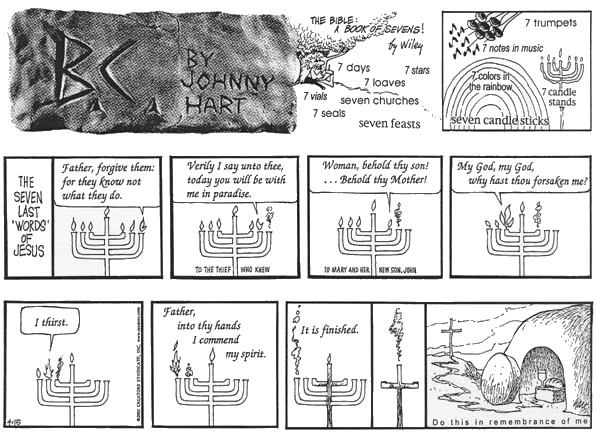
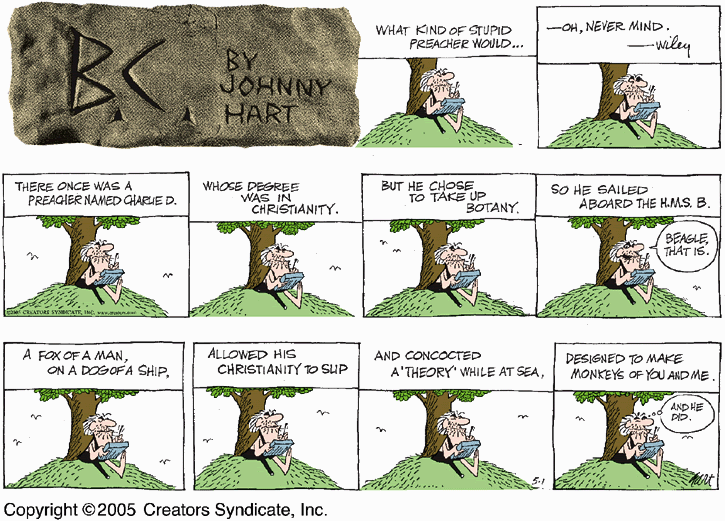
I had not read the strip in decades when I learned that he had decided to go out of his way to inject his strict fundamentalist Christian views into his work. Strips like this, this, this and this seem unasked for at best and hateful at worst. To start with only the most obvious, how do you explain a bunch of cavemen discussing evolution? Or Jesus? In a strip titled, ahem, B.C.? It’s one thing to write according to your beliefs, but why use an art form (on the funnies page, no less) as a tool to bludgeon Jews, Muslims and, essentially, anyone who isn’t also a fundamentalist Christian? Charles Schulz was a devout Christian and wrote of his beliefs with elegance, charm and great warmth. Not every cartoonist can be a Schulz, and my early life was greatly enriched by Hart’s work, but he ended his career on a decidedly sour note of intolerance. UPDATE: An eloquent appraisal of Hart’s talents can be found here.
Good TV
I’ve got to say, it’s bracing for me to see unstoppable force meet unmovable object here. These are two of my least favorite television personalities ever, and I don’t think I’ve ever heard them both sound this sincere before, and certainly not at the same time. Since I think of both of them as insufferable pricks, it’s hard to actually pick a side in the debate; my only real wish would be that the confrontation devolve into an actual fistfight that leaves them both hospitalized.
Here, by the way, is the story they’re discussing.
Holy week expands to embrace alternative religions
Dinosaur comic makes me laugh! I enjoy laughing, it’s better than sadness!.
Meanwhile, what could be funnier than Dinosaur Comics? Nothing I can think of! Unless maybe it’s panels from Dinosaur Comics presented in a constantly-changing random order!
A screenwriter’s notebook

I carry a little notebook around with me. I jot down things in it as I’m traveling around town.
I work on anywhere from 5 to 20 projects at any given time, so a single book will have all kinds of notes about different projects.
Sometimes I write things down while I’m watching a movie. Sometimes that makes it hard to read later.
Here are a few pages from my current notebook: