You Only Live, twice

I got so wrapped up in all the excitement surrounding my analysis of You Only Live Twice that I forgot that I had actually addressed the subject once before about a year ago. The context was somewhat different, and I hadn’t seen the movie in years, and so unfortunately conflated Blofeld’s retarded scheme in You Only Live Twice with Blofeld’s retarded scheme in Thunderball, but those of you who are new to my blog may enjoy this vintage slice of Bondage whilst waiting for my scintillating analysis of Diamonds Are Forever.
On Her Majesty’s Secret Service

Ernst Stavros Blofeld and James Bond do not recognize each other. I wonder why?
WHO IS JAMES BOND? Well, funny story, one that does not need to be recounted here. Suffice to say, James Bond is young again, which counts for something. He’s dapper, classy, amused and amusing, can still fight fiercely and kill without remorse. Because the year is 1969, he’s even now anti-authoritarian, going “off the res” to get the bad guy. Because the year is 1969, he is also deeper and more complex than before. It’s bad enough for poor George Lazenby that he had to follow Connery, who owned the part from the first shot of him in Dr. No, but Lazenby also need to reinvent Bond as a thinking, feeling, loving human being. He’s not unlikeable as Bond, but let’s face it, he’s not good enough to make us forget the man he refers to as “the other fella.”
we have all the time in the world — 2 hours and 20 minutes, to be precise
You Only Live Twice



A middle-aged James Bond caught between the visions of two evil geniuses — Ernst Stavros Blofeld and Sir Ken Adam.
WHO IS JAMES BOND? If this was the first James Bond movie you ever saw, you would be correct in assuming that Bond is a middle-aged fantasy, a balding, vain, stocky, aging Englishman (although his Scottish accent begins to assert itself here) who, in spite of falling apart physically, can still pilot a toy helicopter, jump onto a pile of empty cardboard boxes and, occasionally, bed beautiful women, although it’s never as much of a done deal as it has been in the past. It’s only been two years since Thunderball, but Bond has gained at least twenty pounds — not enough to shudder in horror, but enough that he needs a double for his wetsuit-scene. His toupee starts out bad and turns dramatically worse before the movie’s over.
In spite of carrying the burden of an entire generation’s fantasies of manhood, Bond is sprightly here again after moping his way through Thunderball. He’s clearly middle-aged now, but he’s not raging against the dying of the light — there’s something like acceptance and grace in his behavior. Women pass him by as often as they give in to him in You Only Live Twice, and that seems perfectly okay with him — as though he’d just as soon get some sleep.
With Bond’s arc of “middle-aged guy getting used to Japanese culture,” You Only Live Twice resembles nothing less than Lost in Translation, but with car chases and helicopter fights. With his two bad wigs, his expanding belly and his slowly collapsing face, the middle-aged Bond is starting to feel less like a sex symbol and more like a dirty old man. It makes perfect sense that Connery would want to stop doing these movies at this point. However, it’s also worth noting that, for a moment in Act II, the narrative slows down, Bond gets married, and just for a bit, You Only Live Twice starts to take on a different dimension, something a little more character-driven, subtle and, well, something more like a “real movie.”
WHAT DOES THE BAD GUY WANT? We finally meet SPECTRE #1, Ernst Stavros Blofeld (he uses all three names, as apparently Ernst Blofeld is a common name throughout the world and he doesn’t want anyone to mix him up with Ernst Blofeld the conceptual artist, Ernst Blofeld the Prime Minister of Turkey, Ernst Blofeld the champion racecar driver or Ernst Blofeld the comedian). Blofeld’s ambition has returned — he wants nothing less than to spark a nuclear war between the US and the USSR. He’s going to accomplish this by — I’m sorry, what now?
Let me get this straight. Blofeld wants to spark a nuclear war between the US and the USSR. He’s going to do this by sending a series of rockets up into space and “kidnapping” both American and Soviet spacecraft, returning them to his secret underground lair, where the American and Soviet astronauts will be held in a detention cell, until — um — until the world is destroyed. And then SPECTRE can take over.
Um, okay. Ernst? May I call you Ernst? No? Sorry. Mr. Blofeld.
Mr. Blofeld, this plan — I — I — why? You’ve got a secret underground rocket base, and that’s a good thing. You want to take over the world, and that’s a good thing. I, I just, I have to ask you — please, take your hand away from that button please, for a moment — I have to ask you, is this the best plan? If you don’t mind, I have some suggestions.
1. Your space technology is far in advance of anything the US or the USSR currently has. Why not take up a career in aeronautics? McDonnell-Dougles and Hughes Aircraft rule the world in ways you cannot possibly imagine. You, your lesser numbers, and your cat could all be very happy in such a world, and you could get that awful scar fixed.
2. Why are you “kidnapping” the American and Soviet spacecraft? What does that do? You’re trying to start a nuclear war — start a fucking nuclear war! Are you telling me you can design, finance and build a private space program, complete with spacecraft-eating technology, but you can’t just drop a bomb on Washington? Why are you “kidnapping” spacecraft? Blow them out of the fucking sky! What, do you have a soft spot for astronauts?!
3. The “Monday Morning” question: do you know for sure that kidnapping spacecraft will lead to nuclear war? What if it does not? What happens then? Have you thought about that?
4. “Nuclear War” is a little risky — it tends to spread. Have you though about that? Let’s say you kill, oh, ten percent of the world’s population — three hundred million people or so. How do you know that you won’t be one of them? And let’s say you survive the nuclear war — how do you know that people will turn to SPECTRE to lead the post-nuclear world? What if they put two and two together and figure out that you’re actually the one who killed everybody? Do you think they’ll let you rule the world then?
Remember Auric Goldfinger? He had a plan. He’d thought it through. You, you’re a, you know what you are? You’re a movie villain. You know what a Movie Villain is? A Movie Villain is the guy who thinks the story’s over when he gets what he wants. And there’s a freeze-frame and a fade-out and it says “The End.” But in real life, Mr. Blofeld, the story goes on. You know who a Movie Villian is? George W. Bush is a Movie Villain. His “Mission Accomplished” speech on the aircraft carrier was his “The End” moment. But you know what, Mr. Blofeld? The story kept going on, and now look where he is.
Don’t be a George W. Bush, Mr. Blofeld. Don’t be a Movie Villain. Think, Mr. Blofeld. You’re a super genius, you should be perfectly comfortable doing so. Please, for your own good, for the good of SPECTRE and for the world.
WHAT DOES JAMES BOND ACTUALLY DO TO SAVE THE WORLD? A good balance is struck here between detective work, heroic acts, defending himself and screwing women. The movie starts out as a real nuts-and-bolts detective story and gradually, even gracefully, builds into a surreal, gonzo, sci-fi/action spectacular.
HELPFUL ANIMALS: This Bond has a longer view of life, it seems, than his earlier selves — he knows when he needs to act alone and he knows when he needs help. Helpful animals are numerous in You Only Live Twice, and for the first time they are compelling in their own right. First there’s Tiger Tanaka, who is the head of some kind of Japanese good-guy spy team, then there are not one but two capable, comely Japanese spy-girls who Bond gets to know better, then there is a whole army of ninjas — and as soon as someone says “ninjas,” the pulse of the whole movie picks up. Ninjas! They explode out of the screen, a whole new (to Bond) cool world of flying bodies, wild stunts and anarchic possibilities. There’s a scene in Act II where Bond is shown around the Ninja Academy, and you can actually watch as Bond becomes obsolete before your eyes, standing there haplessly watching the future of action films unfold before him, looking suddenly pathetically square, in a pink shirt no less.
A NOTE ON Q: for the first (and I’m afraid, only) time, imho, the relationship between Bond and Q is exactly right. Q’s not showing up and foisting his toys on Bond as Bond stands there looking bored; Bond needs something specific (a gadget-laden helicopter), demands it from Q, and is professional and even bossy with him when Q delivers. I can’t tell you how much more I enjoy this version of Bond’s relationship with Q. Q is always, for some reason, this stern father figure (or perhaps uncle-figure), this stick-up-his-arse fuddy-duddy who’s always giving Bond toys but forbidding him to play with them, and it makes no sense. As I discussed earlier regarding From Russia With Love, spy toys aren’t created in a vacuum, they are invented because agents need them. When Q shows up and piles a bunch of crap on Bond, Bond is then obligated to use that crap, whether he wants to or not, and the narrative always shows the burden of that expectation — oh, we can’t go home yet, we haven’t used the exploding talcum powder. It’s so much more logical and satisfying that Bond would encounter a situation, requisition the items he needs to navigate the situation, then deal with Q as an equal instead of as a whining, wrist-slapping authority figure.
HOW COOL IS THE BAD GUY? For the first two acts of You Only Live Twice, Blofeld is still “that guy with the cat in his lap.” There are so many shots of the cat while Blofeld is talking that I began to suspect that the cat is actually SPECTRE #1, a feline criminal genius and a ventriloquist to boot. Come to think of it, when I consider the flaws in Blofeld’s plan, perhaps I’m not giving him enough credit. It’s an awe-inspiring plan, for a cat.
Once he shows up, Donald Pleasance does not disappoint as Blofeld. His scar is icky, he pulls off the SPECTRE uniform, he’s clearly insane: 1 point for appearance. 1 point for the piranha tank. 10 points for the jaw-dropping, Ken Adam-designed volcano stronghold. Even with his childishly retarded plan, Blofeld is a bad guy second only at this point to Goldfinger.
QUESTION: Bond is sent to Japan to find this volcano stronghold. He is put in touch with Tiger Tanaka, who is a great deal of help. There is some kind of bullshit ticking clock installed in Act II that requires Bond to be fully trained as a ninja, and married, and convincing as a Japanese man (yeah, right) before he can go blow shit up. Here’s the question: why does James Bond have to do this? Any one of the ninjas we see training looks already qualified enough to handle the task, why wait for Bond to become Japanese?
DON’T BOTHER ME WITH YOUR TECHNICAL MUMBO-JUMBO: During the stupefying climax of You Only Live Twice, Bond is required to blow up the spacecraft-gobbling rocketship before it gobbles up another spacecraft. How will he do it? Well, as it happens, Blofeld has thoughtfully devised a remote-control self-destruct mechanism for just that purpose. What is the name of this mechanism? “The Exploder Button.” With tech-heavy jargon like that, it wouldn’t surprise me to learn that Blofeld also owns a laser called a “Bright-Light Thing.”
FAVORITE MOMENT: There’s another moment in the climax, before Bond gets to the Exploder Button, he and Blofeld and a million bad guys are standing around in Blofeld’s control center when an explosion goes off. All the humans are fine, but Blofeld’s normally cool-as-a-cucumber cat, quite naturally, freaks out like you wouldn’t believe. Blofeld must forcefully restrain the cat, its eyes bulging in abject fear, to keep it from leaping, terrified, from his arms. This little bit of business is notable to me because, if the actor playing Blofeld is holding onto the cat that hard in this take, that means there was at least one take earlier where the actor was not able to restrain the cat from leaping, terrified, from his arms. That means that the production staff knew that the cat was in dire straits during this shot, and did nothing about it, except for advising the actor to hold on tighter. Now, You Only Live Twice is a gargantuan production, and even the most brilliant production manager can’t think of everything, but Sweet Hopping Jesus, the actor’s back is already turned to the camera, give him a fucking prop cat.
NOTES: It’s hard not to think about the career of Ken Adam during this movie, because he clearly owns the picture. In fact, a darker plan than even Blofeld’s starts to form in my mind — all this is happening because of Ken Adam. I mean, face it, he’s the one element that all these different people share. He designs enormous volcano strongholds for SPECTRE, and he designs the offices of the Japanese industrialist working for Blofeld, and he designs the private train of Tiger Tanaka, and he designs the opera-house-sized makeup room for Bond’s Japanese transformation, and he designs the Russian space center! He’s everywhere, every room has the same tilted ceilings, the same hard, bold lines, the same creamy, mid-sixties palette, the same invisible, recessed lighting — what kind of security clearance does this guy have? Didn’t anyone notice — hey! SPECTRE’S volcano stronghold looks just like the Russian space center! (and Dr. No’s underground lair, and Goldfinger’s house in Kentucky, and SPECTRE’s boardroom) All of this unpleasantness could have been easily avoided if they had just sent Bond after Ken Adam! When you consider that Adam also designed the War Room in Dr. Strangelove, it’s a wonder the world ever made it out of the 60s alive — the man was obviously a dangerous double-agent, contracting for both sides! Blofeld’s plan even starts to take on a cold kind of logic when you remove Blofeld and insert Ken Adam: Ha ha! The Americans and Russians will blow each other up, and then they will hire ME to rebuild everything — I’M THE ONLY CONTRACTOR THEY KNOW! HA HA HA HA HA!
Thunderball


Largo: I demand $100 million dollars. Bond: Ah shit, now what.
WHO IS JAMES BOND? For the purposes of Thunderball, this is the $64,000 question. Bond has undergone a personality change. For three movies he attacked his job with the same mischievious, adventurous spirit. There was a glint in his eye and a spring in his step. If he got pissy it was because some innocent person (usually a bird) was dragging him down while he was trying to do his job. Once the job was over, he went back to existing in what he considers man’s natural state: drinking, smoking and screwing on an indefinite timetable. But something has changed in Thunderball: Bond starts the movie grumpy and out of sorts, and never comes out of his mood. He can still charm the birds and he can still play Baccarat, but he doesn’t seem to get any joy out of it any more. In Dr. No, he postpones his trip to Jamaica to have sex with Sylvia the Lady Gambler; in Thunderball he interrupts his massaging of his nurse companion with a mink glove in order to go investigate a mysterious delivery in a spa. Work used to take a distant second to pleasure in Bond’s world, now it seems like he can’t pass up the women fast enough to get back to work, even inventing work if he has to to get the ladies off his back.
Goldfinger


Bond contemplates necrophilia while Goldfinger says hello to his grandmother back home.
WHAT DOES THE BAD GUY WANT? One of the chief joys of Goldfinger is the bad-guy plot. Goldfinger’s scheme is logical, surprising and utterly horrifying and evil. Goldfinger trades in gold, but instead of robbing Fort Knox he plans to set off a “dirty bomb” inside it, killing tens of thousands of people, making America’s gold worthless and his own ten times more valuable. On his way to achieving this goal, he’s willing to kill just about anybody he feels like, even his own financiers and allies.
WOMEN? Four: a fiery Latina before the titles, good-sport “Dink”(!) in Miami, poor doomed Jill Masterson in the hotel, and then the more challenging Pussy Galore. In general, the sexual politics in Goldfinger are more complicated than in the previous two movies. Not all women simply jump into bed with Bond any more — some are femmes fatale, some are easy pickings, some aren’t interested in sex at all (and don’t get it), and some are classy, independent thinkers who must be, um, persuaded.
FRIENDLY ANIMAL Felix Leiter is back, but has been re-cast as older and frumpier (don’t tell me they couldn’t “get” Jack Lord). But it’s still the same Felix Leiter, Bond even refers to their Jamaica adventure. Maybe the past few years have been tough on the CIA, what with the Bay of Pigs and the assassination of Kennedy and all.
HOW COOL IS THE BAD GUY? Goldfinger is a riveting and fascinating character, played with startling realism by Gert Frobe. He’s not a moustache-twirling bad guy, he’s a disgusting slob with a dyspeptic grimace, but an extremely wealthy and powerful one, which makes all the difference in the world. Speaking of Cold War villains, he reminds me of no less a personage than Col Tom Parker. Goldfinger is so evil, the Italian mobsters assembled at his home in Kentucky come off like a bunch of yahoos and cheeseheads (and this is back when the Italian mafia was a true force to be reckoned with). How cool is Goldfinger? He’s responsible for not one but two urban legends about ways to die: the “getting painted to death” legend and the “getting sucked out of an airplane window” legend, both of which, we now know, are total hogwash. How sick is Goldfinger? He has a prison cell in the basement of his Ken Adam-designed house and not one but two peepholes into the bathroom of his private jet. He gets -1 point for hustling gin games in Miami Beach, 1 point for ultra-cool henchman Oddjob, 1 point for living in a Ken Adam set, 1 point for killing a woman by painting her gold (you can’t tell me that’s Oddjob’s job) and 100 points for his brilliant, devious plan.
NOTES: This is the first Bond movie to offer the pre-title sequence. Let’s run through this one: Bond swims through the ocean to a dock with a fake gull taped to his head. He climbs over a wall to a field of oil tanks. He goes to a specific tank, throws a secret switch and goes inside. The inside of the oil tank is someone’s secret living quarters (designed by Ken Adam — he was everywhere in the 60s). This person’s secret living quarters are lush, spacious and well-appointed. In addition to the swank furnishings, there is a pile of red oil drums marked “NITRO.” Because hey, you never know when you need a pile of gigantic oil drums filled with nitro. Bond plants a bomb in the nitro, escapes from the secret living quarters, sheds his wetsuit to reveal a white dinner jacket, then goes to hang out in a local bar while the oil field explodes and the town’s economy evaporates. Later, he goes to visit a local exotic dancer, who, it turns out, doesn’t appreciate him bombing the hell out of her town, and before you know it he’s got to kill a guy. Just a day’s work for our pilot-raping super-spy.
Apart from the rape thing (and Bond’s stated abhorrence of the Beatles), this is by far the best script in the series up to this point. It’s like the filmmakers have finally found their voice or hit their stride or something. It’s a real detective story with plenty of twists and surprises, actual clue-sorting and legwork, and Bond interacts with the bad guy from the very beginning. Oddjob is still killer stuff 43 years later, brutal and implacable, although I can’t for the life of me figure out how his hat works. I get that it’s got some kind of razor-sharp blade in, but I can’t figure out how he could possibly throw it hard enough to cut a cable or behead a statue (or a lady sharpshooter).
I understand why Goldfinger needs a big laser, but I can’t understand why it needs a coiled blue neon light on it.
I note that the air squadron is called Pussy Galore’s Flying Circus, and I wonder if perhaps, on some level, the name Monty Python is meant as a kind of reply to Pussy Galore.
I also note that Bond (or, rather, a Bond-rehabilitated Pussy) alerts the CIA to Goldfinger’s plot, and wonder if Fort Knox actually falls within the CIA’s jurisdiction. Would Kentucky not be the FBI’s territory? I also wonder what, exactly, the CIA would do with a warning from a woman named Pussy Galore, when they couldn’t bring themselves to respond to a memo titled “Bin Laden Determined To Strike Within US.”
Further thoughts on Attack of the Clones

Many pixels have been spilled in the pages of this journal regarding Attack of the Clones. Most of them revolve around the world of Kamino, particularly the mysterious and seductive scoopy chair.
But one has not seen a movie until one has watched it with a six-year-old boy, as I did with Attack of the Clones today. I think this probably works with any movie; watch it with a six-year-old boy and any narrative flaws will become immediately clear. I must remember to try it with L’Avventura sometime soon.
The love story, as everyone knows, is an embarrassing shambles. And its not that the actors’ performances are so bad (although they are), it’s that the script makes absolutely no sense at all. From the very top, it’s simply unbelievable that Padme would fall deeply in love with Anakin, who is, throughout, nothing more than a petulant, moody, griping, disturbingly awkward pest. The most romantic thing Anakin says to Padme while he pitches woo to her is when he talks about how one day the republic will bend to the will of an iron dictator. As for his attempts at poetic flattery, search the racks of every greeting-card store on the planet and you will not find a single verse that tells a woman she is not like sand.
The detective story, “Who is trying to kill Padme and why?” works very well, thank you and is the best reason for the narrative existing. Obi-Wan tracks down Padme’s would-be killer in a crackerjack chase scene, finds a clue that leads him to a remote planet, where he stumbles upon a vast mystery that will change the course of history — as all good clues do. Super. Although I will add that Obi-Wan is a miserable detective — he can’t find a planet just because a snippy librarian tells him it doesn’t exist, but, literally, a six-year-old boy can.
The rescue story (“I must find my mother”) comes out of left field half-way through the movie, is motivated by nothing and leads nowhere. It’s ugly, brutal and racist (between the flies buzzing around the somehow-even-more semitic Watto and the characterization of the Sand People as “animals”). The action story (“We’ve got to find Obi-Wan!” “Uh-oh! Gladitorial combat!”) works well, and would work even better if the rescue story wasn’t in there. And the war story is gloriously staged and truly spectacular.
In fact, one of the interesting things about Attack of the Clones is that the CGI characters consistently give better performances than the live actors. Case in point: compare the arena scene on Geonosis with the pod-race sequene in Phantom Menace. The human extras at the pod race give terrible performances and look ridiculous in their rubber masks and silly costumes. In contrast, the giant-bug Geonosians look utterly believable and in fact give more subtle, more believable performances. And when a human has to interact with a room of CGI creatures, the effect is always awkward, but fill the screen with monsters and robots and it looks absolutely splendid and believable.
Now then: I still have some notes.
It says in the title crawl that “thousands” of solar systems have fallen under the power of “the mysterious Count Dooku.” Are we to believe that thousands of systems, representing untold billions of individuals, have decided to throw in with a leader they know nothing about?
Palpatine’s desk — it’s too clean. In fact, everything in Attack of the Clones is too clean. Everything looks like it was just unpacked yesterday.
Jango Fett comes to Coruscant to kill Padme. He contacts a female bounty hunter and gives her the squiggly bugs to drop in her window (they are apparently homing squiggly bugs — otherwise this is a stupid plan). The female bounty hunter takes the canister of squiggly bugs and loads it into a little flying thing, which takes off for Padme’s window (good thing for the bounty hunter she didn’t decide to sleep on the living-room couch at the last moment). My question: why does Jango Fett need the goddamn female bounty hunter? Can’t he load the goddamn flying thing himself? He’s already got the canister of squiggly bugs, presumably he knows how it fits in the flying thing. What the hell is his problem?
Senator Padme travels back to Naboo and chats with the new Queen. She counsels action but the new Queen chooses caution and patience. Padme nods in acquiescence because she understands from her own experience that becoming Queen of Naboo turns you a fucking idiot.
Now those Kaminoans (you knew it would come back to this): I’m sorry, I just — now wait. Play this back for me. Ten years ago, a Jedi guy came to you and placed an order for a clone army. In the ensuing ten years, you’ve been diligently manufacturing that clone army. The Jedi guy never called back to check up, and in fact business has otherwise dropped to zero due to your planet being removed from the archives, but you have kept on making this clone army. It must cost untold billions of dollars, and is useless to you personally, but that is, apparently, the way you do business. Okay. I get that.
Here’s my question. Ten years later, another guy in a Jedi robe shows up. He obviously knows nothing about the clone army and in fact seems to be lost. Don’t you even ask him for his receipt? Is this how you operate in your business? The only order you’ve had in the past ten years, and you don’t even ask for a receipt? Suppose this Jedi guy you don’t know says “Hey, nice army, wrap ’em up, I’ll take ’em with me,” and then the next day your actual client stops by? What are you going to do then, Kaminoans?
(By the way, today I counted a total of six Kaminoans, not two as previously reported: the Greeter, the Prime Minister, Jeeby, and three others, wandering around the halls of Kamino. The lack of population probably explains why the Prime Minister doesn’t even own a desk, but just sits in his windowless glowing room doing nothing while waiting for visitors to drop by every ten years.)
Note to Obi-Wan: when you’re chasing Jango Fett through a deadly asteroid field, what prevents you from simply leaving the asteroid field? You’ve got a freaking tracking device on him, and he’s heading for a giant planet, and everyone knows that in Star Wars Land every planet only has one or maybe two places to land — where the hell do you think he’s going to go?
C-3PO falls into the robot-factory machinery, then, within 24 hours, ends up wandering out onto the arena field with the rest of the just-created battle-droids. Yet all the battle-droids with him are already beaten up, scuffed and dirty. My son Sam suggests that they’re actually made to look like that. Perhaps the Separatist army prefers their droids pre-distressed, like stone-washed jeans — it gives them character and let’s you stop worrying about keeping them pristine.
From Russia With Love

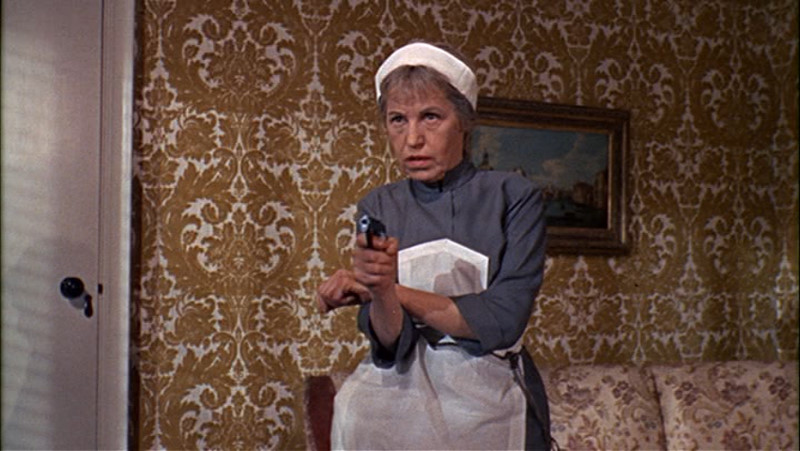
Tania: woman. Rosa Klebb: mm, not so much.
WHAT DOES THE BAD GUY WANT? The bad guy is the mysterious, faceless, cat-laden “Number 1,” leader of SPECTRE. SPECTRE, the super-criminal think-tank, as in Dr. No, wants to rule the world. To do that, it is imperative that he gets his hands on a special decoder thingy. We come to understand a good deal more about SPECTRE, its organization, its training methods and its structural politics in the movie. However, what Number 1’s “Monday Morning” plan is remains undiscussed. Is he prepared to rule the world once he gets it? What are his plans for health care, security, taxation?
WOMEN? Four. The first is the ladygambler from Dr. No, who has now acquired a name (it’s “Sylvia,” for those keeping score), then Bond scores a two-for-one deal with a pair of Gypsy women (the women are deadly enemies until exposed to Bond and his culturally advanced, egalitarian genitals), and finally Tania, to whom Bond remains loyal for the remainder of the movie.
HOW COOL IS THE BAD GUY? Nowhere near as cool as Dr. No. He’s got a yacht, a cat and some fish. Yawn. However, he’s got two of the best “second villains” ever — Robert Shaw, who is incandescent in this movie, and Lotte Lenya as the aforementioned Rosa Klebb. Robert Shaw comes with a watch-wire garrot thing (which later shows up on the wrist of John Lithgow in Blow Out), Lotte Lenya comes with a pair of deadly shoes. These guys make a great pair — Shaw is the proverbial brick shithouse, unstoppable and cunning, yet also utterly believable, and Lenya is tiny but a cruel, stone-hearted monster — and also utterly believable. To make a measure of how good Shaw is in this movie, watch it and try to even imagine him, ten years later, as the Irish gangster Doyle Lonnigan in The Sting, much less twelve years later as the crusty seadog Quint in Jaws. And yet all of those performances are highly stylized, not naturalistic at all — he’s practicing a kind of heightened naturalism, his choices specific yet cartoonish. Lenya, on the other hand, knows she’s no physical match for Bond — the cowardice on her face in the scene at the end when she sneaks into the hotel room disguised as a maid is great — but you know that she’s so cold that her heart (or other body parts) could never be melted by Bond’s fiery western genitals. Rosa is there as the anti-Tania, the “bad” woman, her soul locked behind an emotional Iron Curtain.
GADGETS? A handful. Bond gets a briefcase full of crap from Q. Sniper rifle, exploding talcum powder, hidden knife, 50 gold sovereigns — all standard issue, we’re told. Which leads me to ask: standard issue, pursuant to what? These new gadgets seem to take Bond by surprise, as though it would have never occurred to him to need anything as obvious and vital as exploding talcum powder. And yet why is Q dreaming up all this stuff? Here’s what I’m saying: ideas come from somewhere. Q’s not out in the field, he’s in his lab at Q division. Agents are in the field. Obviously, agents must be coming back from missions complaining about a crucial lack of exploding talcum powder.
Q. How was the mission, 006?
006. Oh, it was all right — tell you what, though — I really could have used some exploding talcum powder.
Q. You know, you’re the third agent to mention that this week. Hang it all, that’s it — from now on, all agents shall carry exploding talcum powder in their briefcases at all times. We cannot afford the endangerment of any more agents.
006. What briefcases?
Q. W-why, your, you know, your briefcase — don’t you carry a briefcase?
006. No one ever gave me a briefcase.
Q. No br — ! All right. All right. That tears it. God damn it, we’re sending agents out there naked! I’m issuing a memo — all agents shall have a standard issue briefcase with exploding talcum powder.
006. And a hidden knife.
Q. Yes, yes — hidden knife, good —
006. And a sniper rifle —
Q. Well yes of course a sniper rifle —
006. And fifty gold sovereigns.
Q. Now how the devil am I going to get fiftygold sovereigns into a — never mind, I’ll figure it out.
006. And —
Q. Out! Out! I need to think.
NOTES: One movie into the series and already Bond is getting a little mannered, a little self-conscious. He cannot kill anyone without adding a witty bon mot, and his seductive powers are already leaning toward camp. He carries more than the weight of the western world on his shoulders, he carries the weight of his own reputation. He’s James Bond, he must act like James Bond.
Narratively, a whole different ball game from Dr. No. Apart from taking its sweet time getting started, we spend a whole lot more time examining the motives and machinations of the bad guys. My favorite bit is Rosa Klebb flying from Number 1’s yacht to SPECTRE Island, where all the top SPECTRE bad-guys are trained. She is escorted through a training field, filled with men running and shooting and killing and karate-chopping, until she comes to Robert Shaw sunbathing. Shaw snaps to attention, Klebb punches him in the gut, says “he’ll do,” then turns around and leaves. Doesn’t stay for lunch, doesn’t want to see anyone else, doesn’t have any papers or requistions to fill out — she spends an afternoon and god knows how much money flying to SPECTRE Island just to punch Robert Shaw in the gut. Now that’s a bad guy.
Dr. No


Dr. No shows off his collar, Honey Ryder shows off her shells — which will get more of Bond’s rapt attention?
WHO IS JAMES BOND? He’s a gambler. He smokes. He drinks (but not to excess). He’s charming, mischievous and occasionally bossy (when dealing with civilians). Straights bore the pants off him. He has sex with nameless women, while his boss’s secretary pines for him. He knows the rules of Chemin de Fer, he knows how to kick and punch, he knows judo, he knows how to wear a suit, he knows how to spot an assassin and how to burglar-proof his hotel room, he knows how to lose a tail, he knows his wine (he would never use a bottle of Dom Perrignon ’55 as a weapon, even against a madman bent on world conquest).
Venture Bros: Assassinanny 911
I have received numerous requests to analyze this episode of The Venture Bros; now that Season 2 is out on DVD it seems like a good enough excuse to do so.

Sexual tension and examination of sex roles is always a feature of The Venture Bros, but the sexual tension in “Assassinanny 911” rises to the level of sexual hysteria, even outright sexual panic.
Take the cold opening. In a flashback, Brock Sampson reports for duty to Col. Hunter Gathers. In short order he is jumped, pinned to the floor and threatened with all manner of phallic objects — a knife, a baton, and a jutting, thrusting cigarette holder (later, Col. Gathers will remark on how “big” Brock is –as well he might). What does Brock want in the scene? To be “made a man” — or re-made as one, anyway; as Col. Gathers puts it, a “Frankenstein.” In the context of this episode, to “be a man” is explicitly to kill. Once Col. Gathers has dominated Brock, stabbed him, destroyed his identity (with that phallic cigarette holder, no less) and knocked him down with his baton, he ejects himself from what turns out to be an aircraft of some kind, the shape of which one can only imagine.
Now that the Cold War is over, Molotov wants to consummate the flirtation that was begun with Brock 20 years earlier during a Paris stakeout. That stakeout ended with Brock being pinned down to a bed with knives in a flaming hotel room (and is apparently not the same time that he took her left eyeball, as Molotov escapes unharmed).
But Molotov is not about to get what she wants, for Brock has been called away on a mission and has asked Molotov to babysit Hank and Dean. The mission (an assassination, a killing — his “old” male identity) is just a piece of gruntwork for Brock, who finds his new role as nurturer and caretaker much more rewarding and, let’s face it, more challenging. Challenging as in Manaconda (another phallic symbol), who leaps out of the X-1 fusillage (another phallic symbol), is killed by Molotov (who, for the purposes of this episode, is the male, ie “killer” presence), and turns out to be, as Dean notes, “Womanaconda” (thus underlining the episode’s themes and foreshadowing the surprise ending).
Brock doesn’t exactly drag his feet on his way to meet his contact, he’s not that kind of guy, but neither does he have patience for the spy-spy rigamarole of his briefing — the spy biz has changed too much since he was in it, it’s no longer a “man’s world” — Brock tosses out the gadgets and weapons from his kit, muttering “gay, gay, useless…” as his briefing officer tries to tempt him with a unthreatening-looking pen(is). (In case the gay subtext in this scene is not strong enough, it is noted that Brock will get the next part of his briefing from, er, “Captain Swallow.”)
(Side note: when Brock opens the case file to see that his target is Col. Gathers, the file is, in fact, printed backwards. Is this a mere technical glitch, or are Jackson and Doc hinting at a “backwards” nature of Col. Gathers’ personality?)
Once Brock is gone, Molotov turns herself to her task of “turning Hank, Dean and Rusty into men.” This involves shooting at them with a machine pistol and getting Hank and Dean to try to kill each other. (There is, on top of everything else in the show, a puzzling dwelling on the wounds of Christ — Brock is stabbed through the hand by Col. Gathers, and Dean is stabbed through the foot by Hank with a pen[is]cil. Are Jackson and Doc suggesting that Christ was not a “real man,” as he was not a killer but rather a healer?)
Once Hank “kills” Dean (or so he crows, having wounded him), he believes himself to be a “real man.” The ability to kill gets mixed up in Hank’s mind with the desire to have sex with Molotov — one gives rise (so to speak) to the other, in spite of the fact that the object of Molotov’s affections, Brock, is a killer but no longer wants to have sex with her.
Rusty, for his part, believes his “mature” status gives him an edge over the boys (“mature” here meaning “stealing the neighbor’s newspaper for the double coupons”), while Dean, as ever, is just confused and hapless.
On the way to his rendezvous with assassination (shot from the phallic submarine in an even-more-phallic torpedo), Brock remembers his training and partnership with Col. Gathers. The phallic symbols (sharks, spearguns, oxygen tanks, the Eiffel Tower, baguettes [“don’t eat that! It’s C4!” — indeed]) and sexual confusion (Col. Gathers’s cross-dressing) abound as Col. Gathers explains the finer points of assassination etiquette — “no women, no kids.” Minutes later (literally, as the “clock” in the lower left-hand corner of the screen indicates) Brock finds these rules tested as he attempts to bed Molotov and finds himself bedded instead — it seems that he could kill Molotov if he wanted to, but is restrained by his code of assassin’s honor.
Back at the Venture compound, Molotov finds herself doing some “mother” work, perhaps in spite of herself — we see her with a very un-assassin-like bag of groceries (bought with Rusty’s double coupons?). Her single “motherly” gesture is not wasted on Hank, who becomes filled with Oedipal rage when he sees his new “mother figure” become “friendly” with Rusty and the “real man” urge to kill becomes intertwined with the urge to have sex with Molotov.
(One wonders if having a motherly presence in the Venture compound would be in any way a good idea, as the sexual dysfunctions compound themselves so quickly with the mere presence of a female.)
Brock, on his mission, shows how not-gay he is by bedding a native woman, who shops from the Bond Girl catalogue — thus signifying her as a “real woman” — a purely sexual object who comes complete with six-pack and easy-open bikini-top. The “native woman” is a lover, not a killer, not, essentially, a “man,” like Molotov.
By the poolside, Hank drowns as Dean chats with his own foil/crush, Triana. Molotov must perform the ultimate non-assassin act, bringing Hank back to life with mouth-to-mouth resusitation. Both boys suffer from swollen swim-trunks in this scene — Hank’s from his mouth-to-mouth erection, Dean’s from having his pockets fill up with water. Hank, we see, is at least physically ready to have sex with a woman (although he is pointedly not mentally ready — when his erection is pointed out, he panics, saying his “pants are haunted”).
There is a nice double climax (so to speak), twin Apocalypse Now parodies, as Hank turns his murderous Oedipal rage on Rusty and Brock confronts his target. Hank, for his part, grabs his crotch and swings his phallic sword wildly as Brock is confronted with Col. Gathers’s ultimate truth. Brock is shocked with what he finds, but he should not be: he has come to the same conclusion, in his own way. Brock has found value in life outside of killing (ie being “a real man”). Col. Gathers has taken the notion to its logical conclusion, and in the context of The Venture Bros has struck on a solution that would satisfy even
![[info]](http://stat.livejournal.com/img/userinfo.gif)
— he has escaped the dead-end role of “real man” by becoming a woman. As the surgeon makes explicit, Col. Gathers started as Brock’s Frankenstein father and ends as his even-more-Frankenstein mother.
Brock returns home, lesson learned. The episode ends with Hank’s melancholy as Molotov drives away, suggesting that, for him at least, this struggle is not yet over.
Discussion of the other episodes of Season 2 of The Venture Bros can be found here, here, here, here, here, here, here, here, here, here, here, and here.
The Ipcress File

It’s a good measure of the impact of James Bond movies on the 1960s that, in addition to spawning countless imitations, they also spawned a healthy number of reactions, that is, movies that stepped forward to say “James Bond isn’t how international espionage is, this is how international espionage is.” The angriest of these reactions was probably The Spy Who Came In From The Cold, with a disgusted Richard Burton grousing about espionage being filled with degenerate, failed, perverse little men, a movie so intent on disproving the Bond romance that it becomes a romance of a different kind, a romance of failure and self-absorbtion.
And then there is The Ipcress File, which presents a whole nother vision, an anti-Bond fascinating in its own right.
There is a comically pedestrian, almost Pythonesque nature to Harry’s adventures in espionage. He is spy as civil servant, his office and its doings being barely above that of a DMV post. He bickers with his coworkers about paperwork, he’s surrounded by muttering drones, dull-minded superiors and “put the kettle on” pepperpots. When Harry needs to find a missing scientist, there are no secret meetings, code words or labyrinthine precautions; he just walks up to his contact in a library and asks him where the guy is. When it turns out the guy has a tough bodyguard, there are no razor-hats or metal teeth, just a simple punch-up on the library steps.
Michael Caine’s talents continue to astonish. He manages to make Harry a living, breathing entity; one senses the bitterness of a wasted life underneath Harry’s unflappable facade. There is an everyday, almost depressive feel to Harry, a mopey, buttoned-down dullard who wouldn’t know a casino, laser cannon or volcano stronghold if he woke up in one. The investigation Harry’s on rarely rises above the level of a routine police story, with spies wandering around in the open and trading exchanges like:
SUPERIOR: Well. It looks like we’re too late.
HARRY: If we had been on time, I’d be a hero.
SUPERIOR: But we weren’t.
(everyone prepares to leave)
HARRY: Hey. This stove is warm.
SUPERIOR: Really?
HARRY: And look, there’s something inside. (examines the thing) That’s recording tape.
SUPERIOR: Let me see it.
(examines it — it is clearly labelled “IPCRESS”)
HARRY: Do you think it means something?
SUPERIOR: It might. (pause) It just might.
In Act III, Harry is framed for murder, kidnapped by the bad guys and brainwashed, which raises his pulse a little bit but does not seem to ruffle the feathers of anyone he works with. It’s British Reserve carried to its logical conclusion; even when in life-or-death situations, Harry’s cohorts cannot bring themselves to perform desperate acts; they can only sigh and get on with it.
It is perhaps indicative of Harry’s stance that the final horror, the bad guy’s sinister world-threatening brainwashing technique, involves exposing him to modern art and electronic music.
I would be remiss if I did not mention the utterly original, stylized direction of Sidney J. Furie, which recalls nothing and exists within its own cool, implacable logic. Furie, bafflingly, went from what feels like a highly personal directing style to projects as diverse and anonymous as Superman IV: The Quest For Peace, Iron Eagle and Ladybugs, before going on to Dolph Lundgren action movies and episodes of VIP.