Fairies and Fantasy: The Dark Crystal


First of all, let me just say that this is a much better movie than Jim Henson’s later feature-length puppet-show Labyrinth. It has a better script, a more organically-constructed world and a total lack of David Bowie in stretchpants. This does not, however, mean that it is without flaws.
First, let me make sure I’ve got the story straight:
Okay. First off, a note on explanatory introductions. You know the kind, where the movie hasn’t started yet and a deep-voiced narrator intones: “In the mystic land of Urgh, a terrible darkness has overtaken the land as the evil emperor Zugg has imprisioned the good princess Thrak in the dark dungeon of Brell, which was located in the castle Aggghhh on the mystical island of Duhhhrrr” and so on. Note to screenwriters: don’t do this. Please. Why not? Because we haven’t met Zugg or Thrak and we don’t know why anyone is doing anything so we don’t care about any of that. No one has ever in the history of movies listened to the narration at the beginning of a fantasy. It does the opposite of informing the audience; it gives them a headache. The worst example of this I’ve ever seen is at the beginning of David Lynch’s Dune, where the first lines of the movie are a narrator intoning something about how there are four different planets in this story and they all have different political goals and are peopled by different kinds of creatures. I was there for the opening weekend of Dune in 1984, and when that stuff came on the screen my heart sank and I got sweaty palms: I felt like there was going to be a test at the end of the titles. The movie trailed off from there. I remember Sting in metal underpants and Kenneth McMillan drooling on some poor actress’s face, and then taking a plug out of some teenage guy’s chest and drinking his blood. And I think Kyle McLachlan was in it and his eyes glowed. Oh yeah, and there was a giant floating slug with a big brain and a vulva for a face, who for some reason was really important to the story.
Um, where was I?
The Dark Crystal starts with one of these impenetrable paragraphs of narration, describing the planet and the titular crystal and the vulture guys who worship it, intoned whilst we look at a picture of what looks like a coral Christmas tree on the Planet of Primitive Special Effects. Then, once that’s out of the way, before we’ve learned anything about the coral Christmas tree or why the vulture-guys worship it, we shift our attention to another place where some wrinkly dude makes a sand-painting, and we get another introductory paragraph about another bunch of characters we haven’t met yet. Then, unbelievably, we shift to a third location, where an elfy-looking guy plays a flute on a stream bank, and we hear another paragraph of introduction describing another bunch of characters we havent’ met yet. And with all this narration, we haven’t yet got one lick of storytelling yet, only a bunch of descriptive passages that have almost nothing to do with the images we’re seeing.
And then, after all that, the narrative that then unfolds, it turns out, is really quite simple and would have greatly benefitted from no introduction at all, much less three. If a movie has introductory narration it means that someone, either the screenwriter or the director, didn’t do their job right, forgot to tell the story in a series of images, and so in editing they had to scrounge around and find some shots of various objects that they could show to give us something to look at, whether they’re connected to the narrative or not, while the narrator tells us about stuff we haven’t seen, characters we haven’t met and political alliances we couldn’t care less about.
Moving forward:
In the village of the Mystics, Head Mystic tells Jen, The Last Gelfling, that it’s his destiny to find the missing shard of the crystal. He doesn’t tell him what he needs to do with it, just tells him he has to go to such-and-such place and get it from so-and-so. Then he dies. As he dies, we cut to the Crystal Castle (it turns out that’s the coral Christmas tree), where the vulture-guy emperor is also dying. A struggle for the dead emperor’s scepter ensues, during which one of the competitors, Skeksil, is shamed and banished. The new vulture-guy emperor sends his army of giant crab-guys out to find Jen before he gets to the shard.
So far, so good. A little pokey, but still hanging together.
Meanwhile, on the other side of the planet, Jen, confused and, frankly, a little miffed, heads out of town and makes it, without too much trouble, to the place he needs to get to. He gets the shard he needs from a crazy lady who runs an observatory, and she warns him that he must use it to “heal” the dark crystal or else the world will end. Because of, you know, the prophecy.
Now, I know there are always prophecies in these movies. Hell, The Matrix has a prophecy and it works just fine. But I find prophecies lazy. Who made this prophecy? When? Why? What happened to that person? But, all right, there was a prophecy and the prophecy says that only a Gelfling can fix the crystal. Why only a Gelfling? Who knows? It’s a prophecy.
Question: Head Mystic is dying, the Great Conjunction (the once-every-1000-years alignment of the three suns) is nigh, and so Head Mystic tells Jen of his destiny and dies. Here’s my question. If the Great Conjunction happens every 1000 years, doesn’t that give Head Mystic quite a bit of lead time to prepare Jen for his quest? He could have told Jen about his destiny a year earlier, he could have told him when he was a mere boy. No, he waits until the ticking clock is about to go off and he doesn’t even tell Jen everything he needs to know before he keels over and dies. Which, now that I think of it, if he had 1000 years of lead time, why didn’t Head Mystic just go get the goddamn shard himself? Jen wouldn’t have to go out of his way at all.
But, you know, you give a Mystic a 1000-year lead time and he’ll always leave everything to the last minute. So Jen sets off on his quest and, you know what? The rest of the Mystics do too! We don’t know where the Mystics are going, but every now and then we cut back to them slowly, slowly traversing the desert. Turns out, the Mystics are heading to the Crystal Castle! And they get there just in time to participate in the climax of the movie! Jen just can’t get rid of these guys!
But I’m getting ahead of myself. Jen lights out for the territories, he gets the shard, he’s one step ahead of the giant crab guys, and he meets Kira, who’s a girl Gelflling, and her dog Fizzgig. They fall in love — hardly surprising, since they are the last two Gelflings left on the planet. What is surprising is that Jen, once he’s hooked up with Kira, and about half-way through the running time, literally stumbles across an ancient Gelfling temple, which tells him everything he needs to know about his destiny. And your humble correspondent hangs his head in shame.
Really? Stumbles across an ancient Gelfling temple? No other character could have given him his instructions? Noother character could have directed him to the ancient Gelfling temple? Kira couldn’t have said “You know, the elders of this village tell me of a ruin not far from here, they said I should go there if a male Gelfling with a crystal shard came by,” and then taken him there? There couldn’t have been an ancient scroll secreted in a locket given to Kira when she was an infant? Stumbled across the ancient Gelfling temple?
Anyway, so Jen and Kira get to the Crystal Castle, and right on time (end of Act II), Kira gets kidnapped and tortured and needs to be rescued. This is sigh-worthy enough on its own, but it actually makes the villains weaker. The villains, we are told, out of the blue, some time in Act II, in addition to wanting to keep the dark crystal broken, also seek to prolong their lives. To do this, they round up the local populace and drain their “life essence” out of their bodies with a piece of equipment they keep downstairs. Once your life essence is sucked out by this machine, you become a slave of the vulture-guys.
Why is this a bad thing? For the same reason Scaramanga is a bad villain in The Man with the Golden Gun: it gives them too many motivations. A good movie villain has one goal and one goal only. A villain might have a secondary motive, but it must be related to and dependent upon the primary motive. That is, a villain might try to kill the protagonist as a part of their drive to world conquest, but they must not kill the protagonist and also plot to steal the world’s largest diamond and also have a heat ray. When you give the villain more than one motive, it dilutes their power. Think about it, we talk about a scary villain as being single-minded. The Terminator, Hannibal Lecter, Dracula. What would we think of the Terminator if, in addition to wanting to kill Sarah Connor, it also planned to take over the computer-chip market?
So the first half of Act III of The Dark Crystal involves getting Kira out of her essence-draining trap and getting Jen to where he needs to be to heal the crystal. Much import is placed on how Jen needs to fix the crystal before the suns align, but we’re never really told what happens if he doesn’t. Do all the Mystics then die? What happens then? We’ve seen that when a Mystic dies, a vulture-guy also dies — obviously the vulture-guys don’t want the Mystics to all die. One of the vulture-guys mentions how the crystal will give them all eternal life, but if your eternal life fix was just a few minutes away, why would you bother draining the essence out of a Gelfling who happened by?
Anyway (spoiler alert), there are some complications on the way, but Jen gets the crystal fixed just as the Mystics walk in the door, and the crystal turns from purple to clear, and the Mystics and the vulture guys merge into one race of really-tall translucent alien dudes. So now I’m really confused — is this what the vulture guys were trying to avoid, turning back into these tall alien dudes? Because the tall alien dudes look ten times more immortal than the vulture guys. I mean, I really don’t get it, what was so great about being vulture guys that they wanted to stay that way?
As in Labyrinth, there is some fine puppet design, although in general I find the Labyrinth puppets to be more alive than their Dark Crystal counterparts. A rubber puppet, dying, in closeup, fails to generate much sympathy for me.
The Venture Bros: The Family that Slays Together, Stays Together part 1


One of the most propulsive, dynamic scripts in the series, “The Family that Slays Together” is also one of the most sincere and thematically coherent. Its action scenes rise to a new level of excitement and there is palpable dramatic tension, which makes the bent humor pop that much more.
But first, Molotov and her Blackhearts attack. Molotov, it seems, has come to warn Brock of his impending assassination by OSI. She does not try to kill him herself, but rather says she doesn’t want to “share” his assassination with the other OSI assassins. Her love/hate for Brock, and her jealousy for his other “suitors,” will save him — for now.
Brock is on the run with his life in danger, but he’s saddled with the responsibility of family, as the Monarch pursues his love, arching Rusty, while saddled with the responsibility of his family, the Moppets, Dr. Mrs. The Monarch and his henchmen, all of whom behave on this trip as a family — the Moppets are the misbehaving children, Dr. MTM (hey! MTM! And she even has Mary Tyler Moore’s haircut!) is the wayward spouse, the henchmen are the bored, easily-distracted teenagers. Which raises the question of The Monarch’s love for Dr. MTM — is she a stabilizing influence in his life, or is she just another burden that keeps him from his true love, Rusty?
The three assassins sent for Brock have their own love issues. Herr Trigger has a dangerously perverse love for his firearms (I kept expecting him to burn his tongue on one of his just-fired weapons), Go-Fish has his love of the sea and La Tueur develops a brief affair with Hank over their mutual love of Batman.
Brock goes to see Hunter to obtain safe passage. Hunter is, of course, a self-contained love/murder contradiction, a hermaphoditic stripper who gives Brock the tools he needs while giving him a lap dance, a pretend-love ritual which which Brock is deeply uncomfortable. Hunter’s and Brock’s obvious love for each other has, paradoxically, hit a barrier due to Hunter’s sex change. Brock once loved Hunter as a man, but now that he’s a woman there will always be a wall between them.
Under attack from Trigger, Brock orders the Ventures into the X-1. To get them to go, he barks that he never loved them. Hank interprets this as “the Lassie trick,” but I’m not so sure — I could still go either way on Brock’s love of the Ventures. He neither agrees nor disagrees with Hank’s interpretation, but goes to extraordinary lengths to protect Hank anyway (even though Rusty could, theoretically anyway, clone Hank again if he needed to).
(Brock then calls the X-1 to tell Rusty that he forgot his son, and Rusty says “no, Dean’s right here,” fuelling my pet theory that Dean is Rusty’s son and Hank is Brock’s.)
The Monarch finds his love conquest foiled — there’s nobody home at the Venture compound. He shoots his darts into empty rooms — no symbolism intended there, certainly — while Dr MTM prepares herself for an evening of seduction that never occurs. Instead, there is a different love crisis — a heartbroken Sgt Hatred sobbing in the bathroom. Sgt Hatred’s love/murder problem is that his wife Princess Tinyfeet has left him, and he has decided to commit suicide-by-arch by hiding out in the Venture compound and waiting for Rusty to get home.
(And, since Rusty is unlikely to kill Hatred by himself, it’s really Brock Hatred needs to come home. Sgt Hatred’s desire hinges on Brock’s love for the Ventures — if Brock does not love the Ventures, he will solve his OSI problems and, theoretically anyway, no longer have an obligation toward them.)
Even Helper has a love/murder problem in this episode! When Brock kills his car, Helper interprets the act as a salvo in a human/machine war. Once the problem is cleared up, Helper enthusiastically embraces his would-be killer and, later, bravely proves his loyalty to his family by acting as landing gear for the X-1. (The Venture clan, true to form, forget all about him, leaving him, apparently, to the predations of The Monarch in his flying coccoon.)
“The Family that Slays Together,” in its relentless drive to include every love/murder combination possible, includes a pair of ex-OSI agents who have become born-again Christians (or, rather, they have transformed/perverted their love for each other into a love of a deity). When pressed into action, these Jesus-lovers are happy to take up weapons to kill — although they seem to be more in love with the rituals of religious belief than in any kind of reality-based action (fair enough, if you ask me). They futz around with their trappings of holy devotion while Brock, the man of action, saves himself from Go-Fish. (Hey, wait — Jesus-loving agents, a fish-centric assassin…hmmm…)
(Two other things about the Brock/Go-Fish encounter: either Brock, somehow, shaves his head in order to fake-out Go-Fish, or else he’s actually bald and wears the mullet as a wig. Either way, there is a Biblical reference in the idea of “Samson” losing his hair, and thus his power — Brock loses his hair and it gives him more power. And, once the fight is done, he shows that he’s no slouch at Bible study — the implication being that he could keep up with the Soul Mates in the God-love thing, he’s just more firmly rooted in the world of action.)
Rusty, having inadvertently turned The Monarch’s love quest into a dead-end, not just masturbation but masturbation without climax, spends the episode unattached, gripy and bothered by all the tumult around him — altogether appropriate, as he seemingly loves only himself — which is, I suppose, why he needs the conditioner. For his beard.
Movie Night with Urbaniak: Primer
![[info]](http://p-stat.livejournal.com/img/userinfo.gif)
came over last night, ostensibly to watch Oliver Stone’s World Trade Center (United 93 had made him curious). Over burritos from Taco Plus (surely the best burritos on the west side) he told me about his experiences shooting his guest shot on Without a Trace and I told him of my adventures wading in the dark, scary waters of the 4chan message boards.
Unfortunately, the DVD of All the President’s Men I have dates back to the dawn of the digital age, and it became quickly apparent that it was a crappy transfer of an unrestored print, dark and muddy. About ten minutes in, I mentioned that I would go to the DVD store and get a remastered copy of the movie, and Urbaniak leaped in and said that he’d much rather do that than continue watching it now — watching movies on a high-definition projector on a nine-foot screen has turned both of us into frightful DVD snobs.
With both World Trade Center and All the President’s Men scotched, Urbaniak said “Hey, what about that low-budget science-fiction movie you were raving about?” I had, indeed, raved about Primer in the past, modestly touting it as one of the most incredible movies ever made. I hadn’t watched it in a few years (I saw it once in the theater, and probably three or four times on DVD) and was also eager to see how it would look on my big system. As much as I had praised it to Urbaniak, he assured me that I had not hyped it enough. The movie is flat-out unbelievable — a sheer delight and a heart-stopping sci-fi thriller from beginning to end, albeit in ways utterly unexpected and unpredictable.
First, there’s the fact that it was shot for, they say, $7000. Now, anyone who’s ever made a movie will tell you that $7000 gets you exactly nothing. For $7000, everyone is working for free and you make the movie on weekends in your living room. By all rights, a $7000 movie should look like utter crap, have non-actors giving non-performances and a script by a writer so untalented he couldn’t get any money to shoot it. None of this happens with Primer — it looks great, the script is one of the best I’ve ever seen shot and the performances are uniformly excellent — but, I mean, really, really excellent.
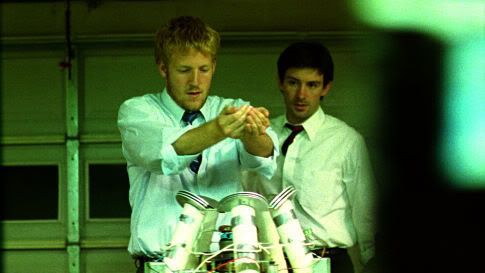
As far as I can tell, Shane Carruth, who wrote and directed the movie (and stars in it, and edited it, and scored it, and designed its production and sound) is an ex-engineer of some sort who used what is, apparently, his extensive understanding of technical matters to concoct this story of a couple of guys who are working on some kind of project in their garage and who accidentally discover a new application for their invention. What Wikipedia doesn’t tell you is that the guy is a born filmmaker.
When I hear “low-budget independent first feature,” you know what I think of? I think of Clerks, a movie with a loose concept and a rough shooting style that requires the logorrheic charm of its writing and the attitude of its cast to hold an audience’s attention. That ain’t Primer. Primer has a brilliant concept, finely-crafted writing that, on every level, commands attention, exudes authority and confidence, filmmaking that crackles with tension and vivid, ultra-natural performances from actors and non-actors alike.
Scenes are written without the slightest consideration of “inviting the audience in,” and cut to the bone of comprehension. The movie is about a bunch of wonks deeply involved in their world of engineering, and their conversations are full of — almost consist entirely of — long strings of technical terms as they debate this or that application of various mechanical processes. This decision creates incredible tension in the early scenes as the viewer struggles to keep up with the story, and also serves the dramatic purposes of the narrative, which is, essentially, about a start-up technical enterprise that goes bad. The characters, in some scenes, might as well be speaking in a foreign language, and so the viewer is forced to follow the non-verbal cues of the scenes closely — who is angry with whom, who no longer trusts whom, who is hiding what from whom, who is doing what behind who’s back.
This is not merely excellent genre writing, this is screenwriting of the highest order. This should be the goal of every ambitious screenwriter — to present moments of detailed, impeccably observed, unadorned, uninflected human interaction, and the camera happens to be there in the room at the time. It’s one of the hardest things to do, but Primer does it over and over again, in a narrative that relentlessly escalates into higher and higher realms of speculative fiction.
But that’s just for starters. On top of being a screenwriter of the first rank, Carruth also knows, somehow, right out of the box, where to put the camera, how to cut a scene together for maximum tension and surprise, how to place actors in the frame, how to coax subtle, lived-in performances from his cast, how to design and dress sets, how to effectively score a scene, and how to act. It all feels ridiculously “real,” which serves to make its fantastical narrative that much more creepy and suspenseful.
On the other hand, I’ve watched it four or five times now and am only now beginning to understand what the hell actually happens in it — this is a narrative so full of impressive twists and mind-bending concepts that it makes Mulholland Dr. look like Flipper. And it’s all presented in the most subtle, least melodramatic form possible — go for a handful of popcorn and you could easily miss one or two key plot points. Carruth insists that the information is all there in the movie for people to figure out, and since he’s obviously about ten times smarter than me I’m sure that’s true. The nice thing about Primer is that its scene-by-scene filmmaking is so enjoyable (and its running time so brief) that it easily invites — no, cheerfully demands — multiple viewings.
David Bowie: a subjective overview, part 3


David Bowie’s sudden right turn from freak-flag Stonesy rock to blue-eyed Philly soul remains, 35 years later, one of the more startling transitions in pop-music history. This transition is most notable on Changesonebowie, where the LP suddenly goes from “Rebel Rebel” to “Young Americans,” and if you’re not prepared it can snap your head around like a spring-loaded head-snapping machine. The transition is so complete and uncompromised, it’s hard to believe it’s even the same artist — until the distinctive voice comes in, which somehow doesn’t make the transition any easier to digest. Rather the opposite — if the Bowie of Diamond Dogs was the “real Bowie,” then this bouffanted smoothie with the gold bracelets and the smoldering cigarette must be some kind of put-on, right? Because if it’s not, what could this music possibly mean? And yet the music on Young Americans seems, if anything, more authentic and accomplished than the half-parody rock of the Ziggy Stardust era. Then, was Ziggy the real put-on? But then who was the long-haired prog-folk freak in the dress from the first three albums?
The soul influence on Young Americans is obvious and pervasive, but almost as important is the influence of the young Bruce Springsteen. Bowie recorded both “Growin’ Up” and “It’s Hard to be aSaint in the City” and the panoramic, complex lyrics of “Young Americans” shows his influences — the first verse, with its doomed, working-class lovers making out in the car under the bridge is practically parody. What makes it impressive is not that it’s imitation but that it’s so well-executed, as though it were a long-lost early Springsteen song, performed by, say, Teddy Pendergrass. And if you were to remove the ridiculous, over-emphatic cover of John Lennon’s “Across the Universe” (honestly, if there was ever a song ill-suited to the soul-man shout-out treatment, it’s “Across the Universe”) and substituted Bowie’s version of Springsteen’s “Saint,” Young Americans would be instantly improved and have a lot more cohesion. (His version of “Growin’ Up” is another story.)
The other startling thing about Young Americans is the sudden improvement of Bowie’s songwriting skills. Of the eight songs on the album, fully half of them are well-made, with nary a clunker or doff line among them. This, oddly, presents a different problem: Bowie, on Young Americans, has digested his source material so thoroughly that some of the songs feel more like genre exercises than personal statements, songs anyone could have written. It shows great dedication to form but leaves little room for expression. They’re all enjoyable, but only “Fame” bursts through with a distinctive point of view. (There are two other songs of this stripe, “It’s Gonna Be Me” and “Who Can I Be Now?” that are just as good, if not better, but weren’t on the original LP for some reason, although either could have replaced the dreaded “Across the Universe.”) After “Young Americans,” the best, most startling song is “Somebody Up There Likes Me,” where Bowie takes one of his oldest motifs, the shape-shifting Nietzschean overman, and, somehow, manages to put him into the context of a sweet soul croon.
Station to Station is to Young Americans as Aladdin Sane is to Ziggy Stardust. The material is weaker, the production more ambitious, drama again substitutes for content and focus is again a problem. The title track sounds impressive, with its multiple sections and widescreen production, its vague-yet-serious-sounding lyrics. It, like the line says, drives like a demon from station to station, but I’m telling you, I’ve been listening to this song for 30 years now and I can’t tell what the hell he’s going on about.
I’ve been reading the Wikipedia article on Station to Station, which notes that the frosty, insincere nature of the singing is apparently due to the “character” of the Thin White Duke that Bowie was “playing” through the recording of the record, who apparently is not a very nice man. Well, it’s nice to know that this is supposed to be a “character,” but that doesn’t help me enjoy the record more. There are six songs on the LP, six, all of which are quite long, as though that were some kind of guarantee of seriousness, one of which is ten minutes long, or one-fourth of the total running time. One is a cover, three others are impersonal genre exercises not unlike the ones on Young Americans, well structured and but sung with more detachment and a kind of melodrama that leaves me cold. The most baffling of these is “Word on a Wing,” which Bowie (or the character he’s playing) would have us believe that he is a passionately devout Christian. I remain unconvinced.
That leaves “TVC 15,” which is, of course, a delight — weird, personal and idiosyncratic, with a beat and arrangement that kind of comes out of nowhere and sounds like nothing else on the record. I’m not sure exactly what happens in the song, I think it’s about a man who falls in love with TV set, then loses his girlfriend inside it. It’s not “Penny Lane,” but it comes closerto my idea of what good Bowie is.
Epic fail, part 2
For the second time in a week, Epic McFail chooses to behave as though the past eight years — oh hell, the past twenty years — did not happen. The Russian/Georgian conflict, he says is “the first…serious crisis internationally since the end of the Cold War.”
Everyone says stupid things. I say stupid things all the time. But then again, I’m not running for president. John McCain has been saying stupid things for months now, incredibly stupid things, regarding foreign policy, the one subject he considers to be his forte. And yet somehow he’s still taken seriously by some people (the media, primarily) as a presidential candidate.
The other day I thought maybe his flatulent “in the 21st century, nations don’t invade other nations” line was some kind of misstatement of chronology — after all, a man who doesn’t know what a computer does can hardly be expected to understand when the 21st century began. But now he’s decided that the two wars we’re currently fighting, the two wars his party started and promptly fucked into a cocked hat, simply don’t count as “serious international crises.” No, they aren’t crises — they are logical progressions of events that run with the precision of fine Swiss craftsmanship.
These are not gaffes, these are not misstatements. This is his point of view. The Gulf War, Afghanistan, um, 9/11, um, the war in Iraq, it seems none of those count to him, none of those are “serious international crises.” What he means, of course, is that the Russia/Georgia conflict is the first “serious international crisis since the end of the Cold War” that he has a chance of understanding, that he has any kind of frame of reference for. McCain, and the rest of the fossils dominating the crumbling Republican party, miss the Cold War oh so dearly, when we knew who the enemy was and how to fight them, and I’ve seen signs in the Washington media this week that say “Oh boy! Another war! With Russia!! Hooray!! It’s just like the good old days!!!”


Found on the internet
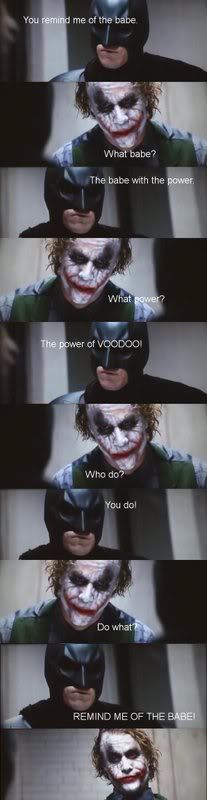
I generally don’t do the “meme for meme’s sake” thing, but, given our Labyrinth discussion of last week, I thought this was pretty funny.