
Movie Night with Urbaniak: United 93

It’s been some while since
![[info]](http://p-stat.livejournal.com/img/userinfo.gif)
came over for dinner and a movie, so I figured, why not celebrate with a harrowing drama of the events of our nation’s darkest day?
Anyway, United 93 is a swell movie — if you don’t mind holding your breath for two hours. It is about as well-executed as a movie like this — a real-life social drama about highly-charged events of recent history — could be. The writing, shooting, editing and acting are all excellent, creating a suffocating, well-nigh unbearable sense of dread and horror.
I saw United 93 on its opening weekend at the Arclight in Hollywood. The screen was huge, the sound was enveloping, the gritty, naturalistic drama overwhelming. The crowd, while not huge, was large enough. As the movie began, I began to get a sinking feeling — I realized that I had bought a ticket for a ride I didn’t really want to be on. As the drama intensified and intensified, it got to the point where I felt physically ill and short of breath. The movie was too well-made and too compelling to walk out of, but around the time the first plane hit the World Trade Center I suddenly remembered that I didn’t have a good time that day, and wondered about the wisdom of buying a ticket to experience that fear, horror, uncertainty and dread again. Plus, the bulk of the audience in the theater came, apparently, to see those fucking Arabs get it — when the final confrontation occurs in the closing minutes of the movie, there were plenty of shouts of “Kill those bastards!” in the theater.
The ensuing years have given me a little distance on the movie. It is a marvel of execution and feels unbearably “real.” (Paul Greengrass, in his shooting style, makes Costa-Gavras look like Stanley Kramer.) It is, structurally, a sophisticated supsense thriller, almost a heist movie with an ensemble cast. Suspense thriller? I should say it’s essentially a non-stop, 111-minute supense sequence. There is not a single moment of breathing room, no letup of suspense, only a steadily-escalating dread and horror that ends in a chaotic exclamation point.
It has all the elements of a crime melodrama. There are the terrorists, who are trying to execute their crime of crashing the plane into the Capitol building, there are the “cops,” the various air-traffic-control folk we see throughout who are trying to “solve the case” in a thicket of conflicting information and bureaucratic snafus (Urbaniak said he expected, and wanted, Walter Matthau to show up and just, you know, deal with things), and there are the passengers, the vigilantes who, pushed to their limit, finally take the law into their own hands. Hell, it’s practically The Dark Knight in that regard.
The suspense of Act I is: oh no, will the terrorists hijack the plane before their cover is blown by the other planes hitting the World Trade Center? There is a runway delay before takeoff, there are the pre-hijacking jitters of the lead terrorist, uncertainty hangs in the air. Weirdly, it puts us into the terrorists’ shoes: we sit there, squirming, ready to scream “Hijack the goddamned plane already, you assholes!” anything to break the steadily-ratcheting tension. The suspense of Act II is: oh no, will the military figure out what’s going on and cut through its red tape before the plane reaches the Capitol? The suspense of Act III is: will the passengers figure out what’s going on, make their stand and save the day?
In the end, the criminals don’t pull of the big job, the vigilantes succeed only in stopping the criminals, and the detectives don’t know there’s even a case until everyone’s dead. There’s a 21st-century lesson in there somewhere.
The filmmakers, with very few exceptions, avoid sentiment, but still, even though I know the ending when I start the movie, there is a moment mid-way through when I suddenly realize “oh shit — all these people are going to die,” and feel weird about even watching it any more. It’s the whole “how does this qualify as ‘entertainment'” question, the same one I have while watching Schindler’s List. When you watch a Holocaust drama, dammit, you want to see Nazi atrocities, and if those atrocities are elided or prettified, you feel short-changed — they didn’t give me full bang for my Holocaust-drama dollar. Similarly, in a 9/11 drama, dammit, you want to see those planes crash. What else would you be watching the movie for?
(It is indicative of, well, something, that when the second plane hit the WTC, the first thought in every American’s mind was not “oh the humanity” but “my God, it’s just like a movie.”)
David Bowie: a subjective overview part 2


Pop music albums don’t get much better than Ziggy Stardust. The hippie leanings of Bowie’s previous three albums vanish completely, his mystic pretensions have been fully digested and formed into nuggets of pure pop gold. The sound is crunchy, compelling and immediate, the songs are short, punchy, direct, concise, catchy and irresistible. Lyrical gaffes are kept to a minimum, and there is much to delight in. Cliches are avoided or inverted, the sense of drama is thrilling and palpable.
As a song cycle, it is both over-ambitious and too thin. The “plot,” such as it is, stalls out for long periods before lurching forward in the space of a few lines here and there, when it does not back-track and repeat itself. There’s a reason why it has not been turned into a Broadway show.
So Ziggy Stardust should not be compared to Mahagonny-Songspiel. Rather, it should be compared to its rough contemporaries Sgt Pepper, Tommy and Animals, all of which it compares to very well indeed. Plot is sparse, but drama is abundant. Ziggy Stardust oozes with drama.
There is not a dud song here. “Five Years” sets the scene beautifully — what could be more arresting than the quiet, understated opening, wherein it is revealed, in a dry, matter-of-fact tone, that the world is about to end? The narrator starts the song cold and dispassionate, almost journalistic, before getting caught up in the emotion of the situation, taking us along with him.
“Moonage Daydream” introduces the title character with the unforgettable lines “I’m an alligator, I’m a mama-papa coming for you, I’m a space invader, I’ll be a rock-n-rollin’ bitch for you.” To which, all I can say is “hey — sign me up.” “Starman” continues the Nietzschean-overman motif, a motif that shows up so often in Bowie’s work that I’m inclined to think that he really believes in this stuff. Conviction leaps out of the speakers on Ziggy Stardust, whether it is half-baked, jejune or just plain silly. Bowie plays with masks and identity here a lot, and will continue to do so for the remainder of his career, but it doesn’t get much more direct and passionate than the “Gimme your hands!” of “Rock-n-roll Suicide.”
Aladdin Sane feels rushed and thin in comparison, almost a step backwards. The songs are generally weaker, and many pretensions return shored up with the production values of extravagant arrangement. Focus is a major problem, radically different song forms sit uncomfortably next to each other. Drama turns to grandiloquence and self-importance, and there are even signs of padding — apparently, Bowie decided the world wasn’t going to end quite yet after all. In the lyrical gaffe department, it doesn’t get much sillier, or more pretentious, than “Time, he flexes like a whore, falls wanking to the floor.” This is, to put it mildly, crap — unless, of course, Bowie is referring to the magazine, in which case, you know, right on.
Pin Ups, Bowie’s album of British Invasion covers, is, generally speaking, a delight, although only a 27-year-old alien savior overman with one eye on the apocalyptic clock would feel nostalgia for songs released a mere six years previous.
I have a soft spot in my heart (or is it my head?) for Diamond Dogs, even though it is sillier and more pretentious than Aladdin Sane and conceptually weaker than Ziggy Stardust. Plotlines and characters are introduced and dropped, folded into other songs or ignored. Somehow its incoherence and ambition, the way it juxtaposes the intimate with the societal, the personal with the political, are intriguing instead of off-putting. “This ain’t rock-n-roll, this is genocide!” is certainly a startling rallying cry, and there is a weird, private love story winding its way through the songs that I find compelling in its incompleteness. There are few, if any, “well-made songs” here, only the jagged wreckage of half-formed notions, but that wreckage I find still compelling 34 years later.
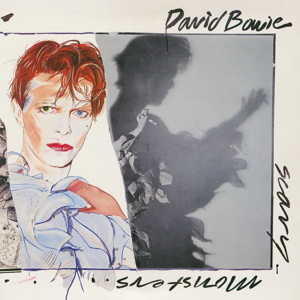
And let me step aside for a moment here and talk about cover art. The four album-cover designs pictured above are all pretty flawless, except for the type on Aladdin Sane and Pin Ups. Bowie had already done the no-title-on-the cover thing for Hunky Dory, why did he (or, more likely, the label), think they needed it for these LPs? The fonts do no one any favors, and the design elements just kind of hang there looking embarrassed, marring the images instead of enhancing them. You’ve got that face, in that make-up, why would a record company think they also needed to remind the buyer whose record this is with clumsy type?

I found this at my local used CD store yesterday for $6.99. I haven’t had a chance to fully digest it, but let me start off by saying that it’s nowhere near as bad as I feared. “The Laughing Gnome” isn’t even on it, and neither is “London Bye Ta-ta,” which speaks well of any album.
The Venture Bros: ORB

Are we doomed?
In her book Dark Age Ahead, the late Jane Jacobs argues, persuasively, that western culture is headed for a new dark age, and that in this dark age the knowledge and expertise we now possess will be lost. She points to Dark Age Europe, where societies that once thrived suddenly collapsed, the people of those societies forgetting how to maintain the bedrock of their cultures: agriculture, irrigation, education, so forth.
How is such a thing possible? How does a society forget how to plant and care for crops? Well, here’s one way: there is a shift at the top of the society’s power structure, wars are started for the benefit of the ruling class, the society’s economic framework is re-purposed to serve the needs of the power-mad, ignoring the needs and interests of the lower classes, there is a societal shift where the caretakers and practitioners of vital knowledge are driven away, or isolated, or killed as knowledge itself is demonized. And inside of a generation, superstition and ignorance become the norm. Suddenly, the center cannot hold and the society collapses, generally overthrown by the next rising power.
(That’s the one thing Idiocracy left out — the fact that, once the US gets as stupid as it is in the movie, they will have been long-before taken over by, say, China.)
(Another thing to keep in mind, not directly addressed in “ORB,” is the fact that the internet is controlled by very large corporations who are currently champing at the bit to try to figure out how to pry money out of this bonanza of democratization. Once those corporations seize control of the flow of knowledge, I guarantee you that the internet will contain only information unharmful to those in power — and will be used by a generation of people completely incapable of getting information from books, partly because they have never learned to do so and partly because all the libraries will have been shut down by communities that could not afford to keep them open, since their tax base has been eroded by mass real-estate foreclosures and bank failures.)
But what’s all this then? Isn’t this an awful lot of heaviness to load upon a 22-minute cartoon? Well, when the maguffin of that cartoon is a device of “ultimate power,” I’m going to say no.
So there is this orb. And the orb is some kind of remarkable device. It’s not just that no one knows what it does, it’s that everyone has a different idea of what it does. The Guild (or, as I like to call it, The Guild of Extraordinary Gentlemen) has possession of his device, and is under attack. From Tesla, which, lest the reader forget, is just another way of saying David Bowie. I’m going to go ahead and say that the battle in question is actually being waged because of the orb, that Tesla wants to get his hands on it and the Guild has promised to keep it safe.
(There is some sly social commentary in “ORB” regarding the corruption of societies, in this case secret societies, as the do-good Guild has, somehow between then and now, morphed into the Guild of Calamitous Intent, very much, I’m guessing, as the Republic of Star Wars morphed into the Empire. How exactly this happened is yet unexplored, but it’s worth noting that the main difference between The Guild and the later Guild of Calamitous Intent is that the Guild featured not one but two artists, whereas the GCI consists entirely of power-mad costumed freaks — David Bowie notwithstanding. Or, perhaps, now that I think of it, David Bowie inclusive.)
(And, as long as we’re here, it’s worth noting that the Guild includes a number of real-life people. What would Samuel Clemens and Oscar Wilde have to contribute to this secret society? My guess is that their humanist overview helped to keep the Guild on a moral track — and when they were gone and the Guild co-opted, only the power-mad costumed freaks were left. And I’m guessing that Crowley was not killed when Sandow threw him out of the airship, but rather astral-projected or something and ended up with Tesla’s team. Ah, but this is all mere wild speculation on my part.)
The more aggressive members of the Guild, particularly Fantomas, believe the orb is some kind of ultimate weapon, and they cannot wait to activate it, even though they have no idea what form this weapon will take or what its effects are. The more scientific members of the Guild, namely Col. Venture, believe the orb is a benign, problem-solving agent of good. So the orb is different things to different people, depending on their point of view. The only thing Fantomas and Col Venture agree on is that the orb is a device of incredible power.
The issue being skated around here, of course, is that, metaphorically, the orb isn’t a device at all — it is power itself. The orb (that is, great power) can create or destroy, can educate or kill, can free the masses or enslave them — depending on who possesses it. This is the crisis of “ORB,” and is, of course, the crisis of our society. Will the orb be possessed by the emotionally-stunted power-mad freaks, or the “men of hope” in the scientific world? Or will it be possessed by a total fucking idiot? Is the orb meant to serve the needs of the people or to serve the whims of the powerful? Should power reside with the elite, or is it a birthright to all humanity?
“ORB” reveals the soft underbelly of the generally caustic, despairing Venture Bros. Startling in its lack of irony and cynicism, the script contains genuine (if absurd) mysteries, a genuine comic-thriller plot (or two) and a remarkable sense of possibilities.
The A-story hinges, as many of this season’s do, on Jonas’s relationship with Rusty, and Rusty’s gradual rapprochement with the memory of his father. Jonas, it seems, knew from the very beginning that Rusty was a useless little idiot, albeit a profitable one, and concocted an elaborate ruse to keep Rusty from ever finding the orb. That is, the wise father, understanding the importance of the orb, made sure that it would not fall into the hands of those unqualified to use it.
(On the other hand, the wise father also took his son along on international spy adventures, deprived him of a normal childhood, and regularly placed him in situations where he would need to kill other men. So there’s that.)
(In real life, of course, our father GHW Bush, was never wise and did everything he could to ensure that the orb would be possessed by those unqualified to use it.)
(And, if you’re in the mood for it, the “simple substitution code” on the toilet-paper roll does not spell out “ORB” but “VLJ”, which means what exactly? And did Kano really kill Jonas, and was it because Jonas got close to wielding the orb? Is the Venture compound located where it is because Jonas knew the orb was buried there somewhere? Is that why he designed and built the extensive fallout shelters, to find this orb? Wheels within wheels.)
Rusty begins the episode in possession of his usual greed, laziness and cynicism, but as the mystery deepens and the intrigue takes hold, he finds himself transforming into something else — his younger, more idealistic self. How much more self-knowledge could Rusty obtain after he has, after his long, ridiculous journey with Billy, taken possession of the orb and then, upon reflection, decided that he is too stupid to activate it? And yet he does so with great calm. Rusty, in this episode, has achieved one of the greatest pieces of wisdom one can — he now knows that he does not know anything. Paradoxically, the wisdom of his ignorance saves his life (his ignorance, of course, extends to him not knowing that his life was in danger to begin with) and, for all we know, saves the world entire.
The Rusty Venture title sequence is, of course, a smash, and alone is worth the price of admission.
David Bowie: a subjective overview, part 1


I am not a musicologist. I am a dramatist, and I am therefore prejudiced toward structure. My form is the screenplay, which means, you know, doubly so. This means, in terms of pop-music appreciation, I tend to appreciate the “well-made song.”
(One day, I will do an entire post on Avril Lavigne’s “Sk8ter Boi”.)
David Bowie: a personal history


Watching Labyrinth the other night re-awakened me to the thrill and the puzzle that is David Bowie.
You know how sometimes you have a vague awareness of an artist’s work, but then one day you experience it in an unexpected context and somehow the new context illuminates everything that artist has done, and suddenly the artist “clicks” for you in an unprecedented way and becomes your favorite artist ever?
Well, the opposite is also possible. Your favorite artist ever can sometimes put out a piece of work so baffling, lame and unambitious that it ends up throwing suspicion on everything else they’ve done, and then you look at all that work you loved so much and think “Hey — I’ve been duped, this guy’s a fraud.”
David Bowie made a whole career out of this dynamic.
In some ways, Bowie’s career is a distorted, funhouse mirror of Paul McCartney’s — mountains of talent, tons of creativity, work too important to be dismissed, but also long stretches of losing the thread and outright embarrassing work.
(Both musicians also paint, and Bowie’s paintings, very much like McCartney’s, suck like there’s no tomorrow.)
Wadpaw friend The Editor noted watching the recent Ian Curtis bio-pic Control with a friend who huffed impatiently through an early scene of Curtis sitting in his flat listening to a David Bowie record. The Editor, apoplectic, had to explain to the friend that, no, you don’t understand, David Bowie used to mean something, David Bowie recordings once had deep messages in them about identity and transformation and the fear and thrill of being alive. The scene wasn’t a time-waster about a shiftless young man, it was, in fact, a succinct character beat that told you everything you needed to know about the young Ian Curtis.
I was once that guy. I was that teen, sitting in my bedroom, listening to David Bowie records over and over, feeling like he was imparting secret knowledge to me, things only I would understand, hidden worlds, dark and wonderful, frightening and weird, illuminating a path to an adulthood more interesting and alive than those of the pinks around me.
It was the spring of 1979. I was 17 years old and, since it was a Tuesday afternoon, in a record store. I was into Elvis Costello and Talking Heads and I was looking for other “New Wave” records to change my life. I saw, up on the shelf, Lodger, the new album by David Bowie, pictured above.
Look at that cover. That was the cover of an album by a major artist on a major label. I saw that cover and thought: “Huh. That’s weird. What the hell isthis?” To put the cover of Lodger into context, here are some other albums I might have seen in that record store that day: this, this, this, this, this, this, this, this and this.
The cover of Lodger was, in fact, so strange and mysterious that it spooked me a little. It was printed sideways and backwards, for one thing, with the image wrapping around the side of the gatefold, and the record top-heavy in the front pocket rather than weighing down the back. Everything about it was wrong, weird, fucked-up. I put David Bowie in my list of “artists to keep an eye on” and moved on to, probably, this.
A year or so later, David Bowie turned up, in Chicago (I was living in nearby Crystal Lake), performing in a run of the hit play The Elephant Man before taking over the title role on Broadway. As an aspiring 18-year-old playwright, I was primarily excited about seeing a genuine “Broadway play,” the fact that pop-star David Bowie was in the show was a secondary concern.
Well, the show was great, and Bowie was great in the part, and his first appearance on stage was as he appears in the second image above: naked but for a loincloth, his body way too thin and way too pale, as if the baby Jesus had been caught in a taffy-pull. I’ve been told that the part in The Elephant Man is “actor-proof,” but that didn’t detract from my enjoyment of Bowie’s performance as he mimed John Merrick’s illness and distorted his voice to approximate the sound of a man with a head full of bulbous bone growth.
So this David Bowie fellow suddenly became very interesting to me. And he had a new record out, Scary Monsters, which had a cover almost as weird and fucked-up as that of Lodger. I snapped it up at my local record boutique, took it home and dropped a needle on it.
Well.
The Buddhists say that when the student is ready, the teacher will appear, and Scary Monsters was exactly the record I needed to hear in the summer of 1980. At this point, I was living in a trailer in southern Illinois, in a neighborhood where, no kidding, an 18-year-old kid could get beaten up for listening to David Bowie. Or for listening to anything to the left of this.
Scary Monsters had everything: huge amounts of weirdness, oddly tuned guitars, plenty of jarring, unsettling effects, great passion juxtaposed with jaded disaffection. It was, yes, scary and super, monstrous and creepy.
The following three years involved me soaking up everything Bowie had doneup to that point. He became the center of my musical universe — he went to Africa before David Byrne or Peter Gabriel did, he worked with Robert Fripp and Brian Eno before Talking Heads did and hired Adrian Belew before Talking Heads did too, for that matter. His records swerved all over the place from weird and arty to weird and poppy to weird and soulful to weird and blistering. I rarely believed a word he sang, but sincerity somehow seemed beside the point — underneath and alongside the layers of irony and pose, covered over and thrown into relief by incident and marketing, the “message” in Bowie somehow always was located somewhere outside the lyrics.
Bowie was silent for a time, then exploded into a new realm of popularity in 1983 with Let’s Dance and its attendant “Serious Moonlight” tour. I was skeptical of Let’s Dance and felt sure that it was part of some plan on Bowie’s part, that he was, somehow, smuggling interesting and serious ideas in the guise of shiny, mainstream pop, rather than merely turning his weird, off-center stance into showbiz hackery. I saw him perform the “Serious Moonlight” show in Chicago (at the Rosemont Horizon, a sports arena under the O’Hare Airport flightpath, with overhead planes drowning out the music every ten minutes or so), and, while I could kind of work up some zeitgeisty enthusiasm for my hero going pop, there was something very much amiss there — all the dangerous edges had been sanded off Bowie’s music, it had been repackaged in a shiny new box for mass consumption.
I, unlike most Bowie fans, preferred Tonight slightly to Let’s Dance, but then came Labyrinth, which, at the time, I chose to simply ignore as an aberration, but which, now that I revisit it, was a harbinger of things to come, almost a new statement of purpose.
(In 1980, Rolling Stone published a Kurt Loder piece on Bowie, Scary Monster on Broadway, in which Bowie carps about the cultural desert of Chicago, specifically, a dreadful museum show dedicated to Jim Henson and the Muppets, which seems to have greatly offended him. This great offense, somehow, did not prevent him from snapping up the offer to appear in Labyrinth — exhibit A in my “what the hell happened” file.)
1987 brought Never Let Me Down, the first out-and-out artistic disaster of Bowie’s career. I could barely listen to it, it swerved madly from the lame dance-pop of “Day-In, Day-Out” to the excruciating Spinal-Tap-ish mystical epic “Glass Spider.” I listened to it maybe three times, trying in vain to find some layer of irony that would tell me that this glossy, embarrassing piece of product contained some nugget of artistic value, before I finally gave up on it.
Bowie, and his repuation, never recovered from Never Let Me Down. Before Let’s Dance, Bowie was known as a trend-setter, a musician magically capable of anticipating what everyone would be listening to in the near future. After Never Let Me Down he reversed himself, became a trend follower, seemingly desperate to appear hip and “with it” in whatever musical moment seemed to be popular with the kids at the moment. Post-punk, drum-n-bass, cyberspace drama, self-imitation, every record, no matter what style it was in, seemedto diminish the lustre of the landmark recordings he put out between 1972 and 1980. Some of the records made between 1987 and now have aged well and some of them haven’t, I still find interesting ideas here and there, but none of them come within shouting distance of the vitality and daring of Scary Monsters.
(I saw him again with Tin Machine at the Academy in New York City in 1991 with Radiohead as an opening act. It was a good show.)
In the midst of my obsession, 1982, I acquired my very first cat. There was no question what he would be named: Bowie was my avatar, my polestar, the banner of my identity. The good news is that Bowie, the cat, lived to a ripe old age. The bad news is that he lived long enough to see his name go from generating appreciative nods to generating looks of bafflement and skepticism, which would then require an elaborate explanation on my part.
Mantis update: mantis rampage!
Ceiling can taste freedom.

Booie, the littlest and, frankly, weediest of our latest mantis army, died quietly in the night a few days ago. In accordance with mantis tradition, his body was devoured by crickets.
In what’s becoming an Alcott family tradition, the death of the weakest mantis is a signal that the others’ days are numbered, and the survivors should be released into the wild, where they might mate and create another mantis army to menace the insects of tomorrow. The liberation ceremony for Ceiling and Snacks was held this morning on our front porch.

Pick me up! Pick me up! shouts Ceiling from the depths of the carrier she shares with Giant Black African Millipede.

Snacks, out in the open air, taking his first look at the big, wide world, where, theoretically anyway, there are many insects for him to devour.

Meanwhile Ceiling, getting a whiff of the liberty that is the divine right of all mantids, tries to climb the sheer plexiglass walls of her enclosure.

“What is this strange thing I’m perched upon?” asks Snacks — his first encounter with Nature. Shortly after this photo was taken, Kit (5) asked if she could try to pick him up one last time, or “do you think he’s wild already?”

Out of her enclosure and a little spooked by the wide open spaces, Ceiling goes into a defensive “put up your dukes” pose. Note the super-aggressive “scorpion tail.”

The crickets did not miss out — predator and prey each gained their freedom on this day.

Ceiling, still asking for trouble, crouches on Sam’s hand and, like Sean Penn, dares the photographer to approach — for a fist full of knuckles.

Once on a leaf, Ceiling visibly relaxes. “I could get used to this,” says the enormous, voracious, meat-eating predator. Crickets of Santa Monica. YOU ARE DOOMED.
An anatomist on The Dark Knight


After seeing The Dark Knight, I had one burning question (sorry): were the depictions of Two-Face’s injuries anatomically accurate?
To answer this question, I turned to anatomist, choreographer and Bentfootes creator Kriota Willberg. Kriota is the only person I know who has actually dissected a real live — er, I mean, real dead — human body. This is what she had to say:
There you have it. Subtracting the pain and shock that would naturally occur in such an instance (or, as my wife put it, “you’d go insane” — to which I reply “well…”), The Harvey/Two-Face look is perfectly plausible (and, I’m sure, somewhere in this world there is someone, right now, surgically adapting their face to look more like Harvey Dent). Now, just imagine the final act of The Dark Knight with Aaron Eckhart not only looking like Two-Face but sounding like him too. With the uncontrolled saliva constantly roping off of his open jaw cavity. He’d have to wear a bib. I wonder if the Dark Knight folk considered addressing these issues, or if that would have made the movie a little too horrifying.
MEMO
TO: Hollywood
FROM: Todd Alcott
As of 2:00am, 8/7/08 —
Post on Labyrinth: 155 comments.
Post on Act V of Schindler’s List: 3 comments.
FYI.
Spielberg: Schindler’s List part 5





Schindler’s List is a movie about a man who is powerfully motivated to succeed in business. His journey, from Act I to Act V, shows how he comes to define that success.
In Act I, Schindler sets up his business in the context of a once-in-a-lifetime opportunity to exploit history and human suffering. In Act II, history responds in the form of Goth, a purely evil man who takes Schindler’s business away from him. In Act III, Schindler exploits Goth’s character flaws to make a deal with the devil and re-build his business. In Act IV, Goth’s boss, Hitler, shuts down Goth’s business and, in the process, shuts down Schindler’s business again as well. As he moves through these acts, Schindler becomes aware that success in business comes with a price, and the price is paid in human lives. This, after a long process of changes, forces him to consider the balance of materialism vs life.
In Act V, Schindler rebuilds his business yet again, but this time with a completely different focus. Instead of creating a business that exploits human lives and makes him a fortune, he structures his new business to squander a fortune but preserve human lives. In this way, it becomes not a “Holocaust movie” or even necessarily a “WWII movie,” but a drama about the hidden costs of capitalism.
13:00 -15:03: The final act of Schindler’s List, like the acts preceding it, begins with a roll call: another list of names, another recitation by Germans. The difference here is that where there was once a sea of faces, a panoply of “humanity,” now there are only a handful, and by this point we recognize almost everyone’s faces, and this roll call, instead of announcing the names of the doomed, is announcing the names of the saved (Act V of Schindler’s List is structured, in many ways, almost as a mirror of Act I, as we will see). There’s the kid in the cap, somehow alive after being rejected from the latrine during the last selektion, there’s the little girl in the glasses, now with her mother, there’s Helen Hirsch, and there’s even Goldberg, the “Bad Jew” from the ghetto who turned into a policeman when the going got rough. His inclusion on the list I find intriguing and hopeful: Spielberg seems to be saying that, in spite of his behavior, Goldberg, as a Jew in Cracow, is more sinned against than sinning, as it were, and thus deserves to be saved along with the people he betrayed. It’s a small moment but it keeps registering with me. The last boy named is a one we haven’t met before, a gawky, bespectacled kid named Edward Hillman, who bears a startling resemblance to a teenaged Spielberg: it seems he felt a need to include himself on the list of the saved.
15:03-17:00: Welcome to Brinnlitz! The trains out of Cracow arrive in Schindler’s home town — at least the trains carrying the men. The Nazi officer in charge of overseeing Schindler’s new factory is anxious to make a good impression with the millionaire industrialist, but let’s face it, he’s no Goth, he’s an ordertaker, and Schindler baffles him — another point where Act V reverses the actions of Act I, the Nazi officer tries to ingratiate himself with Schindler instead of the other way around.
17:00-30:13: The train carrying the women from Cracow arrives not in Brinnlitz but in Auschwitz. In a movie bristling with striking, powerful sequences of human suffering and evil, Spielberg here seeks to get to the kernel of the Holocaust, a look into the mouth of the beast. He puts the women of the story (the same ones who, an act or two earlier, were shown talking themselves out of the possibility of the existence of Auschwitz) through the most degrading and horrifying ordeal imaginable — and then, oddly, pulls his punch. Not that we want the women to all die, quite far from it. But the sequence, for all its power, and as unblinking as it is visually, for me somehow sits uncomfortably in the rest of the narrative. As we see the women stripped down, shaved and degraded, I can’t help but be reminded by Mamet’s comment that holocaust movies are a form of pornography, a fantasy of absolute power and absolute submission. If that notion is true, this sequence comes close to literalizing it, and, with its desire to show but not show, to take us to the edge of mass death and then back off, feels like a kind of a tease. Spielberg seems all too aware of the moral quandaries involved in making an entertainment about this kind of atrocity at all, and the viewer is implicated in that quandary several times in Schindler’s List: we want to see, we want to know, we want the experience, but at the same time the notion of consuming these kinds of images is, or should be, deeply troubling. Maybe that’s why Spielberg takes us all the way to the brink of the realityof the Holocaust but then spares us the ultimate truth — there are some places he simply can’t bring his camera to look. (Kubrick said that Schindler’s List isn’t a “holocaust movie”, because holocaust movies are about the six million Jews who died, and Schindler’s List is about the 1100 who lived, and the Auschwitz sequence boils that notion down to 13 minutes.)
(It’s my understanding that the Auschwitz sequence is not part of the historical record or the novel on which Schindler’s List is based. This does not affect my appreciation of the sequence, but it does raise questions about why it was included. It seems as though Spielberg, understanding that his would be considered some kind of “definitive” Holocaust movie, felt that it must include a glimpse of Auschwitz in order to feel comprehensive. This is also troubling, as it implies that a movie-going audience would walk out of the theater griping “What kind of a Holocaust movie was that? He didn’t even show us Auschwitz! What a rip!”)
In another inversion of a scene in Act I, Schindler, in his pursuit of getting the women freed from Auschwitz, goes to a Nazi officer and makes the same deal he made to Itzak Stern: in the coming months, “portable wealth” is the only kind that will mean anything. He bribes the officer with a pouch of diamonds, and officer dyspeptically admits that the trouble of clearing “his” Jews is largely one of troublesome paperwork.
30:13-31:36: The women and children, now rescued from Auschwitz, arrive in Brinnlitz. In a kind of echo to Goth’s Act II speech to his soldiers, Schindler lectures the Nazi guards as to what he considers proper behavior in his camp. The shoe is definitely on the other foot in Act V, and yet Schindler, still the good-time Charlie, follows his veiled threats with a welcome-basket of beer.
32:50-33:15: In yet another inversion, Schindler tracks down his wife and assures her of her place in his life. In his shedding of his identity as a businessman, he seems intent on acquring a new identity as a mensch.
33:15-34:40: Stern asks Schindler about the nature of this new business. Again, this is an inversion of Schindler’s Act I dealings with Stern: then, he was the grinning smoothie who understood nothing about running things and Stern was the man with all the secrets, now Stern is the confused accountant and Schindler is the man with the secret. Here, the secret is revealed: Schindler’s new business is designed not to make money but to shed it, and to shed it in great quantities. Stern worries that the plan might attract the attention of the authorities, which Schindler answers with yet more money — it seems like he won’t be happy until all his money is gone.
34:40-36:44: Schindler reminds Rabbi Levertov of his duties. The factory shuts down on a Friday sunset and sabbath is observed again. The candles used in the scene bloom into color, linking them to the candles of the title sequence, symbolizing the renewal of hope.
36:44-37:15: In a few brief minutes, and after an explanatory title card, Schindler’s impulse for Act V is fulfilled: he is broke, worse off than he was at the beginning of Act I.
37:15-38:00: Just in time, the war ends.
38:00-47:28: Schindler assembles the cast in his factory and delivers a speech, outlining the ironies of the current situation. Once a prosperous businessman, the end of the war has turned him into a war criminal. This is quite a bit worse than where he began his journey. A lot of people lose their patience with Schindler with this scene, with its grandstanding tone and sanctimony, and it bugged me for a while too, but now it’s one of my favorite scenes in the movie. At the end of a long movie filled with intense conflicts and extensive degradation, Schindler here brings the story to a place of universal truths (and, not coincidentally, a place where Spielbergis very comfortable): the family. Schindler has worked to bring families back together, and he enjoins the Germans in the room to go back to their families as well, while they still posess shreds of their humanity.
Out in the railyard, Stern, the “good Jew”, Schindler’s Jiminy Cricket, gives him a ring, forged from the gold tooth of one of his workers (an echo of an Act III scene). The ring’s enscription reads “He who saves one life saves the world entire.” For years I thought this beat was simply too much, all we need, dramatically, is for Stern to approve of Schindler, to say, essentially, “That’ll do, pig,” it seemed a little over the top that Stern would present Schindler with a ring like a high-school quarterback after winning the big game. Then I found out that this is, apparently, exaclty what happened. So go figure.
In any case, Stern’s climactic approval of Schindler gives Schindler the exact opposite of comfort. Instead, the man who was once obsessed with making a fortune in business is reduced to a quivering mass of sorrow and regret as he realizes how much more he could have achieved by giving more away. His suit, his car, and finally that Nazi pin, the pin we first saw him put on in his introdutory scene in Act I, all could have been traded in for more lives. The “things vs lives” motif, developed from the beginning of the movie, is here focused down to a literal pinpoint.
47:28-end: Schindler, whom we met as he was getting dressed up in his nice suit to go impress the Nazis, we now leave as he sheds his suit and puts on the clothes of a prisoner. “His” Jews are left behind in the rail yard: why they don’t wait inside the factory I’m not sure. In any case, they are greeted, one morning soon after I suppose, by a Russian soldier come to “liberate” them. Their liberation is short-lived, as the Russian soldier (who, I’ve learned, was also a Jew) informs them that there’s no place in the area they are welcome.
Then comes the curtain call, which, I’m not ashamed to say, just floors me every time. I know it’s manipulative, I know it pushes the boundaries of taste, but something about seeing the movie’s cast members standing next to the people they’re playing as they file past Schindler’s grave just gets to me every time, brings the narrative into the “real world” in a way that I’ve rarely seen replicated (until, of course, Saving Private Ryan).