Senator Craig resigns
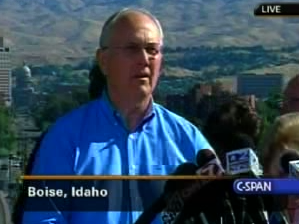

Well I for one am disappointed — I was truly hoping this would drag out for a long, long time. Partly because this guy is fascinating in a way that fellow vicious, hypocritical Republican lawmakers (Gingrich, Vitter, Ney, Foley, Abramoff, etc etc etc) aren’t, partly because I was looking forward to what Craig was going to do next. What legal recourses are there available to a man who was caught red-handed (so to speak) in a crime, then pleaded guilty, on tape, and paid the fine? That would have been a fine legal proceeding to follow indeed, and would have, I’m guessing, done much to expose the Republicans for what they are — the party of Nero, drunk on absolute power and engaging not just in lewd behavior in public restrooms but, essentially, engaging in any behavior that pleases them. Honestly, at this point it wouldn’t surprise me to learn that George Bush has sex with animals and ritually sacrifices children on a stone altar in the Oval Office.
(The latter is, of course unnecessary — Bush has no need to ritually sacrifice children in the Oval Office, he ritually sacrifices other people’s children every day in Iraq. And don’t think he doesn’t fully realize that and glory in it every day. Face it — The man likes to kill people. His actions in Texas prove that. I’m honestly surprised he never actually sat in on any of the executions he ordered, licking his thin lizard lips as the condemned man/woman made their last convulsions.)

Meanwhile, once-beloved actor and game-show host Ben Stein has, apparently, lost his mind. Stein argues that the Minneapolis police were using Gestapo tactics on poor, innocent Senator Craig. And in case you’re thinking he perhaps is exaggerating or misspeaking, he repeats it — “gestapo, gestapo, gestapo.” Yes, I see now, that’s why Senator Craig resigned — because he did nothing wrong. Yes, it’s all so clear now. It’s not the blatant hypocrisy, it’s not the staggering levels of delusion and denial, it’s not the no-doubt long list of others who would come forward to say that they, too, had had illegal sex with Senator Craig in public restrooms, furthering damaging his reputation and the Republican party. It’s because of the gestapo tactics of the Minneapolis police.
Stein goes on to bravely confess that he’s been to Idaho, as though it were not a large state within the contiguous US, but some exotic, foreign locale. He characterizes Idahoans as nice, innocent people, rather like one would talk about the Tasaday. Then, his rhetorical bucket almost empty, he reaches down and scoops out another bizarre argument, “and so what if he was soliciting gay sex in an airport men’s room? That’s not a crime.” Um, well, except that it is, a misdemeanor specifically, a point the arresting officer makes several times during Craig’s apprehension.
But Stein isn’t done yet. In a stunning WTF moment, he goes on to suggest that the White House is somehow responsible for setting up a sting operation to entrap senator Craig and destroy his career. Hey, listen, I fully believe the Bush White House to be completely capable of executing such an operation — anyone who can blithely order the surveillance of hundreds of millions of innocent Americans and the torture of American whistleblowers is clearly capable of anything — but I can’t for the life of me figure out why they would do it to Craig instead of, say, you know, A POLITICAL ENEMY instead of a loyal Republican who, as far as I know, served his party and constituency with honor and integrity for thirty years.
In fact, now that I’m thinking about it (it’s always dangerous to think too much about the Republican mindset), I have no idea what the hell Stein is talking about. The issue of Larry Craig is, first and last, the hypocrisy. There is nothing else to make the story interesting. I AGREE: there’s nothing wrong with men having sex with each other. HOWEVER: there is a law against soliciting sex in an airport men’s room, and senator Craig BROKE that law, and KNEW he had broken that law, and THEREFORE pleaded guilty and paid his fine. That’s all hunky-dory, and unworthy of a media circus. He didn’t tell his wife or staff or constituency or even his lawyer — well fine, it was an embarrassing predicament to be in.
The only thing that makes the case interesting is that senator Craig is a major, long-standing opponent of gay-rights legislation, and has, with one toe-tap, probably demolished the Republican’s ability to use the threat of gay marriage as a swing-voter (hey, I don’t make up these terms) issue in 2008. That’s why his party has not rallied around him, that’s why they’ve pressured him to resign, now, only days after issuing his stern denial of everything (and I mean everything). Preferably on, say, oh, a Saturday, during a four-day holiday weekend.
But Stein, like all other Republicans today, sees his party’s problems as anything other than their own actions. It’s the newspapers, it’s the cops, it’s the Democrats, it’s the media, it’s Al Qaeda, it’s the pink-gun-toting lesbian gangs.
Blog blog
This blog has hit the big time — Shane Richmond at Britain’s Telegraph newspaper mentions me in his blog-roundup column with regards to my Katrina piece (“a great blogger, by the way” — now there’s a money quote).
(And here I thought my numbers had doubled because of the penny-stacking link.)
Anyway, it’s always nice to have a professional journalist point to my work, and not being familiar with the Telegraph, I looked it up online. Wikipedia refers to it as a conservative newspaper, and, given the tenor of my thoughts on Katrina, it surprises me that I caught the interest of one of its columnists. Now why would a conservative newspaper want to direct their readers to my blog, given the “strong words” I have for the Bush administration?
I don’t know what it means exactly, but I like to think that, perhaps, “conservative” in the UK means, you know, actually conservative in one’s political views, which is the opposite of what it means in the US. “Conservative” in the US means “espousing a conservative viewpoint while actually doing the exact opposite,” like declaring that the government needs to be smaller while making the government substantially larger, or decrying “tax and spend liberals” while wiping out a decade of economic growth and plunging the country into a debt that will take generations to pay back, or advocating “morality” and “family values” while looting the treasury, taking bribes from lobbyists, doling out patronage in the billions, preying on teenage boys and playing footsie in airport men’s rooms. A conservative politician I can respect — what I can’t abide is a Republican politician.
(For the record, Mr. Richmond seems interested in the piece primarily for my confession that I get my news from blogs — which makes the tip o’ that hat even more intriguing — coming from a newspaper and all.)
(Wait a minute — Shane Richmond isn’t
![[info]](http://stat.livejournal.com/img/userinfo.gif)
, is he?)
UPDATE: It occurs to me that, in addition to being a nice mention, Mr. Richmond’s nod contains not a single untruth, distortion, misrepresentation or mean-spirited smear against me –making it unique among my experiences in print media. A columnist in a “conservative” newspaper in the US would not be able to mention my Katrina piece without first characterizing me as “far-left blogger Todd Alcott” or “tinfoil-hat-wearing leftist blogger Todd Alcott” or even the milder “One-hit Hollywood hack screenwriter Todd Alcott.” So the Telegraph is okay by me.
Do you want to hear the audio recording of Senator Larry Craig’s arrest in an airport in Minneapolis? Of course you do!
My favorite moment — well, there are two.
First of all, Senator Craig is having a dissociative moment where he does not really understand what’s happening to him. He doesn’t really understand that a police officer is about to end his career, he doesn’t understand he’s been caught, literally with his pants down, soliciting sex in a public men’s room and his career is about to end. He mentions early on in the recording that he has to make his flight, meaning, “I am still a powerful, busy, important man — you are a small, insignificant man, why won’t you go away?” He’s acting like he’s getting a parking citation or talking about his cable options with the guy from Dish Network — “what do I have to say to make you go away?”
(Listening to the recording and hearing the disassociation in his voice, I begin to understand why he pleaded guilty — simply to make this stop, so he could get back to his previously-scheduled life as quickly as possible and pretend none of this ever happened.)
(Literally, pretend it never happened, both to protect his job and to make it that much easier the next time he wants to do it.)
Second, his sad, obvious, transparent denials of how long he was in the men’s room, what he was doing there, even the order of events is topped by his interjection, out of nowhere, “I am not gay.” The officer never uses that word, and it even seems inappropriate to the conversation. The officer never says anything like “Minneapolis has had it up to here with you gay men and your perversions,” he’s very straightforward, calm but firm, charging the senator with a specific crime, not even a very serious crime, that carries a specific penalty. Craig is like the guy who gets pulled over for a busted taillight and blurts out “I don’t know why you pulled me over, there’s nothing weird in my trunk, I’m not an axe murderer.”
cartoonist of the day: Mark Gleim

Mark Gleim’s A Simple Apology is good. The drawing, as you can see, could not be simpler, but is deceptively so. But I’m impressed by the sheer number of left turns he manages to put into his strips.
Some thoughts on the anniversary of Katrina

Of all the horrifying images of Katrina, the one above is the one that sticks with me most. Bush, in the photo, is flying over New Orleans surveying the flood damage. He has turned to the camera to give what he thinks is his best “heavy is the crown” face, but all I can see in his expression is “can I go home now?” “I’ve flown over the destroyed city, I’ve looked out the window, I’ve ‘shown I care,’ can I go home now and get back to killing people, spying on Americans, crushing dissent, gutting the constitution and making all my friends wealthy?”
Katrina, for me, was when the mask finally came all the way off, revealing the administration of Bush II for what it was: an unfathomably brutal, cynical, uncaring cabal of monsters concerned only about accruing wealth and power. Karl Rove spoke often of building a “permanent Republican majority,” but time has shown that the Bush II people (who, let’s face it, are also the Bush I people, the Reagan people, the Nixon people) don’t even care about their party — they care only about themselves. They act as though they are the last people who will ever preside over the government of the United States. They believe this whole system of government was set up for them to loot the treasury for eight years and then leave town chortling.
But I was talking about Katrina.
First thing that happened two years ago today was that, for me anyway, the mainstream American news media became obsolete. The news out of New Orleans was coming too fast for outlets like the New York Times to keep up with, so I started looking elsewhere. News blogs like Eschaton, Crooks and Liars, Daily Kos and Americablog I had heard spoken of but never frequented, but during Katrina I sought them out because they were gathering information from all kinds of different places, giving me a much fuller, more truthful picture of what was going on on the ground than, say, CNN or Fox News were, including Anderson Cooper and Chuck Roberts and Geraldo and their efforts to convey the horrors of the flood.
I have not looked back since. I haven’t turned on the TV to watch an American news outlet since Katrina and I find that I am better informed for it. American TV news, it will surprise no one, is driven not by a search for journalistic truth but by advertising dollars. This formulation can only lead to networks promoting sensation over substance in their attempts to garner more viewers than their competition. The “liberal blogs,” I find, regardless of their openly-stated biases, to be more informative and ultimately more truthful than any money-driven corporate news organization.
The second thing that happened was that Katrina exposed America’s conservative movement for what it truly is. I saw a clip from The O’Reilly Factor where Bill O’Reilly, within days of the disaster, denounced the dead, the homeless and the doomed as lazy, shiftless losers who deserved exactly what they got. Now, I know that O’Reilly is a merely a heartless clown who believes in no ideology beyond the continued dominance of his little patch of media real estate, but I, who have seen a lot from these monsters in the past few years, was still struck by the sheer hatefulness of his response. I couldn’t find the clip on YouTube, but the quote I remember was O’Reilly saying something along the lines of “It is not the responsibility of the federal government to help the people of New Orleans, it was the responsibility of the people of New Orleans to get good jobs and good educations so that they would not have to live in poor neighborhoods below sea level.” His words were decidedly more snide and scabrous, but you get the idea.
Anyway, I got stuck on the first part of the statement and it rolled around in my head for days. It’s not the responsibility of the federal government to help the citizens of a major American city when it is struck by a natural disaster? I had heard a lot of denial of responsibility from conservatives over the previous five years, but this was a new one on me. If the federal government is not responsible for protecting its citizens, what, in God’s name, are they there for? Why should we pay federal taxes to a government who, literally, does not care if we live or die?
This concept bothered me so much that I went around reporting this to friends. One of those friends, not a poli-sci major but a regular, garden-variety college graduate, gave me a strange look, as though she suddenly realized that I was, in fact, only five years old, and said “But Todd, that’s the whole point of a conservative government — you give them all your money and they use it to fight wars forever.”
And so that weekend, not only Katrina but Iraq came into sharp focus for me. The Bush administration declared war on Iraq not because Iraq had weapons of mass destruction, or because they were linked to Al Qaeda, or because Saddam was a bad, bad man, but because it served their political ideal of always being at war so that nothing they do can be questioned and they can take all the money they want. I guess I always knew that on some level, but it took Katrina, and that quote from O’Reilly, and the above photograph to fully expose Bush and Cheney for what they are.
Because I realized, the reason Bush has that look on his face is because, for him, Katrina was not a disaster. When he told the lying, stupid, incompetent, crony head of FEMA he was doing “a heckuva job,” he wasn’t being clueless or idiotic, he was speaking honestly. Because for him, Katrina, far from being a disaster or tragedy of monumental, history-changing proportion, was the perfect fulfillment of his principles, namely, that in the perfect conservative world, the wealth of the nation is ever-concentrated upward from the poor to the middle class to the upper class to the ruling class, where it stays, and then the poor die, proving, by divine providence, that they were unfit to live in the first place. Bush, in his actions, said “I am your leader. Give me your money and then die, so that I and my friends in the military/industrial complex may flourish.” I remember one Republican politician surveying photos of the inundated 9th Ward and reasonably judging that “it looks like that could all just be bulldozed,” as though it was not actually a city, where thousands of people had homes, but simply another felicitous opportunity for gentrification for some lucky real-estate developer.
It was only when even Fox News was horrified by the scenes of unspeakable carnage and loss that Bush and company realized that they had to put on some kind of show of caring, which is exactly what they did — they put on a show. They put Bush in New Orleans, turned on the lights, put a camera on him, and as soon as he was off the air, turned off the lights again, and as far as I know, that’s the last time Bush ever thought about the destruction of New Orleans. Bush in that speech looked ridiculously uncomfortable and stiff, not because he was reeling from the loss of a major American city on his watch, but because he honestly had no idea what the hell it had to do with him.
UPDATE: Given the above, how appropriate it is that Bush chose the anniversary of Katrina to ask the American people for another $50 billion to continue his endless war in Iraq (which has, by the by, now killed more Iraqis in four years than Saddam Hussein managed to kill in thirty).
UPDATE UPDATE: Pam Spaulding of Americablog is on the ground in New Orleans today and efficiently outlines just how much caring has been done by the Bush administration on the behalf of the city.
The fault lies not in our stars

Stars: “I am not gay, I have never been gay.”
One of the major tenets of conservative thought, a perfectly legitimate one, is that people should be responsible for their own lives. And yet, one of the major tenets of the conservatives in Washington today is that nothing is their fault and they never do anything wrong, even when, especially when, there is overwhelming evidence that it is and they have. Pushing this example to its most absurd extreme, Senator Larry Craig (R-Idaho), a major opponent of gay-rights legislation, claims that an Idaho newspaper is to blame for his actions in a Minnesota airport men’s room.
How this works I’m not exactly sure. A newspaper devotes column space to trying to prove you’re gay, so you, understandably distracted and anxious about this crisis, proposition a cop in an airport men’s room? Then, when you’re arrested for this behavior, instead of saying “no, wait, this is all a misunderstanding, and it’s ironic that this has happened, because, oddly enough, there’s this newspaper in Idaho that keeps saying that I do things exactly like this all the time, and I’ve been very distracted and anxious about that,” instead of saying that, you say “I am guilty as charged and I hope this ends the matter.” Damn those Idaho newspapers! They get our highest elected officials into the most awkward situations! How do they do that?
Senator Craig

Crooks and Liars posts this video of Senator Larry Craig (R-Idaho) giving his statement regarding his arrest for and confession of propositioning an undercover cop in a Minnesota airport men’s room.
Aside from the obvious (yet another anti-gay Republican senator being revealed to be a closet case), I am interested in the piece for the senator’s opening remarks. He begins by saying “I’d like to thank you all for coming out today — ” and my pulse was momentarily raised by the possibility that he was then going to finish the sentence with ” — by doing the same myself.”
Alas, he didn’t. But that would certainly be something, would it not? Imagine if this were his statement instead of his blah-de-blah boilerplate, easily-dismissed denial (“denial” having multiple meanings here):
“You know, I’m glad this happened. I’m glad this happened, because it’s a perfect example of the kind of behavior people like me have been driven to by the repressive, inhumane laws that people like me have passed. Now that everyone knows I’m gay, that my personal life is a sham and that my professional life is a gigantic, brutal machine of self-hate, maybe now I can say “screw all that, I’m not going to be a politician any more, I’m going to finally try to make my life line up with the acts I spend my waking life performing, I can let my wife have some kind of normal existence for her remaining years, and I won’t have to proposition strange men in airport men’s rooms for my kicks. I’m 60, I’m fit, I’m rich, I’m ready for action — who wants me?”
Unless, of course, he’s afraid the answer would be “no one.”
Movie Night With Urbaniak: L’Eclisse


YOUR ATTENTION, PLEASE: This post was originally at least twice as long. Somewhere in the posting of it, half of it got mysteriously eaten by some livejournal program glitch. This makes me angry, but I currently don’t have the time or energy to re-write it. Suffice to say, I liked this movie and so did
.
[beginning of original post]
You know how I mentioned last time around how L’Avventura has no plot, yet is still tremendously exciting? Well, L’Eclisse has even less plot than L’Avventura, and is even more exciting. It’s almost like Antonioni is daring himself to stretch this method of designing narratives as far as it will go.
[significant portion of post mysteriously eaten here.]
[description of first 50 minutes of the movie — Vittoria’s difficulty with relationships, her restlessness, her discomfort, her flight to Verona]
[we join the post half-way through — I am describing a rather amazing 10-minute scene set in the buzz and flurry of a bad day at the stock exchange]
Urbaniak says, “the best extra work of all time.” I mean, it’s really quite stunning, it’s a hugely complicated scene, certainly as complicated as, say, any Hitchcock suspense scene, and as exciting, but like I say, it’s even more of an impressive stunt because we have no idea what it has to do with anything.
Anyway, Vittoria’s mother is there at the stock market, as usual, but today she’s really upset because she’s losing all her money. The market takes a downturn and stays there and everyone is quite upset by the end of the day. And Vittoria shows up toward the end of the day, wondering what all the excitement’s about. She knows nothing about the market and less about crashes (“But if someone lost the money, then surely someone else had to get that money — right?” she asks, hopefully).
10. Piero points out to her a man who has lost 50 million lira in the day’s trading, a sad, overweight, bespectacled man who wanders silently out of the marketplace, and I say “it would be great if the movie now just suddenly dropped everything and followed that guy around,” which, much to my amazement, it then proceeds to do, for about five minutes. Vittoria follows him as wanders, a little shell-shocked, around Rome, much like we’ve watched Vittoria wander shell-shocked, only we know the reason for this guy’s discomfort. But it seems Vittoria sees a kindred spirit in this man who’s lost everything and doesn’t quite know how that happened. She tails him to a little cafe, where he sits down and busies himself with a pencil and paper. We think maybe he’s writing a suicide note or a letter of resignation, but when Vittoria (and we) finally see the paper, it’s covered with childish, even girlish, drawings of little flowers.
11. Vittoria takes Piero to her mother’s apartment for some reason, I don’t know why. She barely knows him, only that he’s her mother’s stockbroker (and her mother now owes him quite a lot of money). We see the room where Vittoria grew up and learn that her father died in the war and her mother is terrified of poverty. As is everyone, quips Piero, but Vittoria says that she never thinks about it. Or being rich either. And we realize that Vittoria doesn’t seem to have given much thought to anything in her future at all — she just kind of blindly gropes forward, hoping the next thing that comes along won’t be quite as much of a dead end as the last thing. She flirts with Piero, then shies away, then flirts with him again. Mom comes home, worrying about where she’s going to get the money to pay Piero — she’s already hocked all her jewelry.
12. At Piero’s office, Piero’s boss tries to explain to the workers how they’re going to get through the crisis of the next stock cycle, how it’s vital to get the money lost from the deadbeats who’ve lost it. Piero needs no coaching on this — he’s regular monster when it comes to making investors feel like losers and idiots for trusting him with their money. And like I say, suddenly we’re seeing everything from Piero’s point of view instead of Vittoria’s. And while Vittoria is vaguely unhappy and fidgety and uncomfortable with everything, Piero is a callous heel who doesn’t seem to have a thought in his head beyond eating and drinking and screwing and doing business — which is to say he’s a stockbroker.
13. After work, Piero, at a loose end, drives over to Vittoria’s place and woos her beneath her balcony (aha! So the Romeo and Juliet reference was intentional!). Why is he attracted to her? Does it have something to do with her mother owing him a great deal of money? More to the point, what does she see in him? Anything? Or is this just how she is with men, just kind of wandering in and out of relationships, not really knowing what she’s doing there, not really having the will to break away? While Piero’s chatting her up, a friendly drunk steals Piero’s pricey sports car and drives it away. This bothers Piero, but not enough to stop him from trying to get a leg over with Vittoria.
14. Next thing we know, the drunk (I think) has crashed Piero’s car and it’s getting fished out of the river. Vittoria is a little horrified by this, but Piero is only concerned about whether or not it will greatly affect the car’s resale value. Everything in the audience’s will screams for Vittoria to go far away from this cad, but she spends the afternoon wandering around the suburbs with him anyway, strolling past a number of rapidly piling up symbols — baby carriages, priests, a recurring horse-drawn cart, and most important, a half-finished new building and the stacks of construction materials surrounding it, which get treated to many disconcerting, lingering closeups.
Vittoria grabs a balloon off a baby carriage, then sends it aloft to her not-very-good friend Marta’s balcony. Marta, the daughter of the big-game hunter, obliges her by getting her father’s elephant gun and blowing the balloon into atoms.
As Vittoria tries to decide to let Piero have his way with her, she rather strangely plunges a chunk of wood into a rain barrel on the new building’s construction site. It’s an odd moment, but it gets odder still, as we will see.
15. Later that night, Vittoria calls up Piero but then doesn’t say anything when he answers.
16. Several times before the end of the movie, we cut back to that chunk of wood in the rain barrel. I don’t know why, but apparently the chunk of wood means something. Is it Vittoria’s soul? Are we checking to see that her soul is remaining afloat? Or is it hope that floats? In any case, the chunk of wood starts to take on significant emotional significance. We want to shout out “go chunk of wood! float! float! float!”
17. Vittoria allows Piero to take her up to his place. Piero is just as big a heel in his own apartment as he is in public. Even though he grew up in this apartment, he has no connection to anything there and seems to have no inner life. He’s decorated the place in cheap bachelor-pad decor and keeps his supply of nudie novelty pens in the study. To underline the metaphor succinctly, he offers Vittoria a chocolate from a box, but when he opens it he finds that the box is, in fact, empty.
Vittoria and Piero fidget around in this apartment, trying to figure out how to start this love affair the two of them apparently want to have, not knowing quite how to do it. The sequence is almost as long as, and serves as a bookend to, the first scene with Riccardo — there, Vittoria was stumblingly trying to figure out how to leave a guy, here she’s trying to stumblingly figure out how to get together with one. “Around you I feel like I’m in a foreign country,” she says, and we know exactly what she means. To make his point succinctly, Antonioni has their first kiss happen through a pane of glass.
The tag line for Annie Hall was “A nervous love story,” but that fits L’Eclisse even better. Both of these beautiful young people are absurdly nervous about something — love or “the world” or something, I don’t think they know. I think Antonioni knows, but I don’t think he wants to tell us — that would somehow ruin everything.
They apparently finally get it on, and Vittoria, for a moment or so, seems happy. Why, we don’t know.
18. Then — crisis! The rain barrel leaks, spilling its water into the street and down the gutter. The camera lingers on this for a long time, the water gushing out of the rusted barrel, Vittoria’s special chunk of wood, her stick of hope, swirling around helplessly as water level drops.
19. Then, as a denouement, some buildings, some faceless people wandering around the cold, modernist, characterless suburb, and a curtain call of symbols. The baby carriage again, the priest, the horse and carriage. A sprinkler is shut off. A modernist streetlamp comes on. There’s that building again, with its heaps of unused construction materials. A man gets off a bus carrying a newspaper — the headline is something like “ARMS RACE SHOWDOWN” and “A NUCLEAR SHADOW,” which almost ruins the whole movie. It’s like Da Vinci writing at the bottom of the Mona Lisa, “She’s smiling because Italy has justemerged from a thousand years of church-dominated ignorance.” Does the H-bomb account for Vittoria’s discomfort, for Piero’s callousness, for the stock-market crash? Is that what the movie is finally “about?” Or is the nuclear threat only a symptom of something else, something harder to put one’s finger on? Because these answers are harder to come to, ultimately I think L’Eclisse is a more daring and accomplished movie than L’Avventura — Antonioni here really seems to be on the verge of something profound. This is tough, unsentimental, rigorous, hugely disciplined filmmaking, with the highest of artistic aspirations — no wonder the purists are so upset by Blow-Up, which is stylish, superficial and glib in comparison.
In the closing moments of the movie, a jet plane flies overhead. The sound-effect geek in me cannot help but note that the “jet plane” sound used is the exact same recording heard a few years later at the beginning of The Beatles’ recording “Back in the USSR.” Coincidence or incredibly-obscure homage? You be the judge.