Sam’s corner

Martian Manhunter, his wife and child, drawn by Sam (5), from looking at his Justice League action figures.
“I’m trying to really look!” he exclaimed in the middle of his work.
The Joy of Lex
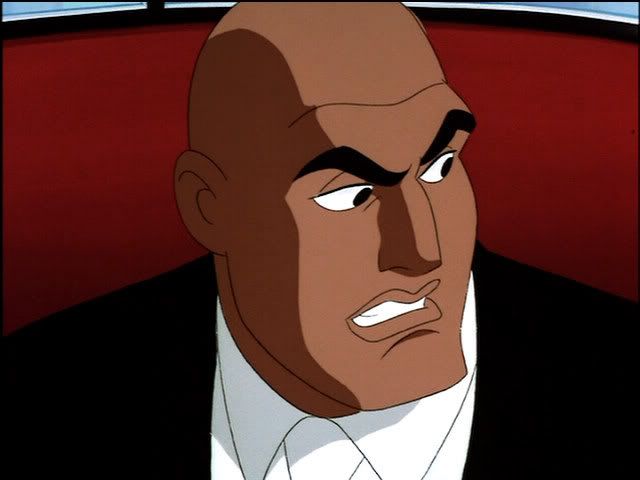
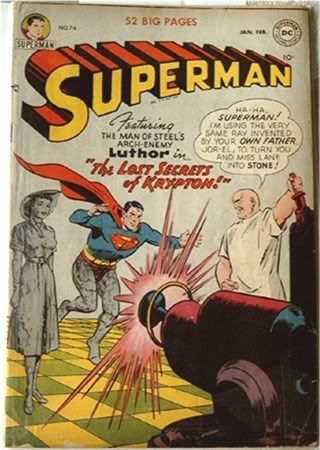
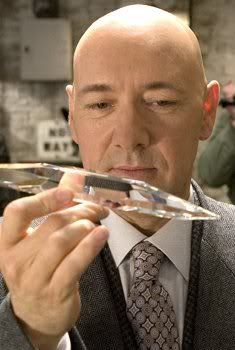
SAM (age 3): Who is that?
DAD: That’s Lex Luthor.
SAM: Is he the bad guy?
DAD: He is the bad guy.
SAM: Then why isn’t Superman fighting him?
Lex Luthor is the greatest, and most difficult to define, villain in the comics universe.
In 1940, when he was just Luthor, he was a mad scientist, much like many other mad scientists of the day. He created amazing machines and planned to use them to take over the world. There was a lot of that going around in the 1940s, when there were plenty of scientists, mad or not, and they very much did take over the world. People understandably were nervous about technology and its ability to shift the balance of power in the world.
The idea was, if Superman was Strong and Good, then his nemesis must be Smart and Evil. Lex created Superman robots, Superman clones, anti-Superman rays, all matter of ingenious devices for no other purpose but to destroy Superman. (In one of the many delicious plot twists of the the stunning Red Son, Superman comes to the realization that, if not for his existence, Luthor would have been able to use his vast intellect to solve every problem humanity faces — he would have been the greatest leader in human history.)
In the 1980s, John Byrne re-created Lex as a businessman, a tycoon, the head of Lexcorp. Again, it fit with the times — the villains of the 1980s were men like Gordon Gekko, bloodthirsty capitalists who cared nothing for people, lives or even businesses — they yearned only for money. Again, it’s a good foil for Superman because it’s natural strength vs. economic strength.
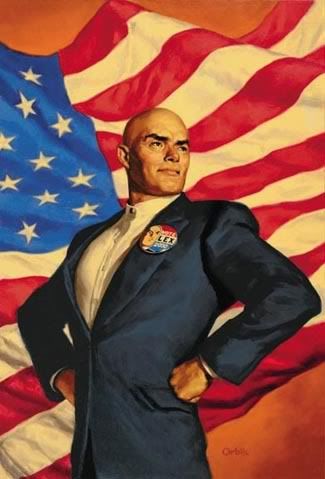
In the 2000s, Lex became President of the United States. One has to wonder what took him so long.
On Superman: The Animated Series and Justice League, they put all of these visions together to arrive at the fullest, most complex version of Luthor yet. This Luthor is hugely wealthy, employs millions of people, controls the economy of Metropolis, runs for president and, when the mood strikes him, finds time to tryto destroy Superman.
Maybe that’s what makes him interesting: he actually has other things to do besides destroy Superman.
The conversation quoted at the top of this entry occurred while Sam and I were watching one of the first episodes of Superman: TAS. They were taking great care to show who Lex is, how his business is constructed, how he’s an important and vital member of the community, not some penny-ante thug with a crazy plan — all of which completely baffled my (then) 3-year-old son. He couldn’t understand Lex, Lex’s legitimate business, he couldn’t understand that not even Superman can just fly into Luthor’s penthouse suite and punch the guy who employs more people than anyone in Metropolis and also controls municipal government. How do I explain to my son that you can’t punch someone merely because they’ve risked the lives of millions of people in their pursuit for power, that, in fact, in our country men are greatly rewarded for that kind of behavior?
(Note: I began this piece before I was aware of the president’s speech on Iraq tonight.)
When I was a kid I kept hearing about the Mafia and how there were these terrible criminals running organized crime in America, and everyone knew who they were but they were still running around free. I just kept wondering “If everyone knows who they are, why can’t the police just walk in and arrest them?” Like those Mafiosos, Lex is too smart to get caught in any of his nefarious schemes, and, more often than not, Lex’s schemes for power-grabs backfire on him in ways that have nothing to do with Superman’s interference. The Lex Luthor of Superman: TAS and Justice League is no two-dimensional bad-guy. The Joker is a psychopath in a garish costume, Sinestro is an evil guy with a magic ring, Mr. Freeze is a guy with a gun; you can see those guys coming a mile away. But Lex? If you foil a Lex Luthor scheme, chances are it’s because he wanted you to foil it because it somehow serves his greater plan. Only the Lex Luthor of Justice League could devise a presidential bid that’s actually a distraction to divert attention from his REAL plan.
As the earlier Luthors served their times, this Lex serves ours. A brilliant scientist, who is also the head of a multinational corporation and also president of the United States? The only thing that sounds out of place there is that we would have a brilliant man as president. Just as we once felt suspicious about science and capitalism, we now as a nation are starting to get the same sense of ill-ease about our corporate-owned political leaders. Despite their rhetoric, we get the feeling that maybe they don’t have the best interests of us, or the Earth, in mind when they make their decisions.
(The climax of Season 1 of Justice League Unlimited features a jaw-dropping team-up of Luthor and Brainiac that plays to both of their strengths — Brainiac wishes to destroy the universe (yes, the universe) and Lex seeks ultimate power — and in this case is offered the chance for godhood. The — ahem — “surprise reveal” of the team-up is one of the most disturbing things I’ve ever seen in children’s programming.)
For some reason, for the live-action movies, Superman, Superman II, Superman IV and Superman Returns, Warner Bros neglected every possible valid aspect of Lex Luthor. In these movies, Lex is not a scientist, a businessman or a politician. He’s a fop, an opportunist and a jerk. Far from being a genius, he’s not even bright. His plans are ridiculous, obtuse and fatally short-sighted. He is, in fact, the opposite of a genius — he is a man who keeps saying he is a genius. He’s a blowhard and a poser, vain and obvious, surrounding himself with morons and sycophants to make himself feel smarter. The Lex of the animated show doesn’t have a two-bit hussy and a slobbering idiot in a straw boater for a staff, he seeks out and hires the best and the brightest people in the world (a strategy that sometimes backfires for him when they get wise to his plans for universal domination). What does it say if I’m watching the $200-million-plus Superman Returns and I keep wishing I was watching a cartoon instead?
Christ, in Superman they wouldn’t even present him as bald! It seems obvious to me that the screenwriters of the first Superman movie never even bothered to read one of the comics they were supposedly adapting. I can just see the first meeting between Mario Puzo and Alexander Salkind:
M. So, Superman, blue suit, right?
A. Yes, and the red cape.
M. Super-strong or something, right?
A. Good-looking. The ladies like him.
M. Right. And who does he fight?
A. Um, let me — Ilya!
I. (from the other room) Yes?
A. Who does Superman fight?
I. Lex Luthor.
A. Lex Luthor.
M. (writing it down) L-e-x, L-u-t-h-e-r.
A. That should be an “o” in Luthor.
M. What?
A. Nothing.
M. So this Luthor guy, what’s he like?
A. He — Ilya?
I. WHAT!
A. Come in here so I don’t have to shout!
(Ilya comes in)
I. What.
A. Tell us what Luthor is like.
I. He’s a, a guy.
A. Yes?
I. And he hatches evil plots.
M. Mm. Yes?
(pause)
I. What.
M. That’s it?
I. And he’s bald.
(M winces)
M. That’s going to be a tough sell. They’re never going to get Hackman to shave his head. Does he have to be bald?

Justice League part 3 — the Martian Manhunter
left: the Man of Steel. right: creepy green loser.


Superman: super-strength, super hearing, super breath. Telescopic sight, X-ray vision, heat vision. Can fly and travel at super speeds.
Martian Manhunter: super-strength, super breath, heat vision, can fly. In addition, can read minds, communicate with spirits, walk through walls, change his shape.
Superman: the last surviving member of his race, the only living Kryptonian (except for Supergirl, Krypto, Streaky the Supercat, Comet the Superhorse, Beppo the Supermonkey and the entire city of Kandor — Jesus, did anybody but Superman’s parents die when Krypton blew up?). An alien on Earth, doomed to a life of loneliness, except for Lois Lane and the billions of people who adore him.
Martian Manhunter: the last surviving member of his race, the only living Martian. An alien on Earth, doomed to a life of loneliness.
Superman: invulnerable, except to an ultra-rare metal.
Martian Manhunter: invulnerable, except to not-rare-at-all fire.
On paper, Martian Manhunter is the more powerful figure, much more powerful than Superman and possessing a richer internal and emotional life. And yet everyone follows Superman as a natural leader, while Martian Manhunter is the creepy guy who always stands in the back of the group photo. Why?
In the comics, Martian Manhunter has his back-of-the-bus position simply because of seniority. Superman had been around for twenty years before Martian Manhunter showed up, and while MM might come in handy blowing out a forest fire or lifting up a bus, the Justice League in the ’60s couldn’t find much use for his talents. It took Bruce Timm and Co. to not only bring Martian Manhunter to life but to make him the most soulful, introspective and interesting member of the team.
The most obvious difference between Superman and Martian Manhunter, of course, is their looks. They’re both tall (MM is actually a good six inches taller than Supes) but Superman is white and handsome with a lantern jaw and a cleft chin, gimlet eyes, oodles of charisma and a charming spitcurl while Martian Manhunter is green, sepulchural, bald, sullen, beetle-browed and red-eyed.
But apart from the looks thing, why is it that Superman leads the Justice League around the world, punches robots, melts buildings and spaceships, destroys alien menaces and makes speeches to governmental bodies about the wise use of power, while MM can be found, every day, chained to a desk at the Watchtower, administering shift-changes and delegating task-work? Why does Martian Manhunter get no respect?
I think it has something to do with when their respective planets were destroyed. Superman was a baby when his father blasted him off of Krypton; he has no memory of it. All he knows is his his home planet was great and his parents loved him enough to give him a new lease on life, on a planet where he would be worshipped like a god. Martian Manhunter, on the other hand, was already married with a child when Mars was destroyed by an alien invasion. Superman has nothing but fond memories of his home, MM watched his wife and child murdered and his civilization destroyed before his eyes.
It’s broken him. He can’t just fly around smashing things because he’s seen too much flying around and smashing things in his life. It’s turned him into a scold and a gloomy gus. He’s always staring out windows and chastising the other members for being too quick with the violence. This sometimes makes him a wet blanket and a stick in the mud as he intones about the lessons he learned in seeing his home destroyed (in one issue of the comic, Flash, upon hearing the umpteenth iteration of MM’s origin story, finally sighs and says “Were all the Martians as whiny as you?”).
Then there’s the fire thing. The fire thing is lame. A shape-changing, building-lifting superhero should not be afraid of fire.
Maybe the fire thing has made MM gunshy. Maybe, despite his awesome powers, he’s happier in his administrative position, high above the Earth, unlikely to be caught in the clutches of a supervillain who might have, say, a book of matches and a pile of oily rags. MM stays in the Watchtower to avoid the embarrassment of a headline like “JUSTICE LEAGUE TRIUMPHS! Martian Manhunter felled by kid with Zippo.“
Then there’s the self-hate thing. MM failed his family, his civilization and his planet. In his mind he will never be free of his survivor guilt. Maybe that’s why he chooses to look like a tall, green creepy guy. I mean, keep in mind, the way we see MM is not how he sees himself. MM, in his “natural state,” looks like this:

That’s right — the creepy-green-guy look is how MM changes his appearance so as to look normal and not creep people out too much. He could look like Brad Pitt if he wanted to, but the MM look is what he chose. (In case he’s not creepy enough for you, keep in mind that the cape, trunks and pirate boots are all artificial; that is to say, MM is actually always naked. So when, say, Hawkgirl stands around the Watchtower with MM, she’s aware on some level that she’s standing next to, you know, a naked shape-changing Martian.)
But, point is, he has chosen to look the way he does. He has chosen to creep people out, to stay on the fringes of the group; his choice of look throws up a barrier to anyone who might get too close to him. Compare MM, moping around in his artificial creepy-guy state, with X-Men‘s Mystique, who prefers to strut around in her blue scaly state and only uses her shape-shifting powers to rob an armored car or bust a guy out of prison (there is the famous exchange between Nightcrawler and Mystique in X2: Nightcrawler asks “If you can change the way you look, why don’t you?” and Mystique sniffs “Because I shouldn’t have to.”) MM is not proud of the way he “naturally” looks, but at the same time he refuses to look “normal.” He shifts from “repulsive-looking” to “differently repulsive-looking.” It’s as though a Jew were to flee Poland and change his name from Greenberg to Lopez in order to sound “less Jewish.” That’s a level of self-disgust I’m not sure children should even be exposed to.
Then there’s the mind-reading thing, which, truth be told, is a burden to MM as much as it is an asset, and something he only uses when he really needs to. Otherwise, he is exposed to what everyone around him is really thinking, both about him and about the world. Martian Manhunter couldn’t live like Clark Kent, live a normal life with a job and friends and a love-interest. Because the natural, everyday masks that people wear don’t work for him. How could he be married if every time his wife kissed him good morning he could feel her resentment towards him or her subtle yearnings for the man next door? How could he go to work and carry on a job if he knew what petty, self-involved, disgusting thoughts were bubbling under the surface of the most mundane of everyday transactions?
Justice League part 2 — Green Lantern is a job



.JPG)

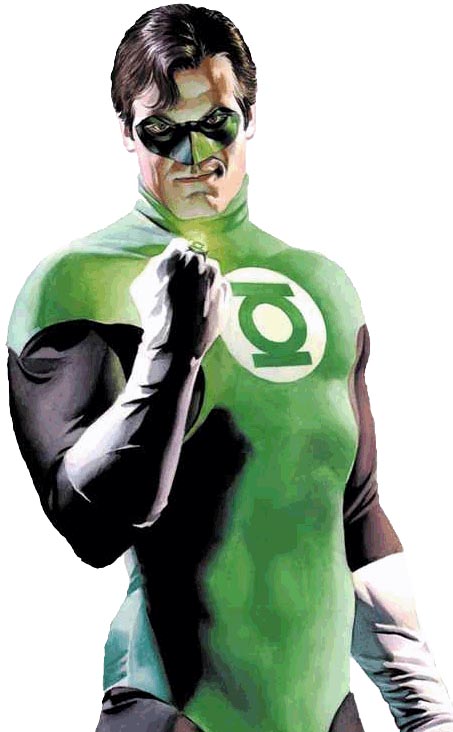
Left to right: Alan Scott, Hal Jordan, Guy Gardner, John Stewart, Kyle Rayner, Arkkis Chummuck — all entirely different people.
I was in New York recently, having dinner after a show (as one does) with some friends. At the table were the Magazine Editor, the Famous Actor, the Rock Star and the Primatologist. Conversation turned to Justice League. (Conversation has, no doubt, been edited to be more self-serving.)
TODD. My son has turned me into a geek.
PRIMATOLOGIST. (apres spit-take) Turned you into one?!
TODD. Hey, before Sam started watching Justice League, I had never heard of Arkkis Chummuck. Now I know who Arkkis Chummuck is.
ACTOR. Who is Arkkis Chummuck?
TODD. Arkkis Chummuck is a Green Lantern that Hal Jordan was teamed up with for a while. Arkkis is from a planet of werewolf-looking creatures who practice cannabalism. And Hal Jordan kind of held Arkkis Chummuck at arm’s length, thinking that he was some kind of a savage for his cannibalistic ways. But as we get to know Arkkis and his culture, we come to learn that there are deep, spiritual aspects to their practices that Hal simply didn’t bother to think about because of Arkkis’s appearance and habits. So Hal —
EDITOR. Wait — what do you mean he’s “teamed up” with Arkkis Chummuck?
TODD. Hal Jordan is only one Green Lantern. The Green Lantern Corps, you see, is based on a planet called Oa, where the the Oans have the magic Power Battery, which happens to look like a green lantern. And that’s where the Green Lantern Corps is based. Hal Jordan is only one of, I think, 36,000 Green Lanterns, and each Green Lantern polices a certain zone of the universe. Hal Jordan was only the Green Lantern of the zone that includes Earth, since that’s where the intelligent life is in our sector of the universe. If you —
ROCK STAR. And who is the “Jon Stewart” guy?
TODD. He —
ACTOR. There’s a Green Lantern named Jon Stewart?!
TODD. He — yes, he spells it with the “h” —
EDITOR. I wonder if Jon Stewart named himself after —
TODD. John Stewart was an “angry black guy” living in Detroit in the late sixties, and Hal Jordan got teamed up with him —
PRIMATOLOGIST. Wait, why did Earth get two Green Lanterns?
TODD. John Stewart was being trained as Hal Jordan’s backup. And in the Justice League cartoon, John is still from a bad neighborhood in Detroit but they made him a marine —
ACTOR. Wait, so “Green Lantern” isn’t a guy —
TODD. No, although there is a Green Lantern named Guy Gardner, redhead with a bowl haircut who nobody likes —
ROCK STAR. And isn’t one like a cartoonist or something?
TODD. That’s Kyle Rayner —
ACTOR. — “Green Lantern” is a, an office. A position.
TODD. That’s exactly right. “Green Lantern” is a job. So when people say they don’t like Green Lantern, it’s like saying they don’t —
EDITOR. I had no idea —
PRIMATOLOGIST. Are there any female Green Lanterns?
TODD. Are there? Why, one of the most important Green Lanterns is Katma Tui, a dark-red-skinned alien who trained John Stewart —
ROCK STAR. But the whole thing with the, you know, the color yellow —
TODD. Ah, yes. But, according to one story, you see, the power ring is not vulnerable to the color yellow — rather, the Guardians merely tell Green Lantern that his ring has a flaw, because otherwise he would eventually be driven mad with power. But the important thing is, people, they — all these Green Lanterns are entirely different people. Hal Jordan is a test pilot and John Stewart is a marine and Kyle Rayner is a cartoonist and they’ve all been given this responsibility and they all respond differently to the job. It’s like the word “Policeman.” You have all kinds of different policemen and all kinds of different stories you can tell about policemen. You have Hill Street Blues and Dirty Harry. Or “Lawyer.” Or “Doctor.” So that’s why Green Lantern, a character I’d never even thought about, suddenly has become, I don’t know, vital and interesting to me, just that one twist — Batman is a guy, Superman is a guy, but Green Lantern is a job. And I think he’s the only one who is a job, I —
The Prestige


Taking time off from my Futuristic Dystopia project to see a current release, and what could be more current than —
BATMAN VS. WOLVERINE IN 19th CENTURY MAGICIAN SMACKDOWN!
(read in complete safety! no spoilers revealed!)
Who will win in this titanic battle of magical superheroes? Batman’s got the skill, the ability to misdirect and the mastery of his dual nature, but Wolverine has mutant powers! He doesn’t have to put on a mask to do magic — he is magic!
Point for Batman — his character has thirty years on Wolverine, he’s acquired a lot of wisdom. Plus — he is the night.
Point for Wolverine — he’s got three blockbusters under his belt! Not to mention extra-super healing powers, an adamantium skeleton and retractable claws! Snikt!
But wait! What’s this, a femme fatale? Lovely Rebecca from Ghost World, twisting a spritz of highbrow, independent comics into the mix! Where do her loyalties lie? Only one thing is for sure in a movie about a superhero magician smackdown — nothing is as it appears to be.
Actually, one thing is for sure — 19th-century magicians are total dicks.
But watch out, there’s a ringer! Yes, that’s right, a plant in the audience! But who? Maybe it’s Batman’s butler, Alfred, or maybe it’s the guy from Labyrinth! He’s magic for sure! Hell, he might even be a space alien!
Exquisite in its production and complex in its construction, a thoroughly good time at the movies.
Truth be told, Michael Caine is probably here less to remind us of Batman and more to remind us of Sleuth, the premise of which could fit into any given five minutes of this movie.
Special mention goes to Rebecca Hall, as the Other Woman, who’s quite good and has not been in any big-hit movies. Go Rebecca Hall!
And the lovely and talented David Bowie is also quite good here. Bowie has most often been used as an effect in most movies, stunt-casting, but he gives an honest-to-goodness performance here, unflashy, controlled, subtle and sad. He also does for The Prestige exactly as he did for The Venture Bros — create an environment where it seems that anything could happen.
The screenplay, which is devilishly constructed, cheats, twice. There is one highly unlikely coincidence and one big fat made-up lie. But unlike, say, Vanilla Sky, this movie uses its big fat made-up lie to say something interesting and worthwhile about its time. Saying more than this would give away the game.
If folks would like to discuss the many spoilable things in the movie, perhaps we could do so below the fold. But that may be too immodest.
Justice League (part I)
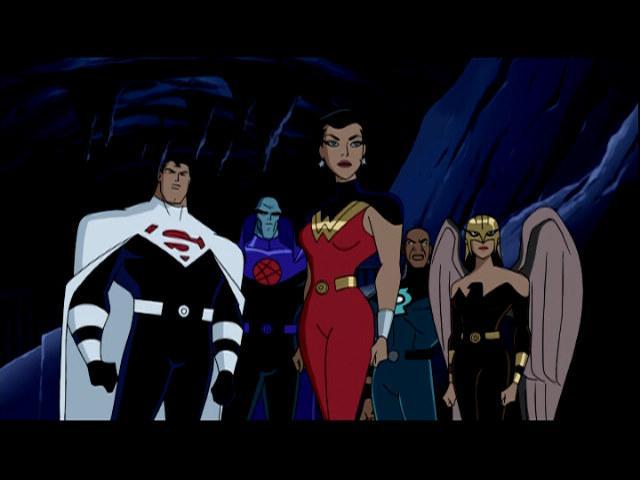
The Justice Lords would like a word with you.
My son has turned me into a geek.
I never read comic books as a kid. I think the first comic book I ever read was Watchmen in 1985. I read Dark Knight Returns after Tim Burton’s Batman movie came out. I didn’t start reading comics until Joel Silver asked me to work on the Wonder Woman movie in 1999. Even then, it was all “just research.” It was more fun than reading Dickens (mostly), but I never considered it a pursuit in and of itself.
My son has changed all of that.
He loves superheroes. He can’t get enough of them. When he wakes up, his first thought is about someone he needs to look up on Wikipedia so that he can draw a picture of them. The Marvel splash-panel I posted last week is only one of dozens of superhero drawings that lie scattered in heaps around the house. His walls, floor and shelves are plastered and stacked high with drawings and figurines. (Strangely, every time I’ve tried to interest him in an actual poster showing the same superheroes, he’s never interested; they never “look right” to him.)
Part of it, I know, is related to his interest in dinosaurs, which recently reached its saturation point. That is, like the dinosaur world, the superhero world comprises another world of tiny pieces of information for his rapidly-expanding mind to categorize. In dinosaurs, you have plant-eaters and predators, in superheroes, you have good guys and bad guys. Among plant-eaters you have long-necks and short-necks, among predators you have therapods and oviraptors; among good guys you have metahumans and “regular guys in costumes,” among bad guys you have aliens and robots. And all combinations of the above. (His interest in dinosaurs supplanted his interest in trains, which occupied the first half of his life.)
So a conversation between us will go something like this:
S. Dad, what do you know about Magneto?
D. Magneto can control metal with his mind.
S. Is he a good guy or a bad guy?
D. Magneto is a bad guy.
S. And does he have superpowers or is he a regular guy in a costume?
D. He has superpowers. He can control metal with his mind.
S. Yeah, but he’s not super-strong, and he doesn’t have, like, heat vision or anything.
D. Yeah, but he can control metal with his mind. That’s his super-power.
S. But how did he get like that?
D. He was born like that. He’s a mutant. That’s the difference between X-Men and The Avengers. The X-Men were all born with their powers, the Avengers are all regular people who had accidents.
S. But what about Wolverine?
D. Wolverine is an X-Man.
S. But he’s in the Avengers! And so is Storm!
(one trip to the Marvel Encyclopedia later)
D. Okay, but Wolverine and Storm were in the X-Men first.
S. And is Elektra a good guy or a bad guy?
D. Elektra is kind of like Catwoman. Sometimes she’s a good guy and sometimes she’s a bad guy — it kind of depends on where you happen to be standing at the moment.
And so on.
(Of the many differences between DC and Marvel, one of the most striking, from an “adult trying to explain comic book heroes to a child who can’t read yet” point-of-view anyway, is that the lines of good and bad are drawn much more clearly in the DC universe; in Marvel, characters are zipping back and forth over the line all the time. How do I explain that the Punisher, who slaughters people with guns, is a good guy, while Batman, who despises guns and never kills anyone, is also a good guy? Or for that matter, how do I explain that the Hulk is a good guy, when no one, not even the Hulk, thinks he’s a good guy? And how do I explain how the media in Spider-Man’s world shapes the public’s perception of him, making a good guy look bad?)
Anyway, long story short, there’s this show, Justice League, that a year or so ago just hit my son like a truck.
I can’t explain it. He liked the Bruce Timm Batman show, but it was always a little too scary for him. He liked the Bruce Timm Superman show, but the plots were a little too complex for him (typical conversation: Sam: Who’s that? Dad: That’s Lex Luthor. Sam: Is he the bad guy? Dad: He’s the bad guy. Sam: Then why isn’t Superman fighting him?). But Justice League hit him just right. Something about the family dynamics of the group, Superman and Batman and Flash and Green Lantern and Wonder Woman and Martian Manhunter and Hawkgirl all in the same show, bouncing off each other and having their own adventures, somehow that clicked in his brain in a way that the individual heroes’ shows did not. The complications, which I would have thought would have made the show more difficult to follow, instead gave him more to feast on.
Now then: none of this means that I’ve been watching all these shows with him. Normally, these shows exist as something for Sam to watch while mom and dad get to spend 23 minutes having a conversation or eating dinner. But one night a few weeks ago, I called my wife to dinner and she didn’t come. Ten minutes later she wandered up from the TV room as though in a daze and said “I’m sorry, I got caught up in Justice League.” And I made a sound like Scooby-Doo does when he’s confused, and when after everyone went to bed I stayed up to see what the hell was so interesting about this episode of Justice League.
Check this out: the episode (it’s a two-parter) is called “A Better World.”
The show begins like this: Lex Luthor has somehow become president and is, apparently, about to destroy the world. Superman busts through White House security and confronts him in the Oval Office. Lex sneers at him and says “Go ahead, arrest me, put me in jail, I’ll just get out again, I always do, you’ll never be rid of me, you know that,” and Superman sighs and says “Yeah, you’re right,” and kills him. Just kills him. Just turns on his heat vision and zaps him, right there in the Oval Office. And Luthor falls over in a heap. Because Superman could totally do that, you know. Who would stop him? No one can stop him. Why didn’t he do it a long time ago?
And Superman just stands there over Luthor’s body. There’s no triumph or release, just grim silence. And Wonder Woman comes in and sees the dead body and says “…Oh. (beat) Well, I guess it had to happen at some point.” And the crisis is over, poof, all the world’s problems are solved.
Fade out. Roll titles.
Cut to: two years later, and the Justice League has all new uniforms, a new name (The Justice Lords) and they never leave the Watchtower (that’s their spaceship), because they never have to, because there is no crime. There is no crime because, as we come to find out, the Justice League has lobotomized all the criminals. We visit Arkham Asylum and find Joker and Poison Ivy and Two-Face and everyone else cheerful, model prisoners, milling around the grounds like pleasant, happy zombies. Gotham City is so clean and bright it looks like Metropolis. There’s an incredible scene where Justice Lord Superman is battling Doomsday (whom, aficianados will know, once killed Superman in the comics) and, just as Doomsday is about to go into his “MWAH HA HA” victory laugh, Justice Lord Superman zaps him in the forehead and we watch his brains melt down the sides of his face and Doomsday gets a queer, disconnected, disappointed look in his eyes as he slumps to the ground, still alive but no longer dangerous; somehow, it never occurred to him that Superman possessed the power to lobotomize him.
With no crime to fight, Justice Lord Batman has turned to science and has made an important discovery: he’s stumbled across a parallel dimension, where the normal, regular old Justice League with their colorful costumes and bickering ways are still wasting their time, struggling through a world filled with supervillains. The Justice Lords take pity on the poor old alternate-dimension Justice League (who we realize, in time, are our dimension’s Justice League; that is, the whole first part of the show is taking place in an alternate dimension and the protagonists don’t enter until the beginning of Act II) and, in a gesture of kindness, kidnap them and take them prisoner so that they can clean up the other dimension too. And so Act III has the Justice League taking on the Justice Lords, which, you can imagine, is difficult because they are, in fact, the exact same people, only a teeny bit more ruthless. And on the one hand, you don’t like the Justice Lords because of that ruthlessness, and on the other hand, it’s like — well, how come the Justice League took this long to get their act together? And the tension is unbearable because, as the title suggests, the Justice Lords have truly made their world better, and the Justice League is actually fighting to make it more chaotic and dangerous.
Bizarre enough? It gets better. To solve the problem of the Justice Lord Superman, whom no one can subdue, the Justice League must turn to Lex Luthor, who is still alive in this world, and who has the scientific knowledge to build a super-power-sapping device (“device” being the operative word here). Luthor will zap the Justice Lord Superman so that the good-old Justice League can take back control of our world (or, rather, relinquish control of our world). In exchange for his super-power-sapping device, the Justice League grants Lex a full pardon for all his past crimes and makes him a free man.
In the epilogue, we see a sobered, grateful Lex at a press conference, vowing to give up crime forever and — you knew it had to come — announcing his bid for the presidency. And the cycle begins again.
And I’m sitting in front of the TV with my mouth hanging open. This is a far cry from Superfriends. In the span of a 45-minute superhero cartoon, Bruce Timm and company have just told me more about society, civilization and justice than I ever learned in a season of Law and Order. Sure, Superman could just kill Lex. Of course he could. Why doesn’t he? That would make everything better. All it takes is the will to do so. And that goes for all the Justice League. Why bother negotiating with murderous thugs? Why not just kill them? They obviously have the power to do so. Why put up with giggling psychopaths who have nothing to contribute to society? Why not just kill them? And then, dumb as it sounds, it hit me: that’s why they call it Superman’s “Never Ending Struggle for Truth and Justice.” The whole point of the Justice League (and their real-world counteparts) is not to rid the world of crime, but to be vigilant in the fight against it. And then I was reminded about something regarding God as well. The DC superheroes were always modelled after the Gods, were they not? Well here’s the answer to the great question, Why do the Gods allow evil to exist?
Okay, enough for now. I’ve barely scratched the surface of my thoughts about this show. There’s a three-part episode where, get this, the Justice League goes back in time to World War II, in order to…restore Adolf Hitler to power.
Suffice to say, it’s no longer Sam saying “Hey, let’s watch Justice League!” Instead, it’s him saying “Can I watch Scooby-Doo?” And I’m saying “No, c’mon, let’s watch Justice League!” Now I know who all the characters are and what their backstories are (Did you know Hawkgirl was a detective on her home planet?) and what’s more, I care about them in ways I never have before. And I will get into the reasons for that in Part II.
I leave you for the moment with what is probably my favorite moment in the series, and emblematic of its genius. There’s a robot (AMAZO) who has the ability to imitate the powers of any superhero it sees. If it sees the Flash, it can run at the speed of light, if it sees Green Lantern, it can fashion a magic power ring, etc. It sees Superman, and acquires all his powers, and starts smashing stuff up. Batman, who has no powers to acquire, is the only one capable of fighting it. Thinking fast, he takes a lump of Kryptonite out of his pocket and lobs it at the robot, who collapses like a ragdoll and falls into the river (Batman reasoning that if AMAZO has acquired Superman’s strengths, he might also have acquired his weaknesses).
And Wonder Woman comes out from under a piece of rubble and says “So, what, you just always carry around a piece of Kryptonite with you?” And Batman scowls and mutters “Call it insurance,” and dashes off into the night.
Because he’s seen the “Better World” episode, probably.
Take the Marvel challenge!
My son Sam (5) has quite suddenly made a dramatic shift from DC to Marvel. Interest in Batman and Superman has dropped precipitously, interest in Iron Man and Hulk has increased exponentially. More to the point from a marketing point of view, he has immediately and instinctively assessed Marvel’s presence as a “brand,” and refers to Marvel characters not as “superheroes,” but “Marvel superheroes.” As in, he goes up to other kids at school and asks if they want to “play Marvel superheroes.”
One result is that he has gone from drawing pictures of the Justice League to drawing pictures of, well, everyone in the Marvel universe. All in the same drawing, as though trying to catch up after years of neglect.
Below is one of his latests efforts. Test your Marvel knowledge! How many of these characters can you name?
click on images to enlarge


THE ANSWERS:
Robolizard has done a heroic job with some tough material. The ones he missed are all pretty much the ones I missed too. Luckily I had the artist available to interpret for me.
Here is the complete set:
1. Mr. Fantastic
2. Silver Surfer
3. Spider-Man
4. Ant-Man
5. Nightcrawler
6. Daredevil (complete with endearing backwards 5-year-old double-D)
7. The Hulk
8. Black Panther
9. Iron Man (would be easier to identify if Sam had had access to the correct shade of red)
10. Lightspeed (who is Lightspeed? She is a member of Power Pack, of course, why do you ask? She is identifiable by her rainbow trail that she leaves whenever she zips from place to place.)
11. Rogue (probably the toughest one here. Sam had trouble getting across the idea of the white streak in her hair.)
12. Wolverine
13. Human Torch (Johnny Storm, that is — everyone knows the original Human Torch has no face.)
14. The Thing
15. The Wasp
16. Elektra (I know, I know, she’s topless — how advanced my son is! — but he got her little strappy things right.)
17. She-Hulk.
Congratulations to all our — well, our player!
Hulk

A number of extremely talented people worked to try to make this the best movie possible. It’s hugely ambitious and has a complex, elaborate editing scheme. I liked it a lot better than I did when I saw it in the theater.
I wish I had a better understanding of exactly what the hell is going on in it.
This paragraph from A.O. Scott’s review in the New York Times sums up my feelings regarding the plot:
“I’m far from an expert in such matters, but I would have thought that a combination of nanomeds and gamma radiation would be sufficient to make a nerdy researcher burst out of his clothes, turn green and start smashing things. I have now learned that this will occur only if there is a pre-existing genetic anomaly compounded by a history of parental abuse and repressed memories. This would be a fascinating paper in The New England Journal of Medicine, but it makes a supremely irritating — and borderline nonsensical — premise for a movie.”
And I also agree with this paragraph:
“All of this takes a very long time to explain, usually in choked-up, half-whispered dialogue or by means of flashbacks inside flashbacks. Themes and emotions that should stand out in relief are muddied and cancel one another out, so that no central crisis or relationship emerges.”
The tone sways wildly from ponderous to outrageously campy, sometimes in the same scene. At one moment a father and daughter discuss the unpredictability of the human heart, at the next moment the daughter is attacked by a giant mutated poodle. At one moment the Hulk is smashing tanks and swatting down helicopters, the next moment he’s lounging on a hillside contemplating lichens with a misty, faraway look in his eyes. At one moment a father and son have a colloquy on matters of identity and social order, the next moment Nick Nolte is gnawing on an electrical cable.
There are three bad guys, and none of their plots seem to make any sense. The biggest of them, which gets a very late start at an hour and eighteen minutes into the movie, involves Nick Nolte turning on some kind of machine and huffing on some sort of hose, then turning into some kind of super-being with some kind of super-powers which are visually impressive but which also seem tacked on, forced and incoherent.
There seems to be some kind of battle going on between the creative team and the genre they’re working in. They’ve chosen to make a movie about an enraged green smashing guy, but they also want the movie to be about “deep” themes and ideas. They’ve given their protagonist an inward journey (“Who am I?”) instead of an outward problem (“I’ve got to stop the bad guys”) and so the narrative seems choked, static and listless at just the points where it should be fleet, extravagant and larger-than-life.
Then there’s some problems with the plot. I’ve seen the movie twice now and there’s things I just don’t follow. I think I know why Hulk’s dad tries to kill him but I don’t know why he set off whatever green bomb thing he set off, or what the consequences of the blast were. I know in the comic book, it’s the “gamma blast” that created the Hulk, but here the script takes great pains to explain that the blast had nothing to do with it. Then why is it in the movie?
Then there’s the matter of the General’s daughter. This is a movie about, among other things, intergenerational conflicts, and so in addition to a scientist who has problems with his scientist father, there is a daughter who has problems with her general father. And the plot has to bend itself into a pretzel in order to keep those conflicts afloat, which is too bad because there isn’t much interesting going on in them.
But for the record, here goes: A Long Time Ago, there was this army base, see? And there was this general. And the general had a daughter. And the general was tussling with this scientist, who blew up the base with the Gamma bomb and then ran home to try to murder his son. And then many years later, the son grew up, forgot all about his murderous father, and then became a scientist, where he, by sheer coincidence, began studying in the exact same field as his murderous father, alongside the general’s now-grown-up daughter! This is a plot to make The Comedy of Errors seem like the acme of observational behavioralism.
Then there’s whatever Nick Nolte turns into. It’s pitched as the big battle that the narrative has been leading up to all this time, but it comes off as a late attempt to kick the movie into gear. Nick Nolte argues with his son, bites into an electrical cable, becomes a Big Weird Thing, then flies off, somehow, with The Hulk, to Some Place Far Away where the two of them fight as Nick turns into rocks and water and lightning and ice. Then a jet comes by and drops some kind of Large Bomb on them and somehow that takes care of Nick but also leaves Hulk alive. If anyone has any idea what any of that is supposed to mean, please let me know.
Then there are the special effects, which never quite take off. There are moments of great visual flair and compelling action, although the titular Hulk never really seems to be part of the scene he’s in. That’s okay, I don’t quite buy the special effects in the Spider-Man movies either. The difference, I think, is that the Spider-Man movies are pulp, understand they are pulp and function well as pulp, carrying their cliched truths lightly and with grace, while this movie slows down so often to think about “serious ideas” that it gives you too much time to realize how silly all of it is.
Deadgirl

A while back, I was up for a gig writing an X-Men spinoff. The gig didn’t happen, but I spent a year researching the X-Men universe anyway.
My favorite tributary of the X-Men river was X-Statix, which managed to have an involving story, evocative characters, biting satire and high-spirited parody all at the same time. And one of the many, many great characters from X-Statix was Deadgirl. Both utterly ridiculous and unexpectedly moving, Deadgirl brought the whole title to a new level.
Now she has her own graphic novel, X-Statix presents Deadgirl, in which she teams up with Dr. Strange to defeat a team of killed-off Marvel characters (including lame-os like Mysterio and Kraven) who keep coming back from hell to wreak havoc on Earth.
Again, the artistic team hits the pitch-perfect balance of silliness, adventure, drama and parody, creating an effect not unlike that of The Venture Bros. In fact, Venture Bros came to mind almost immediately as we are introduced to Dr. Strange, who is found in his study simultaneously conjuring the netherworld and complaining about his hemorroids, all in the ultra-po-faced style of Mike and Laura Allred’s illustrations. I immediately thought of Dr. Orpheus, and another brick in the Venture Bros wall of cultural influences fell into place. It made me wonder if the Deadgirl team had seen the last season of VB and decided to take the idea back to its source.
Anyway, the book’s a hoot.
This entry brought to you by the Wacom Tablet ™
My son loves the Justice League like you wouldn’t believe. So one of the “father and son bonding activities” we do is take extreme close-up photos of his 4.5-inch Justice League collection. Here’s one such image.

To get myself used to drawing with the Wacom tablet, I put this image into Photoshop, added a “new layer” and simply traced over it with the Wacom tablet. There’s a trick to getting used to the stylus, since you’re not drawing directly to paper. There’s a weird hand-eye thing that you have to acclimate to.
To give it the feeling of a spontaneous drawing, I limited my “tools” to the Photoshop “pencil” tool and kept it at the same pixel-breadth throughout. That gave me the same limitation as though I had only a piece of paper and, say, a warm, fat grease pencil (which is exactly what the stylus feels like on the tablet surface. I also tried to limit the amount of erasure and keep myself to the kind of marks I would make if I were “live” in art class instead of working with an infinitely malleable digital artwork.
When I felt like the drawing was done, I saved only the top layer and voila! Hawkgirl!
Click for larger view. For those blessed with Firefox, MUCH larger view.

And, using the same technique, here is ol’ gloomy-puss himself, Martian Manhunter:

