The Evil Tub of Goo

The man who started it all.
In the spring of 1940, an unidentified criminal fell into a tub of goo. From this tub of goo emerged The Joker, and the world has never been the same. Clayface, Mr. Freeze, Two-Face, Solomon Grundy, Parasite, all fell victim, in one way or another, to tubs of goo. Christ, the Creeper fell into the same tub of goo as the Joker! You would have thought that having one person turn into a raving psycho would be enough for that company to stop manufacturing that particular brand of goo, but that’s corporate America for you.
(In the film Batman and Robin, even Poison Ivy falls into a tub of goo, although her comic-book counterpart did not seem to need to take it that far.)
Where would we be without tubs of goo? How many of our psychotics, mutants and monsters owe their existence to tubs of goo?
And not just villains, good guys too. Flash fell into a tub of goo too, and was struck by lightning to seal the deal. Metamorpho, Plastic Man, Swamp Thing — all goo-produced phenomena.
Over in the Marvel universe, in addition to having their own swamp thing called Man-Thing (who fell into the same tub of goo as Solomon Grundy but with vastly different effect) they actually have a tub of goo from outer space, one that will actively seek out people and jump on them, turning super-heroes bad and bad guys evil.
(It should be noted that the Marvel Universe seems to be plagued with radiation instead of tubs of goo, perhaps as a symptom of coming of age after the H-bomb testing began.)
Where is the anti tub-of-goo legislation? Or just lids, what about lids? Just put some goddamn lids on the tubs of goo, would that be so hard? Bruce Wayne needn’t have changed his life and become a fearsome creature of the night, he could have just sprung for some lids and his city would have been perfectly safe.
Justice League of America

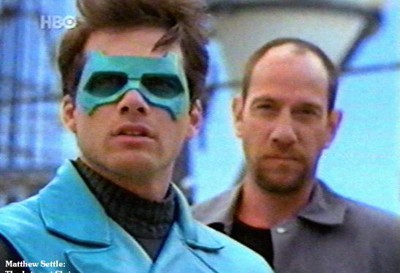
Martian Manhunter David Odgen Stiers fights middle-aged spread, while Green Lantern wonders if he can turn to confront Miguel Ferrer with a straight face.
Strangely enough, in 1997, while the world was waiting for Bruce Timm to create the show Justice League, CBS commissioned a pilot for a live-action Justice League of America. And as it happens, my local video store happened to have a copy of this little-seen pilot. As a “free rental,” no less. How could I resist?
A perfect example of how wrong a thing can go, Justice League of America shows what can happen when a decent idea falls into the hands of the uncaring. Now mind you, I never thought the original comic books (that is, in 1960) were any kind of ground-breaking miracle (they are mostly busy-work potboilers), but the makers of Justice League of America do not seem to have given a thought as to what their show is even about.
The lineup of this particular Justice League, for those interested, is Martian Manhunter, Atom, Flash, Green Lantern, Fire and Ice. The key thrust of the show seems to be “What if the Justice League were ordinary people, trying to lead their ordinary lives, trying to love and work and make friends, but then periodically having to dash off to save the world?”
Now, I’m all for superheroes behaving like human beings (that is, in fact, what makes the Bruce Timm show so successful), but there are limits. In Justice League of America, the superheroes aren’t just ordinary, they are desperately ordinary — sub-par slackers, halfway between The Incredibles and Mystery Men.
Take the Atom, for instance. In the comics, the Atom, Ray Palmer, is a brilliant physicist. That isn’t just a plot convenience, it’s the whole character. Ray Palmer must be a brilliant physicist because he invented the suit that enables him to get microscopic. In Justice League of America, Ray Palmer is a doughy, dull-witted, bespectacled high-school science teacher, unable to fix a television, much less rearrange the molecules of, say, an alien menace’s brainwaves.
Or the Flash. For the purposes of this show, it has been decided that Barry Allen can’t get his life together, attract women, or hold down a job. And so there is much “comedy” mined from Barry’s job misfortunes, lack of money and boredom. Why can’t he hold down a job? Well, because he moves too quickly, of course. Because apparently, in the world of this show, speed in one’s work is something that is frowned upon.
Or Green Lantern Guy Gardner (well, he’s called Guy Gardner, but he wears Kyle Rayner’s outfit, and of Lanterns, most closely resembles Rayner in temperament). The man who carries the most awesome weapon in the universe is a blithe, jokey ad executive, a man who has never given a moment’s thought to the responsibility he carries or the lineage he serves. I once wrote that Green Lantern is a job, but for Guy Gardner it appears to be more of a hobby.
Instead of watching Earth from their Watchtower up in space, this Justice League lives in a dumpy, retro apartment, where they bicker about chores and their love lives. That’s right, it’s Friends with superpowers. Far from protecting the world from intergalactic menace, it takes the whole team to protect one city from a terrorist with a plan that Dr. Evil would pass on as too absurd.
Now then: there is plenty in comics history to suggest that a group of superheroes with screwed-up personal lives could click — something 2000’s X-Men did beautifully — but what happens here is, disaster of disasters, the protagonists, dull as they are, become less interesting when they don their colorful outfits and fight crime. Their costumes are atrocious and laugh-inducing; they look like idiots dashing around their fake city in their bulky, ill-fitting suits and masks, rescuing tykes and dragging cats out from underneath porches. They have no ideas for fighting a menace or saving the city, they just kind of plod along, putting out fires while they wait for evidence to fall into their laps.
For those interested in viewing some representative clips, they may be found here.
The cast and crew of the pilot is a solid bunch of TV professionals, which makes it all the more perpexing that the show feels more like the production of some enthusiastic amateurs, not quite as polished as this.
Artist of the day: Carlo Barberi
As I’ve noted in the past, my son Sam’s favorite TV show is Justice League Unlimited. The problem is, there are only a couple dozen episodes of Justice League Unlimited, and there are 365 days in a year. This creates a gap for Sam of Justice League Unlimited stories.
This gap is filled, somewhat, by the existence of Justice League Unlimited comics, which keep coming out even though the TV show ended its run last year. These comics, more often than not, are what I read to Sam at bedtime.
I know relatively little about the superhero comics biz, but I’m guessing that the job of “imitating the character designs of a TV show for a superhero pamphlet” is not the prime job for most comics artists. And it often shows in the sloppiness, abrasiveness and lack of coherence in these titles, which may seem like simple product to many artists and readers, but which form a vital link to another world for people like my son.
An exception, I’ve found, is Carlo Barberi, an artist I’d never heard of before buying Justice League Unlimited for my son, but who has quickly become one of my favorites. Click for larger views.


There’s something about the “plastic” qualities of the characters that matches the subject matter well, invites the reader in. It’s light, brightly lit and colorful. The poses are dynamic without being emphatic. There’s something a little “freeze-dried” about the line that makes it fun and pliable. And I like his page layouts; they have a fluidity and spareness of design that makes the action clear and lucid. Look at all that blank space; and yet it doesn’t feel “blank,” it lets the reader follow the action swiftly and easily (believe me, I’ve gotten such headaches from trying to follow the action in some comic books myself, much less trying to explain what’s going on to my son).

I love this panel of Dr. Fate in his office, the camera angle, the big blank ceiling, the magical, mystical objects floating in air, the colors, and then the humor of it being sold with Dr. Fate’s petty concerns.

Even better is this page where Blue Beetle is left on monitor duty. Bored to tears, he tries paddle-ball, trying on the other hero’s outfits (note that he’s already tried on Wonder Woman’s clothes before moving on to the Flash’s), and, finally, the purest expression of superhero boredom, googling himself. Again, the elegance and cleanliness of the designs helps sell the action. This page made me laugh out loud, even if Sam didn’t quite get all the jokes.


Speaking of action, here are two terrific pages. I love how Parasite is flinging Wonder Woman clear off the page (Barberi will often have characters’ faces disappear off-panel to create tension) and how he’s tilted the camera to make the action more chaotic. Then, at the other end of the story, the dry, unemphatic line and empty space provides an ironic counterpoint to the cataclysmic action of Steel crushing Parasite with the Daily Planet globe.


Finally, he seems to be a master at these moment-to-moment kind of exchanges. Sometimes for comic effect, sometimes for silent, understated drama, all these exchanges leave it to the reader to fill in the blanks (no small feat in this often frantic, overstated genre, believe me). Best of all (and I realize these are script issues, not drafting issues), all these beats work for character reasons — these beats arise out of conflict between personalities, not machinations of plot.

Q: How do you get a 5-year-old boy interested in chess?
A:


Yes, it’s a Justice League chess set, and my son Sam has instantly learned chess.
I’m not the kind of dad who insists that his 5-year-old play chess, but Sam has been playing this Justice League video game, “Halls of Injustice,” in which his heroes move on a grid and make specific actions to defeat their opponents, and it’s about five time more complicated than chess, so I thought I’d give it a shot. No problem at all. He grasps the principles without a second thought. I doubt I have another Mac Pomeranc on my hands — although I would not complain if I did — but it’s a huge leap forward for the boy and, as usual, I have the Justice League to thank for it.
The players, for those curious, are:
White (let’s call them white, even though they’re silver) Superman is King, Wonder Woman is Queen, Flash is Bishop, Batman is (Dark) Knight, and Hawkgirl is Rook. Green Lantern is the Pawn.
Black (gold) are: Shade is King (What? No Lex Luthor? I guess he’s too much of a Superman villain), Star Sapphire is Queen (well, better than Cheetah, I guess) , Solomon Grundy is Bishop (Solomon Grundy? They let him run the diagonal length of the board? Solomon Grundy?) Ultra-Humanite is Knight, Copperhead is Rook (Copperhead, right — guy in a snake suit is going to go up against a flying alien with an indestructible weapon), and an alien robot called a Manhunter (Sam had to remind me which episode they appear in) is the Pawn.
All of this makes sense to me except Hawkgirl, who doesn’t seem to be very rook-like in her attitude. But it was either her or Martian Manhunter, and someone had to get the axe — might as well be the creepy green guy from another planet no one likes.
Martian Manhunter’s mother: “You can change your shape, J’onn, why don’t you change it to look more like that nice Superman boy? I’d bet you’d get your own chess piece then.”
J’onn J’onnz: “Moo-oommm…”

Captured on the sidelines, the Amazon queen steals some time with her Dark Knight. Batman, of course, plays it cool.

John Stewart: “Wait a minute, why is the black guy a pawn? What are you trying to teach kids?”

Superman, for some reason, looks a little put out at having been made King. Little pouty. Like maybe he said “Ooh! I’ll be King!” And then he found out that he can only move one space and everyone wants to kill him.
It’s a little weird to hear things like “Are you sure you want to move your Wonder Woman there? Because my Copperhead could capture her and that would put your Superman in Check. Why don’t you move your Batman there, ’cause that would block my Ultra-Humanite from capturing your Flash,” but one gets used to it quickly.
Avengers Defeat Galactus!


This was the scene early yesterday morning in Sam’s bedroom, where one of the most fearsome titans in the universe was soundly defeated by the Avengers, aided by members of the X-Men and the Fantastic Four. Ben Grimm stood proudly upon the stomach of the fallen giant and surveyed the scene with a calm wisdom while Iceman, Spider-Man, Logan and Bishop covered the lower half of this seemingly unbeatable foe.


The Hulk stomped out the eyes of the intergalatic plunderer and gave a triumphant roar of “Hulk smash!” while Professor Reed Richards plunged his elastic arm deep within Galactus’s ear to scramble his brains.

Among the fallen was a collection of villains formidable in their own rights, but puny mortals compared to the immense, god-like Galactus. Left to right: Sabretooth, Magneto, Dr. Doom (his gun still clutched in his cold, dead hand), Dr. Octopus and Juggernaut.

Iron Man was unable to participate in the attack on the supervillains, as he was out of scale. He had to be content with providing moral support from the headboard.
Sam’s cosmology
The pantheon. Click for much larger view.

As we see, the Justice League takes up the top shelf, as befitting their status as supreme beings. The order of the seven is taken from Justice League publicity materials, which always order them in this way.
But then, curiously, the Justice Lords (the evil Justice League from an alternate time-stream) are placed on the same shelf, and in the same order (minus Justice Lord Flash [or Reverse Flash], who is not featured as a member of the Justice Lords proper [except for the false Justice Lords generated by the Luthor/Brainiac monster]).
Below the Justice League are the second-tier Leaguers: Plastic Man (a custom job bought on eBay), Vixen (posed below her current boyfriend, Green Lantern) Shining Knight (who should be posed beside Vigilante, who has not yet been acquired), Black Lightning and Isis (two more eBay custom jobs), Robin (Robin? The hell is he doing here?), Atom Smasher (the lone Justice Leaguer who claims Jewishness as part of his identity in this otherwise areligious team), Green Arrow (mysteriously, not posed next to Black Canary), Aquaman (note that the Aquaman posed here is the one without the cape; this is the real Aquaman), Batgirl (partially obscured) (Batgirl?!), Huntress, Atom, Red Tornado, Hawk, Dove, Metamorpho and Zatanna.
(Sam is loath to place one character in front of the other — they are all equal [on their shelves] to each other. It pained him to place Aquaman in front of Batgirl but he was forced to due to space considerations.)
Then, we have the third-stringers, or supporting characters: Supergirl (whom I would have placed in the second tier), Orion, Black Canary (another second-level hero, imho), Starman, Booster Gold (a third-shelfer, even though he has his own episode of JLU, Elongated Man (yes, the official Elongated Man is trumped by a custom Plastic Man, as he should be), Nightwing (Nightwing?) Steel, Wildcat, Waverider, Dr. Light (that’s Dr. Light II, not the rapist of Elongated Man’s wife), Aztek, Dr. Fate, Rocket Red, The Creeper.
I do not know what system Sam uses to rank these figures. Black Lightning is a second-shelfer, even though Sam knows very little about him and has not seen him featured on the show, and while he’s never seen a Plastic Man comic and he is not featured on any of the Justice League shows, Sam somehow understands thathe outranks Elongated Man (comics fans, of course, know that Plastic Man did not begin his life as a DC hero, he was purchased from another publisher; Elongated Man was the pale imitation DC cooked up so they could have their own stretchy guy). Isis has never been featured on the show or even in the tie-in comics; Red Tornado he finds compelling enough to put on the second shelf, even though the character only has the most passing moments on the show. Robin, Nightwing and Batgirl get included, even though they are not part of the League (and are presumably either off with the Teen Titans or guarding Gotham City, dating Bruce Wayne (Batgirl only) (I think) and growing old while waiting for Terry McGuiness to take up the Batman mantle). (And before anyone starts complaining about Robin and Nightwing being featured at the same time, the Robin featured here is Tim Drake, not Dick Grayson.) The Green Lantern Corps (Katma Tui, Kyle Raynor, Arkkis Chummuck, Tomar Re, Kilowog), although they dominate several key episodes, currently reside in a bench on the other side of the room (presumably the bench is the same relative distance from the shelf as Oa is to Earth). Vixen is posed beneath Green Lantern, but Zatanna is not posed beneath Batman, although they have been romantically linked.
The underworld. Click for much larger view.

On the bottom shelf, crammed together, we have the villains, with the most powerful in the center, growing less powerful (or relevant) as we move to the edges. Thus, Lex Luthor, Joker and Brainiac take center stage (with the Very Tall Darkseid, Doomsday and Bane behind), flanked by Poison Ivy, Amazo, Mr. Freeze and the ultra-lame Copperhead to the left, and Catwoman (seated), Sinestro, Two-Face, Bizarro, Harley Quinn (obscured by Bizarro), and the ultra-lame Mirror Master to the right.
Even casual Justice League viewers will note the preponderance of Batman villains here. Strictly speaking, Joker, Bane, Mr. Freeze, Catwoman, Poison Ivy and Harley Quinn shouldn’t be here at all (although some of them put in a brief appearance in a couple of episodes). It is, I’m guessing, their overwhelming importance to the Batman/Gotham City mythos that warrant their inclusion in the Legion of Doom.
I cannot explain Poison Ivy’s outranking of Amazo. The Amazo character in Justice League is one of the key stories of the whole series, second only to the Justice Lords scenario. We even have two other Amazo figures (one gold and one clear, symbolizing different levels of Amazo’s evolution), which have been banished along with the Green Lantern Corps (perhaps for similar thematic reasons — Amazo does, after all, leave Earth when it has nothing more to offer him). Similarly, I cannot explain why Catwoman is seated; Sam is adamant about this point however and has corrected her posture on more than one occasion. The Joker’s distance from Harley can be explained for character reasons (Joker seems to spend half his time distancing himself from Harley) (He’s even gotten Bizarro to hold her off).
Reverse Flash, who until recently lived between Harley Quinn and Mirror Master, now mysteriously resides in a box under the desk.
Justice League vs. God


The Magazine Editor was visiting the other day and conversation turned, as it often does in my house, to the Justice League.
My son Sam (5) is, to say the least, obsessed with the Justice League, an obsession I’ve done little to discourage. He sleeps under a shelf full of Justice League dolls action figures (he has 80 or so, not including the inevitable copies, and also not including the various members of the Green Lantern corps, who, although appearing on Justice League, are not actually members of the Justice League), as well as banks, comic books, encyclopedias, posters, and a wall covered with his own drawings of various members.
TA. I don’t know — I think I might have gone too far with the whole Justice League thing.
TME. Could be worse. You could send him to Sunday school.
(laughter)
TA. I mean, I don’t mind, you know, the intensity of it — and it’s not violent like Batman is violent — but I just worry that he’s watching something that he isn’t really getting. I mean, there are all these moral and ethical concepts in the show that are just too sophisticated for him —
TME. That’s what I mean. It could be worse, you could be sending him to Sunday School.
So be it. Sam likes Justice League because it’s more interesting to him than Superfriends or Magic School Bus (both of which delight his four-year-old sister) and he’s too old for Maisy or Thomas the Tank Engine. Its moral lessons are couched in high drama, well-drawn characters (in every sense of the word) and fluid, exciting, colorful action, more so than any Sunday school class I remember (although the Bible is certainly not lacking in colorful, absorbing, morally complex action stories).
Sam confessed to me the other night:
SAM. Dad?
DAD. Yeah?
SAM. I believe in superheroes.
DAD. Sure.
SAM. No, I mean I really believe in them. I think they’re here, I think they’re hiding, so they can be there if we need them.
Well, okay, he’s five, so I’m not too concerned about him having actual paranoid delusions. If he believes there really is a Superman who is good and strong and (mostly) invulnerable, a vastly powerful being with an unerring sense of right and wrong (or at least a team who will correct him if he’s wrong), if he believes in a collection of smart, quick-witted, eloquent heroes who will help him out when he really needs it and never let him down, well, that’s the message of Justice League, but it’s also the message of Sunday school. And as far as I’m concerned, as far as belief systems go, I would rather have him believe in the brightly-colored pop-culture fantasy of Justice League than in the blood-encrusted gothic tales of organized religion any day.
Batman: The Movie

Seeking some undemanding entertainment the other night, I put on my DVD of 1966’s Batman.
As bad as it is, it seems silly to attack this movie too strongly. It is, after all, a comedy. More than that, it’s not even a movie. It was not meant to compete with, say, Torn Curtain. It’s merely product, a brand extension, designed to increase the value of a television show.
The plot, such as it is, makes no sense and wanders all over the place. This shouldn’t be a problem for a comedy (Horsefeathers has no plot whatsoever but is still pretty damn funny) but still it tests the patience of an intelligent viewer. The characterizations are loud, silly, grating, contradictory and unfaithful to the source material.
For those unaware of this unique cultural artifact, the plot goes like this: Catwoman, The Joker, The Penguin and The Riddler have conspired to kidnap Commodore Schmidlapp, who, in addition to running a distillery, is the the inventor of a gizmo that can instantly dehydrate people. The bad guys use the device to turn the UN United World Security Council into piles of colored dust. Before they do that, they spend an entire act screwing around with an attempt to kill Batman by kidnapping Bruce Wayne. Catwoman, who is normally a cat-burglar (hence her name), is here turned into a master of disguise, pretending to be a Russian journalist. The Penguin, normally concerned with bird-related crimes, here pilots a penguin-painted submarine and also briefly becomes a master of disguise. The Riddler, being The Riddler, is compelled to give away all their plans with his clues. The Joker is given nothing to do; in retaliation, Cesar Romero has refused to shave his mustache, clearly visible under his clown-white makeup.
The tone veers from genial camp to bizarre, psychedelic comedy. Adam West, looking like the young Harrison Ford (or maybe Dennis Quaid) plays Batman with a keen edge of ironic seriousness. The villains suffer from the same problem as the heroes in Superfriends; they have no characters to play, only a clutch of symptoms. The Batman of Batman: The Movie is not one to brood in a cave between illegal bursts of vigilante activities; this Batman takes place entirely in broad daylight. Batman holds press conferences at police headquarters, trots down the street in crowded lunch-hour traffic and punches a shark while dangling from a ladder. Far from being the world’s greatest detective, this Batman is an easily-fooled dolt who blunders from clue to clue, solving crimes almost by accident.
The climax of the movie, which involves Batman intoning a solemn prayer for peace and the future while holding a garden hose, is almost worth sitting through the rest of the movie.
This evening, my son Sam (5) found the DVD sitting out and asked to watch it. I warned him that it was not the Batman he’s used to, that there would be no swell animation, that this Batman would not be grumpy and sullen, that he walks around in public in broad daylight, that the whole movie was kind of silly, but he was still game.
Enthralled.
I remember when I was a kid taking Batman seriously, but that was a long time ago (I was exactly the same age as Sam is when it first came on TV). Sam has never shown interest in live-action versions of his favorite cartoon stars; the George Reeves Superman got a thumbs-down, and while he’s curious about Superman Returns, he hasn’t pushed to see it.
Tonight he was so caught up in Batman: The Movie that he needed company while watching it. Not to make sense of the plot (which is impossible anyway) but to verify the fact that it was actually happening. He was transported, stunned, horrified, confused (unsurprisingly), intrigued, and held in the grip of suffocating suspense.
While the tone of blithe camp escaped him (the dehydrated pirates were a source of genuine anxiety), he got the broader jokes, such as when Batman can’t get rid of a large, round bomb on a crowded pier and pines "Some days you just can’t get rid of a bomb!" or the Bat-copter crashing, fortuitously, atop a mountain of foam rubber. He asked if there were more Batman movies like this one. I said "Sam, there are, literally, dozens of Batman movies like this one," which delivered to his cerebral cortex a vision of heaven. (Why are those episodes not available on DVD? I assume a rights issue, as the characters are owned by WB and the series was produced by Fox.)
Sam disagrees with my assertion that the Joker does nothing ("No! He zaps those guys with the dehydrating gun!") but he does not approve of Cesar Romero at all. He totally bought the obviously-rubber exploding shark, and its cousin the non-exploding exploding octopus. He liked the penguin submarine and all the bat-machines. When asked what his favorite things in the movie were, he correctly answered "Catwoman and the Batmobile."
Mouths of babes.
Superfriends vs. Justice League


When a child first sees a cool new superhero, the first question is usually “What does he do?”
This is a fitting query regarding characters of action, but it is no way to structure a TV show. And yet, it is seemingly how the producers approached the structure of Superfriends. In contrast, the producers of Justice League took the “What does he do?” question for granted and instead asked the far more important question “Who is he?” The characters in Justice League are individuals with points of view, motivations and personalities, the characters in Superfriends are merely agglomerations of abilities.
The cape is not the man, and this, I opine, is the basis of why Justice League will be treasured for generations to come while Superfriends will always be regarded as a camp classic fit only for the simple.
In Superfriends, Batman has a computer and a cave full of gadgets, Wonder Woman has a magic rope and an invisible plane, Green Lantern has a magic ring, Flash is fast, Superman has his multitudinous powers, Aquaman talks to fish. Those are all fine attributes, but they do not, in and of themselves, constitute character. If all that mattered was the number of powers, Martian Manhunter would be a more popular superhero than Superman. What the producers of Superfriends chose to do is give all their heroes the exact same personality, whether they are the Last Son of Krypton, the Dark Knight, the Amazon Princess or The Guy Who Talks to Fish. The heroes of Superfriends are uniformly game, brave, chipper, chatty, easily startled and, paradoxically, unflappable. No sooner do they exclaim “Great Krypton/Hera/Gotham/Neptune!” than they pull some improbable solution out of the air and calmly implement it (as Seanbaby mentions, this solution often involves “spinning around” the bad guy/explosion/missile/lava/monster/lava-monster until the spinning affects it somehow). This conceptual blunder, not the dumb plots or the cheap animation, is why Superfriends is so reviled. Television can soar on dumb plots and cheap animation, it cannot survive without characters. This is why episodes of Superfriends feel so shallow, repetitive and lame; there are seven main characters and they all think and act exactly the same way. Think about it: Hanna-Barbera actually gave the members of the Justice League less personality than they gave to the members of the Mystery Gang.
Because their protagonists have no personalities (or, if you like, they all have roughly the same personalities as Batman and Robin do on the Adam West Batman show, the source of Superfriends‘ most likely inspiration) there is no dramatic tension in the scripts. That means that the writers must come up with ever-more-improbable, ever-more-lame, ever-more-fantastic, ever-more-bizarre plots of exhausting, spiraling action to put their heroes and their various abilities through their paces. These plots can be wonderful diversions, but they do not constitute drama.
The producers of Justice League, coming from the success of their Batman and Superman animated series’, understood from the beginning that it actually doesn’t matter what a superhero’s abilities are; what matters is who the superhero is.
Take Green Lantern. The beauty of Green Lantern is not that his ring can make anything happen, it’s that his ring can make anything happen within the bounds of his imagination and that that magic is limited to the force of his will-power. Green Lantern is not about a magic ring, it is about Imagination and Will. If the wearer is a dullard, he makes a very poor Green Lantern indeed, and his ring is useless if one can wear down his will. (The creator of Green Lantern borrowed the magic-ring idea from Arabian Nights; the first Green Lantern’s name was originally to be Alan Ladd, off of Aladdin.) Green Lantern’s appeal lies not in his ring, the ring is a tool, like a badge or a gun; Green Lantern’s appeal lies in the personality of the man/woman/space-creature wearing the ring. Like a western or police drama, it’s doesn’t matter that one carries a badge, what matters is who carries the badge. One can be a great policeman, a corrupt policeman, a shy policeman, an incompetent policeman, a sly policeman, a duplicitous policeman. The same principle applies to doctors, lawyers, detectives and space explorers, to name only the most prevalent of TV professions. And yet, in the minds of the producers of Superfriends, Sherlock Holmes, Hercule Poirot, Philip Marlowe, Sam Spade, Mike Hammer, Jim Rockford and Barnaby Jones are all the exact same person.
In Justice League, what was important to the producers about Wonder Woman is not that she’s super-strong or has a magic rope, but that she’s a princess who has led a coddled, innocent, priviledged life apart from man’s world. The strength and the rope are tools that happen to be sitting around, useful in fighting alien menaces, but the point is that her naive personality and optimistic attitude give rise to drama as she clashes not with bad guys but with Batman’s scowling cynicism or Hawkgirl’s brazen forthrightness (favorite Hawkgirl line: “Less talking, more hitting!”). The producers of Justice League didn’t get around to mentioning that WW’s lasso is a lie-detector until the third season, and even then it was total surprise to WW. What makes Flash work in Justice League is not that he’s fast but that he’s a careless goofball. What makes Batman work is not that he’s a brilliant detective but that he’s bitter, remote and scornful. And, as I’ve mentioned before, what makes Martian Manhunter a different character from Superman is not his powers but his soul. The characters in Justice League aren’t a bunch of superheroes, they are a bunch of people who happen to have super-powers. This seems like an obvious distinction to make, and has been in the comics since their inception, but it never occurred to the producers of Superfriends.
When any seven people are thrown into a high-stakes, high-pressure situation, drama inevitably occurs. While the plot contrivances of Justice League are more carefully, logically and elegantly presented than those of Superfriends, they are not more interesting or believable. A talking gorilla, an evil computer or an alien overlord are of the same narrative value whether they are designed by Alex Toth or Bruce Timm. What keeps Justice League alive is the drama that arises from the clash of personalities responding to the crisis.
Clayface vs. Grey Ghost

Clayface vs. Grey Ghost. Clayface is pictured on the right.

After many months of watching Justice League, Sam (5) abruptly asked to watch “some Batman” today. I got out our old DVD sets of Batman: The Animated Series and asked him which episode he’d like to see. Sam decided the way he usually does, by looking at the pictures on the DVD box, and chose “the one with Clayface.” That would be “Feat of Clay,” the two-part episode introducing the new villain.
I think what he was expecting after a not having seen the show since he was 3 years old was a plot where Clayface wants to do something bad and Batman has to stop him. Instead, this is what he got:
Lucius Fox, an employee of Wayne Enterprises, goes to meet Bruce Wayne in the middle of the night in an abandoned tramway station. Lucius, it seems, has some information on a crooked industrialist named Daggett that he’s turning over to Bruce so that Bruce can give it to the district attorney (which would be Harvey Dent, but that’s another story). Bruce Wayne, however, turns out not to be Bruce Wayne but rather an actor impersonating Bruce Wayne, on the behalf of some gangsters working for this Daggett fellow, who want Lucius dead. This actor turns out to be a Lon-Chaney-style “Man of 1000 Faces” named Matt Hagen. Hagen was in an accident years earlier and sold his soul to this Daggett creep in exchange for a miraculous makeup compound that gives Hagen the ability to fix his scarred face enough to keep working in movies. Trouble is, the makeup is addictive and makes your skin fall apart if you stop using it (a plot that WB would use again, to little effect, in their movie Catwoman, which might as well not have been based on a comic book at all for all it resembled the DC character). Meanwhile, Daggett has gotten tired of Hagen’s unpredictability and puts a hit on him. Daggett’s hit men could easily shoot Hagen, but they decide at the last minute to, instead, dump a beaker full of this magic makeup gunk on his face. The gunk soaks into his skin and affects him on a cellular level, turning Hagen into the hideous Clayface, a monster with the ability to mold his features into any form.
And that’s just Part One.
Setting aside thedarkness of tone and the ugly, brutal quality of the violence, Sam was utterly baffled as to what was going on. As well he might be. He kept turning to me and saying “What’s going on? Where’s Clayface?” (Clayface, indeed, does not even put in an appearance until well into Part Two.) Once Clayface appeared and Batman started pursuing him, he was still confused. “Wait, why is Batman after Clayface? What did Clayface do to Batman?” (Imagine: he’s five years old, yet he already grasps the notion of “probable cause.” A costumed vigilante can’t just pursue a shape-shifting monster merely on a hunch, there are rules!) I tried to explain as simply as I could what was going on, how Batman (that is, Bruce Wayne) isn’t after Clayface per se, he’s after whoever tried to kill Lucius Fox, and that leads him to Hagen (but not before a couple of dead-ends and having to spend the night in jail), and Hagen, after a great deal of angst, embraces his new-found powers as Clayface and uses them, not to commit crimes, but to get even with Daggett, the corrupt industrialist who made him this way. So Batman, by the end of the show, isn’t even fighting Clayface, but trying to help him reintegrate his fractured personality, an issue close to the heart of the 1992 Batman.
It’s impressive how much these early episodes of Batman TAS were real detective shows; there are gangsters and murderers and briefcases full of incriminating evidence and surprising amount of innuendo, references to things unsaid and shady, mysterious moral zones. Characters sometimes have complex, perverse or contridictory motives; you have to really pay attention to follow the plot, even as an adult. Also impressive, after watching so much Justice League, is how dark and painterly the animation is (that is to say, it looks like the Fleischer Superman shorts). Justice League looks like a kids’ show in comparison.
But the darkness and complexity of the plot was a little too much for my little guy to soak in and he needed a pallette-cleanser. He chose “Beware the Grey Ghost,” an episode where Batman teams up with the actor who used to play Bruce Wayne’s favorite costumed crime-fighter, the Grey Ghost, to solve a series of mysterious Grey-Ghost-inspired bombings taking place in Gotham.
This, especially after the scary, sophisticated Clayface two-parter, was right up Sam’s alley. Bruce Wayne watched superhero shows with his dad when he was a kid! Sam was right there. He completely understood who the Grey Ghost was and what he meant to Batman, and it was revealed that Batman has a secret cache of Grey Ghost toys and action figures, you could see the Batman universe snap into sharp focus for him. And when Batman teams up with his childhood hero in order to solve a crime, it was wish-fulfillment on a meta-level.
For Sam’s 45-year-old dad, there was great humor in the episode as well, since Adam West voiced the part of the Grey Ghost and the mad bomber turned out to be a demented toy-collecting manchild played, both in looks and voice, by series producer Bruce W. Timm.
For a bedtime story, it was the new issue of Justice League Unlimited, where B’wana Beast saves the day by punching a giant bee. That was one he could easily wrap his mind around.
For my readers who wonder if I’m ever going to write about a movie made for grownups again, go see the hugely entertaining, compulsively watchable Notes on a Scandal. It features a deft, accomplished script by Patrick Marber, a thunderous, tumultuous score by Philip Glass and a couple of stunning, detailed, utterly lived-in performances from Judi Dench and Cate Blanchett.