Thanksgiving greetings from What Does The Protagonist Want


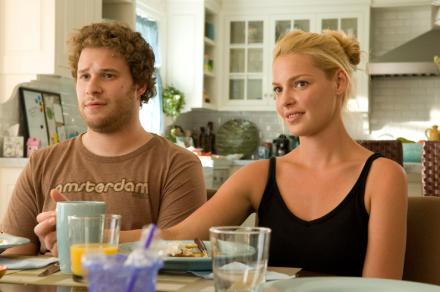
For your holiday family viewing pleasure, I recommend taking your siblings and parents to Margot at the Wedding. It is neither heartwarming nor life-affirming, but I will promise you this: no matter who you are or what your family is like, there is not a chance in hell that they are as screwed up as the family in Margot at the Wedding. Seriously, you could have a sibling who, I don’t know, tortures animals for a living or something, and if you took that sibling to see Margot at the Wedding, I guarantee you, after the movie you will turn to that sibling and hug him or her and say “Thank you for being such a wonderful sibling.”
(Margot at the Wedding is a great family movie in the same way Your Friends and Neighbors is a great date movie. Anyone in any stage of any relationship could go see Your Friends and Neighbors and walk out feeling like they were with the warmest, kindest, most understand person on Earth. You could be dating a serial killer, and go to see Your Friends and Neighbors, and want to cuddle up nice and snuggly next to them afterward.)
So, Margot at the Wedding is about a really, seriously crazy woman who shows up to ruin her sister’s wedding. And that sounds like a facile movie cliche, but let’s not forget, Margot at the Wedding is written and directed by Noah Baumbach, who wrote and directed the shining miracle The Squid and the Whale, one of the greatest movies of this young century. Margot, in some ways, is almost a sequel to Squid, it’s like we follow that neurotic teenage boy and his even-more-neurotic middle-aged mom on an adventure in the country.And it’s one thing to say “crazy woman at the wedding,” but nothing I could say could prepare you for how sharply, finely-drawn this character is in her craziness. I’m assuming that she’s based on Noah Baumbach’s mother, and I’m kind of sorry that he had to live through that, but I’m glad he did and I didn’t, and I’m extra-glad that he at least inherited her talent for turning family trauma into great writing (if you see the movie this will all make sense).
The acting is wonderful throughout, but I just want to say, that Nicole Kidman? Boy she sure can act.
On a completely unrelated topic, I also watched Knocked Up this evening. I had missed it in the theaters for reasons having nothing to do with its qualities, which are supreme and abundant. I laughed, I cried, I recognized humanity.
Nicest of all, I got to watch both of these movies, for free, in the comfort and privacy of my own home. Why? Because I’m a member of the WGA, that’s why, and the studios send me all kinds of stuff to watch in the hopes I’ll vote for them for a writing award. That’s right, the studios care that I might like the writing in their movies, so they send me free DVDs.
And that’s why the WGA has to win this strike, because if the studios breaks the union I won’t get any more free DVDs between Halloween and Christmas.

The Shining


If you, like me, are writing a haunted-house movie, it’s a worthwhile exercise to compare the structures of Stanley Kubrick’s hypnotic masterpiece The Shining with Steven Spielberg’s thrilling, personable Poltergeist. Both are movies about families trapped in haunted houses, but The Shining is grand, quiet, still and stately, while Poltergeist is small, noisy, casual and antic. The Shining is, unquestionably, the greater of the two, but I would argue that Poltergeist comes up with more ingenious solutions to the haunted-house-movie problem than The Shining does. Where Poltergeist can’t wait to throw all kinds of wild ghost stuff at you, The Shining hoards its secrets extremely carefully, keeping us waiting over an hour before the first ghost shows up, and two hours before we’re absolutely sure the ghosts are real.
(Much later, Spielberg tried, again, to make a definitive haunted-house movie, The Haunting, a movie that turned out so poorly he took his name off it.)
The plot of The Shining, for those recently born, goes like this: Jack, Wendy and little Danny move into a hotel that’s closing down for the winter. The hotel, we’re told, does not have a sterling history. Jack, a frustrated writer, starts to act testy with his family while Danny starts seeing ghosts. Then Jack starts seeing ghosts, only to him they’re not so scary. Wendy remains clueless pretty much throughout. The ghosts pressure Jack to murder his family and Jack finally gives in and tries to do so.
What does it do with a running time of 140 minutes?
The pace of The Shining fascinates me. It shouldn’t work — it’s too slow, plodding even, long takes of actors speaking exposition extremely slowly. A hotel manager explains how the hotel works, a cook talks about the hotel’s past, long lists of consumables are recited, unremarkable rooms are shown in solemn procession. None of it should work — we should lose patience quickly with what appears to be a pretentious, overly-serious genre exercise — but strangely, it does work, these scenes suck us in, convince us that something serious, something important, even cosmic is going on.
With no ghosts for an hour, how does the movie stay scary? Well, I’m going to come right out and say it cheats. It gives us Stephen King’s favorite crutch, the Psychic Kid, and teams him up with one of cinema’s hoariest conventions, the Magic Negro. These days, of course, psychic kids wander in and out of narratives with the regularity of Swiss manufacturing, but the idea of combining scary-movie concepts (Psychic Kid in Haunted House, Ghosts and The Devil, Vampires in Space) was still exciting back in the po-mo eighties. When it can’t wring scares from its Psychic Kid, it manufactures tension from music cues, camera movement and absurd, pointless title cards (I will never forget hearing audiences scream at the word “TUESDAY”).
For its third act, the ghosts remain firmly in the realm of the ambiguous — are they in Jack’s mind? Did Jack try to kill Danny? Is Jack crazy? Is Danny crazy? Will the Magic Negro help save the day? Only at the end of Act III, when the ghosts actually let Jack out of his prison to go kill his family, does the movie actually take a stand and say that there are actually ghosts in the hotel. Then the movie turns into a chase thriller for twenty minutes.
My viewing companion for this evening, who had not seen The Shining since its initial release, marveled at Shelley Duvall’s performance — not so much because it’s good, although it is, but the fact that it exists. Imagine The Shining made today with an actor as good as Jack Nicholson — Russell Crowe, say — and now imagine a director, any director, matching that actor with Shelley Duvall. Wouldn’t happen. It’d be Jennifer Connelly or Gretchen Mol.
The kid playing Danny is great. Nicholson’s performance I go back and forth on every time I watch the movie but the kid’s only gets better and better with every viewing. And then you watch the “making of” documentary and you see that Kubrick seems to have treated the kid absolutely no different from the other actors (“More scared!” “Now run! Faster!”) and you have to wonder what the kid thought he was doing, especially in the scene where he has to sit in Nicholson’s lap for the least encouraging father-and-son chat in movie history.
When I made the change from Movie Fan to Movie Maker, I watched all my favorite movies again and mercilessly analyzed them, killing all the magic they held for me but revealing all their secrets. When I sat down to trace the structure of The Shining, I found I had a hard time identifying the protagonist. Jack is certainly the main character, and almost an antihero, but he does not set the plot into motion and his actions, like the actions of most of the characters, are reactive. Danny is not the protagonist, or if he is he’s not a very active protagonist. “Staying Alive,” I’ve learned, is not an adequate motivation for a strong protagonist. Wendy, as I’ve noted, remains utterly clueless throughout the narrative — the movie has less than zero interest in what she wants out of any of this. Then I realized that the protagonist of the movie is the hotel. The hotel sets the plot into motion — it torments Danny, it seduces Jack, it drives them both crazy, and finally, when Jack proves incapable of doing his duty, it intervenes. The Shining is about how the hotel tries, and ultimately fails, to get Jack to kill his family. I was thinking about this tonight when the Woman In The Tub tries to strangle Danny. I thought — well, right there, we can see that the ghosts can manipulate things — if they want Danny dead, why don’t they just kill him? They could just pick up an axe and kill him themselves, why are they making Jack do it? And I realized, well, the point is not that Danny gets killed, the point is that Jack, who has “always been the caretaker,” fulfills his destiny, kills his family and himself, and returns to the hotel forever. In a way the hotel is simply asking its wayward son to come home. And that’s why the movie spends a half-hour showing us around the place, they want us to see the building as a character in and of itself, to get to know it, feel it embracing these characters, suffocating them, driving them crazy.
A QUESTION: Where does Halloran The Magic Negro go when the Overlook closes for the winter? He’s an 80-year-old man, but he lives in a garish bachelor pad with foxy naked-chick paintings on the wall, a wet bar, and hunting trophies. Whose place is this? Not his, certainly. Is he staying in his nephew’s place, that crazy kid who’s outdoorsy and likes his ladies retro and very naked? And what’s the deal with his briefcase? Why does Halloran have a briefcase? He’s a cook, what need does he have for a briefcase? It’s prominently displayed on his wet bar in his swanky pad in Miami, and then he even hauls it to Denver when he goes to rescue Danny. Why does he take his briefcase to Denver? Even if he had some “cook business” he could address in Colorado, the entire state is under ten feet of snow, nobody’s going to be doing business that week. What the hell?
FUN FACTS: Jack types his experimental novel on an Adler, one not dissimilar to this one. In the “making of” documentary that accompanies The Shining on DVD, we see that Kubrick also types on an Adler, although his is a sporty, yellow model more like this one.
The drink Grady The Waiter spills on Jack is Advocaat, a “rich, creamy liqueur made from eggs, sugar and brandy.” Rest assured, I have never seen Advocaat outside of The Shining.
Even though the Overlook Hotel is in Colorado, most of the folks in the hotel, both living and dead, including the bartender, the desk clerk, the waiters and many of the guests, are all English (as is Danny’s doctor in Boulder). To make things more mysterious, there is a bidet in the bathroom of Room 237, something I’ve seen in no bathroom in the US, much less Colorado. This strange disparity is left unexplained.
For those interested in staying in the Overlook Hotel, you’ll have to make two trips. The outside of the hotel is the Timberline Lodge on Mount Hood in Oregon, the interiors are in Yosemite’s Ahwahnee Hotel. Both hotels were built after the date of 1921 shown in the final image.
Post of self-interest

If you and your family are interested in seeing Enchanted over the Thanksgiving weekend, I will not try to discourage you. I’m interested in seeing it myself, since I worked on it for a year, and a lot of my material, as far as I can tell, is still in the movie (I receive no credit on the finished product). So if you see it, you will, in a way, be supporting my work, although probably not in any way that will actually benefit me.
I won’t kid you, it’s a very strange thing to work on a movie for so long, and have the completed movie contain a fair amount of my work, and not have my name on it, but that’s how it goes. Not so long ago, people tried to remove my name from a movie because they felt it didn’t belong there, and the rules of the WGA protected me. This time, they didn’t, but here we are. In any case, the movie is being well-reviewed and I wish the Disney people the best of luck with it.
Poltergeist


It’s hard to imagine, 25 years later, how fresh and peculiar Poltergeist felt in 1982. Before Poltergeist, haunted house movies usually went basically like this:
ACT I: Some people move into a haunted house. Maybe on a dare, maybe out of necessity, maybe in a spirit of inquiry. We are told the house is haunted and so we wait for something scary to happen. And the filmmakers drag out every trick they can think of to produce "fake scares," things that have nothing to do with actual paranormal activity.
ACT II: Scary things happen, but they are explained away by one thing or another. Factions are drawn among the members of the people in the house. One person sees ghosts, the others don’t. Maybe it’s all a trick being played by unscrupulous real-estate developers. Maybe it’s all in the mind of one of the people in the house.
ACT III: The people are now trapped in the house and cannot escape, and it is revealed that there are, indeed, ghosts. And many scary things happen as the people desperately try to figure out how to get out of the house. And someone, usually the last person you’d suspect, has the key to get out of the house, or the solution that will appease the ghosts. And maybe it turns out it’s actually unscrupulous real-estate developers after all.
Poltergeist does none of this. Spielberg has so much he wants to tell you about ghosts, you can feel the giddy excitement in the narrative as he unpacks every box of ghost research he’s got. In this way, Poltergeist is almost a sequel to Close Encounters — it’s not enough that Spielberg entertain you — he wants to make you a believer.
Coen Bros: Miller’s Crossing
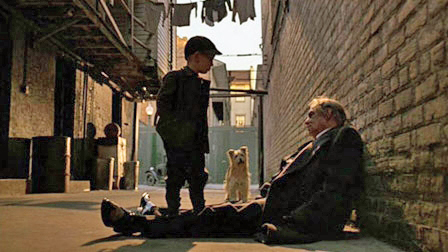
THE LITTLE GUY: For one of the few times in their movies, the Coens tell a story not about a poor man. Tom Reagan is the right-hand man (I think) of Leo, the Irish mob boss who controls whatever vaguely-east-coast city this story takes place in. So although he is not the top dog, he’s close enough to the top to make a difference in his world.
Obviously, Tom’s got secrets. He gets through life alive by not telling people what he’s thinking. His silence gives him the illusion of wisdom (an illusion Eddie the Dane sees through). The Coens need Tom to keep his secrets, even from the audience. So we watch Tom’s actions, but often their meanings are withheld from us. This withholding is, in my opinion, the root of the movie’s coldness, the reason people love The Godfather but scratch their heads in puzzlement over Miller’s Crossing. We know exactly what Michael Corleone wants, and it breaks our hearts to see him corrupted and lost. We have no idea what Tom Reagan really wants, and it keeps us outside the movie.
(The Coens’ coldness is, I think, the think that keeps me linking their careers with that of Kubrick. Absent a warm central figure to identify with, Kubrick’s movies become about systems and conditions instead of about individuals. Likewise, the Coens’ movies often are about communities and moments in time, and how individuals cannot hope to assert themselves against larger societal realities. And, with God’s help, that last sentence will be the most pretentious thing you’ll read in my analysis of the Coens’ movies.)
Tom’s problem is Verna’s brother Bernie. Bernie is causing trouble for everyone, he’s broken the rules, and he needs to be dead. Tom wants Bernie dead and Caspar wants Bernie dead. Leo doesn’t care one way or the other about Bernie but he’s keeping Bernie alive because that’s what Verna wants. So Tom wants Bernie dead, but he can’t kill Bernie himself because then he would lose Verna. So instead of killing Bernie himself he orchestrates Bernie’s capture and murder by Caspar’s men — or so he thinks, anyway.
So Tom is no saint. In a way, he’s worse than Caspar — he’ll woo Verna while plotting to murder her brother, all the while getting other people to do his dirty work for him, while getting Caspar to murder his closest allies and setting up Bernie to murder Caspar.
TOM’S HEART AND HAT: Then there’s the Bernie question. As Bernie logically points out, once Caspar and Eddie and Mink are all dead, there’s no longer any reason to kill Bernie. Then why does Tom do so? Bernie says “Look into your heart” and Tom replies “What heart?” as he puts a bullet through Bernie’s head. Verna doubts the existence of Tom’s heart as well — and maybe that’s what the movie’s about, the gradual death of Tom’s soul. Engineering Leo’s return to the throne seems to have killed something inside of Tom and he can’t live in this world any more.
The movie famously begins with a shot of Tom’s hat blowing through the woods, and so we keep careful track of Tom’s hat’s movements throughout the movie. The hat seems to be some sort of symbol of control for Tom — he’s terribly anxious without it, and every time he loses it, or even takes it off his head, it’s an indicator that he’s lost some measure of control in that scene. So when he says goodbye to Leo in the forest at the end of the movie, he takes a moment to affix his hat before looking dolefully after Leo (who is, at that moment, removing his yarmulke and putting back on his Homburg). Tom’s heart may be dead but his hat is firmly in place. Maybe the movie is really only that, a drama about the battle for control between Tom’s heart and hat.
NOW THEN: I have read analysis saying that Tom Reagan is gay, that Tom only seems to be interested in having sex with Verna, but in fact he’s really interested in having sex with Leo. He can’t have sex with Leo, so instead he has sex with Verna, Leo’s moll, in order to be closer to Leo. I don’t see a great deal of evidence to support this theory, but I will say this:
1. There are an abnormally large number of gay gangsters already outed in Miller’s Crossing. Eddie the Dane, Bernie Bernbaum and Mink Larouie are all out, and even married-with-children Johnny Caspar hints at dalliances with men in the past (it’s hard to tell sometimes in the world of Miller’s Crossing if, when someone says something about their relationship with another man, whether they talking about a friend, a lover or a business associate — the terms are often transposed and interchangeable, which makes the sexual waters of Miller’s Crossing that much more muddy). If three of the ten main characters of this gangster movie are openly gay, who’s to say that they aren’t all gay on some level? Tom and Leo certainly trade a number of meaningful looks full of big eyes and pregnant pauses — are they discussing business or dancing around the love that dare not speak its name?
2. It appears that Tom goes to extraordinarily great lengths to restore order to the universe of Miller’s Crossing — he finally kills Bernie Bernbaum (even though he doesn’t have to), gets Johnny Caspar and Eddie the Dane out of the way and single-handedly ends the gang war. Then he goes trotting over to Bernie’s funeral and is surprised to learn that Verna and Leo are going to get married — even though Verna no longer needs Leo to protect Bernie. This news, apparently, changes everything for Tom. When Leo tells him he’s marrying Verna, Tom tells Leo that they’re quits, even though Tom has moved heaven and earth to restore Leo to his throne. Is he that upset about not getting Verna, or is he upset about not getting Leo?
IS THERE A GOD?
![[info]](http://stat.livejournal.com/img/userinfo.gif)



points out in my Raising Arizona post that the Nathan Arizona Jr. is not merely a baby born to the only Jew in the movie, but also his father is a Jew who sells wooden furniture. Jesus is mentioned a number of times in Miller’s Crossing, mainly by people staring at Gabriel (!) Byrne, looking hurt and saying “Jesus, Tom.” Is Tom meant to be a Christ figure? Does he do all he does as a sacrifice to amend for his world’s sins? Is that why he turns his back on his world?
There’s also a good deal of talk in Miller’s Crossing about the nature of civilization. The gangsters constantly worry about civilization — that is, organized crime — falling apart and mere anarchy reigning in the city. (Interestingly, the gangsters all operate casinos — games of chance — while reserving their highest anxieties for the notion of chaos; that’s why all the games are fixed.) “I can’t die out here in the woods, like a dumb animal!” is part of Bernie’s extensive plea to Tom, and Caspar’s opening monologue about “etics” warns against a return to the jungle. That’s why the Hades of Miller’s Crossing is the woods — that’s what the gangsters fear the most. Not the death, necessarily, but the woods — brute animal nature. (Is this why Caspar always tells his men to “put one in the brain,” to show how the gangster’s desire for orderly civilization is constantly doing battle with his need to destroy that civilization?)
(The trees are important in Miller’s Crossing — almost as important as Tom’s hat. Even when the gangsters are not literally out in the woods, there are always pillars or balusters or some kind of strong vertical lines to indicate a metaphorical woods. And when Johnny Caspar is killed in Tom’s stairwell, we hear the same creaking-trees sound effect that we hear out in the woods.)
CRIME AND PUNISHMENT: The law enforcement agencies of Miller’s Crossing are bought and paid-for accessories — probably the bleakest view of the police in the Coen world.
THE MELTING POT: The world of Miller’s Crossing is, I’m willing to bet, the most ethnically diverse in the Coen universe. The main factions are Irish and Italian, but Eddie the Dane is, obviously, Danish (the part was originally written for Peter Stormare and called Eddie the Swede, fyi), Bernie and Verna are Jewish, as is, I’d bet, Tom’s shylock Lazar. Idiotic boxer Drop Johnson is most likely Scandinavian. I’m not sure what kind of name Mink Larouie is, it sounds like a corruption of LeRoi, which would make him French, but Steve Buscemi sounds very much like a guy from Jersey. The bartender at the Shenandoah Club sounds Scandinavian too, but I couldn’t place his accent — is he German, or even Jewish (he is close, after all, with all the Jewish bookies)? Then there is Tom’s downstairs neighbor at the Barton Arms, who seems to be German. Where, however, are the African-Americans who are playing all the jazz music? Are there none in this anonymous east-coast American city?
Is there a political allegory at work in Miller’s Crossing? The protagonist is, after all, named Reagan. Is this a movie about the US’s place in the world? If so, how to read the plot? Is this a movie about how difficult it is to be a leader in this dangerous world where protecting a Jew starts an all-out war that leads to untold deaths and non-stop political upheaval? If so, why would the Coens be making that movie?
MUSIC: Once again, there are two dominant musical worlds presented, with a third musical world representing the “outside.” Here, it’s Irish Traditional vs. Italian Opera, with Jazz Standards being the music of that symbolizes the world of people who aren’t part of the story.
Write your own ironic headline
“President Bush looked at Gen. Pervez Musharraf and saw a democratic reformer when he should have seen a dictator instead, critics say.”
Gosh, I wonder how that happened.
Daily Show writers on the WGA strike
A teeny bit more about The Lady Eve


Where does hyper-literate punker Elvis Costello get his vicious, intricate hyper-literacy? Why, from Preston Sturges, of course. There is a line from his 1981 song “White Knuckles” (from the album Trust) that had always baffled me, and, before Al Gore invented the internet, it was impossible to verify just what the hell he was singing, what with his strangled delivery and the clattering racket behind him. The song is about (what else) a couple with marital problems and for years I could have sworn there was a line in the bridge that went “She needs a lock, the ass needs a turn-key,” which seemed to make enough sense, even though it seemed like kind of a lame line from such a, you know, hyper-literate lyricist.
So, as The Lady Eve unspooled last night, imagine my surprise when, out of nowhere, the great Barbara Stanwyck suddenly announces, regarding Henry Fonda, “I need him like the axe needs the turkey,” which Costello adapted (slightly) to “He needs her like the axe needs a turkey.” And yet another mystery of my youth was solved.
Is this a common phrase that Costello picked up, or was he inspired to thieve from Sturges? A cursory Google search could unearth no other occurrence of the phrase, and I can imagine the young Costello at a revival house somewhere in London, or camped out in front of the telly, watching The Lady Eve with a pen and paper in his lap, furiously scribbling down the dense wit that flies thick and fast in Sturges’s masterpiece.
Movie Night With Urbaniak: The Lady Eve
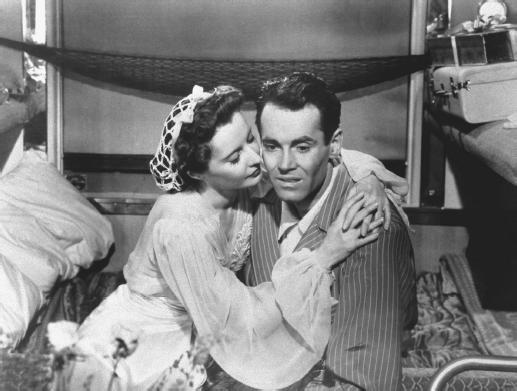
I will have much more to say about this landmark comedy from 1941 in connection with my forthcoming analysis of The Hudsucker Proxy, which lifts a number of scenes from it.
For now though, let me just say this: I have often lamented that our generation doesn’t quite have a Myrna Loy, but my God, we don’t have anything within miles of a Barbara Stanwyck. An actress who can play an “experienced,” conniving, manipulative grifter, give a complex, multi-layered performance, and be hysterically funny, and make us like her, and make our hearts break for her?
Of course, to discover an actress such as this, two things would need to happen: we writers would have to write a part as good as the one Stanwyck plays in The Lady Eve, and then a Hollywood studio would have to produce that script. I can see the first happening, but the second? That would involve a movie with a female protagonist, and everyone knows those don’t make money.