R.I.P. Roy Scheider

I am greatly saddened by the news of the passing of Roy Scheider.
I was about to say that the first time I saw Mr. Scheider was in the police thriller The Seven-Ups, but that’s not quite true. I first saw Roy Scheider in the Mad magazine parody of The French Connection, which was entitled What’s The Connection?
In any case, by the time Jaws came out in 1975 I was looking forward to it almost as much as a Roy Scheider vehicle as a Steven Spielberg movie. I enjoyed his work in Marathon Man, Sorcerer, Still of the Night, Blue Thunder, Naked Lunch, The Punisher and especially, of course, All That Jazz.
Few people probably know about his work as the voice of Japanese author Yukio Mishima in Paul Schrader’s Mishima: A Life in Four Chapters. That movie blew me away — I was working at a theater it was playing at when it was released and would watch it several times a day for weeks. When the DVD was released, I was shocked and dismayed to find that Scheider’s precise, measured readings of Mishima’s texts were gone, replaced with voiceovers by Paul Schrader. They’re not the same, and to me the movie is greatly diminished because of the change. I’ve never figured out why that change was made (I have read somewhere that there was a rights issue with the translations used), but it is definitely a loss.
The Whale part 1

from Moby-Dick by Herman Melville
ONE
(Ahab’s cabin, night. There is a scream, off. Starbuck, Stubb and Flask carry in a thrashing Ahab, who has just been fished out of the ocean. He lacks a leg. They put him into his bed.)
AHAB. Aaaagh! Aaaagh!
STARBUCK. It’s all right, Captain. You’re all right.
AHAB. Is he dead? Did I kill him?
STARBUCK. He got away, captain.
AHAB. Got away? Got away?
STUBB. He’s a big fish, sir, he –
AHAB. We have to go after him! Set sails!
FLASK. We’re not going anywhere tonight, sir –
STARBUCK. Just lie down, captain.
AHAB. He, he smashed by boat! Is my harpooneer –
STUBB. He’s fine.
STARBUCK. Just lie down, sir –
AHAB. Did you see him? Did you – tell me you saw him!
FLASK. We saw him.
STARBUCK. We’ll go after him tomorrow.
AHAB. He, he, he thought he had me. But he didn’t. He thought he did but he didn’t.
STARBUCK. No sir.
AHAB. Bastard thought he had me. But not Ahab. He didn’t have Ahab. No.
STUBB. No sir.
AHAB. There isn’t a whale alive who can get Ahab. No one – AAGHH! WHERE’S MY LEG?! WHAT HAPPENED TO MY LEG?! MR. STARBUCK? WHAT HAPPENED TO MY LEG?!! AAAAGH!
(Blackout.)
TWO
(Ishmael addresses the audience.)
ISHMAEL. So I thought I’d go to sea. There’s nothing “weird” about that, nothing “strange”, nothing “peculiar” about that. People go to sea. Men are drawn to the sea. The sea, water –
New York City, lunch hour. What happens? Battery Park, people go and stand by the water. Look at a map: where do they put the cities? By the water. Guy paints a picture, nice bucolic landscape, what’s in the middle of the picture? A lake. A stream. A pond. Why not?
So I thought I’d go to sea. Big deal. It was either that or kill myself. Or kill somebody else.
But that’s not the thing. The thing, the thing is, I am crazy about whales. I am nuts, I am gaga, I am absolutely round the bend about whales. Can’t get enough of them whales. Stories, pictures, books, scrimshaw, if it’s whales I like it.
So perfect: I go to Nantucket to get myself booked on a whaling boat. Me and my new best friend Queequeg – he’s from the South Pacific (it’s a long story) – we decide on this ship the Pequod.
(Lights up on the Pequod. The deck bustles with activity.)
It’s an amazing ship. Not the biggest, not the nicest, not the fastest, but definitely the coolest. Everything on the ship is made of whale-bone! The pins are teeth, hammered into boards of bone. The tiller is a jawbone. It’s a death ship. The thing is a death ship, a cannibal ship, it’s a monster, it’s a flesh-eating zombie ship. It’s a death-ship, and that’s the kind of ship I want to be on.
THREE
(A cabin on the Pequod. Peleg at a desk. Bildad reads the bible.)
ISHMAEL. Are you the captain?
PELEG. What if I was?
ISMAEL. I want to join on.
PELEG. You’re not from Nantucket.
ISMAEL. No.
PELEG. You know whaling?
ISMAEL. No sir. But I’m a quick study. I was in the merchant marines…
PELEG. Merchant marines my ass. Talk to me about the merchant marines, I’ll rip off your leg, I promise. What are you, a pirate? A wanted man? You robbed your last captain? You get to sea, you murder your officers?
ISHMAEL. No sir. No.
PELEG. Then why whaling?
ISHMAEL. I – I don’t – I like – I want to see whales. I want to see whaling.
PELEG. You want to see whaling. Have you seen Ahab?
ISHMAEL. Who?
PELEG. Ahab.
ISMAEL. Who is that?
PELEG. Christ. – Ahab is the captain of the Pequod.
ISHMAEL. I – I’m sorry. I thought you were.
PELEG. Christ no. I’m Peleg – this is Bildad. We own the ship. And before you get all hopped up about
“whaling”, I suggest you take a look at Ahab.
ISHMAEL. W-why is that, sir?
PELEG. You’ll know when you look at him.
ISHMAEL. I-I see sir.
PELEG. He’s got one leg, how’s that?
ISHMAEL. Oh. Really. What happened to the, the – what happened to him?
PELEG. Why don’t you take a guess.
ISHMAEL. Um…a whale? Um, took it?
(Pause.)
PELEG. Ate it. A whale ate it.
ISHMAEL. Yes. Well. Accidents happen, sir.
PELEG. It wasn’t an accident.
ISHMAEL. Excuse me?
PELEG. It wasn’t an accident.
ISHMAEL. Uh, right.
PELEG. You’ve never been to sea –
ISHMAEL. Yes sir I have. Four trips in the merch –
PELEG. Fuck the merchant marines! You want to go whaling?
ISHMAEL. Yes sir!
PELEG. You’re ready to pitch a harpoon down a whale’s throat and jump in after?
ISHMAEL. If it comes to that, yes. Although I’d rather not waste the harpoon.
PELEG. Good answer. Bildad!
(Bildad grunts.)
You readin’ that damn book again? You been readin’ scripture for thirty years now, how far ya got?
(Bildad looks up from the book.)
Guy here says he’s our man.
BILDAD. Yes?
PELEG. Says he’s the one we want. What do you think?
(Pause.)
BILDAD. He’ll do.
(He goes back to reading, murmuring with the text.)
PELEG. Well then that’s that. Sign here. Now: your wage. Bildad?
(Bildad grunts.)
His lay.
BILDAD.(not looking up) One seven hundred seventy-seventh. “Where moth and rust do corrupt, but lay…”
PELEG. For Christ’s sake, Bildad! You want to swindle him?
BILDAD. One seven hundred seventy-seventh. “For where your treasure is, there will your heart be also…”
PELEG.(sighs) He’s ridiculous. I’ll put you down for three hundred. (to Bildad) Three hundred.
(Bildad looks up. Pause.)
BILDAD. Well aren’t you a kindly old fool. And whose money is that you’re so generously giving away? Yours? Mine? No. It belongs to the widows and orphans who have shares in this ship. Your act of benevolence toward this boy you’ve never seen before in your life takes
bread out of their mouths.
PELEG. God damn it Bildad! If I did everything you told me to, I’d have a conscience heavy enough to sink a ship!
BILDAD. Mr. Peleg, the weight of your conscience is not my concern. I suspect, however, from your lack of penitence, that it is heavy enough to drag you down to the fiery pit.
PELEG. Fiery pit! Fiery pit! So I’m going to Hell. Is that it? Go on, say it again. Say it again, I’ll swallow a live goat with his hair and horns on! God damn you! God damn you! (Pause. To Ishmael –) Well. That’s over. I’ll put you down for three hundred.
ISHMAEL. Thank you sir. Could I – do you think maybe I could see Captain Ahab?
PELEG. Why? You’ve already signed on –
ISHMAEL. I know. I just want to – you mentioned –
PELEG. You want to see Ahab?
ISHMAEL. Yes.
PELEG. Well you can’t.
ISHMAEL. Oh.
PELEG. He’s sick.
ISHMAEL. What’s the matter with him?
PELEG. I don’t know. He won’t come out.
ISHMAEL. If he’s sick –
PELEG. He’s not sick –
ISHMAEL. No?
PELEG. No. But he’s not well. He won’t see me, he sure won’t see you. He’s a – he’s a strange man. Don’t get me wrong, he’s a great guy. A great, God-fearing, Godless, Godly son-of-a-bitch. Doesn’t talk much. But when he talks, you listen. He’s done it all, knows colleges and cannibals. He knows things deeper than the ocean. And his lance is the sharpest on the island. He’s not a Peleg and he’s not a Bildad. He’s Ahab. Another Ahab was king, you know.
ISHMAEL. Uh, yes. A, a very bad king, if I remember correctly.
PELEG. Yes. Well.
ISHMAEL. I mean, a really bad king.
PELEG. Come here, boy. Here. Listen: Ahab did not name himself. His mother named him. And she was crazy, died a year after he was born. And maybe that means something and maybe it doesn’t. But I’m telling you Ahab is a good man. Okay: last trip, he went a little crazy; so what? He’d lost his leg, you know? So he’s a little moody. A lot moody. All right, he’s a savage. But I’d rather sail with a moody captain than a laughing one. Besides, he has a wife! Beautiful, and a son, a little boy. So how bad could he be?
(Blackout.)


There Will Be Blood part 2

![[info]](http://stat.livejournal.com/img/userinfo.gif)
has taken a firm stand — Daniel Plainview’s primary motivation, he feels, is greed. There is no doubt that DP is a greedy man — not to mention a pathological liar and a homicidal maniac — but I think he’s more complicated than that, as I will hope to demonstrate as I move forward in my analysis. Yesterday I got as far as the end of Act I, and today I’ll be moving on from there.
The act begins. DP and HW travel to the Sunday ranch, pretending to be campers hunting for quail (DP’s lies are not restricted to his words — he’s also fully capable of lying with actions). He meets Paul Sunday’s identical twin Eli, and here’s where DP’s Gap presents itself. Everything in the movie up to this point has gone pretty much as DP expected it would, a couple of accidents and an impromptu adoption aside (more on that adoption later). DP is caught short by the appearance of Eli, who he first suspects is actually Paul pretending to be someone else.
DP and HW discover oil on the Sunday ranch. They sit on a hillside at sunset and DP tells HW his plans. In a Disney movie, this would be the place for the “I Want” song — “Just Around the Riverbend” or “I Just Can’t Wait to Be King.” DP has a vision of his future, involving digging for oil in Little Boston and piping it to the coast, thus avoiding the railroad’s shipping costs.
So here we have another motivation, not just greed but a need to “prove” something to somebody. It seems endemic to American businessmen, and maybe all pioneers, to not just “succeed” but to prove that they are smarter, wilier and more forward-thinking than those in power. For DP, it’s nice that he’ll save some money by not using the railroads but it seems more important to him to show Standard Oil and the railroads that he’s smarter than them.
And so this circles back to DP’s being alone at the beginning of the movie. He, and he alone, dug the hole that found the silver that made him the money to hire the crew to dig for oil — he’s done it all through hard work and sacrifice (some of it even his own) and he’ll be damned if he’ll let a bunch of three-piece-suited businessmen come along and profit from his hard work (of course, he sees nothing wrong with dramatically underselling the local residents so he can do all this on their land).
DP offers to buy the Sunday ranch, telling the father that he needs a place with dry weather for HW’s health. We’ve now heard three sales pitches from DP, each one tailored to the prejudices of the mark. DP is, essentially, a con man with a talent for digging.
The father is on the hook, but Eli steps in, and here DP’s Gap bursts wide open. Eli, it turns out, thinks of himself as a preacher, divinely chosen to lead people. As much as DP was caught short by Paul Sunday having a brother, he’s struck dumb when Eli announces that he has a church. When he has gathered his wits, he looks Eli in the eye and says “That’s good. That’s a good one.” What he means, of course, is that he recognizes Eli as a fellow con man, who has a good con to play.
In any case, soon DP has bought almost the entire town and “shown” the big oil suits how smart he is. He meets a colleague at the train station and advises him to “look east” for more oil. He says he’d rather his friend drill there than those guys from Standard Oil he hates, but I’m not so sure. We haven’t seen the friend before, and given the way DP treats his competition (with one curious exception, as we shall see) I’d be willing to bet that DP is sending his colleague on a wild goose chase just for laughs.
In his most focused speech yet, DP tells the townsfolk of Little Boston that he and his business are going to transform the town. He’s going to provide roads, employment, agriculture, schools, even bread. DP presents himself, in fact, as a kind of father figure — “Don’t worry about anything, folks, I’m going to take care of everything.” He presents his sales pitch not as “I will take all your valuable resources,” but as “I will give you everything you need.” As the movie goes on, we see that none of his promises are kept in any perceivable way. The town becomes busier, true, but it’s just full of dust and workers and smoke — we never see a school built, a local employed or a farmer’s field bloom.
Eli, of course, sees a missing piece in DP’s plan — he sees that DP’s industry will bring money into the town, which will create sin — drinking and whoring — and thus create a spiritual void. He, essentially, horns in on DP’s con, blows DP’s angle, hoping to make his own fortune from the profitable blight that DP brings with him. DP makes gestures toward providing a spiritual cushion — he promises to build a road to Eli’s church and even says a prayer at the opening of the new well, but they’re only gestures — he not only has no spiritual core, he’s making the gesture to steal Eli’s thunder, lessen his impact on the community, essentially treating Eli as another competitor for the town’s attentions.
In any case, the well is dug and the derrick is put into operation. To sum up the plot for the act:
DP, acting on a tip from Paul Sunday, comes to Little Boston, tries to con the Sunday family out of their ranch but is thrown off by Eli, who sees exactly who DP is and is running his own con. DP promises to buy Eli off, buys the ranch, buys most of the rest of the town, convinces the townsfolk that he’s their new daddy and they’re all going to be a big happy family, and sets about building his first derrick (to seal the deal, he names it after Eli’s sister Mary).
Toward the end of the act HW informs DP, apropos of nothing, that Mary Sunday is beaten by her father. After the derrick opens, there is a celebration and DP hugs Mary to him and tells her, in full view of the father, that there will be “no more hitting.” He repeats this a few times, which makes me think that DP was abused as a child. Given that he’s a cold-blooded sociopath, it’s not surprising, but DP has a peculiar relationship with children all through the movie. To all appearances, he seems to have genuine affection for HW, his adopted son (although he denies it later). He confides in HW and tries to teach him the tricks of the trade, and tomorrow I’ll talk about where I think his affection for HW comes from.
DP pledging “No more hitting” to Mary Sunday, of course, will come to have terrible repercussions later, but I’ll get to that in time.
There Will Be Blood part 1

Faithful reader Kent M. Beeson has asked my advice on how to present a character’s motivation in a screenplay. This is a tricky situation — the best thing to do is not present motivation but rather action, and let the audience wonder about motivation. But motivation does lie close to the heart of the question, the question being, of course, What Does The Protagonist Want?
As Mr. Beeson was composing his question, I, coincidentally, was re-watching There Will Be Blood, in anticipation of a blistering attack from longtime friend and PT Anderson-hater
. Blood presents us with a protagonist who plays his cards very close to his vest — perhaps so close that not even he knows exactly what he’s holding.
Daniel Plainview is not an easy character to figure out. He devotes a fair measure of his energy to concealing his motivations from other people and those people, it follows, includes us. We could say with some certainty that, to an extent, Plainview’s motivations are a mystery even to himself. To suss out the motivations for his actions, we have to add up the clues in his actions and see what we get. As this fine motion picture is still in theaters, I urge my readers to go see it before reading the following.
First of all, let’s see if we can divide Blood up into coherent act breaks. I count six, and they go like this:
ACT ONE: “Plainview makes a name for himself as an oil man.” We see him dig for silver, find silver, dig for oil, strike oil, then set up his oil business. At the end of this act, Paul Sunday shows up in his office and presents to him the discovery that will ultimately make Plainview his fortune.
ACT TWO: “Plainview sets up operations in Little Boston.” We see him travel to this godforsaken town in the middle of nowhere, con some simple folk out of their land, deal with Paul’s brother Eli and his burgeoning church and get his first well underway.
ACT THREE: “Plainview loses his son.” We see Plainview’s well gush, which brings him great wealth but makes his adopted son deaf.
ACT FOUR: “Plainview replaces his son with his brother.” Henry Plainview arrives in Little Boston, claiming to be Plainview’s brother. Plainview takes Henry into his confidence and sends his son HW off to a special school in San Francisco. Plainview is approached by Standard Oil for his land, but he has plans of his own. He and Henry plot out a pipeline, walking 100 miles to the sea, to sell their oil to Union Oil. While at the beach, Plainview realizes that Henry is not his brother but an impostor. He kills him and buries the body.
ACT FIVE: “Plainview gets his son back.” Daniel, having learned his lesson, completed his work and made his fortune, fetches HW back. Eli uses his influence to pressure Daniel into a situation where he (Eli) is able to humiliate Daniel in public. HW grows up and marries Mary Sunday, Eli’s sister.
ACT SIX: “Plainview has the last laugh.” It is some time later. We see Plainview, wealthier and older, disown HW for undergoing what he considers a competitive business venture. Eli, who has beenlaid low by the intervening years. comes to Daniel for a favor. Daniel drinks his milkshake and bludgeons him to death with a bowling pin.
(These last two acts are rather brief, only twenty minutes apiece. This would, ordinarily, suggest that they are, in fact, one act, except that a good deal of time passes between Act V and Act VI, and Act VI is too long, and too explosively climactic, to be considered an epilogue.)
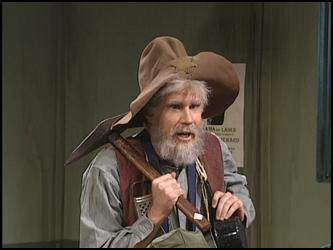
ACT ONE: It is 1898. Daniel Plainview (DP), a grizzled prospector (looking not unlike this guy), digs a hole, alone, in the middle of nowhere, in the desert. In a movie rife with Kubrick references, DP, covered with hair and dirt and swinging his pick, looks like 2001‘s Moon-Watcher with his bone.
Why is he alone? Wouldn’t the job of digging a deep, deep hole in the middle of nowhere be easier, not to mention safer, with a crew or at least a partner? And yet DP goes it alone. Perhaps he’s seen Treasure of the Sierra Madre and knows better than to tell anyone where he’s digging, or it could simply be that he, like Garbo, prefers to be that way. And indeed, we will learn later that DP doesn’t particularly care for people. It is not a “good” or “bad” quality — it is just, we would say, Who He Is.
We could say that this DP is pure DP. Miles away from anyone, his life is not a performance. His actions are simple and direct and uninflected. He’s not asking to be loved or trying to prove his superiority. He’s digging a hole and climbing a ladder and hauling a winch and blowing up some dynamite. PT Anderson, like Kubrick, is interested in examining systems: this is how an atom bomb gets delivered to its target, this is how a group of teenage boys are turned into killing machines, this is how a shuttle docks with an orbiting space station, this is how one gets precious materials out of the ground. We could say that this first part of the movie shows DP in his element. We could say that this is when he is happiest, alone and accountable to no one and on no one’s schedule.
(Speaking of elements, three of the four classical elements get real metaphorical workouts in this movie — Earth, Water and Fire all make dramatic appearances. And I suppose Air gets blown around too, whenever one of the principles needs to sell something to somebody.)
DP finds silver in the hole he’s digging, which gets him enough money to get started in what will be his life’s work, digging for oil. We see him next with a small crew of men, digging another hole in another middle of nowhere. They strike oil — whether through intent or by accident isn’t clear to me. One of the men has a baby boy, HW, who is baptized with the newly found crude.
(This is the first we see of oil-drilling as a kind of belief system, which will become important later.)
A few scenes later, HW’s father is killed in an accident. This is the second accident in the movie — DP broke his leg in the first hole, now HW loses his father in the second hole. To quiet the sobbing infant HW, DP feeds him whiskey. The significance of this becomes important later (and has nothing to do with milkshakes). Oil struck in this hole, DP moves on with HW to greener pastures.
We see DP with HW on a train. HW, though an infant, seems to like DP and DP seems to like HW. So it seems that DP is not a wholly antisocial creature; given the opportunity, he will be nice to a defenseless infant.
Fourteen minutes into the movie, we get our first dialogue. It is 1908 and DP is seen trying to sell his drilling operation, which as grown considerably, to a group of townspeople. The tools of his speech to the townspeople are crucial. He uses words like “family” and “community” and “trust” and “friendship” when what he’s really talking about is stealing these people’s land so he can turn it into an oilfield and make a ton of money. So while DP may prefer to be alone, he apparently has learned somewhere how to work a crowd. Public speaking, the most common of fears, does not seem to slow down DP. When the town meeting breaks down into argumentative shouting, DP gets up and walks out. “Too much confusion,” he says, limping out to his car.
The next thing we see is DP in the kitchen of a middle-aged couple, negotiating to buy their land. He lies to them about HW’s parentage and his status as a family man. This scene, up against the previous one, confused me until I read the screenplay (which can be found here), which indicates that DP, through buying the middle-aged couple’s land, is getting the same oil he would have been getting by leasing the land of the argumentative townspeople of the previous scene. He doesn’t explain it there, but the issue is “drainage,” the same concept he ends up explaining with the “milkshake” metaphor in Act VI. He could, apparently, lease the whole town, which would benefit everyone but involve dealing with a large group of people, or he could lease the land of just the middle-aged couple, get all the same oil eventually, and not have to talk to anyone.
Through this first part of the movie we see that yes, DP is a greedy capitalist, but he is also not afraid of hard work, risking his life and limb, or getting his hands dirty to achieve wealth. He’s even willing, up to a point, to be fair to people — unless there are too many of them with too many agendas, in which case he’d rather just withdraw and make a deal that screws everyone. That is, he’s greedy but his greed is secondary to, I think, his prime motivation — his dislike of people.
In any case, DP gets his well in Signal Hill and takes over the house of the middle-aged couple he was dealing with (this is another tidbit I got from the screenplay. DP transforms the Signal Hill house with so much construction as to make it unrecognizable). It is his success in Signal Hill that brings Paul Sunday to his office. Paul Sunday, a poor but apparently wily young man piques DP’s interest in a tract of land near a town called Little Boston, which brings us to the end of Act I.
So, in plot terms, what we have so far is: DP, alone, digs for silver, which leads to DP making a small fortune, which leads to DP and a crew of men, including the infant HW, digging for oil, which leads to the death of HW’s father, which leads to DP’s adoption of HW. The success of the well that killed HW’s father leads to DP’s business expanding to include, among other sites, a successful well in Signal Hill, which leads to Paul Sunday seeking DP out to offer him his family’s ranch as a potential drilling site. This series of events all lead to DP heading out to Little Boston and the Sunday Ranch, which is where Act II begins.
And this has gone on long enough for one day, I will pick it up anon.
iTunes catch of the day: Cassandra’s Dream and “The River in Reverse”


Few have ventured to see the new Woody Allen movie, so most are unaware that Allen has, for one of the few times in his career, commissioned a score for his soundtrack, from an actual living composer, Philip Glass, no less. And what a corker! I buy all of Glass’s soundtracks whether I’ve seen the movies they’re in or not, and this one has quickly vaulted to the top of my list of favorites. Stormy, melancholy, brooding and propulsive. If you like Glass or have an abiding interest in soundtrack music, this is a real treat. Can’t say I like the cover. You can listen to little bits of it either at iTunes or Amazon.
Meanwhile, Elvis Costello has knocked off a handful of his songs in solo settings for the iTunes market. I enjoy all of these renditions, they are some of my favorites of his songs, but the new recording of “The River in Reverse” is just stunning. I enjoyed the album of the same title when it came out, but to hear Costello snarl his way through this searing, scathing reading is a remarkable experience, even coming from this longtime snarler. His insistent, plangent solo guitar sets lyrics like “In the name of the father and the son/in the name of gasoline and a gun” in bold relief and elevates this song to a classic to stand with “Pills and Soap” in its withering social criticism.
Today is Super Tuesday
Which means that if you, like me, are a citizen of the United States, there’s a good chance that you live in a state with a presidential primary. If you, like me, are a patriot, I urge you to perform your civic duty and vote. If you, like me, are a registered Democrat, I urge you to vote for Barack Obama.
I don’t spend a lot of time thinking about the campaign. I don’t listen to the speeches, I don’t watch the debates. I know from long experience that a candidate will say and do whatever it takes to be elected and that the various media outlets will spin all that to their own ends. I know it’s all a big circus, so I don’t pay it that much attention.
I’m voting for Obama tomorrow because, of everyone who has stepped forward to claim their place in the spotlight, he’s the only one who doesn’t make me sick to my stomach when I look at him.
McCain and Romney have given the United States their solemn oath to continue down the disastrous trail that George W. Bush forged, and Clinton, although more in my ideological arena, has run a brutal, vicious campaign that, to my mind, has shown her to be an oily, cynical political animal, willing to stoop to whatever level necessary to gain power. I think we’ve had enough of that.
Finally, if you, like me, can occasionally be influenced by a cheesy, sentimental music video, I urge you to watch this:
How good is No Country For Old Men?
It’s now apparently winning golfing trophies, that’s how good.
Screenwriting 101: The Gap


One of my favorite terms that I got from reading Robert McKee’s Story is The Gap.
The Gap is simply the distance between what the protagonist thinks is going to happen and what actually happens. The wider The Gap is, the more interesting your story will be.
Example: you’re at the water cooler, and a fellow employee says “Let me tell you about my morning.” He goes on to tell you about how he ate some toast, watched Good Morning America, got dressed, checked his email and then went out to get the bus. This is a protagonist with no Gap at all, and thus his story isn’t very interesting.
(On the other hand, if you are the protagonist in this story, your Gap is a teeny bit wider because what you expect to happen is that your co-worker will tell you a worthwhile story and what actually happens is he’s a crashing bore.)
If your co-worker says that he bit into his toast and discovered there was a dead mouse baked into the bread, his Gap just got appreciably wider. If he says that he turned on the TV and started a fire because he has too many appliances plugged into his outlet, his Gap is wider still. If he says that he sat down to watch Good Morning America and found they were broadcasting his obituary, his Gap is about as wide as it’s probably going to get.
Since Cloverfield happens to be on my mind, and has an exceptional example of The Gap, let’s look at that narrative for a moment:
Rob in Cloverfield is in love with Beth but can’t bring himself to tell her so. He’s moving to Japan soon and doesn’t want to deal with his newfound emotional detour. What Rob expects to happen is that he will move to Japan, as scheduled, never deal with Beth again, and eventually get on with his life. What actually happens is that Rob’s friends throw a surprise going-away party for him, Beth shows up with another guy, Rob finds all his feelings for her coming to the surface, and then a giant monster comes along and destroys Manhattan.
That, speaking as a professional, is some freakin’ Gap.
Clarice Starling in The Silence of the Lambs is an FBI trainee who is asked by her superior, Jack Crawford, to interview Famous Creepy Guy Hannibal Lecter, in the hopes that she will get him to shed some light on a serial-murder case that’s troubling him. What Clarice expects to happen is that Lecter will creep her out, but ultimately help her in her pursuit of her goal, which is to curry favor with her superior. What actually happens is that Lecter creeps her out to a level far beyond what she would have thought possible, and draws her into a web of intrigue so personal and disturbing that it turns out that Clarice, and Clarice alone, is able to capture and kill the serial killer that’s troubling Jack Crawford.
Richard Kimble in The Fugitive comes home one evening to find his wife being murdered by a mysterious one-armed man. That’s a pretty freakin’ wide Gap right there, but that’s not really the Gap of Richard’s narrative. What Richard expects to happen is that he, sober, bearded vascular surgeon, will simply tell the police what happened and the police will then diligently pursue his wife’s killer. What actually happens is that Richard finds himself accused of his wife’s murder, and is thrown into jail, tried and convicted.
Marion Crane in Psycho steals some money from her employer and high-tails it out of town to make a new life for herself. What she expects to happen is that she will probably be arrested, but almost certainly she will calm down, return the money and get her life organized. What actually happens is she gets so murdered by a guy in a dress that the rest of the movie isn’t even about her, which is probably the widest Gap in the history of movies.
The Ticking Clock is one of the most celebrated of all plot devices, but The Gap is sometimes overlooked, which is a shame. Take Alien for instance, a brilliant motion picture which, brilliance notwithstanding, not only takes its sweet time announcing a protagonist (you would be forgiven for thinking it’s Tom Skerrit for the first half of the movie) but, until the goddamn thing bursts out of John Hurt’s chest, The Gap between what the protagonist expects to happen and what actually does doesn’t seem that wide to me. The team is called to a desolate planet to investigate a distress call, and nobody wants to do it, because they all expect to find something horrible. Which, indeed, is what happens. The Gap comes later, when they think they’ve figured out what the nature of the thing they’ve found is, figuring which turns out to be dreadfully, dreadfully inaccurate.
One way to successfully install a Gap in your screenplay is to have a good idea about who your protagonist is, and a good idea of where you want him to end up, and then look at that protagonist and that ending and see if there’s a way to tweak it so that the protagonist is expecting anything other than where he’s going to end up. If Richard Kimble came home to find his wife being murdered by a one-armed man, and immediately thought “I’ll bet my best friend Pharmaceutical Industry Guy is behind this!” he wouldn’t have much of a Gap. And if Clarice Starling was asked by Jack Crawford to go interview Hannibal Lecter and thought “Aha! I’m going to hijack this case from my superior and kick this guy’s ass!” her character wouldn’t have anywhere to go. And if Rob had just gone ahead and told Beth he loved her that day in Coney Island, he probably could have saved everybody a great deal of trouble.