Some thoughts on Digger
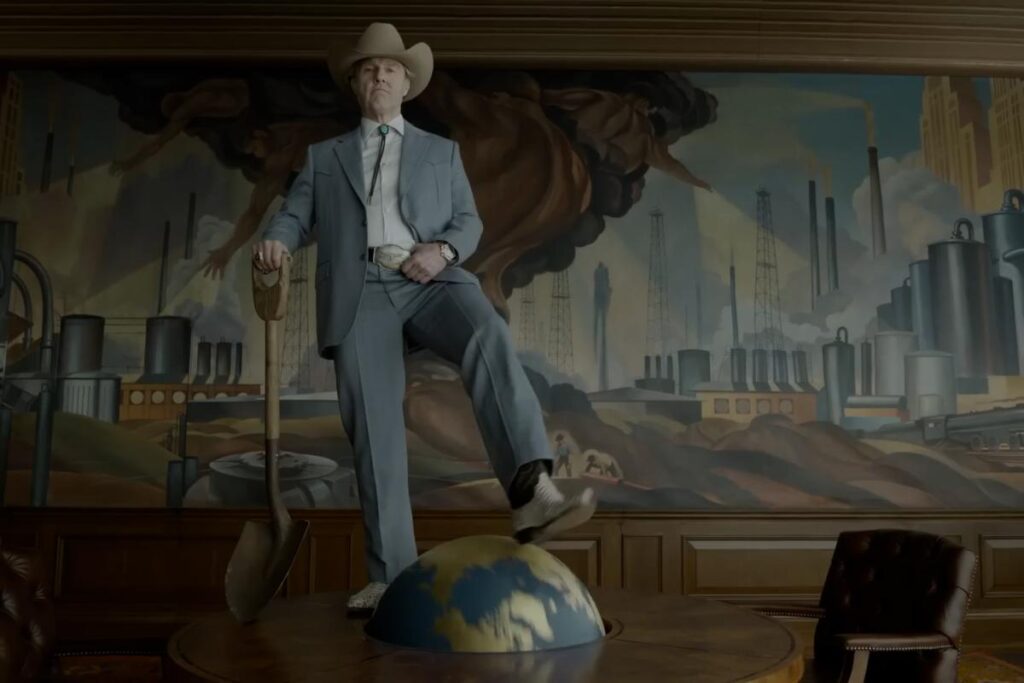
A number of people (zero is a number) have asked me to write about what I thought of Digger. Massive spoilers ahead for the movie Digger. If you don’t want to know anything about Digger, you shouldn’t read further. If you want to go see Digger, go see Digger. I don’t want to stop you. If you read on, and decide that hey, that sounds like a cool movie, please go with my blessings.
I find Digger to be a fundamentally dishonest movie.
So. In the movie, Tom Cruise plays an actor named Curtis. Curtis is the star of a play, titled Fossil Fools, which is a broadly comic satire about a global catastrophe, and, specifically, the oil baron who is responsible for said catastrophe, Digger Rockwell. So Tom Cruise is playing an actor who is playing a role in a play in a movie about the production of that play.
In the third act of the movie, it is revealed that the play we’re watching is not fiction, but a cartoonish recreation of historical events that happen in the future. That is to say, we are in a theater, in the future, watching a performance of a play about a historical event that happened twenty years earlier (in the movie’s timeline).
If all that sounds like exciting postmodern storytelling to you, you’ll love Digger. Lots of wonderful people do.
Here’s my main problem with the movie. Fossil Fools, the play that takes up the bulk of the runtime of Digger, is really bad. It’s a hack piece of political farce that’s grating, obvious and clownish.
The play is also in love with its main character, Digger. Digger is an oil man, but that’s not his skill set. His skill set is bullying people and forming narratives that can manipulate people into doing what he wants. And he wins every time. He gets all the best lines, and is shown to be wise, canny, foxy, and the smartest man in any room he enters, because he’s so good at manipulating a narrative. The truth, he takes pains to explain, is not a story, and people cannot resist a good story, no matter how true or untrue it is.
No other characters in the movie come anywhere near to besting Digger. He’s too smart, too funny, too unafraid to tell it like it is. Bang bang bang! The token liberals in the play are all weak-willed eggheads, spouting statistics and displaying their hypocrisy, while Digger is loud, crude and proud of it.
The play loves Digger, and the movie does too. Digger wins in every scene, no matter what problem is presented to him. Every character sent to oppose him, and there are many, is shown to be a gibbering idiot, sometimes literally so. While everyone else shouts and frets and trembles, Digger always has a solution and a path forward. His solutions only serve himself, but no one else in the movie has any alternative.
The climax of Fossil Fools takes place at some kind of world court, where Digger is forced to get up and explain himself to the world he’s destroyed. He gives a version of the Col Jessup speech from A Few Good Men (for which Jack Nicholson was nominated for an Academy Award), except in A Few Good Men, Col Jessup’s speech is the thing that hangs him and wins the case for Tom Cruise, and in Digger the speech is meant to tell the audience that billionaires aren’t responsible for destroying the world, the masses are, because they forced Digger to drill faster and faster, to keep up with our insatiable thirst for oil.
I’ve seen people online repost this scene, saying “This is the greatest speech in the history of film,” which surprises me, because it’s essentially saying “corporate greed is OUR fault, leave the billiionaires alone!” Indeed, in the scene, Digger turns the court completely around. He goes in and they bay for his blood, but by the end everyone is cheering for him and the few dissenters are shouted down by the crowd.
At which point, I found myself asking, why are we watching this story? If the point of the movie is that we’re all responsible for murdering the planet, why are we spending our two hours traffic upon the stage following around a billionaire as he escapes accountability? What is the audience of the movie, and of the play in the theater in the movie, supposed to make of that scene, where the oil-baron protagonist points to everyone in the crowd and says “You MADE me do this!”? In this movie about the destruction of the planet, why is the billionaire’s story the only one that’s deemed worth telling? No one else in the play has an inner life, everything revolves around Digger, his is the only fate that gets explicated.
So I find myself asking “Why does this movie exist?”
It is revealed that the production of Fossil Fools has been financed by Kenny, the nephew of the “real” Digger Rockwell, played by Jesse Plemons. Kenny comes forward out of the darkness to tell the cast and crew, and us, that he’s been obsessed with this play since it was first performed 20 years ago (in the movie’s timeline), and he wants a live audience to see the life of his uncle Digger and the world he destroyed in all its silliness and farce. But I have to ask myself, what is Kenny’s real motive for financing this production?
We find out that Kenny is ALSO a billionaire, and owns some sort of Palantir-style surveillance company. So why is Kenny spending so much money on this play? The only two reasons I can think of is that he either sincerely wants to own up to his own role in the ruin of the world, or he wants, like his uncle Digger, to create a narrative that will keep the masses happy enough to ignore the rest of the things that billionaires are doing to ruin the world.
There is a subplot about Curtis’s daughter getting lost in a hurricane during the tech rehearsal, and Kenny steps in to offer the services of his surveillance company. This is seen as a purely good thing, and Curtis is super grateful to Kenny for saving his daughter, even though, by Kenny’s own admission, he didn’t really do anything.
So the play Fossil Fools loves Digger, and the movie certainly loves Digger, and the actor playing Digger loves Digger, and also Digger’s nephew, because billionaires, the movie has already shown us, are the only people that matter. They make the decisions, they tell us what we can and can’t see, and, most important, they still control the narrative, even as the theater audience wanders out of the theater at the end of the movie into a ruined city.
So that’s all very meta and very smarty-pants, and I have no problem with that. But, I have to ask myself, if the message of the movie is “Always question the motives of a piece of corporate entertainment,” well, Digger, the movie starring Tom Cruise, is a piece of corporate entertainment. It is directed by an Academy-Award-winning smarty-pants director Alejandro González Iñárritu, who won Leo his Oscar for The Revenant (which is a great movie).
But the movie would not have happened without Tom Cruise. Why did Tom Cruise want to play Digger? Because he wants an Oscar, probably. What was Cruise’s impact on the production? Based on my 30 years experience as a screenwriter, I will guess that Cruise went through the script, line by line, and gave all the best lines to himself, and told the writers to make everyone else really stupid and easily defeated.
Because he’s Tom Cruise, he can never lose on film, he must always win. He’s Tom Cruise.
Did the director ever push back? No, because getting Tom Cruise in the movie is the only way the movie is getting made. In the same way that Digger may be a jerk but a necessary evil, Digger gets sacrificed to its star who will never allow himself to shoot a scene where he loses.
(People online talk about how amazing he is in this movie, but I don’t see anything particularly difficult about playing a cartoon character.)
There’s even a scene where Curtis, played by Tom Cruise, stops the rehearsal to complain that his character, Digger, is not played sympathetically enough. So at that point we know that the play, the movie, and the lead in the play all think Digger is awesome and doesn’t deserve the crude treatment he’s given in the narrative.
Anyway, all this was produced by a huge corporation, a corporation huge enough that they can blow $250 million on an art-house movie without anyone worrying about losing their job. And so I find myself questioning that corporation’s motives. I don’t think anyone at Warner Bros (if anyone is still there as of today) thought “well, we should make this movie to assuage our own guilt over our role in the destruction of the world,” or “this will serve well as an opiate for the masses.” They just thought that Tom Cruise + Alejandro González Iñárritu = Oscar Oscar Oscar. They gave him a Mission: Impossible budget for his movie about a play, and a massive promotional campaign. They did all that because they expected to get their money back. The movie stars a man who has made two feature-length commercials for the Navy, regularly flies private planes by himself, and, not for nothing, has a household staff of literal slaves supplied to him by the church/human-trafficking cult he’s the figurehead of. It would be interesting if Cruise took this role as some sort of apology for the life he’s led, but I very much doubt it, because, as I’ve said, he loves Digger, thinks he’s awesome.
At the end of the play Fossil Fools, Digger, reduced to living on a drilling platform in the middle of the ocean, is betrayed by all the people he made wealthy, and then all the people who work for him, and he kills himself after sharing a last dollop of wisdom with his nephew Kenny (who is not named Kenny in the play, tellingly enough). The scene is shot for tragedy, but the audience in the theater of the play hoots and yells, cries and shouts. Why? The play is clearly an elegy for a great and complex man, why does the audience respond as though they just watched him torn to pieces by a lion in an arena? The answer, it seems to me, is that the director’s real message is “audiences can be manipulated any way you want them to be.” Which is also what Fossil Fools is about. Digger, throughout the play, is playing to an audience of some sort or other, whether it’s his staff or the president’s cabinet. Everything is a performance, and every scene can be “won” if you know how to manipulate a crowd.