Update: evil robots, dirty cops,anxious Swedes and a neurotic Jew
My apologies for the recent lack of postings — I am finishing up an assignment and have been dealing with two kids over the moon about the arrival of Halloween.
I have little of interest to report — or perhaps, more accurately, I have little energy at the moment to report anything. However:

ITEM! ![[info]](http://stat.livejournal.com/img/userinfo.gif) urbaniak and I watched Terminator 2: Judgment Day last night. I have little to say about this movie that hasn’t been said many times by many others. It has a screenplay of similar structure to the original (two mysterious strangers from the future show up, one wants to kill the protagonist, the other wants to save him, the first act is devoted to putting the pieces in place, the second act is about explaining the rules and catching the audience up to the action, the third act is about all the pieces coming together in a massive, bone-crushing action sequence) but vastly improved and with about a hundred million more dollars worth of production values. A pinnacle of American movie-making and James Cameron’s greatest achievement. I would also like to commend the two leads, Linda Hamilton and Arnold Schwarzenegger, both of whom turn in career-best performances that, for my money, stand next to another beauty-and-beast team from 1991, Jodie Foster and Anthony Hopkins in Silence of the Lambs, for sheer effectiveness. Schwarzenegger is okay but a little clunky in the first movie, but he’s just spectacular in T2 — slimmed-down, poised and in total command of his movements and voice. Schwarzenegger gets a lot of stick for playing a robot but what he does in this movie is a lot more subtle, complex and nuanced than one would expect from the big guy. He was a special effect in the first movie but here he’s a real actor giving a real performance — and not hogging the camera, either. As for Linda Hamilton, she seems like a completely different actor than the woman in The Terminator. She tough, uncompromising, no-bullshit and impossible to take your eyes off of. I watch her in this movie and am baffled that she doesn’t have a career equal to her contemporaries. I guess there just aren’t enough roles written for women with rock-hard shoulders who want to play moms whose kids can help them load machine guns.
urbaniak and I watched Terminator 2: Judgment Day last night. I have little to say about this movie that hasn’t been said many times by many others. It has a screenplay of similar structure to the original (two mysterious strangers from the future show up, one wants to kill the protagonist, the other wants to save him, the first act is devoted to putting the pieces in place, the second act is about explaining the rules and catching the audience up to the action, the third act is about all the pieces coming together in a massive, bone-crushing action sequence) but vastly improved and with about a hundred million more dollars worth of production values. A pinnacle of American movie-making and James Cameron’s greatest achievement. I would also like to commend the two leads, Linda Hamilton and Arnold Schwarzenegger, both of whom turn in career-best performances that, for my money, stand next to another beauty-and-beast team from 1991, Jodie Foster and Anthony Hopkins in Silence of the Lambs, for sheer effectiveness. Schwarzenegger is okay but a little clunky in the first movie, but he’s just spectacular in T2 — slimmed-down, poised and in total command of his movements and voice. Schwarzenegger gets a lot of stick for playing a robot but what he does in this movie is a lot more subtle, complex and nuanced than one would expect from the big guy. He was a special effect in the first movie but here he’s a real actor giving a real performance — and not hogging the camera, either. As for Linda Hamilton, she seems like a completely different actor than the woman in The Terminator. She tough, uncompromising, no-bullshit and impossible to take your eyes off of. I watch her in this movie and am baffled that she doesn’t have a career equal to her contemporaries. I guess there just aren’t enough roles written for women with rock-hard shoulders who want to play moms whose kids can help them load machine guns.

ITEM! While finishing my assignment, I’ve been taking breaks by watching Season 3 of The Shield. If you’ve never heard of The Shield, stop what you’re doing right now, run to your video store and rent the first season. The pilot of The Shield is not only the greatest pilot in television history, it’s the spearhead of some of the greatest dramatic writing I’ve ever witnessed. Show after show for six seasons, this show kept up a seething, scathing, furious boil of urban Jacobean drama. Astonishingly intelligent, jaw-droppingly intense and complex. When I see a movie these days, I don’t say “Is it as good as Citizen Kane,” I say “Is it as good as an episode of The Shield?” Michael Chiklis as Vic Mackie is one of the great television performances of all time, on a par with Carrol O’Connor on All in the Family, Peter Falk on Columbo and Hugh Laurie on House. The fact that Mackie is perhaps the most unpleasant character ever delineated on television makes it that much more compelling.

ITEM! Before he became one of the 20th century’s most important and enduring artists, Ingmar Bergman was a screenwriter, just like me! His first produced screenplay is called Torment (there’s a calling-card title if I ever heard one). The movie was directed by Alf Sjoberg, but oozes Bergman all over the place. Students of excellent screenwriting must, must, must familiarize themselves with Bergman’s screenplays — they are expertly balanced, classically structured, compact little gems that manage to plumb the depths of human desires and needs without making a big deal about it.

ITEM! Took my son trick-or-treating tonight in Santa Monica. Certain blocks north of Montana were as crowded as Times Square the night before Christmas and as garishly decorated. A splendid time was had by all and I had the pleasure of sighting Larry David making his way through the crowd. As a New Yorker, I am forbidden to approach a celebrity in the street no matter high my admiration for his work.
The dangers of Googling oneself
This is weird. I have no idea whose these young men are or how they found out about my monologue “Television,” and I find it bizarre that they never tried to contact me to tell me they were making a short from my material, but they do give me credit so I guess that counts for something.
For those interested in how this piece originally appeared, you can find it here (click on “9:02 ‘Todd Alcott’ by Skip Blumberg”).
I have also learned that, while I haven’t yet made it into America’s Wikipedia, I’m apparently big in France.
House calls, I listen

Yesterday I broke down a typical episode of House to examine its parts. When you look at those beats (12 in an eleven-minute act!) one by one, there’s nothing outstandingly special or dramatic about them — they’re just television. There is soap and there are fake crises and dramatic standoffs and stern confrontations and passionate advocations, just like in any other show.
And yet House blazes like a, well, like a house (sorry) afire compared to every other detective show or medical drama currently on television. Why?
After watching thirty or so episodes (some more than once) I have some theories.
2. Plotting. As I say, there’s nothing extraordinary about the individual scenes on House, but the skill and innovation brought to bear on their deployment and arrangement is very extraordinary indeed. Each story is so complex and twist-ridden it’s impossible to know where the hell it’s going. Let’s look at “Sex Kills” again, which I consider a typical, not-especially vital or “special” episode of House. The A-story twists go from “man has an STD” to “man has brucellosis” to “man needs a new heart” to “he can’t have a new heart” to “where will we find a new heart” to “a overweight dying woman can give her his heart” to “what did the overweight woman die of” and the show’s only half over! Compare that to a typical A-story on CSI, where the story seems to go from “we know who the murderer is” to “well maybe we don’t know who the murderer is” to “it turns out we were right the first time, butnot for the reasons we originally thought.” The plots on House (and any screenwriter will tell you that plot is the hardest thing of all) are dizzying in their complexity and rarely, if ever, fail to ultimately satisfy.
3. Tempo. With such an elevated level of complexity, everything on House must move very quickly in order to accomodate all its plot machinations. This, as it turns out, helps everything. The acting is better when we don’t have time to dwell on an actor’s choices, the writing is better when we don’t have time to notice that it’s as riddled with cliches as any other show in the history of television, the direction is better when there’s no time for indulgence, the production design looks better when we don’t dwell on its improbabilities, the characters are more interesting when there are more of them and they don’t have enough time on screen for us to register that they aren’t that interesting. Tempo makes the “differential” scenes dazzling displays of knowledge instead of leaden exposition, the “character” scenes are welcome respites from the dense, sometime impenetrable medical jargon, the “crisis” scenes arrive with the suddenness of emergency.
Strangely, even though the show hurtles at an exceptional pace (try watching House back-to-back with Monk — the latter will feel like it’s wearing lead boots in comparison) it never feels rushed. This I’m putting down to —
4. Production design, “background” and camera movement. On top of the speed of the dialogue, the sheer busyness of the show is impressive. Characters are always doing something, and not in the Law & Order sense of “the mechanic can’t stop working on the car in order to talk to a pair of homicide detectives investigating the murder of his best friend.” The hospital of House is a busy, busy place (and filled with all those glass walls so we can see exactly how busy it is) and the characters are constantly hurrying through it on their way to somewhere else. Which makes it that much more ironic and amusing that House himself is constantly found goofing off, watching medical dramas on TV or playing video games. TV shows have had impressive worlds created before, but they always seem artificial and arch, like CSI, which seems to take place in a permanent midnight where no room is well lit. The sunniness of the hospital of House somehow helps sell its darkness. The intense, unbelievable stories (and their intense, unbelievable protagonist) are all happening in an extremely pleasant, well-lit, well-appointed, well-maintained environment. No one on House has the problems with the world House does — he’s a splinter sticking out from an otherwise smooth plank.
5. Stance. By centering the show around the indelible House, the show’s creators present a philosophical outlook that never preaches, never offers solutions and never provides reconciliations. House is never going to be happy, but then he’s not trying to be happy. That keeps him mysterious, unreachable and fascinating. The fact that his brilliance is matched by the desperate ordinariness of his preoccupations — monster trucks, medical dramas, hookers, etc — makes him recognizable, and his pain makes him human. Somehow the parts all add up and provide us with a character we can’t stop watching. As a medical drama/detective show, House is exemplary and exhilirating, but it’s the shows underlying view of humanity, both compassionate and disgusted, that keeps us watching.
notes that the medical stuff on House is as implausible and fantastic as I have always suspected it is. And yet it presents its, shall we say, “heightened reality” lightly (and swiftly), not with grim determination or dark seriousness. House doesn’t have time to sell us on his fantastical diagnoses, he’s got someplace to limp off to. She also notes that too much medical work on House is done by doctors, and yet I am consistenly impressed at the number of personnel on display on the show — there are surgeons and nurses and all manner of interns and students and clerks cluttering up the hallways and when the show calls for someone with specialized knowledge, they, often as not, show up, as in “Sex Kills” where one staff member is shown (she gets her own close-up) preparing to shut off the overweight woman’s breathing apparatus and another is shown to be in charge of organ donations and there are two teams of anonymous surgeons to do the heart transplants. Personnel shows up and trundles off with an impressive regularity on House, indicating that all House has to do is wish it and the personnel will appear to make it so, which I guess is the exact opposite of the care I’ve received in hospitals, where the MRIs are given by MRI technicians, not doctors, and certainly not teams of doctors. On the other hand, in terms of caregiving, Princeton-Plainsboro is a fantasyland on the level of Narnia — when a patient checks into House’s hospital with baffling, contridictory symptoms, heaven and earth are moved to discover the truth. When I check into St. Vincent’s in New York with some unexplained tingling in my limbs, the staff is hurried, incompetent and inefficient, discharges me without diagnosis, refuses to return my phone calls and charges me $17,000.

House rules

I’ve been watching a lot of detective shows lately, and nothing comes close to House. In the future I will try to specify why this show, while containing all the formula, devices and cliches of every detective show and every medical drama manages to be more than the sum of its parts. But for now I’d like to analyze a single episode to parse the dense, intricate twists and turns that make it electrifying television.
I could have chosen any episode at random but I was taken by the extra-twisty structure of an episode from Season 2, “Sex Kills.”
PRE-TITLE SEQUENCE: A young woman, Amy, plays bridge with her father and a group of her father’s friends. She is clearly out of place and uncomfortable in this company, in this activity. Many glances and innuendoes flutter through the air.
Amy suddenly feels ill, says she’s nauseous. Is she pregnant? Is she pregnant by one of the elderly men at the bridge game? Is she pregnant by her elderly father, played by the only “name star” in the episode, WKRP‘s Howard Hesseman? Amy gets up to use the bathroom. Her father stops her. He’s concerned. He knows something. He grabs her arm.
Then, out of nowhere, he freezes and the camera goes into his eye and we see something go blooey inside his brain. He’s having a stroke or a seizure or something. Ha! The show’s not even two minutes old and already we have TWIST #1. The patient of the week isn’t young Amy, it’s her elderly father!
Now then — the show just teased us with the possibility of a young woman pregnant by her own father, then pulled the rug out from under us. That means that whatever is wrong with the father is more shocking, more disturbing, more interesting than him impregnating his daughter.
ACT 1
1. The father is admitted to the hospital. He has had an “absence seizure” and has also complained about having acid reflux for years.
2. The weekly “differential diagnosis” scene: Foreman says the father has all the symptoms of testicular cancer. House says that that can’t be right because everyone is wearing the wrong shoes and goes on to clarify: if Foreman thinks the father has testicular cancer merely because he has all the symptoms of testicular cancer, then there’s no reason to be having this meeting and the team would all be out bowling. Rather, House believes that the father has a micro-abcess in his brain. “When guys have brain/crotch problems, it’s usually the result of using one too much and the other too little.” The shift from testicular cancer to micro-abcess would be an act-break twist in another show, here it goes by in a heartbeat and is never mentioned again.
3. The “personal” story of the week: House believes that his friend Wilson is having an affair with someone on the hospital staff. He’s been acting strangely (at least strangely to House’s Holmesian-level deductive mind), not spending enough time at home, buying foreign chocolates. (“Norwegian chocolates! Frankly, if you buy that stuff the terrorists win,” grouses House.)
4. The B-story: a teenage boy in the clinic wants House to prescribe to him a high dose of Depo-Provera, which, we learn, will chemically castrate the boy. Why does the boy want this? He cannot stop himself from having sex with cows. House believes that the young man has been put up to this by his frat buddies and writes a fake prescription for him to show his friends.
5. Foreman tells the father that they think he has a sexually transmitted disease. The father says he hasn’t been sexually active, he broke up with his wife (who is Amy’s mother) months ago. I’m not sure how we got from “micro-abcess” to “STD” but then I’m not sure what a “micro-abcess” is in the first place.
6. Foreman reports to House with the father’s answer and House scoffs at him. The father’s lying, everyone has sex. He shouts across a crowded lobby to Wilson:
HOUSE: Wilson! How long can you go without sex?
WILSON: How long can you go without annoying people?
7. With Amy out of the room, House confronts the father:
HOUSE: I hear you’d rather die than admit you had sex.
FATHER: I’m sorry, I couldn’t tell my daughter.
HOUSE: Right, because she’s, what, 22?
FATHER: I, I slept with her mom.
HOUSE: She probably knows that happened already.
The father explains the breakup he had with his wife and how they got back together for a one-night stand following a cheese festival.
FATHER: I assume you’ve been in love.
HOUSE: Is that the one that makes your pants feel funny?
Now then: the cheese becomes important later; note how skillfully the writer hid his clue amid two sure-fire comic exchanges so we wouldn’t notice it. I’m going to count “Father gets STD from ex-wife, who he isn’t supposed to be seeing” as TWIST #2.
Amy comes into the room as House isgiving the father a shot and asks what’s going on. The father admits to his daughter that he’s got an STD but he lies about where he got it from and House covers for him. The tension is somewhat released by this transmission of information, but then the father suddenly starts coughing blood as we go to commercial. (Diseases on House must contain at least three shocking, sudden, unpredictable, life-threatening symptoms, one for the end of every act break.)
ACT 2
1. So, it’s not an STD after all. TWIST #2 has barely settled and already we’re onto TWIST #3 as the mystery starts all over again. The gang hold a second differential diagnosis, and we get a healthy chunk of the rapid-fire, Apollo 13-level of jargon: “It’s a flash pulmonary edema, we’ve taken a liter of fluid off but the problem wasn’t with his lungs, it was with his heart — there are vegetations obstructing his mitral valve.” I nod sagely as though I have any idea what Dr. Cameron just said because, well, because Dr. Cameron said it and I like looking at her face and keep hoping she’ll say more. “A disease that attacks the brain, heart and testicles,” muses House, “I think Byron wrote about that.”
2. House confronts the father again. This time he’s asking about the cheese from the cheese festival. He feeds the father some cheese laced with bacteria and the father says he recognizes the taste from the cheese he ate the night he slept with his ex-wife. House explains that the bacteria is around all the time but mostly our stomachs combat it. Because the father was taking antacids for his acid reflux (aha! and you thought the acid reflux was a red herring!) the stomach acids could not neutralize this cheese’s bacteria and the father has come down with a sheep-cheese disease, brucellosis, TWIST #4.
3. As the father gets treated that night, House hangs out with Wilson, accusing him again of having an affair.
4. The treatment on the father does not go as expected. His heart stops beating and they must use the defibrillator on him — and it’s only Scene 4!
5. Meanwhile, House and Wilson continue their conversation about Wilson’s supposed infidelity. Wilson is growing tired of this hectoring and we in our homes wonder how long Wilson has been friends with this pushy, thorny pest that he puts up with this kind of interrogation.
6. The gang confer and explain the heart attack. It was brucellosis, but they got to it too late. A piece of vegetation broke off in the father’s main artery and caused an infarction (again, I’m going to pretend I know what that is). The father now needs a heart transplant — once he’s got that, he’ll be a healthy man and be ready to go home. Ordinarily, the gang on House makes two wrong diagnoses before they hit on the right one, which would ordinarily count as a twist in and of itself, but wait.
7. House goes to the heart-transplant committee and argues for his patient’s case. The committee says the man is too old, and House responds with sarcasm and character assassination, which doesn’t help his case any, and the committee turns him down.
8. Foreman breaks the bad news to Amy and her father.
9. House comes up with a scheme: get the files on everyone who’s died in the hospital recently — maybe someone whose heart is deemed “not viable” will die and they’ll be able to use the heart for Amy’s father.
10. Return to B-story: the “Boy Who Loved Cows” has returned, saying that he tried to have sex with a cow and was kicked in the ankle by his beloved. House, in no mood to listen to this kid, believes him even less this time and threatens him with a series of painful, humiliating tests. The kid takes the dare, toHouse’s surprise.
11. House and Cameron discuss everyone who’s died in the hospital today. One of the deceased is a baby, prompting House to gripe “Babies are useless, they’ve got hearts the size of ping-pong balls.” There is one hope: an overweight woman in a car accident is currently in the ICU and doesn’t look good. House crosses his fingers and hopes she dies.
12. And the act isn’t over yet! House goes to the ICU as the woman in the car accident lies dying on the operating table. The woman’s husband is understandably distraught as House gently but insistently probes him about her medical condition, which included a slight fever and stomach pains, none of which seems very important now that she’s dying from a crushed skull. The fever and stomach pains turn out to be important later, and this time the writer skillfully places the clues inside an incredibly high-stakes scene, where the woman is dying, the husband is distraught, he thinks House is his wife’s doctor, House does not dissuade him, and in the middle of it, a woman comes up to the husband to assure him that his wife’s organs are going to be treated with the utmost respect. The husband becomes apoplectic; this is the first he’s heard that his wife has died. This is a bad situation indeed.
ACT 3
1. The gang need to get the overweight woman’s file. If her heart is deemed “not viable,” they need to know why. House hacks into her file to find out what she was sick with — Foreman says she had Hepatitis C. And slowly the reality sinks in, this is TWIST #5: the show isn’t even about Amy’s father any more. Like Die Another Day, “Sex Kills” is going to change villains halfway through, just as they changed protagonists halfway through the pre-title sequence. The show is no longer “what is wrong with Amy’s father,” that was just a warm-up, the show is “what was wrong with the overweight woman when she crashed her car?” The fact that Howard Hesseman, the nominal “guest star,” vanishes half-way through the episode almost qualifies as a twist all by itself.
2. In the ICU, the tearful husband prepares to pull the plug on his clinically-dead wife. House strides in and turns the machines back on. The husband is furious.
3. House and the husband go to Cuddy. House argues for using the wife’s “not-viable” heart for Amy’s father, the husband has had enough of House and his shenanigans and says that he’s going to take his wife off life support.
4. The husband runs into Amy in the hallway. Amy, knowing nothing of what’s just happened, thanks the husband for giving her father his wife’s heart. The husband, put on the spot, tells Amy that he’s not giving her the heart. House comes along and says:
HOUSE: Hey listen, you take your wife off life-support and I’ll have forgotten about this in two weeks. Gail here on the other hand —
AMY: Amy.
HOUSE: Whatever.
He tells the angry, churning husband not to be angry with Amy but to take it out on him instead. The husband takes House at his word and swiftly knees him in the chest, knocking him to the ground, then tells Amy he’ll let her have the heart.
5. Someone (Chase?) tells Amy’s father that if the dead woman’s heart is not viable, he has perhaps three days to live (one of the best features of House is the relentless use of ticking clocks, sometimes more than one in a single episode).
6. So, now that that’s settled, how do you diagnose a dead woman? What did she die of? Chase suggests a gall-bladder infection.
7. The team performs an MRI on the dead woman as the husband begins to soften on House: “He must be brilliant; if you’re that big of a jerk you’re either unemployed or brilliant” he muses.
8. The dead woman does not have a gall-bladder infection — she has a mass. I’m going to go ahead and call this TWIST #6, although the decision for the husband to give his wife’s heart to Amy’s father is probably TWIST #6. So to be safe we should call this TWIST #7.
9. And the Boy Who Loved Cows is back for his third and final scene. House still doesn’t believe his story about the cows and the boy finally reveals the truth. He has a step-mother who is barely older than himself and who parades around the house in a bikini — or less, as TWIST #8 comes home to roost. The boy is horrified by his sexual attraction to his step-mother and the viewer is satisfied by the inversion of the situation hinted at in the pre-title sequence. House doesn’t see the crisis in being attracted to one’s step-mother, it hardly seems to count, it’s not the boy’s real mother after all, but he’s essentially a pragmatist at heart, not a moralist, and he gives the young man the drug he needs.
10. House needles Wilson about his personal life again and Wilson blows up at him, questioning House’s friendship. House does not take kindly to Wilson’s attack and turns it back at him.
11. The treatment on the dead woman (for a gall-bladder infection) is not working and her condition worsens. House gives up, but now the husband is the one who won’t let her die. In TWIST #9, the gang stare slack-jawed as the husbands demands that they find out what was wrong with her and give her heart to Amy’s father — it’s the only way her death will mean anything.
ACT 4
1. The gang confer over the dead woman. What to do? Should we operate? House grimaces: “She’s a fridge with the power out — we start poking around inside the vegetable goes bad.” Then, noticing the husband standing nearby, “No offense.”
2. House and the husband go to the husband’s house and poke around (a standard scene on episodes of House, usually done without the patient’s permission). House asks the husband if his wife kept anything from him and the husband insists that she had no secrets. When House turns up diet pills and hair coloring, neither of which the husband knew about, the husband sadly shakes his head and muses that “you never really know anyone.” This becomes an important moment later but there’s no way to predict why.
3. Amy’s father is dying as the tension rises.
4. House and the husband come back to the hospital. Cameron comes from the dead woman’s workplace, where she’s found Polaroid photos of naked teenage boys. House isn’t interested — “teenage boys aren’t toxic” he says (as my wife snorts “They aren’t?”).
5. House guesses that perhaps the dead woman had gonorhrea, that she got perhaps from sex with teenage boys? (conceptually linking the boy from the B story to the dead woman from the A story.) The gonorhrea caused her fever and stomach pains, which made her crash her car, which killed her, which made her heart available for Amy’s father.
6. Cameron tests the dead woman for gonorhrea, does not tell the husband she’s doing so (mirroring the Act 1 scene of House discussing the STD with Amy’s father while Amy is out of the room).
7. The dead woman tests positive for gonorhrea as Amy’s father goes into a coma. House orders two ORs for the heart transplant; Cameron objects, saying that the dead woman’s still has gonorhrea in her system. “And tomorrow, it’s going to be in his system,” House says of Amy’s father, noting that it’s better to be alive with gonorhrea than dead without it. Which is as pragmatic and moral a lesson as this episode has to offer humanity.
8. The dead woman’s body is rushed to the OR and House, in a minor TWIST #10, lies to the husband about what was wrong with his dead wife.
9. Another staple of House, a grisly, realistic operating-room scene, involving none of the main characters, just like in a real hospital.
10. Cameron watches the operation with the dead woman’s husband. As soon as it becomes apparent that Amy’s father will live, Cameron starts to tell the husband that his wife had gonorhrea. The husband cuts her off, telling her, in TWIST #12, that he gave her gonorhrea, that he was the one who strayed in their marriage (the Polaroids of the naked teenage boys were a red herring! Curse you, Polaroids of Naked Teenage Boys!), who lied, who gave her the disease that ultimately killed her, without her ever knowing she had it.
11. Amy’s father is all better. And who comes to visit him? His ex-wife, who wants to get back together with him. And we remember that this all started because we thought Amy’s father had gotten an STD from this woman, but no, it wasn’t the sex or the cheating that caused Amy’s father’s problem, it was the brucellosis in the cheese. In minor TWIST #13, Amy tells her father that he must wear a condom if he has sex with her mother, since he now has the dead woman’s gonorhrea.
12. That night, House, alone in his house (no hookers tonight, ironically), listens to a recording of what sounds like an ancient bluesman singing “Honky Tonk Women” (another staple of House — recordings I cannot identify but want desperately to own). The doorbell rings — it’s Wilson. House was right — he is having marriage problems. But, as per the theme of the episode, in the FINAL TWIST, we learn that Wilson is not the one fooling around — his wife is. He has walked out on her and come to House’s, um, house, to sleep on the couch. House, often mistaken, never wrong, shrugs and asks “Want a beer?”
Next, I will try to examine the tumult, hue and cry of this show and determine why it works when other shows of equal quality do not.
Attention people

Tony Millionaire is a friend of mine. A few years ago I tried very hard to get a movie made of his rather astounding Sock Monkey comic.
Now, in the world of showbiz coincidences that is Los Angeles, this fella Eric Kaplan, who just happens to have a child at the the exact same school as my own son (thus proving that Tony Millionaire controls the universe, to borrow the title of another Eric Kaplan show), has created (with Mr. Millionaire) The Drinky Crow Show, for everyone’s pals at [adult swim].
This show is destined to be a paradigm-shifting event especially if you make it so. It’s easy — you go to [adult swim]’s website, watch the Drinky Crow Show pilot, take a moment to absorb the sheer strange, horrible beauty of it, then rate it on the little rating-button thing.
One thing I will guarantee: You have never seen anything like it.
Venture Bros: Assassinanny 911
I have received numerous requests to analyze this episode of The Venture Bros; now that Season 2 is out on DVD it seems like a good enough excuse to do so.

Sexual tension and examination of sex roles is always a feature of The Venture Bros, but the sexual tension in “Assassinanny 911” rises to the level of sexual hysteria, even outright sexual panic.
Take the cold opening. In a flashback, Brock Sampson reports for duty to Col. Hunter Gathers. In short order he is jumped, pinned to the floor and threatened with all manner of phallic objects — a knife, a baton, and a jutting, thrusting cigarette holder (later, Col. Gathers will remark on how “big” Brock is –as well he might). What does Brock want in the scene? To be “made a man” — or re-made as one, anyway; as Col. Gathers puts it, a “Frankenstein.” In the context of this episode, to “be a man” is explicitly to kill. Once Col. Gathers has dominated Brock, stabbed him, destroyed his identity (with that phallic cigarette holder, no less) and knocked him down with his baton, he ejects himself from what turns out to be an aircraft of some kind, the shape of which one can only imagine.
Now that the Cold War is over, Molotov wants to consummate the flirtation that was begun with Brock 20 years earlier during a Paris stakeout. That stakeout ended with Brock being pinned down to a bed with knives in a flaming hotel room (and is apparently not the same time that he took her left eyeball, as Molotov escapes unharmed).
But Molotov is not about to get what she wants, for Brock has been called away on a mission and has asked Molotov to babysit Hank and Dean. The mission (an assassination, a killing — his “old” male identity) is just a piece of gruntwork for Brock, who finds his new role as nurturer and caretaker much more rewarding and, let’s face it, more challenging. Challenging as in Manaconda (another phallic symbol), who leaps out of the X-1 fusillage (another phallic symbol), is killed by Molotov (who, for the purposes of this episode, is the male, ie “killer” presence), and turns out to be, as Dean notes, “Womanaconda” (thus underlining the episode’s themes and foreshadowing the surprise ending).
Brock doesn’t exactly drag his feet on his way to meet his contact, he’s not that kind of guy, but neither does he have patience for the spy-spy rigamarole of his briefing — the spy biz has changed too much since he was in it, it’s no longer a “man’s world” — Brock tosses out the gadgets and weapons from his kit, muttering “gay, gay, useless…” as his briefing officer tries to tempt him with a unthreatening-looking pen(is). (In case the gay subtext in this scene is not strong enough, it is noted that Brock will get the next part of his briefing from, er, “Captain Swallow.”)
(Side note: when Brock opens the case file to see that his target is Col. Gathers, the file is, in fact, printed backwards. Is this a mere technical glitch, or are Jackson and Doc hinting at a “backwards” nature of Col. Gathers’ personality?)
Once Brock is gone, Molotov turns herself to her task of “turning Hank, Dean and Rusty into men.” This involves shooting at them with a machine pistol and getting Hank and Dean to try to kill each other. (There is, on top of everything else in the show, a puzzling dwelling on the wounds of Christ — Brock is stabbed through the hand by Col. Gathers, and Dean is stabbed through the foot by Hank with a pen[is]cil. Are Jackson and Doc suggesting that Christ was not a “real man,” as he was not a killer but rather a healer?)
Once Hank “kills” Dean (or so he crows, having wounded him), he believes himself to be a “real man.” The ability to kill gets mixed up in Hank’s mind with the desire to have sex with Molotov — one gives rise (so to speak) to the other, in spite of the fact that the object of Molotov’s affections, Brock, is a killer but no longer wants to have sex with her.
Rusty, for his part, believes his “mature” status gives him an edge over the boys (“mature” here meaning “stealing the neighbor’s newspaper for the double coupons”), while Dean, as ever, is just confused and hapless.
On the way to his rendezvous with assassination (shot from the phallic submarine in an even-more-phallic torpedo), Brock remembers his training and partnership with Col. Gathers. The phallic symbols (sharks, spearguns, oxygen tanks, the Eiffel Tower, baguettes [“don’t eat that! It’s C4!” — indeed]) and sexual confusion (Col. Gathers’s cross-dressing) abound as Col. Gathers explains the finer points of assassination etiquette — “no women, no kids.” Minutes later (literally, as the “clock” in the lower left-hand corner of the screen indicates) Brock finds these rules tested as he attempts to bed Molotov and finds himself bedded instead — it seems that he could kill Molotov if he wanted to, but is restrained by his code of assassin’s honor.
Back at the Venture compound, Molotov finds herself doing some “mother” work, perhaps in spite of herself — we see her with a very un-assassin-like bag of groceries (bought with Rusty’s double coupons?). Her single “motherly” gesture is not wasted on Hank, who becomes filled with Oedipal rage when he sees his new “mother figure” become “friendly” with Rusty and the “real man” urge to kill becomes intertwined with the urge to have sex with Molotov.
(One wonders if having a motherly presence in the Venture compound would be in any way a good idea, as the sexual dysfunctions compound themselves so quickly with the mere presence of a female.)
Brock, on his mission, shows how not-gay he is by bedding a native woman, who shops from the Bond Girl catalogue — thus signifying her as a “real woman” — a purely sexual object who comes complete with six-pack and easy-open bikini-top. The “native woman” is a lover, not a killer, not, essentially, a “man,” like Molotov.
By the poolside, Hank drowns as Dean chats with his own foil/crush, Triana. Molotov must perform the ultimate non-assassin act, bringing Hank back to life with mouth-to-mouth resusitation. Both boys suffer from swollen swim-trunks in this scene — Hank’s from his mouth-to-mouth erection, Dean’s from having his pockets fill up with water. Hank, we see, is at least physically ready to have sex with a woman (although he is pointedly not mentally ready — when his erection is pointed out, he panics, saying his “pants are haunted”).
There is a nice double climax (so to speak), twin Apocalypse Now parodies, as Hank turns his murderous Oedipal rage on Rusty and Brock confronts his target. Hank, for his part, grabs his crotch and swings his phallic sword wildly as Brock is confronted with Col. Gathers’s ultimate truth. Brock is shocked with what he finds, but he should not be: he has come to the same conclusion, in his own way. Brock has found value in life outside of killing (ie being “a real man”). Col. Gathers has taken the notion to its logical conclusion, and in the context of The Venture Bros has struck on a solution that would satisfy even
— he has escaped the dead-end role of “real man” by becoming a woman. As the surgeon makes explicit, Col. Gathers started as Brock’s Frankenstein father and ends as his even-more-Frankenstein mother.
Brock returns home, lesson learned. The episode ends with Hank’s melancholy as Molotov drives away, suggesting that, for him at least, this struggle is not yet over.
Discussion of the other episodes of Season 2 of The Venture Bros can be found here, here, here, here, here, here, here, here, here, here, here, and here.


Happy Almost Valentine’s Day
For your romantic inspiration, some tender moments from Justice League.


This is, of course, the real reason why I watch the shows of the DC Animated Universe — it’s all the hot, hot man/woman, woman/alien, man/mythological figure, man/scientific experiment, man/winged alien, woman/alien, psychopath/psychopath, woman/scientific experiment, alien/robot, martian/martian, man/psychopath, mythological figure/martian, alien/winged alien, woman/mythological figure love going on.
As my son Sam (5) exclaimed after one episode of Justice League: “Everybody on this show is in love! I thought this show was supposed to be serious!”
Justice League of America

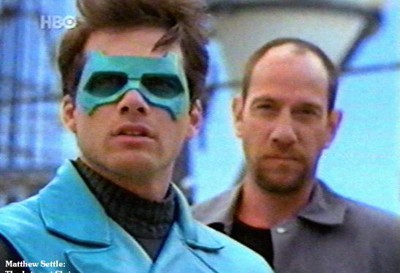
Martian Manhunter David Odgen Stiers fights middle-aged spread, while Green Lantern wonders if he can turn to confront Miguel Ferrer with a straight face.
Strangely enough, in 1997, while the world was waiting for Bruce Timm to create the show Justice League, CBS commissioned a pilot for a live-action Justice League of America. And as it happens, my local video store happened to have a copy of this little-seen pilot. As a “free rental,” no less. How could I resist?
A perfect example of how wrong a thing can go, Justice League of America shows what can happen when a decent idea falls into the hands of the uncaring. Now mind you, I never thought the original comic books (that is, in 1960) were any kind of ground-breaking miracle (they are mostly busy-work potboilers), but the makers of Justice League of America do not seem to have given a thought as to what their show is even about.
The lineup of this particular Justice League, for those interested, is Martian Manhunter, Atom, Flash, Green Lantern, Fire and Ice. The key thrust of the show seems to be “What if the Justice League were ordinary people, trying to lead their ordinary lives, trying to love and work and make friends, but then periodically having to dash off to save the world?”
Now, I’m all for superheroes behaving like human beings (that is, in fact, what makes the Bruce Timm show so successful), but there are limits. In Justice League of America, the superheroes aren’t just ordinary, they are desperately ordinary — sub-par slackers, halfway between The Incredibles and Mystery Men.
Take the Atom, for instance. In the comics, the Atom, Ray Palmer, is a brilliant physicist. That isn’t just a plot convenience, it’s the whole character. Ray Palmer must be a brilliant physicist because he invented the suit that enables him to get microscopic. In Justice League of America, Ray Palmer is a doughy, dull-witted, bespectacled high-school science teacher, unable to fix a television, much less rearrange the molecules of, say, an alien menace’s brainwaves.
Or the Flash. For the purposes of this show, it has been decided that Barry Allen can’t get his life together, attract women, or hold down a job. And so there is much “comedy” mined from Barry’s job misfortunes, lack of money and boredom. Why can’t he hold down a job? Well, because he moves too quickly, of course. Because apparently, in the world of this show, speed in one’s work is something that is frowned upon.
Or Green Lantern Guy Gardner (well, he’s called Guy Gardner, but he wears Kyle Rayner’s outfit, and of Lanterns, most closely resembles Rayner in temperament). The man who carries the most awesome weapon in the universe is a blithe, jokey ad executive, a man who has never given a moment’s thought to the responsibility he carries or the lineage he serves. I once wrote that Green Lantern is a job, but for Guy Gardner it appears to be more of a hobby.
Instead of watching Earth from their Watchtower up in space, this Justice League lives in a dumpy, retro apartment, where they bicker about chores and their love lives. That’s right, it’s Friends with superpowers. Far from protecting the world from intergalactic menace, it takes the whole team to protect one city from a terrorist with a plan that Dr. Evil would pass on as too absurd.
Now then: there is plenty in comics history to suggest that a group of superheroes with screwed-up personal lives could click — something 2000’s X-Men did beautifully — but what happens here is, disaster of disasters, the protagonists, dull as they are, become less interesting when they don their colorful outfits and fight crime. Their costumes are atrocious and laugh-inducing; they look like idiots dashing around their fake city in their bulky, ill-fitting suits and masks, rescuing tykes and dragging cats out from underneath porches. They have no ideas for fighting a menace or saving the city, they just kind of plod along, putting out fires while they wait for evidence to fall into their laps.
For those interested in viewing some representative clips, they may be found here.
The cast and crew of the pilot is a solid bunch of TV professionals, which makes it all the more perpexing that the show feels more like the production of some enthusiastic amateurs, not quite as polished as this.
Justice League vs. God


The Magazine Editor was visiting the other day and conversation turned, as it often does in my house, to the Justice League.
My son Sam (5) is, to say the least, obsessed with the Justice League, an obsession I’ve done little to discourage. He sleeps under a shelf full of Justice League dolls action figures (he has 80 or so, not including the inevitable copies, and also not including the various members of the Green Lantern corps, who, although appearing on Justice League, are not actually members of the Justice League), as well as banks, comic books, encyclopedias, posters, and a wall covered with his own drawings of various members.
TA. I don’t know — I think I might have gone too far with the whole Justice League thing.
TME. Could be worse. You could send him to Sunday school.
(laughter)
TA. I mean, I don’t mind, you know, the intensity of it — and it’s not violent like Batman is violent — but I just worry that he’s watching something that he isn’t really getting. I mean, there are all these moral and ethical concepts in the show that are just too sophisticated for him —
TME. That’s what I mean. It could be worse, you could be sending him to Sunday School.
So be it. Sam likes Justice League because it’s more interesting to him than Superfriends or Magic School Bus (both of which delight his four-year-old sister) and he’s too old for Maisy or Thomas the Tank Engine. Its moral lessons are couched in high drama, well-drawn characters (in every sense of the word) and fluid, exciting, colorful action, more so than any Sunday school class I remember (although the Bible is certainly not lacking in colorful, absorbing, morally complex action stories).
Sam confessed to me the other night:
SAM. Dad?
DAD. Yeah?
SAM. I believe in superheroes.
DAD. Sure.
SAM. No, I mean I really believe in them. I think they’re here, I think they’re hiding, so they can be there if we need them.
Well, okay, he’s five, so I’m not too concerned about him having actual paranoid delusions. If he believes there really is a Superman who is good and strong and (mostly) invulnerable, a vastly powerful being with an unerring sense of right and wrong (or at least a team who will correct him if he’s wrong), if he believes in a collection of smart, quick-witted, eloquent heroes who will help him out when he really needs it and never let him down, well, that’s the message of Justice League, but it’s also the message of Sunday school. And as far as I’m concerned, as far as belief systems go, I would rather have him believe in the brightly-colored pop-culture fantasy of Justice League than in the blood-encrusted gothic tales of organized religion any day.