Dark Knight postscript

Over the summer, I saw The Dark Knight three times in the theaters, and came away stunned and baffled each time — it elevates the superhero genre so much, in so many different ways, it makes Batman Begins look like Batman Forever and it makes the 1989 Batman look like the 1966 Batman. It solves many of the problems inherent in the genre and places the characters in a complex continuum, instead of a hermetically-sealed corporate product. In many ways it is still as broad and "comic-booky" as any superhero movie, but by taking its characters seriously as human beings and thinking their actions through on a broad social level it succeeds in creating cinematic characters that breathe and speak to us. It is also a god-damn freakin’ plot machine, a script so complex and ambitious that I can only sit and wonder at it. Ideas in movies are easy, but plot is hard, and superhero plots are some of the hardest of all, which is why no one — until The Dark Knight — has managed to pull it off. And then, to have the movie be about the hero’s failure instead of his triumph, and then to have it go on to be the biggest movie in the history of the genre, well, that’s some kind of amazing thing.
In August, I had a meeting with a producer who has had some experience producing Batman movies. The Dark Knight was still the number one movie in theaters that day, and conversation naturally turned to it.
ME: So — The Dark Knight.
PRODUCER: I know.
ME: Right?
PRODUCER: I know. It’s amazing. I know.
ME: So. You tell me. You make this kind of movie. You tell me. How?
PRODUCER: How what?
ME: How does a movie like that get made? In this environment, where anything complicated or challenging or pessimistic or visionary get ironed out to appeal to the broadest possible market, how does a movie like that get made? That’s an expensive movie with a lot of moving parts — the producers, the cast, the special effects, the location shooting — how does a picture like that get made, and end up that good?
PRODUCER: Because Christopher Nolan gets no notes.
(pause)
ME: What do you mean?
PRODUCER: I mean, the studio gives him no notes. None. Zero.
ME: The director gets no notes?
PRODUCER: None.
ME: So, you’re telling me, Christopher Nolan and his brother write the script —
PRODUCER: And then they shoot it. And the studio gives them no notes. They’ve given them the project, they trust their vision, and they let them shoot it the way they want. And that’s how a movie like that gets made.
The Dark Knight part 4

At the end of Act III, Bruce, despite his best efforts and his bravest sacrifices, has pretty much screwed up everything in Gotham City. In the act of cleaning up the Mob, he’s created the Joker, and in the act of making his act legitimate (shades of Michael Corleone) he’s created Two-Face. By upsetting the status quo, he’s gotten his girlfriend killed and turned her new boyfriend insane. In Act IV, he will do his best to defeat the Joker — and fail, forcing him to face the consequences of the decisions he’s made.
The Dark Knight part 3

At the end of Act II, Bruce Wayne was ready to reveal himself to be Batman, only to have his decision yoinked away from him by Harvey Dent. At the beginning of Act III, Bruce is forced to continue on as Batman in order to capture the Joker, the key representative of the new breed of criminal class Bruce has created by trying to clean up Gotham. Although there is some question as to whether Bruce’s heart is really into giving up Batman — which Rachel will address later in Act III.
The Dark Knight part 2

At the end of Act I, Bruce Wayne, in his Batman persona, has snatched Mob banker Lau from Hong Kong and delivered him to Jim Gordon. He’s done his job, justice has prevailed, the cops and the lawyers are united against the forces of the underworld and everything in perfect in Batworld.
But of course, it’s not — Lau’s capture is only the beginning. Bruce, in his desire to upset the status quo and rewrite the rules of (out)law and (dis)order in Gotham City creates a wildly unstable new environment, and by the end of Act II, Bruce will be forced to abandon his Batman persona and sacrifice himself, yet again, for the city he loves — that is, until Harvey Dent steals his thunder and turns, in the public eye, from White Knight to Dark Knight.
The Dark Knight part 1
all stills swiped from film_stills .

berkeley314567 asks:
"I wonder if you’re more interested in the structure than the actual content of the script?"
In a screenplay, there is no difference between structure and content, "actual" or otherwise. A screenplay is a collection of scenes devised in a certain way placed in a certain order to achieve a desired dramatic effect. In the same way that "character" is nothing but habitual action, the "actual content" of a screenplay is nothing but the scenes that fill its pages and the order in which they’re placed. To say "I like the screenplay’s structure but I don’t like its content" is to say "I like that guy but I don’t like the things he does."
David Mamet once said that the only question in an audience’s head during a movie should be "What happens next?" The screenwriter’s job is to keep the audience interested in the story. When the screenwriter does his job well, the audience gets sucked into the story and experiences the thrill of drama. When he does his job very well, the thrill of the experience is so powerful that the audience comes back again and again, even though they know how the story turns out. Spectacle may amaze and movie stars may charm, but if the screenwriter has not done his job well, the movie will still turn out bad and the audience will stay home. The Dark Knight engages the audience on a level unseen in movies lately, and does so while employing a number of bold innovations, which I will discuss as we move forward.
The Dark Knight: where I stand

I’ve been reading over the comments from my last post.
My fascination with The Dark Knight is, primarily, structural. I have not encountered an American movie — much less an American movie designed to be a gigantic blockbuster — that is structured as ingeniously and compellingly as this one. I’ve simply never seen anything like it, and after several viewings it still continues to flabbergast.
Dark Knight discontents

It has come to my attention, via yesterday’s comments, that there are folks out there who not only dislike The Dark Knight, but who find it an abomination — or, as berkeley314567 puts it, "a steaming pile of clusterf*ck." I will not be able to begin proper analysis until Tuesday at the earliest, but until then I’d very much like to hear from folks what they don’t like about the movie. To you folks, I’d like to know what you had heard, what you were expecting, where the movie failed you, how it fell short. Well-stated opinions will be respected and specifics will be greatly appreciated.
I will say this: the folks who compare The Dark Knight to The Godfather or Crime and Punishment I think miss the point (R. Sikoryak notwithstanding). I think a comic-book movie to compare to the tragic grace and penetrating social analysis of The Godfather is just over the horizon, but The Dark Knight is better described as a foursquare, meat-and-potatoes pop-culture action thriller that delivers the goods with spectacular visuals, excellent acting, superb shooting and, for the purposes of this journal, an uncommonly intelligent script. It does not tell us anything profound about the corruption of the human soul, and it does not intend to. I would compare The Dark Knight, instead, to The Fugitive, Alien, Star Wars (that is, episode IV) or The Silence of the Lambs — all movies with pulp roots and grandiose spectacle that transcend their genres and achieve substantial dramatic weight through skillful plotting and firmly grounded, well-performed characters.
Wadpaw in Maakies!
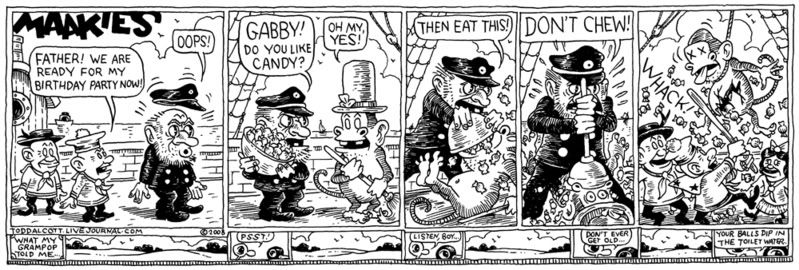
In my ongoing attempts to dominate all media, I am proud to announce that I have succeeded in landing a gag in world-class cartoonist Tony Millionaire’s Maakies.
How, the reader may ask, does one accomplish this feat?
It probably helps if you know Tony, whom I met through a number of acquaintances, including
![[info]](http://p-stat.livejournal.com/img/userinfo.gif)
and Snake n Bacon creator Michael Kupperman (if you don’t know Snake n Bacon, you will — it, along with the Maakies-derived Drinky Crow Show, is set to become yet another [adult swim] show starring the voice of
).
I was nodding acquaintances foryears with Tony before I discovered his “for kids” comic book Sock Monkey. At the time I was riding high off my kids’ movie success Antz and all anyone in Hollywood wanted to know from me was what kind of kids’ movie I wanted to write next. If you’re unfamiliar with it, I advise you to get thee hence to your nearest Sock Monkey collection — the stories are sweet, tender, funny, weird, scary and painfully well-rendered. I immediately saw the commercial potential of a Sock Monkey movie, saw it as a kind of 19th-century Toy Story, contacted Tony and put together a full treatment. Tony and I and an enthusiastic young Canadian director toured all the studios and gave the pitch our best efforts, but Hollywood somehow did not “get” Sock Monkey and we all went our separate ways.
Since then, every now and then I will get an email from Tony saying something like “Quick! My strip is due in six hours and I need an idea!” Not a natural gag writer, I will respond to these emails with some meticulously worked-out concept that sounds great to me but is completely wrong for Maakies. The other day I woke up to find another one of these emails in the inbox and this time took a different tack: I simply thought of the most horrible, saddest, most pathetic examples of bodily harm that could befall a creature, and then tried to think of a gag to work around it. Prolapsed intestines, self-inflicted gunshot wounds, vehicular manslaughter, crablice — and the idea above.
An anatomist on The Dark Knight


After seeing The Dark Knight, I had one burning question (sorry): were the depictions of Two-Face’s injuries anatomically accurate?
To answer this question, I turned to anatomist, choreographer and Bentfootes creator Kriota Willberg. Kriota is the only person I know who has actually dissected a real live — er, I mean, real dead — human body. This is what she had to say:
There you have it. Subtracting the pain and shock that would naturally occur in such an instance (or, as my wife put it, “you’d go insane” — to which I reply “well…”), The Harvey/Two-Face look is perfectly plausible (and, I’m sure, somewhere in this world there is someone, right now, surgically adapting their face to look more like Harvey Dent). Now, just imagine the final act of The Dark Knight with Aaron Eckhart not only looking like Two-Face but sounding like him too. With the uncontrolled saliva constantly roping off of his open jaw cavity. He’d have to wear a bib. I wonder if the Dark Knight folk considered addressing these issues, or if that would have made the movie a little too horrifying.
Dark Knight phenom

Well, the people have spoken and The Dark Knight is a genuine pop-culture phenomenon. This goes beyond “oh hey, Batman movie,” or “thank goodness, two and a half hours of air conditioning, that crummy Journey to the Center of the Earth only gave me 90 minutes.” The Dark Knight has captured the zeitgeist, made off with the summer and changed everything forever.
Why?
I have my own theory, but let’s examine the hypotheses offered by the media:
this I suppose — the audience who made Brokeback Mountain a runaway smash probably weren’t necessarily itching to see the complex crime drama of The Dark Knight, and Ledger’s death certainly focused a lot of attention on the project. But then, where was that audience when it came to I’m Not There — which featured Ledger, and Christian Bale, and Cate Blanchett? Was Heath Ledger even a “movie star” in the sense that, say, Will Smith or Tom Cruise is a movie star? That is, could he deliver an audience on the strength of his name alone? This is not a knock on Ledger, who was a wonderful actor, or his performance in The Dark Knight, which is as good as you’ve heard. Perhaps it’s a case of the right actor in the right part, not unlike Robert Downey Jr in Iron Man or Johnny Depp in Pirates of the Caribbean, where the performance illuminates a role the audience thought they knew and captures the imagination of the public in unexpected ways. Or perhaps it’s more like Leonardo DiCaprio in Titanic, and Ledger’s Joker is simply the right performance in the right movie at the right time and is an unrepeatable phenomenon.
2. According to the Wall Street Journal, The Dark Knight is a smash hit because — wait for it — because the public secretly supports the policies of President George W. Bush. That’s right — Mr. 27%, the most reviled president of the past, oh, hundred years or so, is secretly a hero, an action hero, to a huge movie-going audience, who vote with movie attendance instead of their voices. Take that, Rendition/Valley of Elah/Stop-Loss, etc, etc, etc, Batman has come to show that America loves torture! Did you know, when you paid your money to see The Dark Knight, that you were revealing your advocacy of George W. Bush? I didn’t, but it appears the Wall Street Journal knows better.
But seriously, does Batman = Bush? I’ll admit that the popularity of The Dark Knight reveals something in the present moment of our national character, but I’m guessing “advocating torture” isn’t it. But maybe The Dark Knight does say something about our national anxiety vis-a-vis the Great and Glorious Unending, Unwinnable War on Terror. So let’s take a look at this:
A. The Joker is certainly a terrorist of a very pure kind — he doesn’t even have an endgame, nothing less than the complete destruction of the social contract, or his own death, will placate him. We, as Americans, certainly felt that way about the terrorists of 9/11 — nothing they did made sense to us, we couldn’t begin to understand their motives or beliefs. But does Joker = Osama? Isn’t it kind of weird when the real-life bad guy attacks and destroys gigantic skyscrapers (and the Pentagon!) and the movie guy, the comic-book movie guy, settles for a hospital and a couple of ferries? I’ve been reading complaints about how the Joker “couldn’t have possibly” loaded oil-drums of gasoline into this or that building, or placed the explosives to blow up the hospital, or planned this or that in advance. Well, Osama bin Laden planned that attacks of 9/11 and damn near achieved everything he set out to accomplish — and he’s the real-life guy! What does it say about us, and about our supposed secret support of George W. Bush, when we just kind of shrug our shoulders and let bin Laden get away, but pick over the supposed impossibilities of the plan of a comic-book movie villain?
(and, as
notes below, the analogy of Joker = Osama would only be apt if the Joker blew up the ferries and Batman therefore decided to go after Lex Luthor instead.)
B. Like George W. Bush, Batman does, essentially, bug everyone’s phones, without their permission, in order to catch a terrorist. Unlike George W. Bush, however, Batman makes it clear that he’s bugging everyone’s phones without their permission in order to catch a terrorist, not just because he feels like it or it will bring him more power or will make his political enemies weaker. Batman also refuses to take control of the phone-bugging whatsit — he puts it in the control of Lucius Fox. Whereas Bush put his phone-bugging law (if that’s what you want to call it) in the control of Dick Cheney. If Bush had put FISA in the control of Morgan Freeman, I’m guessing everyone would be a whole lot happier about it.
C. Bush, Cheney, Rumsfeld, Rice, et alia, created a policy of torture for prisoners. This, according to the Wall Street Journal, is the nub of The Dark Knight and the reason for its popularity. We recognize that torture is illegal and immoral, but, damn it, sometimes you have to get your hands dirty when you’re dealing with psychopaths.
Okay. First of all, in The Dark Knight Batman does not torture, nor does he advocate torture. He does, admittedly, slam the Joker around the police interrogation room, but he applies no systematic program of torture. Many other characters in the movie give cryptic arguments for torture, saying that since the Joker has no rules and no limits, we are hobbling ourselves if we don’t act the same. But what Batman argues is the opposite — he staunchly believes that, whatever the cost to him personally or to Gotham City as a community, we must have rules. Here he is, in the actual situation the Bush administration has been warning us about (a bomb is about to go off and the only way to find out where it is, etc) and he refuses to torture the Joker. Oh, and guess what? When the Joker “talks,” his information is incorrect and serves only to make Batman’s situation worse. So it seems that the Joker fully intended to give the information about “the whereabouts of the bombs”, but intended to do so only when doing so would deliver the maximum hurt. I agree that The Dark Knight has provided the US with a cinematic arena to air their anxieties about the issues of the day, but the Joker is not Osama and Batman is not Bush.
3. Hype. Business as usual. Hollywood shoves a cynical, designed, focus-grouped corporate product down the collective throat of the US and the US gladly takes it. The audience are sheep, the critics are bought, it’s all just commerce.
I don’t buy this theory. For one, I pay pretty close attention to advertising campaigns, and I found the campaign for The Dark Knight clear, sober and refreshingly free of hype. The audience for this movie was, somehow, ready for it months before it opened.
When I saw Iron Man at a Thursday-before-opening midnight show, a preview for The Dark Knight came on and the audience went berserk. There was nothing particularly remarkable about the preview, it made the movie look slick and fast and clever, but all previews do that. But the Iron Man audience roared when the Batman logo came on and screamed its approval when the preview ended.
(There are, of course, some similarities between Iron Man and The Dark Knight. Tony Stark and Bruce Wayne are close cousins, narratively speaking, and each movie view its protagonist through a more-or-less “real-world” lens. Iron Man barely seems to belong to the same genre as the silly, romantic Superman Returns — which I think also contributed to Iron Man‘s surprise success.)
If anything, the hype for The Dark Knight didn’t even begin until after people had already seen it. The advertising, somehow, promised less than the movie actually was. There are billboards for The Dark Knight up all over the place in Santa Monica, and few of them offer any sense of the sweeping, multi-layered crime drama the movie delivers. One billboard features the Bat-Pod crashing through a window, one features Batman in front of a burning building, one features the three main characters wielding their key props — all standard comic-book-movie promotional images, but by far the least interesting and least representative images from the movie. No, Warner Bros did something very strange and very unusual for a corporate investment as important as this: they promised a fun, slick, splashy “superhero movie” and then delivered something quite different, and quite more.
My own theory:
It’s a good movie.
I know, I know, that’s just crazy talk. But having seen it twice and looking forward to seeing it again, and then owning it on DVD and taking it apart scene by scene at my leisure, let me tell you: an audience knows when a movie is good, and they’ve been so starved for good movies for so long by a Hollywood system that is destined, in so many ways, to deliver safe, predictable thrills and spills, that when a movie comes along that combines an excellent script, a rich, compelling drama, a crisp, efficient shooting style, an interesting take on contemporary anxieties and talented actors giving clear-eyed, lucid performances, well, by gum, an audience will go see that movie.
(Yes, the fact that it’s Batman punching the Joker and not, say, Reese Witherspoon worrying about the rights of detainees makes it “fun” and therefore “okay” for a mass audience to go and enjoy, but I have heard no one yet say “Go see The Dark Knight, it’s fun.“)