The Wilhelm Scream

Found this at Ain’t It Cool News. Like any movie geek, I love stuff like this.
For me, the sound effect that drives me crazy is what I call “The Wind,” a specific, whistling wind sound thatI hear in every god-damned movie. Wind is something that happens all over the world, 24 hours a day. Go out and record some new wind fr chrissakes.
True Hollywood Story: The Integrity Card

Radiohead has a new record out, In Rainbows. It’s wonderful.
Radiohead has chosen a unique distribution plan for In Rainbows: you can go to their website and download it, for whatever price you feel it’s worth.
This is alarming, and Radiohead know it is. When you place your order at their website, a question mark appears next to an empty price box. When you click on the question mark, the screen says “IT’S UP TO YOU.” And then there’s another question mark. When you click on that question mark, the screen says “NO REALLY, IT’S UP TO YOU.” It is a weird, thrilling experience to download an album for whatever price you feel like paying.
I came across a column on a music industry site where the columnist praised Radiohead for their business acumen: the pricing plan for In Rainbows, says the columnist, may result in a profit shortfall, but the resulting credibility for the band will be immeasurable and lead to much greater wealth. Ah, yes, I said, good plan: credibility will allow you to sell more records. It would, of course, never occur to a music-industry professional that a band might actually desire credibility for its own sake, or might wish to simply reach a broader audience by giving away its music for free — “credibility” can only be part of a devious scheme to hoodwink the people and make more money.
Which reminded me of this story:
My representation calls me one Friday evening, at my home in NYC, with a proposal:
A Big Important Producer has a project, which I will call Heist Movie. Big Star attached, heading into production. They have a script but it needs work. They would like to pay me Substantial Sum of Money to tweak Heist Movie. Not too much work, four weeks tops, in and out, neat and clean.
I say to my representation: but I don’t need a job. I have a job, I’ve committed to the job I’m already doing, I can’t very well stall on the job I already have in order to work on Heist Movie, even if it’s only for four weeks.
Still, it is Substantial Sum of Money.
I say let me read the script. It is at my door within moments. I read it. I say to my representation, what exactly does Big Important Producer (BIP) want me to do with this script? My representation is very clear: BIP wants better heists. The heists in the script are good but not great; BIP wants them to be great. And he wants me in his office on Monday afternoon to tell him my ideas for the great heists. They’re looking to make Heist Movie a gigantic, shiny, spectacular smash.
Monday is three days away. The clock is ticking. And, as I say, I have been offered Substantial Sum of Money.
I set aside the job I’m working on. I go to the video store. I rent a stack of heist movies. I study the heists. I spend the whole weekend examining heists, thinking of new spins on old ideas, cunning innovations, wild turns of events, spectacular derrings-do.
Monday I fly to LA, brimming with ideas for cool heists. I’ve got one wonderful idea that’s fully fleshed-out, but in case they don’t like it I’ve got several back-up ideas that I can probably make sound fleshed-out in the room.
I am being lodged at Pretentious A-List Hotel, for I am a Wonderful New Screenwriter.
I drive to BIP’s office, a charming bungalow on a studio lot. BIP is there with at least two cohorts. Also there is Excellent Young Director (EYD), who has a hit in theaters at the moment and has just directed an episode of Prestigious Detective Drama. There is the usual small-talk, and then the fangs come out. “So, Todd,” says BIP, “What do you have for us?”
I rattle off my ideas. I’m charming and funny. I detail just how intricate, humorous, spectacular and thematically relevant my heists are, how they will fit into their script and place it into the pantheon of Great Heist Movies.
BIP is pleased. He turns to EYD and says “What do you think?”
EYD says “What is all this Mission: Impossible shit? I don’t care about any of that. I want to know about the characters. How are you going to fix the characters?”
At that moment, I should have said “Gosh. I’m sorry. You and BIP obviously need to have a conversation about what movie you’re making, and I shouldn’t be in the room for that conversation. I’ll leave now, you can reach me at Pretentious A-List Hotel.” But I don’t. What I say is “Okay, let’s do that. Let’s talk about the characters.” Luckily, I have been thinking about the characters, and I can talk a pretty good game when it comes to discussing narrative. But in the back of my mind I’m thinking “BIP has a completely different movie in mind from EYD’s. This project is doomed.”
My chat about characters pleases EYD and we have lunch on another day where we talk the movie out.
Here’s the problem: I don’t have time to do what EYD wants done with the script. I signed on to do four weeks’ work, not a page-one rewrite with an open-ended commitment. That was not the deal.
Now then: there is another wrinkle. I learn, right about now, that I am not BIP’s first choice for this rewrite job. BIP wants Great Screenwriter (GS) for the gig, but GS is not available for another six weeks, as he is writing Adaptation of Great Children’s Novel. Now, I am told, I am to write a screenplay for the heist movie that is merely a rough draft for GS to come in and perfect later.
What? I say. How is that supposed to work? Have you even spoken to GS about this plan? How does he (GS is a he) feel about that? What makes you think that, on top of coming up with great heists and re-vamping the characters, I’m going to be able to somehow magically create a script that GS is going to be able to perfect? What exactly is going on with this project?
I have a long phone conversation with GS. GS is a swell guy — really helpful, totally understanding, a genuine pro, full of great advice and tips. His vision for Heist Movie is small, dark, gritty, personal and very realistic — the total opposite of everything I’ve discussed with BIP and EYD.
This is now a nightmare. I make several frantic calls to my representation — who are these people, why are they doing this, what should I do, why am I doing this, why did you get me involved in this insane project where the producer, director and first-choice screenwriter all have completely, utterly, not-even-overlapping different ideas of what the movie is? My representation tell me to hang in there, everything will be taken care of, it’s a great project, it will help my career, and it is, after all, a Substantial Sum of Money.
Somehow this all gets ironed out. They still want to move forward with the project, they still want me to do the rewrite, they’re still positive that this will be a wonderful movie that will make a lot of money.
A meeting is scheduled. I am to go to Big Studio, with BIP, EYD and cohorts to lay out the whole plan to the Studio Executive (SE), the Guy Who Can Say Yes. This meeting is to occur at 10:00am.
At 9:00am I am in my room at Pretentious A-List Hotel, getting ready for the big meeting. My representation calls me at Pretentious A-List Hotel. Excellent news, they report. The Business Affairs office of Big Studio has settled my contract and they are prepared to offer me Insubstantial Sum of Money.
What? I gasp. What do you mean, Insubstantial Sum of Money? What the hell are you talking about? The only reason I took this gig to begin with was that they were offering me Substantial Sum of Money, why should I be happy to get Insubstantial Sum of Money? The Big Meeting is scheduled to happen in less than an hour, and I’m going crazy now. Why would they do this? Why would they put me through all this crap, offer me Substantial Sum of Money, drag me through this confusing maze of personalities, change every particular of the deal, and then offer me Insubstantial Sum of Money? “Well,” my representation says, “that’s how they do it. It’s called Getting the Writer Pregnant. They get you all excited about their project, then they lowball you on the contract. It’s nothing personal, they do it to everyone.” Yes, I say, but you don’t understand: I don’t need this job. I didn’t ask for this job, this job is getting worse every day, the time commitment expands every day, I’m neglecting the other job I already have, there’s no reason for me to do this job. I say, forget it, I’m not doing it, call a car service, get me to the airport, tell them whatever you need to tell them, I’m going home, I don’t mind being a whore but I’m not going to be a cheap whore.
I hang up.
A few minutes later, my representation calls back. Business affairs, they say, has come back with an offer of Insubstantial Sum of Money Plus. I go ballistic. What the hell are you talking about?! I told you, I’m not doing the project! It’s a nightmare! No one knows what the hell is going on with it and I DON’T NEED THE JOB!
I hang up.
A few minutes later, my representation calls back. Business Affairs, they say, has come back with an offer of Substantial Sum of Money — that is, the original agreed-upon fee. I say, it’s too late. They blew it. I have no faith in this project any more. Please call me car service to take me to the airport, I’m going home.
I hang up.
A few minutes later, my representation calls back. Business Affairs, they say, has come back with an offer of Substantial Sum of Money…Plus.
Well. All right then. So it turns out they were prepared to pay me after all, they just wanted to insult me as much as possible first to see if I’d take it. All right then. I say okay, that’s a horse of a different color, where do I sign?
I still have time to make the Big Meeting. My representation congratulate me on my fierce bargaining skills. “Let me tell you,” my agent says, “It’s not a choice I would have made, but I really admire the way you played the integrity card.”
Ah yes. There it is: The Integrity Card. Don’t leave home without it. Integrity being not something one possesses, but merely a useful and canny bargaining strategy. If one holds The Integrity Card, those money bastards will lay down at one’s feet like puppies. Works every time. Shrewd move, Alcott, playing that Integrity Card.
Oh, and PS:
For reasons completely beyond my control and having nothing to do with any of the above, the project falls apart, I never do any work on it, GS never does any work on it (that I know of), the movie never gets made, and I never get any sum of money, Substantial or otherwise. BIP remains a Big Important Producer with many excellent, hit movies to his name, GS remains a Great Screenwriter and is now a Director of Note as well (and, in fact, has written a heist movie of his own which can accurately be described as small, dark, gritty, personal and very realistic), EYD went on to much success in both movies and television.
Movie Night With Urbaniak: Network

Seeing Michael Clayton got me in the mood to watch Network again. Both movies have an inciting incident where the key player of a powerful organization goes nuts (and is played by a Brit playing American), both movies feature great actresses playing soulless, corporate monsters, and both movies imagine the corporate agenda easily including capital crimes. And asking
![[info]](http://stat.livejournal.com/img/userinfo.gif)
to watch Network is like asking a puppy to chase a ball: he’ll do it all night long.
(In the interest of full disclosure, let me add that I was too young to see The Godfather, or even The Godfather Part II in theaters. My formative moviegoing experiences were The Poseidon Adventure, Papillon, The Towering Inferno and Jaws. But I know what she meant.)
But to finally come to the point at hand, I do remember when movies were serious entities to be reckoned with, and I did know it was a special time. In 1976, Network was nominated for the Best Picture Oscar — against All the President’s Men and Taxi Driver. The winner was Rocky, but just think of that. Not just Network, but All the President’s Men AND Taxi Driver, ALL IN THE SAME YEAR. Think of that.
And I knew Network was special when I walked into the theater as a callow 15-year-old, and I knew it was well-written and well-acted. (And I can still feel the electricity that went through the theater during the “Mad As Hell” scene.) What I did not know, could not know, is that, 31 years later, it would only get better. What seemed like bitter, outrageous satire in 1976 is now revealed to be sober, clear-eyed reportage. Howard Beall’s mad rantings still sound clear as a bell 31 years later, and only the vocabulary of the issues has changed — the issues themselves are exactly the same. Gas prices, terrorists, corporate takeover of our news services, assassinations for the sake of ratings, the nations of the world becoming irrelevant in the face of monetary hegemony, everything is exactly the same — in some cases, the issues have actually come into clearer focus than they were in 1976.
There is a scene mid-way through the movie where they first reveal the new “Howard Beall Show” and we see that the show no longer looks like a news show at all, but rather some kind of television carnival complete with sooth-sayer, and my wife (who was watching with us for the first time) said “This is the first thing in the movie that’s over the top.” Then, seconds later, Beall began his rant about how television networks are being bought by media conglomerates who will broadcast the most outrageous bullshit imaginable and call it news, and her criticism evaporated. The Howard Beall show exists, it’s on the air right now, and it’s called Fox News. Who would say, now, that the conversations in Network, about giving terrorists their own TV shows, about assassinating news anchors for the sake of ratings, about staging wars and coups and crises for the sake of ratings, who would say now that these conversations are wild, bitter satire? If anything, the scenarios presented in Network don’t go far enough, seem relatively benign and comical compared to the stunning, sickening mendacity displayed every minute of every hour on Fox News. Who would be surprised to find out that Fox news had knowingly put a certifiably insane man on the air for ratings, or covertly sponsored a terrorist cell in order to get first dibs on the coverage of their atrocities, or contemplated the killing of one of their own anchors to boost their market share?
(As an added note, let me just say that, in 1976, when they showed “UBS” as a fictional “fourth network” in addition to CBS, NBC and ABC, my inner bullshit-detector went off — a fourth network? That’s ridiculous! I thought. Then, the movie goes on to demonstrate how that fictional “fourth network” would necessarily rely on sensation, lies, betrayals and prostitution of ethics in order to gain a foothold in the marketplace — which is, of course, exactly how Fox got where it is. One can easily imagine Rupert Murdoch watching Network in 1976 and, electrified, taking notes. “Yes! My God! It could work! It could work!”
Urbaniak notes: “Could a movie be any better directed?” and indeed, the pitch of the direction of Network is nothing short of miraculous. The entire cast, not known as “comic actors,” all give great comic performances, because they utterly believe in the situation they’re in and play it as seriously and clearly as possible, letting the script take care of the funny. The world of television is brought to vivid life (the production design alone is incredible), the camera is restrained, passive and elegant, there is absolutely no score (as in Dog Day Afternoon, Lumet’s previous movie). The result is a movie of incredible anger, raw power and immense sophistication. They really do not make movies like this any more.
In a movie sprawling with great, great acting, from the leads to the smallest of character parts, there is only one false note. Ned Beatty (whom I love) appears late in the movie to deliver the Big Speech about how money is the only law in the world, and, frankly, he blows it. He “puts on a show” for Howard, coming on like a blustering buffoon, when the speech cries out to be delivered in the most silken, persuasive tone possible. That speech should chill your bones, make you come to a great realization, and instead it gets played for cheap comic effect.
Michael Clayton

As the applause died down and the credits rolled on the showing of Michael Clayton I attended tonight, I remembered that at Rotten Tomatoes the movie is currently enjoying a 90% percent “fresh” rating. For folks like me who think too much about these things, that number, 90, stuck out weird. It’s just too close to 100. 85, I know that’s going to be a pretty good movie, since a movie with an 85 obviously doesn’t appeal to absolutely everyone. But 90? That means that almost everyone liked it, except one or two people who didn’t. And after watching the movie (I intentionally did not read any of the reviews beforehand, as I didn’t want to know anything about it) I just had to find out who watched this movie, in a marketplace otherwise utterly devoid of intelligent, well-crafted, well-executed, adult entertainment, and said “feh.”
Rotten Tomatoes found two in their “Cream of the Crop” section — Jan Stuart seems to have been legitimately (slightly) disappointed, but the other negative review is by Rex Reed, who seems to be a total fucking moron.
He says that Gilroy’s writing and direction is illogical and incoherent, and then goes on at length about a minor story point that he, personally, knows to be at odds with how he and his friends experience the real world. Then he describes the plot of a movie that sounds similar to Michael Clayton, but is, in fact, not. Reed declares a total lack of understanding regarding a plot point that is given about twenty minutes of careful, step-by-step setup and development. Reading the text more closely, the only conclusion I could come to is that Reed did not actually finish watching the movie — rather, he checked out, or stormed out in a huff (as I have heard reports of him doing before) and then wrote his review based on his little brain’s offended imagination.
As a capper, Reed runs down Clayton as being of a piece with other “George Clooney movies:” Syriana is “loathsome,” Solaris is “unsalvageable” and O Brother, Where Art Thou? is “idiotic.” Why this man is even allowed inside a movie theater is a great mystery to me.
I enjoyed the movie a lot and so did my wife, but there was one tonal note that she found lacking: the portrayal of manic depression in the character of Arthur (Tom Wilkinson, pictured above) who goes off his meds (also pictured above) and provides the movie’s inciting incident. Arthur’s rants sounded right to me (in my relatively slight experience with bipolar folk) and my wife admits that, textually, they’re correct, and even admits that Wilkinson’s performance is exemplary, but that the rhythm of speech of the manic person is a very specific, un-wavering, unforgettable thing and that the central event of the movie was tarnished slightly by what she saw as a better-done-than-usual, but-not-perfect representation of bipolar disorder. (She knows a lot about this stuff. No, she is not, herself, bipolar.) Because I have an ongoing interest in representations of mental disorders in movies, I would like to throw this discussion open: any reader with experience with bipolar sufferers have an opinion on Arthur in Michael Clayton? And, extending from that, has anybody seen an accurate representation of bipolar disorder in a movie?
(One bipolar friend of mine was livid at As Good As It Gets, a movie that, in her eyes, had the message of “Love Will Allow You To Stop Taking Your Meds,” which she found to be inaccurate at best and grossly irresponsible at worst.)
Ride With the Devil

Forget everything you think you know about Men With Beards. James
is entrancing in his riveting portrayal of a Man With a Beard in this Civil War drama of honor, sex and violent retribution. The action centers around a poker game where Urbaniak plays against Some Other Men With Beards. Urbaniak, with great nuance, depth, and attention to detail, recites his two lines of dialogue (one expository, one a blazing shocker with the impact of a punch to the gut) with the kind of brilliance that would have made David Garrick weep hot tears of envy. Less is more, less is more.
I interviewed Mr. Urbaniak about his pivotal role in this feature and was shocked to learn that, when he shot it he did not actually have a beard, which makes his performance all the more revolutionary.
Alas, it is all over too soon, and the bulk of the movie is taken up with a subplot about a Missouri farmboy who learns that love makes you happy, hate limits your spiritual growth, babies are good, an economy based on slavery may not be worth fighting for, and Negroes are people too.
Movie Night With Urbaniak: Murder, My Sweet

and I have this game that we’ve been playing for about 15 years now. It all began in a duplex apartment on 13th Street in NYC. I came up to him at a get-together and said: “Tom Cruise is the Clark Gable of our time.” Urbaniak thought for a moment, the gears visibly processing behind his eyes, and then said “Yeah. Okay.” And then we spent the next half-hour or so trying to link up the stars from the past and the stars of the present. Certain types keep repeating themselves in history, turning up in the same kinds of roles, displaying the same kinds of talents, pursuing their art in the same manners.
Murder, My Sweet is a 1944 adaptation of Raymond Chandler’s Farewell, My Lovely. Why is it called Murder, My Sweet instead of Farewell, My Lovely? Well, because RKO Pictures was worried that, with a title like Farewell, My Lovely people might think it was a musical. Why on earth did they think a silly thing like that? Because they made the bone-head mistake of casting fading musical-star Dick Powell as Phillip Marlowe.
This would have been a smashing, head-turning coup if Powell had suddenly transformed himself from affable, aw-shucks boy-next-door into a complex, weary, haunted detective. It would have made Dick Powell the John Travolta of his day, suddenly going from over-the-hill lightweight to crime-movie superstar.
But Powell has nothing going on inside his head. As Urbaniak notes, he’s incapable of simply doing something, he must physically “announce” that he’s about to do something, then advertise that he’s doing it, then congratulate himself for doing it. He doesn’t get angry, he “looks angry.” He doesn’t get rough with a dame, he performs the action of “getting rough with a dame.” He is such a dead-end in terms of inhabiting the character that we ended up spending much of the movie trying to imagine the circumstances under which he got the part. One scenario we came up with was that the director, the capable and efficient Edward Dmytryk, signed on thinking perhaps that Marlowe was being played by William Powell. “Hmm, yes, Bill Powell, that could work, yes,” mused Urbaniak in his best imitation of Dmytryk.
It’s a shame because the script is really good, bristling with all the twists and turns and vivid imagery we expect from the melancholy poetry of Chandler, the direction is crisp and clean, and most of the rest of the casting is wonderful, including Claire Trevor (the Virginia Madsen of her day), Otto Kruger (who would have made a great Bond Villain in another time) and Mike Mazurki (the Big Lug of his time). All these people play their scene effortlessly and with great wit and panache (required tools for Chandler).
Butfor us, a lot of the movie was spent trying to think of who the Dick Powell of today is. It’s a harder task than you might imagine — there isn’t room in today’s movie culture for affable, lightweight leading men. Urbaniak suggested Anson Williams at one point as a possibility, and I countered with Judge Reinhold, but that’s about as close as we could come. Stumped, I moved on to trying to figure out who, today, would be worse casting than Dick Powell in the role of Marlowe. Rick Moranis got a vote, as did Ray Romano and Tim Allen.
PS: One nice thing about watching a Raymond Chandler adaptation on DVD is that you can pause it whenever you want and try to figure out who the hell everyone is and what they’re talking about and who’s fooling whom and what who knows why.
RECOMMENDED: watching a whole bunch of Chandler adaptations and then watching The Big Lebowski. Many of the characters, sets and plot-points of Murder, My Sweet turn up in skewered, inside-out or upside-down versions in Lebowski and watching them in close proximity will help illustrate just how funny and inventive the latter movie is.
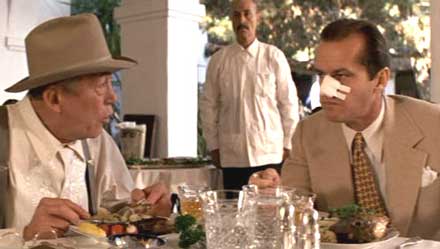
NOIR MOVIE NEWS: Urbaniak and I watched Chinatown a few nights ago, and the next night I happened to go see the new In the Valley of Elah. The movie is good but I couldn’t help notice that, somewhere in Act III, detective Charlize Theron gets her nose injured and spends about twenty minutes of the movie with a band-aid across it. The nod to Chinatown seemed too obvious to be a coincidence, but I had to wonder, was the band-aid put in as a joke by writer-director Paul Haggis, or did Charlize Theron insist on getting her face damaged in order to help sell her as a tough detective?
The Proposition

A gang of outlaws is trapped by the authorities and overwhelmed in a tin shack somewhere in the Australian outback in (I’m guessing) the late 1800s. The gang of outlaws is led by the trim, scruffy Guy Pearce. The sheriff is the not-trim-but-almost-as-scruffy Ray Winstone. Both actors draw vivid, exciting portraits of their characters, men on opposite sides of the law in a savage land suffering the birth-pangs of civilization.
The sheriff gives the outlaw the proposition of the title: I will let you go if you will hunt down your brother and kill him before Christmas. This brother is, apparently, living out in the wasteland, some kind of psychopathic monster, feared by whites and aborigines alike. The sheriff takes the outlaw’s mentally-retarded little brother custody as surety.
This is a terrific setup for a western, with two wonderful actors given parts to sink their considerable teeth into. We can’t wait to see the fireworks between these two characters, the outlaw with a conscience and the sheriff who will commit savage acts in order to civilize a wilderness.
So it’s a little strange when, ten minutes into the movie, the narrative sends the outlaw off in one direction and the sheriff off in another, and doesn’t bring them back together until the very end. What follows is two parallel narrative tracks, with neither track carrying much burden in terms of plot.
The outlaw wanders in the desert, meets a drunken racist and is attacked by aborigines. The sheriff goes home, hangs out with his wife, deals with his subordinates, supervises the simple brother, suffers attacks from his superior, and begins to regret his decision to let the outlaw go. The outlaw meets up with his brother, thinks about killing him, then doesn’t, then decides they should all go get the simple brother out of prison.
The movie is never boring. The scenes are staged with great skill, ingenuity and attention to detail. The photography, acting and production design are skillful and evocative of a blunt, brutal time (the flies covering everything are a particularly vivid detail), but I can’t help think there was a narrative opportunity passed up somewhere. The sheriff’s proposition makes no sense — let a notorious outlaw go to go fetch his more notorious brother, and we’ll keep your simple brother as collateral? That’s his plan? He has been looking for this outlaw gang for a long time and has spent considerable resources on their capture, and the first thing he does is let the leader go? What makes him think he’ll return?
(He says that the outlaw would do anything to save his little brother, but it’s weak — we have only the sheriff’s word on the filial affection, and what, indeed would stop him from coming back with a plan to bust the brother out of prison and kill everybody, which is, indeed, what ends up happening?)
For a while it seems that the outlaw’s journey through the wasteland is going to be an odyssey through the layers of civilization, or perhaps an interior journey into madness and betrayal, but it seems to take no time for the outlaw to meet up with his brother, and even then he gets let off the narrative hook by a spear through the chest, a smashing image that turns the character into a passive protagonist for an entire act.
Why separate the protagonist and antagonist for the entire movie? Where are the stakes? The simple brother is bedeviled in the prison, but the outlaw doesn’t know that, and the “bad brother” doesn’t know anything about the simple brother’s predicament until the end of the second act. There is much brutality and ugliness on display in this angry indictment of nation-building, but little in the way of suspense or narrative drive.
Imagine if in Jaws, the sheriff caught the shark, then let it go, then told everyone that he’d caught it, and then we cut back and forth from the shark swimming around to the sheriff gradually coming to accept that he’d better go kill that shark after all and you have a sense of the powerful, yet curiously static, effect of The Proposition.
Movie Night With Urbaniak: Chinatown
, as you may know, has recently moved to LA. Like any bizzer who moves to LA, he has felt compelled to watch Chinatown. It’s like a trip to the LA History Museum, but entertaining, with sex and murder and incest, which is the way us Neo-Angelenos like our LA history.
I, being an ace Hollywood screenwriter, have watched Chinatown many times, mostly to unravel all the different plot threads. Last time around, for instance, I noticed for the first time that there are, in fact, two mysteries to be solved in Chinatown, which have nothing to do with each other, in spite of involving all the principle characters. There’s the one everyone remembers, about “the girl,” and then there’s the one about “the water thing,” which forms the bulk of the story, but which has nothing to do with the central murder. Chinatown, like any classic noir, is about a jaded detective who stumbles onto a case, which leads him to uncover corruption in the highest corridors of power. But along his way to cracking the first case, this detective also stumbles across a more interesting case. It’s like if the investigators of the 9/11 commission, on their way to investigating Osama bin Laden, found out that George Bush once had an affair with Larry Craig.
Which I’m guessing probably didn’t happen, but I’m wondering now how many hits my blog will now get just for me typing those words.
In any case, it was a change of pace, this time around, to watch Chinatown not so much for story but for the performances.
Our verdict: pretty damn good.
Thinking back over my personal experience of Jack Nicholson’s performances over the decades, and watching this movie on a scene-by-scene basis, I think I have to say that this is probably the best, most detailed, least affected, most well-modulated performance of his career. Just prior to this, Nicholson was a rising star, giving strong character performances in Carnal Knowledge and The Last Detail, and soon after this he gave his career-defining performance in One Flew Over the Cuckoo’s Nest. The “crazy Jack” performance came to its fullest fruition in The Shining, and then in the 80s he veered from character parts to ever-more “crazy Jack” performances, culminating in 1989’s Batman. But here in Chinatown he’s playing someone very close to himself, yet removed by time and profession. There isn’t a single moment where he calls attention to himself, showboats or plays a “character.” The result is a natural, self-possessed performance that lives and breathes, which is all the more spectacular when you consider that he’s playing one of the oldest roles in movies, the jaded, cynical LA private dick. Plot-wise and tone-wise, Jake Gittes is not too far down the road from Philip Marlowe and Sam Spade, and yet Jake is a completely different kind of guy, neat and dapper, ambitious and funny, smart and inventive and nobody’s fool.
Faye Dunaway, on the other hand, seems to be playing someone completely unlike herself, and vanishes into the part. I watched her closely throughout, trying to figure out just what was so strange about her characterization, how different it is from her work in, say, Bonnie and Clyde or Network, how she manages to be so cold, so remote and yet still recognizably human and three-dimensional. Then it occurred to me that it might be her eyebrows, her plucked-out, painted-on eyebrows, such a specific period detail that it removes her character from the 1970s and places her forty years earlier, changes the shape of her face enough to remove memories of past performances, and gives the character the fragile, china-doll (china-doll!) look she requires.
John Huston plays the heavy with such easy grace and sureness, such attention to detail and such confident naturalism, you have no trouble believing that Noah Cross is capable of just about whatever whim crosses his mind. Late in the movie I suddenly thought of Touch of Evil and tried to imagine how Welles would have played Noah Cross, and how very different Chinatown might have played under those circumstances.
At one point in Act III there’s a scene with Nicholson and Dunaway in the front seat of a car. And he’s pressing her on something and she’s being evasive and wrought, and they’ve just had sex a few scenes before, and all the things that have been happening in the story are seeping in between the lines of dialogue, and the actors merge with their characters so completely and I just had to shake my head and think “You know, they really don’t make movies like this any more.”
3:10 to Yuma v The Assassination of Jesse James by the Coward Robert Ford


I liked both of these movies immensely and recommend each highly. They are both exceedingly well-acted, well-shot, well-directed and well-written. But it’s a bad idea to go into one expecting the other. 3:10 to Yuma is a serious, thoughtful, intricately structured, multi-layered yarn of the Olde West, very conscious of its burden of resurrecting an outmoded genre, full of gorgeous landscapes, men on horses, sunlight on hat-brims, railroads under construction, ranchers being forced off their lands, stagecoach robberies, Pinkertons, encroaching civilization, outlaw gangs, cattle drives, a boy who goes on a journey and learns to be a man, Chinese coolies, black hats and white hats and deep thoughts about the delicate razor’s edge the law must walk in a lawless land. It’s not just a classic Western, it attempts to be all classic Westerns, with a dozen different plot turns, smashing character work from all the principles, every scene packed with terrific production design, period detail and realistic lighting. It’s an exciting drama, a rousing Wild West thriller and a well-written character study.
The Assassination of Jesse James is a whole different ball of wax. It has a few gorgeous landscapes, and it does have men on horses, but there is very little sunlight on hat-brims. The railroads are already built, no ranchers are being forced off their lands, there is not a single stagecoach robbery (although there is a wonderful train robbery) or Pinkerton in evidence. A boy does go on a journey and learns to be a man, but in this case the boy is Robert Ford and manhood turns out to be not all it’s cracked up to be. There is, of necessity, an outlaw gang, but the gang is examined so closely, in such minute, well-chosen detail that it never seems like a recapitulation of cliche. In fact, if there is a cliche contained within the execution of The Assassination of Jesse James I am hard-pressed to remember it. Let’s face it, it’s barely even a Western at all, more like a character study, a psychological portrait, a close reading of the last days of an American legend. “Elegaic” and “lyrical” don’t really cover the unsettling beauty and spectral weirdness of this deeply original movie.
If you go to see The Assassination of Jesse James expecting it to be like 3:10 to Yuma, it will probably seem sluggish, tedious and pretentious in comparison. If, however, you go to see 3:10 to Yuma expecting it to be like The Assassination of Jesse James, Yuma will seem shallow, busy and over-plotted in comparison.
THE DIRECTION: I’ve enjoyed most of the James Mangold movies I’ve seen, but the direction in Yuma far surpasses what I’ve seen so far in his work. The shootouts and confrontations are exciting and suspenseful, the actors are all well-directed, the narrative never feels forced or cliched (in spite of containing every Western cliche in the book). I’ve never seen Andrew Dominik’s other movie, Chopper, but the direction of Assassination, as I say, is one of the most original things I’ve seen in movies recently. There wasn’t a single moment where I thought “Ah, and this is the scene where _____ happens.” In spite of the fact that I know the story of Jesse James and have seen it told on screen at least a half-dozen times, I never had the slightest clue what was going to happen next, except that, eventually, Jesse would have to get shot in the back by Robert Ford while adjusting a picture in his house. Big scenes and little scenes are given equal weight, narrative strands come together in beautiful, unexpected ways, surreal beauty haunts the slightest of inserts.
THE ACTING: Wonderful throughout, but again I’m giving the edge to Assassination, partly because, goddamn it, why are two parts as good as the leads in Yuma being played by an Englishman and an Australian? (UPDATE: a Welshman and a Kiwi. I stand corrected. Damn furners.) The leads in Assassination are played by two nice American boys, Brad Pitt is even from the same state as the character he portrays. Pitt’s finely detailed, intelligent, multi-layered portrait of James didn’t surprise me, he’s been blowing me away on a regular basis since Fight Club, but Casey Affleck as Robert Ford is truly astonishing. Russell Crowe and Christian Bale in Yuma are playing “characters,” iconicfigures playing out a grand drama in the West of our consciences, but Pitt and Affleck actually bring Real People to life and add something new and interesting to our understanding of figures who have been examined many times in the past.
THE MUSIC: I was a little disappointed by the score of Yuma — like a lot about the movie, it seemed like an expert recapitulation of classic themes instead of an invention. Whereas the score of Assassination seems both more “authentic” to the time period and more original in its conceit.
Finally, I have to say that the sound design on Assassination is superb, and warrants seeing it in a theater for that reason alone. It’s a very quiet movie about a time before cars, stereos and air conditioners. Far-off laughter, girls singing two houses over, horses hooves in mud, gunshots echoing in a snowy landscape and trains in the misty night are all given detailed, loving attention and go a long way to bringing a lost time to life.
Movie Night With Urbaniak: One-Eyed Jacks

WHITE HAT: “Kid” Rio is a bank robber in Mexico. He steals gold, shoots people and is a pathological liar.
BLACK HAT: Dad Longworth is Rio’s ex-partner. He left Rio to rot in a Mexico prison when a robbery job went south. He took the loot, headed north, bought himself a wife, a daughter, a job (as sheriff, no less) and some respectability.
Kid’s revenge: to rob the bank in the city where Dad’s sheriff and murder Dad for leaving him.
On the way to his revenge, Rio decides to deflower Dad’s adopted daughter Louisa. In the course of the deflowering, Rio is suddenly turned from Max-Cady-like revenge machine to sincere, sensitive soul. Rio lies to get a leg over with Louisa, but by morning he’s confessed all his lies, and by the end of the movie he’s decided against revenge altogether. Such is the power of a young woman’s, um, heart.
LOCATION, LOCATION, LOCATION: Rare for a western, the city in question is Monterey, California. I don’t know why a western on the beach seems unusual, but it does.
WOMEN? There are two major women in One-Eyed Jacks. One is Dad’s Mexican wife (the Madonna), the other is his step-daughter (the virgin). There are also assorted garden-variety barmaids, prostitutes, senoritas and a contessa. Well, the movie is called One-Eyed Jacks, after all (apparently Penises was considered too on-the-nose). Oh, and the Mona Lisa is seen hanging over a bar.
THE STATE OF CIVILIZATION: No doubt about it, Rio escapes from prison to find that civilization is rotten to the core. Thieves put on stars and become law enforcers, hire buck-toothed yahoos for muscle, and use their position to protect themselves from their own guilty past. Rio (spoiler alert) is put through the ringer by this system, but finally figures out a way to escape. Trouble is, he must leave his love, and unborn child, behind, with only the promise to return. Which, given Rio’s luck through most of the movie, doesn’t look too likely. So it seems that civilization is so rotten that living in it is impossible, change only makes things worse. One can only flee. A very Brando attitude.
WESTERN CLICHE ALERT: Outlaws on the run through a desert, chased by a posse. Shootout on a high desert plain. Prison escapees chained at the ankles. Bank job goes south, leading to wasted lives. Protagonist and antagonist switching sides of the law, the criminal becoming moral and the respectable man turning hypocrite. Protagonist and antagonist break bread at the family table, and saying grace before dinner is used as a yardstick of measuring good, and hypocrisy. Protagonist tied to a hitching post and whipped in town square by antagonist. Protagonist is the strong, silent, sly type, until he falls in love, then he becomes earnest, confused and talky, jabbering on and on about his childhood, his lack of direction, his treatment at the hands of the Mexican justice system.
NOTES:I was quite excited to sit down to watch a western directed by Marlon Brando, and was surprised to see that he didn’t seem to have any particular point of view on the material. The direction seems rather anonymous, workmanlike even, and occasionally there are even rookie technical blunders. There are few Brando-ish idiosyncrasies (although the movie opens with Brando sitting on a counter during a bank robbery, tossing banana peels onto a scales, which strikes me as a very Brando-esque way of introducing a theme), the acting is solid but unremarkable by his standards (although Slim Pickens shines as a thoroughly unpleasant sleazeball deputy), there are no daring stylistic moves. There is occasional wit in the screenplay (Dad: “How you doing, kid?” Rio: “Oh, I’m sneakin’ by.”) The sets and lighting look standard-issue, and one prison set looks utterly fake even on the disastrous transfer currently available (see below).
Stanley Kubrick was the original director on the project and it’s hard for me to see what would have attracted him to the material — the story is told in a resolutely un-Kubrickian fashion (which may explain why he ultimately left).
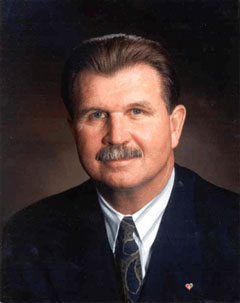
In the course of the narrative, Karl Malden grows a moustache and suddenly looks like Mike Ditka.
The story is told in four acts: Act I, Rio and Dad rob a bank, get chased, Rio is abandoned and taken capture. Act II, Rio vows revenge on Dad and sets about it, planning a bank robbery and deflowering Dad’s step-daughter. Dad gets wind of all this, beats Rio mercilessly and drives him out of town. Act III, Rio licks his wounds and ponders what to do with the rest of his life. Act IV, Rio’s gang goes rogue on him, robs the bank, blows the job, Rio is arrested, escapes from jail, has a shootout with Dad, flees the country.
This structure makes the movie seem quite long. Generally, the action in a motion picture speeds up at the beginning of Act III as the characters’ motivations come into sharp relief and agendas clash, but here the action slows down to a crawl and the protagonist’s goals become fuzzy and confused.
I am told that Brando’s original cut of the movie ran over five hours and was greatly concerned with the shades of gray in all the characters’ lives. Touches of that ambiguity still remain, but as it is, One-Eyed Jacks seems very much like a typical early-60s studio product. The score, too, seems rote and uninspired. The movie was, apparently, a hit, but Brando disowned it and never directed again.
I’d like to note that the DVD Urbaniak and I watched, issued by an outfit calling themselves “St. Clair Vision,” is, by a long stretch, the crappiest DVD transfer I’ve ever encountered. I once wrote that the DVD transfer of Spielberg’s 1941 looked like it had been made by pointing a video camera at a TV playing an old VHS copy of the movie. Well, One-Eyed Jacks looks like it was made by pointing a video camera at a TV playing a VHS copy of the movie, through an aquarium smeared with petroleum jelly. The movie, which has apparently fallen out of copyright for some reason, can be watched in its entirety here, in quality no worse than what we’ve just watched.