Live Nude Plastic Dinosaurs
Successful artists know that regular life-drawing sessions are essential for keeping the eye sharp and accurate.
As an unsuccessful artist, I can’t afford to have naked models come over to my house merely for the sake of honing my drafting skills, so I have to make do with my son’s dinosaur toys.


Screenwriting 101 — The Act Break
asks: “I’m often confused about just where act breaks occur. Reviews often mention them as if they’re obvious, but they aren’t to me. Do you know of a good primer that would help me understand this?”
My father once described it to me like this:
In Act I, a guy gets stuck up in a tree, in Act II they throw rocks at him, in Act III he gets down from the tree.
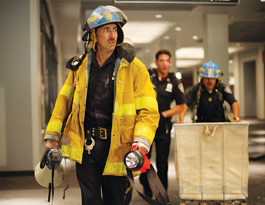
Strangely enough, if you take out “tree” and put in “collapsed skyscraper,” you have exactly the plot of Oliver Stone’s World Trade Center, so let’s look at the structure of that.
In Act II, they literally throw rocks at him for forty minutes. He’s stuck under a ton of cement and twisted metal, he has no idea what has happened to him, he’s got his buddy pinned under a different ton of cement and twisted metal a few yards away and rocks keep falling on his head. And he has to deal with that, and we see, step by step, how he deals with that — he thinks about his family life, he thinks about his job and his friends, he hallucinates visions of the Virgin Mary. And while it’s been a while since I’ve seen the movie, I’d guess that the “Act II low-point” occurs when poor Nic has given up hope of ever getting out from under this collapsed skyscraper.
Then, in Act III, a ray of hope! Someone up top realizes that Nic is trapped under this collapsed skyscraper and we see, step by step, incident by incident, how a team of men work together to get him out. And there is much nail-biting suspense regarding if they’ll get to him in time, if the wreckage of this collapsed skyscraper will shift and smoosh poor Nic, if he’ll lose an arm or a leg or his sanity, et cetera.
So there you have it. Inciting incident: airplanes crash into the World Trade Center. Our protagonist is a simple working-class joe trying to do his job, gets caught up in the story of the century. Act I illustrates how he ends up under the collapsed skyscraper. There is escalating tension throughout Act II because, let’s face it, he’s trapped under a collapsed skyscraper and there isn’t much to go on as far as ideas for how to get out of that situation. Inevitably, despair sets in as it appears he will never get out from under the collapsed skyscraper, then, in Act III, miraculously, he does.
David Mamet put it a slightly different way: he said that Act I is “Once Upon A Time,” Act II is “Then One Day” and Act III is “But There Was One Thing That They Forgot.” So we would say that World Trade Center goes “Once Upon A Time there was a Working-Class Joe just trying to do his job with his team of Other Working-Class Joes. Then One Day a skyscraper collapsed on top of him and he worried that maybe he’d die under all that cement and twisted metal. But There Was One Thing That He Forgot, which was that, Working-Class Joe that he was, he was part of a Community of Working-Class Joes, and if there’s one thing you can say about Working-Class Joes, it’s that they are at their best when things are at their worst, and they will move heaven and earth when one of their own is in trouble.”
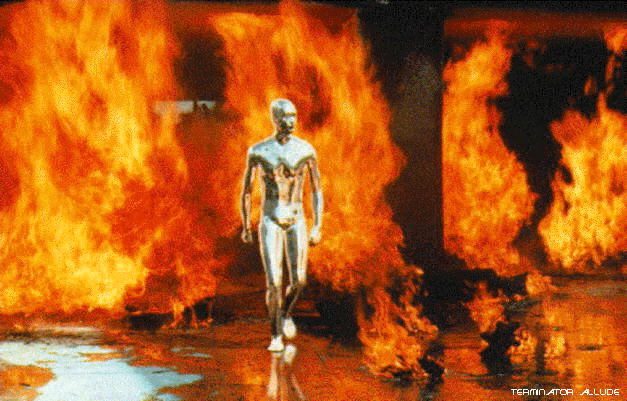
It’s also worth noting that not all movies have a three-act structure. Terminator 2, for instance, has a four-act structure. Act I sets the board with all the different characters: John Connor, the T-101, the T-1000, Sarah Connor, John’s evil foster parents, Sarah’s evil doctor, so forth, and sets them on their courses. Their stories all converge into a massive action sequence at the end of Act I. As Act I ends, John has survived the attack from the T-1000, is away from his foster parents and with his “new dad,” the T-101. Act II involves John beginning to understand the new rules of this new terminator setup and deciding that, in spite of what he’s been told, that they have to go get his mother, and so Act II sends John and the T-101 and the T-1000 all converging on the hospital where Sarah is being held prisoner and climaxes with them busting her out of the joint. Act III has them resting after their adventure, healing up and deciding what to do next. John decides one thing, but Sarah decides another, and Act III has, again, two teams heading to a destination with conflicting agendas. Sarah decides she’s got to kill Miles Dyson and John decides that killing is wrong no matter what the consequences. And again, just as with the preceding two acts, both teams arrive at their destination (that is, Dyson’s house) at more or less the same moment and a spectacular action sequence takes place. Through the prosecution of that action sequence (and again, here we see Cameron’s intuitive genius for the meaning of action) the stakes change. Sarah Connor is prepared to kill Dyson and John and the T-101 show up to stop her, and through the convergence of these two opposing forces, a new and surprising outcome occurs: Sarah achieves her goal of stopping the development of Skynet and does so without having to kill Dyson. (This moment is a particularly wonderful inversion because John has managed to turn the Terminator into a peaceful, protective machine but can’t control his crazy, bloodthirsty, out-of-control mother.) Act III climaxes with the destruction of Dyson’s company headquarters and yet another escape from the T-1000. Act IV is then a massive, multi-part action sequence involving trucks and motorcycles and helicopters and liquid nitrogen and molten steel and all that good stuff.
Movie Night With Urbaniak: Terminator 3: Rise of the Machines

“I’m now beginning to understand your appreciation of the genius of Schwarzenegger’s performance in Terminator 2.” —
, mid-way through Terminator 3: Rise of the Machines
Terminator 3: Rise of the Machines is the perfect expression of commerce trying, and failing, to overtake artistry. The makers of Terminator 3 felt that if they hit enough “Terminator-related plot points,” presented in a new, interesting way and with a large enough budget, they would have another Terminator movie. But let’s not delude ourselves: Terminator 3 is the work of skilled, talented professionals and Terminator 2 is the work of a great artist.
(The animal hospital is destroyed and the woman with the sick cat is killed. We never hear what happens to the cat — there’s a mistake that never would have happened in a James Cameron movie.)
Now then: the action sequences.
Here is a cardinal rule of drama as I understand it: action arises from the desires of the story’s characters. “Action” may here be described as anything from a guy getting up from a table to fetch a beer from the refrigerator to two robots from the future duking it out in an abandoned steel plant.
When The Phantom Menace came out, George Lucas acknowledged that the Pod Race sequence was an homage to the immortal Chariot Race sequence in Ben-Hur. This is a perfect example of a writer-director misunderstanding the use of action.
The Chariot Race in Ben-Hur is, indeed, one of the most thrilling and technically sophisticated action sequences ever shot, but the reason it thrills in the context of Ben-Hur is because everything in the narrative up to that point has been building toward that chariot race. The first act of Ben-Hur is the story of two boyhood friends, one Roman and one Jewish, who love each other dearly but who are forced to become bitter enemies via the vagaries of law and race and heartless destiny. For over an hour we watch their relationship grow and be torn asunder, watch resentments grow and regrets harbored, a lifetime of loss and suffering unfolding before us, the narrative tension being screwed up into nail-biting levels. These two characters love each other and hate each other, and this chariot race is going to settle their differences for all time — it’s a life and death struggle we are heavily invested in, which is why each spill and crash in the famous Chariot Race sequence has thrust and devastating impact.
The Pod Race sequence in The Phantom Menace, on the other hand, occurs because the Jedi’s spacecraft needs a spare part. We care nothing about the Jedi’s spacecraft, we don’t believe that the spare part is important, we barely care about the Jedi’s problems at all, we don’t believe that this Pod Race scheme is the most likely plan for getting the spare part, none of it means anything. The race itself is an exhilarating exercise in staging, editing and special effects, but it has absolutely zero narrative impact.
James Cameron, regardless of any flaws you’d care to assign to him as a director, understands action like few other directors ever have, and all one has to do is compare either of the two truck chases in T2 with the massive truck-chase sequence in Terminator 3. Cameron directs his action with great intelligence, muscle, logic and heart — the characters’ desires conflict and give rise to the action, which flows naturally and with what I can only call humanity. You know where everything is in a Cameron action sequence, they have a sweep and inevitability to them and a sense of escalating stakes, not just escalating effects. You feel every crash, explosion and bullet wound because the action means something. The truck chase in Terminator 3 has been designed, staged and shot with great skill and imagination, but its effects come from nowhere, signify nothing and are there simply because they sounded cool in the story meeting. (“And you know what would be great? In the middle of the chase, what if the crane on the back of the giant truck turned sideways? And then a whole bunch of cars would go flying up in the air, and then, get this, it takes out a whole building!”) The makers of Terminator 3, like so many filmmakers before them, labor under the mistaken impression that audiences flock to movie theaters in order to experience production values.
(The action sequences in the Bourne movies are other stellar examples of action filmmaking. Because let’s face it, under normal circumstances, if someone attacks you with a knife in your apartment, that is, hopefully, a pretty big event in your day. The directors of the Bourne movies understand the startling impact of the simplest action beats — they ground them in a physical reality so specific that it feels like the bad guy is punching you instead of Bourne. They prove that, if you know what you’re doing, you can get more thrills out of a knife, a magazine and a toaster as you can with a flying robot and an army of commandos.)
The fight scene in the bathroom where the Terminator and the TX hit each other with sinks and toilets works quite well, has a logic and impact that the other sequences do not.
(Let me add here that I am a big fan of Jonathan Mostow’s earlier work, especially Breakdown, which climaxes with a wonderful car chase.)
Elsewhere, the script of Terminator 3 is glib and anecdotal when it needs to be epic and primal. The themes and conflicts introduced in the first two movies (fate, destiny, motherhood, fatherhood, manhood, so forth) are here expanded to “romantic love,” an attempt that leads only to lame comedy and unconvincing lovers.
Kristen Loken, who plays the Girl Terminator, plays her Evil Robot from the Future with smugness and and self-conscious sexiness, prompting the quote from Urbaniak at the top of the page. Schwarzenegger is okay in this movie, but he scowls a lot and his timing is off — he’s perfect in T2 but this script, while it has its moments, doesn’t serve his character well.
Even Schwarzenegger’s makeup is off in this movie — when his skin is burned away, it reveals what is supposed to be the metal skeleton beneath, but the “metal skeleton beneath” is obviously a latex appliance stuck to the actor’s jaw — it doesn’t move as the actor speaks, as it would if it were exposed jaw-bone, it just remains glued to the side of his face.
This observation prompted me to tell Urbaniak the one nice thing I have to say about Batman and Robin: surely one of the worst movies ever made, it nevertheless features an outstanding makeup job on Schwarzenegger as Mr. Freeze, a dense, subtle frosting of blues and silvers, believable and evocative, topped off with silvery contact lenses that really help sell the character, as long as he’s not wearing his ridiculous Tin Man outfit.
(Discussion of Batman and Robin prompted Urbaniak to direct me to this, which I now direct you to.)
When Urbaniak and I watched Terminator 2 the other night, I had seen the movie at least ten times and it had never occurred to me before that the steel plant at the end of the movie was a set. But of course it is, the whole thing must be a set. In contrast, the Big Shiny Army Base that Army Dad works at looks absolutely like a set and like nothing else. You’d never guess for a moment that anyone ever worked in any of the offices or industrial settings of Big Shiny Army Base, another example of how Cameron wants us to believe that his fantastical characters are real and in genuine peril, while the makers of Terminator 3 wish to constantly remind us of how much money they spent on this thing. Throughout the movie, you can feel the filmmakers working not from a script but a checklist — truck chase, check, gun cache, check, Dr. Silverman, check, sunglasses gag, check, redneck bar, check, end of the world, double check. Mid-way through the third act, Urbaniak wondered aloud when someone would get around to calling the Girl Terminator a “bitch” before destroying her. The movie obliged less than three minutes later.
Update: evil robots, dirty cops,anxious Swedes and a neurotic Jew
My apologies for the recent lack of postings — I am finishing up an assignment and have been dealing with two kids over the moon about the arrival of Halloween.
I have little of interest to report — or perhaps, more accurately, I have little energy at the moment to report anything. However:

ITEM! ![[info]](http://stat.livejournal.com/img/userinfo.gif) urbaniak and I watched Terminator 2: Judgment Day last night. I have little to say about this movie that hasn’t been said many times by many others. It has a screenplay of similar structure to the original (two mysterious strangers from the future show up, one wants to kill the protagonist, the other wants to save him, the first act is devoted to putting the pieces in place, the second act is about explaining the rules and catching the audience up to the action, the third act is about all the pieces coming together in a massive, bone-crushing action sequence) but vastly improved and with about a hundred million more dollars worth of production values. A pinnacle of American movie-making and James Cameron’s greatest achievement. I would also like to commend the two leads, Linda Hamilton and Arnold Schwarzenegger, both of whom turn in career-best performances that, for my money, stand next to another beauty-and-beast team from 1991, Jodie Foster and Anthony Hopkins in Silence of the Lambs, for sheer effectiveness. Schwarzenegger is okay but a little clunky in the first movie, but he’s just spectacular in T2 — slimmed-down, poised and in total command of his movements and voice. Schwarzenegger gets a lot of stick for playing a robot but what he does in this movie is a lot more subtle, complex and nuanced than one would expect from the big guy. He was a special effect in the first movie but here he’s a real actor giving a real performance — and not hogging the camera, either. As for Linda Hamilton, she seems like a completely different actor than the woman in The Terminator. She tough, uncompromising, no-bullshit and impossible to take your eyes off of. I watch her in this movie and am baffled that she doesn’t have a career equal to her contemporaries. I guess there just aren’t enough roles written for women with rock-hard shoulders who want to play moms whose kids can help them load machine guns.
urbaniak and I watched Terminator 2: Judgment Day last night. I have little to say about this movie that hasn’t been said many times by many others. It has a screenplay of similar structure to the original (two mysterious strangers from the future show up, one wants to kill the protagonist, the other wants to save him, the first act is devoted to putting the pieces in place, the second act is about explaining the rules and catching the audience up to the action, the third act is about all the pieces coming together in a massive, bone-crushing action sequence) but vastly improved and with about a hundred million more dollars worth of production values. A pinnacle of American movie-making and James Cameron’s greatest achievement. I would also like to commend the two leads, Linda Hamilton and Arnold Schwarzenegger, both of whom turn in career-best performances that, for my money, stand next to another beauty-and-beast team from 1991, Jodie Foster and Anthony Hopkins in Silence of the Lambs, for sheer effectiveness. Schwarzenegger is okay but a little clunky in the first movie, but he’s just spectacular in T2 — slimmed-down, poised and in total command of his movements and voice. Schwarzenegger gets a lot of stick for playing a robot but what he does in this movie is a lot more subtle, complex and nuanced than one would expect from the big guy. He was a special effect in the first movie but here he’s a real actor giving a real performance — and not hogging the camera, either. As for Linda Hamilton, she seems like a completely different actor than the woman in The Terminator. She tough, uncompromising, no-bullshit and impossible to take your eyes off of. I watch her in this movie and am baffled that she doesn’t have a career equal to her contemporaries. I guess there just aren’t enough roles written for women with rock-hard shoulders who want to play moms whose kids can help them load machine guns.

ITEM! While finishing my assignment, I’ve been taking breaks by watching Season 3 of The Shield. If you’ve never heard of The Shield, stop what you’re doing right now, run to your video store and rent the first season. The pilot of The Shield is not only the greatest pilot in television history, it’s the spearhead of some of the greatest dramatic writing I’ve ever witnessed. Show after show for six seasons, this show kept up a seething, scathing, furious boil of urban Jacobean drama. Astonishingly intelligent, jaw-droppingly intense and complex. When I see a movie these days, I don’t say “Is it as good as Citizen Kane,” I say “Is it as good as an episode of The Shield?” Michael Chiklis as Vic Mackie is one of the great television performances of all time, on a par with Carrol O’Connor on All in the Family, Peter Falk on Columbo and Hugh Laurie on House. The fact that Mackie is perhaps the most unpleasant character ever delineated on television makes it that much more compelling.

ITEM! Before he became one of the 20th century’s most important and enduring artists, Ingmar Bergman was a screenwriter, just like me! His first produced screenplay is called Torment (there’s a calling-card title if I ever heard one). The movie was directed by Alf Sjoberg, but oozes Bergman all over the place. Students of excellent screenwriting must, must, must familiarize themselves with Bergman’s screenplays — they are expertly balanced, classically structured, compact little gems that manage to plumb the depths of human desires and needs without making a big deal about it.

ITEM! Took my son trick-or-treating tonight in Santa Monica. Certain blocks north of Montana were as crowded as Times Square the night before Christmas and as garishly decorated. A splendid time was had by all and I had the pleasure of sighting Larry David making his way through the crowd. As a New Yorker, I am forbidden to approach a celebrity in the street no matter high my admiration for his work.


Movie Night With Urbaniak: The Terminator

The Terminator perfectly embodies two crucial truths about motion pictures:
The motion of the narrative of The Terminator could not be more perfectly shaped. The first act presents all its players, tells us nothing about them except their actions, and sets them on an irreversible collision-course toward each other. There is no scene where the Terminator explains who he is, there is no scene where Reese pets a dog to make him “likable,” there is no scene where Sarah Connor complains to her roommate “look at me, I’m pushing 30 and I’m still working as a waitress! I’m such a mess, I’ll never get a guy or have kids! My life will never mean anything!” The Terminator moves implacably toward his goal, Reese moves implacably toward his, and Sarah gets caught in between. Once the characters all meet up, chase each other and exchange gunfire, they break apart for the start of Act II and we finally get a little information about who Reese is, who the Terminator is and why they’re doing all these crazy things. As the confusion lifts, solid, eternal themes emerge — destiny, fate, motherhood, fatherhood, the nature and purpose of humanity, all dealt with with a maximum of economy, grace and visual acuity. What Urbaniak calls “the moebius-strip nature of the time-travel movie” is intricately laid out in scenes that are heavily expository yet crammed with suspense and action, so that a 106-minute movie with a complicated backstory flies by in no time whatsoever. Events follow hard upon each other so that the story plays out over a matter of days, the few scenes of rest contain tidbits like a robot peeling off its face or a tutorial on building pipe bombs, the emphasis is on pursuit and jeopardy, sacrifice and honor. The love story, improbable as it is (two people meet, one a soldier from the future, fall in love, have sex and conceive a child, all within 24 hours, while being pursued by an evil, unstoppable robot) works because it stands as the inverse of the antagonist, a character who exists only to destroy.
TRUTH 2: Different narrative forms naturally lend themselves to different aspects of existence. The novel is ideal for presenting the inner lives of its characters, the play is ideal for showing people in a room talking and movies are ideal for showing large metal objects hurtling through the air. Or, to put it another way, novels are good for delineating thought, plays are good for presenting speech, and movies are good for displaying action. The action, however, cannot be action for its own sake. The lesser talents who followed James Cameron into the arena of “80s action movies” often did not share his intuitive sense of what constitutes effective action. An action setpiece in a movie is a lot like a song in a Broadway show. In a good Broadway show, the songs are memorable and powerful and also advance the plot, so that the narrative stakes at the end of the song are higher than they were at the beginning. In the bad Broadway show, the songs are “show stoppers,” big production numbers exuding spectacle and bombast, after which everyone goes back to doing exactly what they were doing beforehand. And so it is with the action movie. The excellent action sequence is a culmination of narrative, sharply expresses character, is innovative and surprising, uses location in a vital and thematic way, and serves as a plot turn without which the narrative is meaningless. The 80s and early 90s teemed with movies whose action sequences did none of these things. These movies are largely forgotten now, but the ones that remain, principally the Die Hard movies, the Terminator movies, Aliens, the first 80 minutes of The Abyss, and a few others stand as the fulfillment of not just action movies but as a genuine fulfillment of the potential of the cinematic form.
Control

Control is a bio-pic about Ian Curtis, the lead singer of the seminal British post-punk band Joy Division. I recommend it highly to those interested in the world of British post-punk music, gorgeous black-and-white photography, excellence in acting. I also recommend it to students of the bio-pic genre.
Many reviewers more qualified than myself have made the case for this movie, so I will keep this brief, but there were a few things of which I’d like to take special note.
The problem with correcting these cliches of the form is that audiences crave plot. Topsy-Turvy, Mike Leigh’s brilliant movie about the creation of Gilbert and Sullivan’s Mikado, is one of the greatest biographical dramas you will ever see, but is not a popular favorite. The conventional bio-pic, Walk the Line for instance, conceives of its narrative (“talented hick singer strikes it rich and has trouble adjusting to fame and wealth”) and then tailors all its scenes to serve the narrative. It takes messy, surprising, disorganized life and retro-fits it into mere “plot.” The result is more commercially viable but also dramatically false. The rise to fame of Johnny Cash is not a surprise to us, because we already know Johnny Cash was famous. We know this because we’ve heard of him.
The creators of Control offer very little cultural context for the creation of Joy Division’s music. There are no fights between band members over the guitar solo that would later go on to become famous, there is no scene where the young songwriter takes in the whole of northern British culture and, at the end of the pier on a stormy night, vows to his girlfriend that one day he will shape the anxiety and alienation of his generation into a sound that set the world on fire, there are no scenes of young men being lured by the temptations of the road (scene in Walk the Line: Johnny Cash: “Gosh, that Elvis Presley has so much energy — how does he do it?” Other Guy: “He ingests illegal drugs — be careful about that, Johnny Cash.“) There is no scene where a smug, supercilious label head says “Songs about William S. Burroughs novels are on their way out, Mr. Curtis.” There is no scene where Curtis has a fight with his wife, during which he says “I love you” and then she screams, “Ian, love will tear us apart!” and then he says “Wait! Say that again!” There is little in the way of delineating the band’s struggle to get to the top — no humiliating failed auditions, no intra-band intrigue, no duplicitous management. There’s this guy, Ian Curtis, he joins this band, they’re good, they play live and excite people, they go on tour. The movie neither promotes nor judges, it merely records, secure that what it records is interesting and compelling by itself.
The ultimate goal of an excellent bio-pic, it seems to me, is to give the impression that your characters are living their lives, and your camera just happens to be in the room at the time. The temptation of the conventional bio-pic script is to have each character live out the thrust of their life story in each scene, so that a movie featuring Thomas Jefferson as a minor character must have him pine for the unfulfilled rights of men and lust after a Negro maiden. (David Mamet sums up this tendency in biographical drama as “Hello, because I am the King of France.”) In real life, people who go around announcing who they are and what they stand for are the most suspicious and false people of all. People don’t go around acting out the arc of their lives; people wake up and eat and hang out and argue with one another and watch TV and fart and make love and think about things, and those are the scenes that make up the bulk of Control.
2. The casting and acting in Control is extraordinary, down to quite minor roles. I knew nothing about the Manchester music scene of the late 70s, but after seeing the movie I went online to look some of these people up and all I can say is that the movie appears to get them all exactly right. Special creditgoes to the young men playing the band, who not only convincingly impersonate Joy Division in performance but also appear to be actual people in their own right. When I think of a movie like, say, Back Beat, about the Beatles days in Hamburg, what I remember is the Beatles boiled down and reduced to types; Control presents the members of Joy Division as bright, talented, slightly sullen young men with not much to say apart from their music. We’re on the outside of these young men; even in an interview scene, they don’t seem to have much to say for themselves. “Restraint” seems to have been a watchword for the producers of Control, and the fact that this is director Anton Corbijn’s first narrative feature makes it all the more impressive.
3. I can’t help think that the people releasing Control missed a marketing opportunity by not putting the movie out in mid-June. would have made an excellent Father’s Day movie. Dad’s in their 40s could reminisce about their youths, bond with their teenage emo kids, and best of all, end up feeling really good about themselves, because, let’s face it, there were few fathers or husbands more irresponsible or screwed up than Ian Curtis. Married in his teens, a father by 21, Curtis seems to have been opaque to his wife, horrified by his child, remote, withdrawn, passive, secretive and incommunicative to the point of robotic. Some of America’s worst dads could leave Control and feel like Father of the Year. I can see a generation of sullen teens watching Control and then sending their dads heartfelt cards of thanks for not hanging themselves in the kitchen for their moms to discover.
Further thoughts on Return of the Jedi

In the past, I’ve discussed Return of the Jedi and compared its plot to the plot of The Empire Strikes Back. I thought I was done with it, but it turns out the movie has more to offer than I have previously noticed, probably because I in the past I have spent too much of the running time looking at the seams on the backs of the Ewok costumes.
The other day, my son Sam (6) requested to watch it again and kept marveling at how swiftly it moved. No sooner had the good guys escaped from Tatooine than Sam exclaimed “Wow! The movie’s already at the ending!” What he was picking up on was the trifurcated nature of ROTJ‘s plot: it’s a 40-minute movie about the rescue of Han Solo, then its a 40-minute movie about the good guys’ adventures with the Ewoks, then it’s a 40-minute movie about the two-pronged attack on the forces of the Empire. Each one of these featurettes is tight, entertaining and beautiful to behold and no, I’d have to say that, taken as a whole, ROTJ is not a chore to sit through.
Sample conversation:
EMPEROR: The rebels have landed on the moon of Endor, exactly as I have planned.
VADER: Yes, your majesty. My son is with them.
EMPEROR: He is? How do you know?
VADER: I have felt his presence.
EMPEROR: Really? I haven’t.
VADER: If you want, I’ll go fetch him and bring him here.
EMPEROR: Yes, that’s a good idea. Exactly as I have planned.
The Emperor has only one goal: lure Luke to the Death Star so that he can turn him to the dark side. This is, in fact, the only reason he has for building the second Death Star. Because, let’s face it, “Second Death Star” is the lamest idea imaginable. The first massive, impregnable Death Star got blown up by a rebel hotshot, what star-system is going to tremble at the thought of a second Death Star, one that’s still under construction? So the Emperor isn’t planning to use the second Death Star to blow up any planets, he’s using it solely as a big shiny object to lure Luke into his trap. I can see the meeting now:
EMPEROR: I need to get that Luke Skywalker guy here so I can turn him to the dark side.
VADER: Dancing girls?
EMPEROR: No, he’s too much of a straight arrow.
VADER: Double coupons?
EMPEROR: He’s a Jedi, he gets discounts all over the place.
VADER: Second Death Star.
EMPEROR: Second Death Star, that’s absurd, it would be a monumental waste of resources and manpower. The last Death Star made me an utter joke throughout the galaxy. Why on earth would I want to build a Second Death Star?
VADER: I’m just saying, if you want to attract Luke, the ol’ Death Star trick is the best bet going. In fact, I’ll tell you what — let’s only build it half-way! It’ll save us money, it’ll bring Luke here on the run and he’ll be really overconfident!
EMPEROR: Yes. Yes. This is exactly as I have planned.
VADER: (throws up hands in gesture of helplessness)
Princess Leia starts off this movie strong, disguising herself as a bounty hunter to free Han Solo, then strangling a gangster slug to death with a chain while dressed in a smashing outfit. But then what happens? She tags along on a mission with Solo, gets picked up by the Ewoks, finds out she’s Luke’s sister. The end.
Han Solo’s destiny is the reverse of this. His motivation through Act I is “to do something about being blind and getting fed to a monster,” which, in screenwriting terms, is what we call a weak motivation. As Act II begins, he volunteers (as a rebel general, no less) to lead a commando raid on the Endor moon to blow up the Shield Generator. His daring raid gets hijacked, like the movie, by the Ewoks, and the rest of his arc revolves around dealing with the Ewoks, hanging out with them (he spends all night sitting around listening to C-3PO tell stories, then complains about being pressed for time) gaining their trust and enlisting their aid in his guerilla attack on the Imperial troops.
Which brings me to the Shield Generator. The Shield Generator, with its unprepossessing “back door,” becomes the locus of action in Return of the Jedi. The plot of A New Hope is driven by the construction, implementation and destruction of a moon-sized battle station, but the plot of Return of the Jedi is driven by a pair of sliding doors in the side of a hill somewhere in a forest. We’ve got to get in through those two sliding doors! How will we do it? If only there were a rebel army to help us! The Second Death Star, face it, barely figures at all into the plot of Return of the Jedi. It’s of minimal importance. Know how I know? Because it gets destroyed not by Luke or Leia or Han or the droids or even Chewbacca. No, the destruction of the Second Death Star falls to Lando Calrissian and this guy, a giggling, mouth-breathing alien we’ve never met before.
So the focus of Return of the Jedi is no bullshit Second Death Star; the focus of Return of the Jedi is more personal and, ultimately, more mysterious and, in part, goes back to this Shield Generator.
First, let’s divide the players of Jedi into three teams: there are the Rebels, the Imperials and the Ewoks. The Imperials dominate the galaxy with their impressive (if ultimately useless) technological marvels and employment of white, English guys, the Rebels have put together a rag-tag coalition of various species, technologies and whatnot, and the Ewoks are, literally, still living in the trees and fighting with rocks and sticks. So technologically, the lines are drawn: Upper Class (Imperials), Middle Class (Rebels) and Lower Class (Ewoks). The Middle Class, rebelling against the Upper Class, are forced to resort to employing the Lower Class to win their battle. They do not do so willingly — the Middle Class does not understand the Lower Class and their primitive ways, and would prefer not to associate with them. One wonders what is to become of the Ewoks in the triumphant new world after the victory of the New Republic. Will there be cuddly Ewoks, with their spears and animal skins, showing up in the new Republic Senate? Regardless of their role in defeating the Emperor, what kind of power would they have in a new Republican order, being so backward and primitive? It would be like the Tasaday having an ambassador to the UN.
There is also a strong religious component to Jedi. Again, separating the players into teams, what we find is that the Ewoks represent the Old God (which, ironically, includes C-3PO, a droid) (but not R2-D2, oddly enough), the Rebels represent the True God (that is, The Force) and the Imperials represent the False God (The Emperor). If we look at Jedi through a religious lens, it becomes a story about missionaries colonizing a new land and bringing their “advanced” beliefs to the funny, superstitious primitives. Luke becomes the rebellious Christ, representing the new covenant, throwing the moneychangers out of the temple, again, oddly, with the help of the superstitious primitives.
(Or, on a nationalistic level, we could say that the Empire represents Imperial England [which would explain all the English people], the Rebels represent the melting-pot United States with its crazy-quilt of races and ideas, and the Ewoks represent the Native Americans. Which means that in Episode VII, all the Ewoks will die from Rebel-introduced diseases or be wiped out as the New Republic colonizes their moon to put up strip-malls and liquor stores. A few hundred years down the line, the few surviving Ewoks will be granted casino licenses to assuage Republican guilt.)
No wonder the bulk of the movie takes place in “the forest” (after successfully negotiating an exodus from enslavement in “the desert”). It’s not “a forest,” but “the forest,” that is, the Forest Primeval. That is the Forest the Rebels and Ewoks and Imperials stumble around in while deciding the fate of the galaxy. Who is “right” in the Forest Primeval? Which god, which class, shall triumph? How will society evolve? Will we remain with our primitive superstitions, or turn to a False God with its powers to create False Worlds (that is, the Second Death Star) with is awe-inspiring technology, or will the True God prevail?
The Ewoks irritate not because of their character design or their “cuteness” or their obvious racial characteristics but because, for forty disastrous minutes, they derail the plot of the movie, keeping the protagonist from his goal (“I shouldn’t have come, I’m jeopardizing the mission,” frets Luke, perhaps not realizing how right he is) and thrusting Theme into a position of dominance over Plot.
The Shield Generator, then, becomes a metaphor for the “shields” constructed between classes, religious beliefs and friends. There is a shield between the Rebels and the Ewoks, between Vader and Luke, between Han and Leia, between Vader and Obi-Wan. When Han destroys the Shield Generator (nice that the Shield Generator is an invention of the False God), all those shields vanish, allowing Vader to see the Emperor for who he is, Han to see Leia for who she is, and Vader to hang out with Obi-Wan and Yoda in blue sparkly heaven. This is all very nice and elegant, but as I say, the plotting of the middle act of Jedi is a disaster.
Some other thoughts:
1. I wonder what happened to Jabba’s criminal empire after Leia strangled him and Luke blew up his sail barge. It was enormous and powerful enough to make Jabba a force more powerful than Vader in the eyes of the Emperor (otherwise why would Vader worry so much about offending Boba Fett in The Empire Strikes Back?) (I mean, apart from the fact that he’s in love with him), such a thing is not going to simply dry up and blow away like so much roasted meat in the Dune Sea under harsh Tatooine binary suns. Odds are, an intergalactic gang-war erupted after Jabba’s death with many deaths, shady deals and spectacular shoot-outs. The gangster aspect of the Star Wars universe is under-served.
2. Yoda dies, and disappears. Obi-wan dies, and disappears. Vader dies, and must be lugged onto a stolen shuttle and hauled down to the Endor moon to be cremated (or barbequed — it’s not clear; the Ewoks, after all, do eat human flesh and threaten to eat Luke and Han earlier in the movie). I couldn’t care less, but this inconsistency confuses my son Sam. Why do some enlightened beings disappear at the point of death and other writhe in bloody agony? Qui-Gon does not disappear when killed by Darth Maul, hundreds of Jedi die like dogs in the dirt in Revenge of the Sith and do not disappear. Sam posits that only those who come back as ghosts get to disappear, and yet at the end of Sith it’s revealed that Qui-Gon has come back as a ghost — why didn’t he disappear? Darth Vader not only comes back as a ghost (just in time to witness his own cremation — that must feel weird), he comes back as his 25-year-old self. That seems to me to be enough magic to allow one to disappear at the point of death, but apparently not.
3. Leia tags along on Han’s mission to Endor. She dresses in Rebel Camouflage. Then she’s captured by Ewoks, and emerges in a lovely Forest Ensemble. Where the hell did that come from? Similarly, Luke goes on a speeder chase through the woods and wanders around with Han, yet when it comes time to meet up with dad, he’s got on his Don’t Mess With Me Jedi Black. Where do these clothes come from?
4. Luke asks Leia what she remembers of her mother. Leia gives him a sketchy description of an unhappy but loving woman. Odd, seeing as how Leia’s mother is also Luke’s mother and she died at the moment of their birth. Obviously, Leia, pressed into an uncomfortable position, has decided to make up a bunch of utter bullshit in the hopes that maybe that will make her appear more vulnerable and interesting to Luke. Then she finds out Luke’s really her brother — oops.
5. Luke, who’s supposed to be a Jedi (or near enough), is a terrible negotiator. He constantly tells his enemies his plans and opinions, giving them plenty of information and tools against him. I like Luke as much as the next guy but Qui-Gon would punch him in the mouth for that bullshit, and I’m surprised Obi-wan “Truth From A Certain Point Of View” Kenobi puts up with it too. Of course, then again, Qui-Gon is the Jedi who was too principled tosteal a Hyperdrive Generator from a slave-owning junk dealer, so he’s a lame-o too. Obi-wan, though, there’s a guy who decides not to tell his own apprentice (and future savior of the galaxy) that the most Evil Guy in the Galaxy is his father because it serves his purposes. Now that’s a negotiator.
Brute Force


I’d never heard of this movie before the Criterion folk released their sparkling new transfer of it on DVD, another reason to say “God bless and keep the Criterion Collection.”
Jules Dassin, of course, in addition to this, directed the heist classic Rififi, one of the movies I watched in regard to Heist Movie, the maguffin of yesterday’s entry. Like Brute Force, Rififi was not available on DVD in 1997 — I had to watch a VHS copy of a transfer from a 16mm print. The copy I saw made Rififi look like it took place underwater, at night. Imagine my surprise when I saw the Criterion edition — it was bright, clear, dazzling — a completely different movie.
In any case, Brute Force is a stunner of a prison movie, with Burt Lancaster leading a crew of men on a massive, all-or-nothing prison break. Hume Cronyn is the smug, supercilious head guard who’s angling to replace the weak, hand-wringing warden.
Every now and then the narrative stops so that the main characters can sit and think about the women they’ve left behind. They’re all good eggs, you see, all led astray by scheming dames or by the vagaries of love. These scenes are comical in their compression and melodrama, trying to explain in a minute or less the whys and wherefores of the mens’ betrayals and weaknesses, but otherwise the tone is grim, blunt and bitter — they called the movie Brute Force and they weren’t kidding around.
Some points about the “issue” of prison reform are occasionally overstated, but then the final act comes along, forty solid minutes of suspense and action, stuffed with craven violence, noble sacrifice, righteous vengeance, kickass fights and stuff blowing up, an extended masterwork set-piece that compares favorably to the classic 25-minute silent heist in Rififi.
The theme of “society as prison,” where no one “deserves” to be there, the prisoners or the guards, remains as powerful as ever. And the central drama of Brute Force, where a smug, sniggering lackey cynically manipulates events so that people get killed and he gains power, to better feed his fascist desires and lust for torture, is far more resonant today than it could have been in 1947.
Regarding The Wilhelm Scream: it is so-called because it is generally recognized that its first appearance is in 1953’s The Charge at Feather River, as screamed by a character named Wilhelm, but I could swear I heard a convict named Wilson use the same scream in Brute Force when his hands are blasted by a welding torch. Perhaps it should be called “The Wilson.”