Seen on the street

These have been showing up in Santa Monica. First it was just a few signs here and there, now they’re everywhere.
Disneyland report ’08

My apologies to my readers who wait with bated breath for my analysis of The Color Purple. My son Sam (6) had a day off from school, and my daughter Kit (5) has a school that consists primarily of her being out of the house for four hours, so my wife and I decided to take them to Disneyland.
We got to the gate at 10:00 on the dot, ie at the exact same time as everyone else. It was surprisingly crowded, I thought, for a Monday morning in April. I have memories of going on a Tuesday afternoon in February of 1996 and the place was almost deserted — there were no lines for anything and I was able to see absolutely everything I wanted to, including the robot Abraham Lincoln, by late afternoon. At which point I shrugged and said “Well, I guess I’m kind of done with this place until I have a couple of kids.” Hence yesterday.
Sam was keen on seeing only two things — the Indiana Jones Adventure ride and Star Tours, the Star Wars-themed simulator ride. He was a little anxious about the rides themselves — he dislikes roller coasters — but he wanted very badly to visit the gift shops associated with the rides to gather props and costume pieces. Kit, on the other hand, likes the Teacups, and generally would be happy to spend the whole day in the pink section of the map.
(Sam had just attended a Star Wars themed birthday party over the weekend where Obi-Wan, Anakin, Boba Fett, Darth Vader and Darth Sidious had all shown up and done bits with the kids. Sam had worn his elaborate Darth Vader costume and is very much into dressing up, or “cosplay” as the older set refers to it.)
The Indiana Jones Adventure was the longest wait of the day — 50 minutes before we got on the ride — and Sam loved, loved, loved absolutely everything about it, right up until the point where he actually had to get into the oversize Jeep that takes you through the experience. I see his point — the wait for the ride is, by a long measure, the most elaborate, detailed and atmospheric I’ve ever experienced, and in the middle of Disneyland that’s saying a lot. There are caves, booby-traps, an ancient temple, a newsreel, period music and all sorts of mood-enhancing foofaraw to get visitors hyped on the experience. The ride itself is rattlingly, shudderingly violent in the way it whips you around in your seat and parades you past a host of scares, thrills and spectacles — far too much to absorb in one go-around — and Sam spent the three-minute experience clutching my arm, with his face buried in my elbow. He was very precise in his assessment of the experience; he didn’t mind the scares — he likes being scared — but he cannot abide the “jerking around.” Indeed, I would agree with him. The Indiana Jones Adventure is an incredible ride, but the violence inflicted on my physical body is considerable.
(I now wonder if Sam’s love of being scared and his disdain for being “jerked around” explains his love of Jurassic Park and his indifference toward E.T.)
While Sam was being terrified on the dark, violent, genuinely frightening Indiana Jones Adventure, Kit was being terrified on the sunny, cheesy, outdated Jungle Cruise, the benign, walk-through Tarzan Treehouse and the utterly laid-back Storybook Land Cruise. Kit, it should be noted, does not like getting scared.
After Indiana Jones, Sam wanted to proceed directly to Star Tours, but my wife and I had made the decision to not split up the day in boy/boy-girl/girl adventures, and we met up on Tom Sawyer Island, or, as it’s now known, “Pirate’s Lair.” The whole way, Sam was insistent almost to the point of complaining (Why can’t we do Star Tours and then meet Mom and Kit? Why do we have to go to the island? Why can’t Mom and Kit come to us? etc.), then, the second we got to the island, he saw there was a treehouse and a complex network of caves, bridges and shipwrecks and we didn’t see either kid for about two hours as they went exploring.
I was a little dismayed at the half-hearted conversion of Tom Sawyer Island into Pirate’s Lair. A lot of the structures are the same, with only tiny emendations to change the island from the Mississippi to the Caribbean. The treetrunk of the treehouse still has “Tom + Becky” carved in it and the island is littered with an utterly anachronistic Indian Village, a river raft, a moose and a derailed coal train. It’s almost as though the Disney folk were hedging their bets, worried that this whole “Pirate” fad will blow over at any time and they’ll have to change the island back to Twainland.
(On the way back from Pirate’s Lair we ran into Jack Sparrow, who, when addressed by that name by a park visitor, resentfully murmured “Captain Jack Sparrow,” in a completely convincing Depp-like drawl, his delivery pitched at a volume no one but me could actually hear. This forced me to realize, yet again, that for all its faults, Disneyland is a demon for details.)
(Oddly, this visit was, for me, one of discovery — almost every attraction we hit was brand-new to me, even though it had been sitting there in plain sight for 54 years.)

Once off Pirate’s Lair (highlight for adults — real baby ducks) Sam and I split off again to see Star Tours while Kit and Mom headed for the Teacups and the Disney Princess Fantasy Faire. The wait at Star Tours wasn’t very long, and as usual there’s plenty of atmosphere to soak up, but as the ride itself approached I began to get apprehensive on Sam’s behalf. Sam understands what a simulator is, but the signs warned that Star Tours is a “turbulent” ride — meaning, you get jerked around a lot. I tried to explain this to Sam, who was confident he’d be okay. In the case of Star Tours, he was willing to get jerked around since there was no actual forward motion involved. Somehow the combination of the two is the thing that sets him on edge.

In the end, Sam made it through a good portion of Star Tours with his eyes open, then enthusiastically made a beeline for the gift shop. He had been given a special Disney Allowance of $20 and spent it on a special Star Tours blaster rifle. When he found out there was a separate entrance to the shop, he said, rather in the manner of a man who has just realized he has been duped, “Wait a minute — you mean I could have made it to the gift shop without having to go on the ride?”
(A note on Star Tours: the signs out front mention that it’s a collaboration between Disney and Lucas, and the experience confirms that — and points out how uneasy a fit those two sensibilities are. Cool Lucas-type design sits right next to cloying, Disney-type design, with big-eyed wisecracking droids and production values that only help remind the guest that Star Wars is a very cool movie indeed, while The Black Hole is deeply uncool.)

Hard upon Star Tours was the Jedi Training Academy, held at the Tomorrowland Terrace, an interactive stage show where kids can train with lightsabers — provided they are picked from the crowd by the Jedi teaching the class. We got there early to get a good seat, and once the show started things got overwhelming very quickly. The actor playing the Jedi Master was convincing, dynamic and in complete control of his difficult situation — organizing, inspiring and directing a group of small children in a rather complicated game, with a dramatic arc, that had to be wrapped up in 30 minutes.
The process of selecting which children go up on stage was, we were told, up to the actor playing the Jedi Master, and Sam, for reasons still a little mysterious to me, didn’t want to press his case too emphatically. As the Jedi Master selected kids from the crowd, everyone else jumped up and down and screamed while Sam subtly raised his hand. I don’t know if it was his sense of manners, a fear of being chosen, or a belief in the justness of his cause that kept him from speaking up, but in the end he was chosen and took his place on stage. Each youngling was given a training robe and a “training lightsaber” (ie, a plastic toy just like the ones they have at home) and the class was then led through a series of sword-fighting moves. No sooner had they learned a simple five-step fight routine than Darth Vader showed up with Darth Maul to challenge the students to a fight.
The actors playing Vader and Maul were both very convincing, to the point where some of the kids started freaking out. There was no attempt to softpedal the villains’ scariness, and the actor playing Maul was particularly aggressive in his attack. When it came time to fight, some of the kids were overenthusiastic, others were terrified to the point of tears. Sam tried to take the whole thing seriously but found that it all went too fast. I also have the feeling that Sam’s emotions were clouded by the fact that he greatly prefers the dark side characters — if he could have, he would have joined Vader and taken over the galaxy.
In any case, Vader and Maul were defeated, the Stormtroopers were sent packing, and all the kids were pronounced Padawans, complete with diploma (but without the robes and lightsabers). The diploma, interestingly, includes a political message, reminding the child that the Force must only be used in defense, never to attack.

Sam and I headed toward Fantasyland to hook up with Mom and Kit, who were investigating the Alice in Wonderland ride, King Arthur’s Carrousel and the Princess Faire show. We stopped at Autopia, another ride I’d never been on, where Sam got to drive his own car. He was a little too short to reach the pedal, but once he got the hang of it he delighted in swerving back and forth, trying to crash into stuff. I said “So, wait — I thought you said you don’t like being jerked around,” to which Sam replied, giggling, “Yeah, but not when I’m the one doing the jerking.” So the issue, finally, is not the jerking but the lack of control.
We found Mom and Kit at the Once Upon A Time shop in Fantasyland, where Kit was purchasing a Minnie Mouse As Princess doll. I don’t know where Kit’s interest in Minnie Mouse comes from. I don’t know where any child’s interest in Minnie Mouse comes from. Or Mickey Mouse, for that matter. They are barely represented in Disney fare except on the most superficial level, faces on corporate product. As characters they barely register to me; they stand for nothing, personify no particular point of view. Who looks at them and feels a deep sense of identification?
The kids were still going strong at this point, but Mom and Dad were about to drop, so we headed to the Rancho del Zocalo, the Mexican place in Frontierland. The food was great, the line was short and there were plenty of places to sit, which is all one can ask of a Disney restaurant. It was a big improvement over the last Disneyland dining experience my family had, where it was so crowded in New Orleans Square that we had to eat our clam chowder while perched on a wall on a major thoroughfare.
At one point, Kit was handed a sheet of temporary tattoos by a cast member who happened by, and at another point was handed a pair of Tinkerbell pins by another (“one to keep, and one to give”). These encounters were random and unsolicited. And again, one can find plenty of things to complain about in Disneyland, but the way they’ve got the guest’s experience figured out sets them far apart from any other theme park I’ve ever experienced. I’ve been to great roller coaster parks like Cedar Point in Sandusky, Ohio, a park with no particular point of view, where guests are forced to wait for hours in the hot sun with nothing to do but stare at the people ahead of them in line. There’s always something to look at while in line at Disneyland and the longest lines are always engineered in interesting ways that help build anticipation for the experience instead of emphasizing the length of the wait. The time generally flies at Disneyland, and while the prices are steep, I can’t remember a time when I left feeling cheated. Add to that random encounters with movie characters who hand out free stuff to your kids and I’m sorry, for a parent it’s all pretty awesome. Yes I know, it’s a gesture designed by a behemoth corporation, intended solely to extract more money from the child’s parents, but I feel like that’s the society we live in, and if a corporation takes your money while teaching your children generosity and non-aggression, well, at least it’s something.
After dinner we happened upon the nearly deserted Sailing Ship Columbia, which was about six times more interesting than I expected it to be. It’s outfitted like a genuine eighteenth-century merchant vessel and it, improbably, actually succeeded in giving one a vague impression of what lifeat sea on a ship like this, for years at a time, might have been like.
Then we headed over to New Orleans Square, where there was no line for the Haunted Mansion. Kit had never been to the Haunted Mansion, and Sam has only been to it while it was re-dressed in Nightmare Before Christmas holiday mode, so we decided to go in. Sam was underwhelmed, I was delighted (it was better than I remember it and has been subtly improved over the years), Mom was slightly disappointed (she remembered it being not so dark). Kit, sadly, went in frightened and was reduced to whimpering apoplexy by the end.

To help Kit over her trauma, I took her for three or four (I lost count) rides on the no-line Many Adventures of Winnie the Pooh ride. The Winnie-the-Pooh ride, like many of the younger-skewing experiences, is weirder, more disturbing and more psychedelic than one would imagine. But it did the trick and got Kit ready for the final events of the day, the Dumbo ride in Fantasyland and the Astro Orbiters in Tommorowland. The difference between the two rides, as far as I can tell, is that they revolve in opposite directions, and Dumbo is three minutes long, while the Astro Orbiters are only a minute and a half. Neither had lines worth worrying about, typical for the younger rides after sundown.
All in all, I think I saw more of the park than I have in any other single-day visit and didn’t even lay eyes on huge swaths of it.
Kit was asleep before we left the parking structure, Sam examined his Star Wars toys for a few minutes but was out before we got to the highway.
Record Store Day


As mcbrennan and The New York Times remind me, today is Record Store Day in the US.
I offer three anecdotes:
1. Back in the day, there used to be a whole district of radio-repair shops in lower Manhattan. It was a thriving district, but by the late 60s it was thriving with cranky old men who gathered in musty shops arguing about arcana. Then David Rockefeller got the idea to wipe the district off the face of the earth and put the World Trade Center there instead. Overnight, a dying, outmoded business disappeared, and the World Trade Center stood in that spot, triumphant and unmovable, 110 stories tall and proud, for, um, 28 years. Well, all things must pass, and pride goeth before a fall, and substitute “record stores” for “radio-repair” and “iTunes” for “World Trade Center” and maybe, perhaps, you won’t feel so bad about the passing of this particular dusty institution.
2. I have spent more time in used record stores than probably any other kind of store in my life. I have, literally, thousands of used-record-store stories, of which only three or so are of interest to anyone but me. Suffice to say, when I was a teenager, living in an unheated trailer in southern Illinois in March of 1980, literally starving to death, living on a 25-cent can of store-brand spaghetti a day and a 33-cent frozen chicken-pot-pie on Sundays, a friend sent me 20 dollars in a letter. Fifteen dollars of that 20 dollars I spent on food, five I spent on a copy of Elvis Costello’s Get Happy!!
3. When I moved to New York in the autumn of 1983, ground zero of my existence was Tower Records at Broadway and 4th St. Tower was a five-minute walk from St. Mark’s Place, which held Sounds, St. Mark’s Books, Venus Records and a few other choice used-record stores. My goal for being a New Yorker was to live within a block of Broadway and 4th St. I lived in New York for 22 years and by 1999 I achieved my goal, living in a loft at Broadway and Washington Place, finally within walking distance of all the places I considered the lifeblood of my creative imagination. Any given Tuesday afternoon I could be found making the trek from Tower to St. Mark’s to the Strand and back. Including Tuesday, September 11, 2001, upon which morning I watched the World Trade Center burn on my TV, 1.5 miles away from the site, then walk downstairs and head over to Tower. The sidewalks were filled with refugees fleeing the financial district and Tower was filled with sobbing, distraught New Yorkers watching the TV monitors. I took all this in, and then bought Bob Dylan’s “Love and Theft” and Leonard Cohen’s Ten New Songs and went back home.
Support your local record store today! I will be at Amoeba in Hollywood this evening. (And let me just note that it was only a couple of years ago that the opening of Amoeba, which is a great store, forced the closing of several worthy Hollywood used record stores. Plus ca change.
Literary Oddities: Ralph Nader, Will You Marry Me?
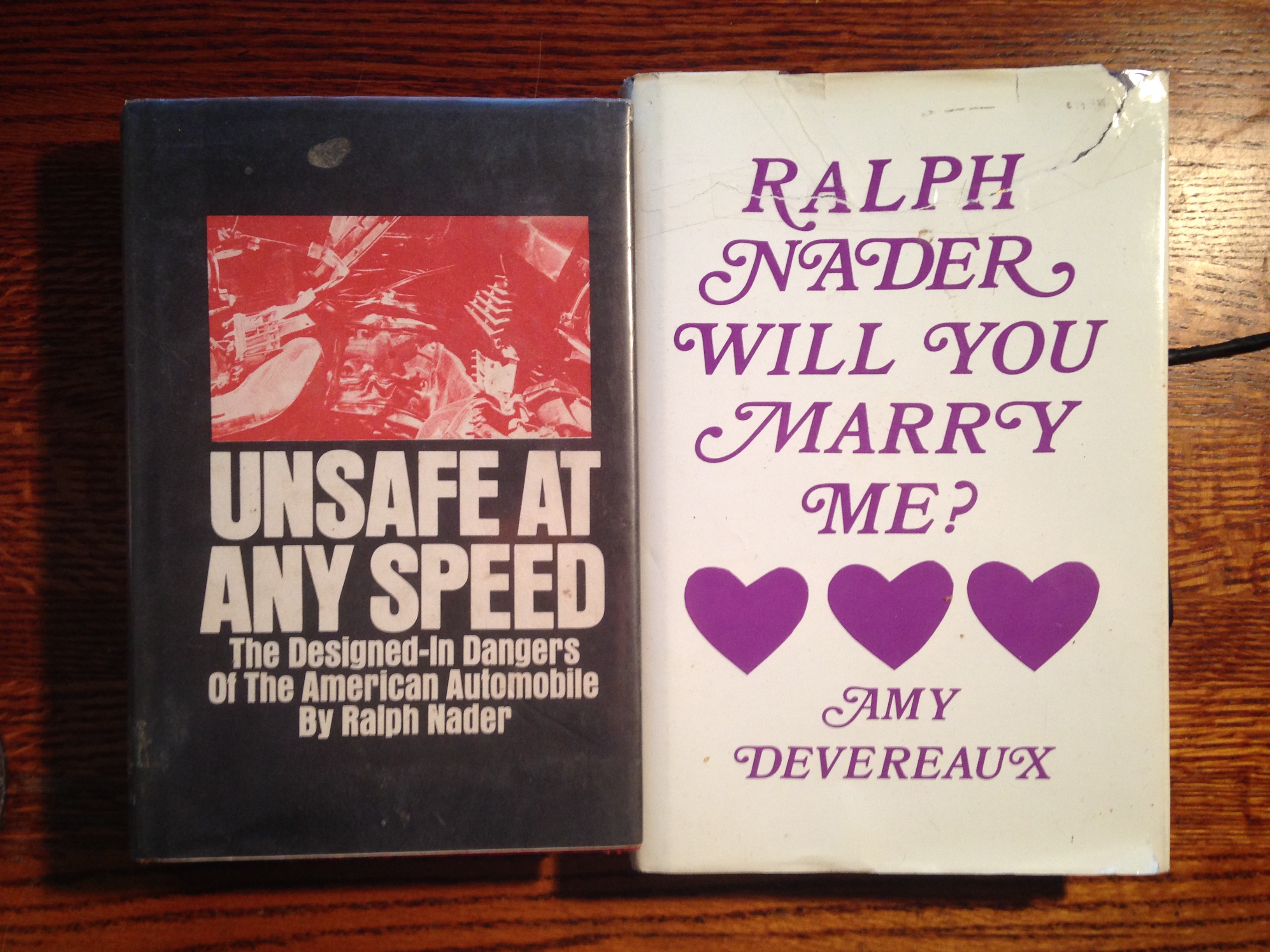


The first thing you notice about the book Ralph Nader, Will You Marry Me? is that its title is Ralph Nader, Will You Marry Me? If that is not enough of a stimulus to pick up a book, I don’t know what is.
Um, okay…
“The author has succeeded in placing herself in a totally vulnerable position where she is completely exposed. Actually at the end she surrenders because she is sick and tired of this war which has taken so much of her time and energy with no tangible results. Now that she is defeated, Amy Devereaux is wondering if Ralph Nader takes prisoners of war or if he shoots them on the spot. In either event, she says she will be happy to finally be at peace with herself and that will be her greatest victory.”
You assume at first that Ms. Devereaux’s wartime metaphor sprung from her writing this book during the Vietnam conflict, but no, it was published in 1988, long past Vietnam, and long past Nader’s glory days as a passionate consumer advocate for that matter.
The incoherence presents a different problem. You’re not sure exactly what the jacket blurb is getting at with this paragraph, except that the author of Ralph Nader, Will You Marry Me? is a bundle of raw nerves, ready to die if that what it takes, to — to — to what, exactly?
“This true story is about how foolish one can act when one is captivated by romantic love. Amy Devereaux is not a fictitious character and neither is Ralph Nader, but this story is really about her. Ralph Nader Will You Marry Me? follows the path that the author’s imagination takes writing letters, songs, poems, and a musical play to her hero. The actual contact that she makes with the real man misses her mark. Afraid to find out what he is really like, she avoids the opportunities she is given to confront him in person.”
Um, so, okay. The grammar is a little off but the message seems clear enough. Ms. Devereaux, it seems, is genuinely in love with, um, with Ralph Nader, and has actually written a book about her love for him. A 165-page-long book. One that includes the aforementioned letters, songs, poems, and, yes, a musical play, which the Table of Contents tells us is entitled Passionate Purple to Ralph Nader, a musical play.
“Confessing her failing, the author hopes to become free of it. In a way the story does not have an end because Ralph Nader and Amy Devereaux do not meet again inside the pages of this book. Will they ever meet? Will Amy and Ralph marry someone else? The answers to these questions remain unknown. Perhaps they will be answered in a prologue to the next edition of her next book.”
Yes, perhaps they will.
In the meantime, you’re still scratching your head. The prose of the jacket flap is not encouraging, but it’s still not entirely clear whether Ms. Devereaux means this book to be tongue-in-cheek, or, or — well, the alternative is that she’s written a book-length marriage proposal to Ralph Nader, and that’s just too weird to contemplate.
Luckily, this copy comes with a press release tucked inside the front cover, from the desk of one Mary Ann Belyea, Ms. Devereaux’s public-relations representative. The press release is four pages long and describes Devereaux’s many attempts to gain Nader’s attention. “During her 12-year romantic pursuit of her dream hero, Devereaux has directed hundreds of letters, gifts, packages and poems to Nader’s Washington office…None of her letters have been returned; none have been answered.”
It goes on: “Nader’s obvious disregard for her pleas for attention have not deterred Devereaux from her pursuit. Nor did it stop her from visiting his office, confronting him in the hallway to sing a solar energy song she had written, and later intruding on a conference to hand him birthday gifts. Even after his angry dismissal that day, Devereaux continued to bombard the consumer advocate with her pleas, devising elaborate schemes to make contact with him, even composing a ‘contract’ for his signature, promising that if they met she would never divulge their conversation. The contract went unanswered, too.”
You can’t imagine what Nader was thinking. A woman accosts him in the hall, sings him an unsolicited song on the subject of solar energy, interrupts a conference to bring him birthday gifts and sends him a contract for a personal conversation — what’s not to like?
The press release — my God, you exclaim, this is a press release! That means she wants people to know these things! — continues to discuss how Devereaux’s obsession with Nader has “caused her to reject other men with whom she might have had meaningful relationships,” and adds, “[Devereaux] sometimes fantasizes that the book…’will get Ralph’s attention, we’ll meet and he will marry me.'”
Well naturally — if you want a man to marry you, what would persuade him to do so better than a book-length marriage proposal?
We also learn that Ms. Devereaux is “a graduate of Arica Institute, est, Insight Transformational Trainings, Silva Mind Control, Adventures in Attitudes, and Peace Theological Seminary classes…and is a minister in the Movement of Spiritual Inner Awareness.” You know, you say, if you ask me, the only thing more convincing than graduating from a crackpot self-help program is graduating from six.
What is wrong with this Nader guy? How could he let a catch like this get away? The press release concludes with an itinerary for Ms. Devereaux’s five-city book tour.
And all of that is before you even open the book.
The introduction begins “I wrote this book attempting to convince Ralph Nader that my love for him is sincere and that I have the ability to fulfill my promises. It will be impossible for Ralph to deny my reality and for me to continue my fantasy once we face the truth together, whatever that is.”
Well, exactly.
“Once RALPH NADER WILL YOU MARRY ME? is in print and widely publicized, I can no longer rationalize Ralph’s silence by telling myself that he has been sheltered from knowing about my existence and my letters by his staff. I do not want to spend the rest of my life in a dream world, like Cervante’s [sic] Don Quixote tilting at windmills. I want to be loved on earth as well as in heaven.”
Well, that answers your question — she is sincere, she loves Ralph Nader, and she’s written a book to get his attention. Singing to him in the hallway didn’t do it, delivering a birthday present to him during a conference didn’t do it, deluging his office with hundreds of letters, gifts, packages and poems didn’t do it, well, god damn it, this book will do it. It has to.
The book proper consists of letters, poems, song lyrics, personal reminisces, a little autobiography, and yes, a musical play. The play begins with a character named AMY entering the offices of a character named RALPH, who is apparently some kind of important consumer advocate. Ralph is reluctant to meet Amy at first, and indeed shows signs of fear and desperation when he hears she has entered his offices. Eventually he realizes what a unique, impressive person she is, and views on solar energy are discussed. There are many love duets.
Sample lyric:
AMY: YES, I REALLY LOVE YOU, RALPH, AS I LOVE MYSELF.
RALPH: WILL YOU HELP ME WITH MY WORK AS WELL AS IRON MY SHIRTS?
AMY: I WILL WORK AS HARD AS YOU, BUT IRONING MAKES ME BLUE.
RALPH: WHAT WILL YOU DO AS MY WIFE, WHEN YOU SHARE MY LIFE?
AMY: I WILL COOK AND CLEAN OUR HOUSE, JUST DON’T BE A LOUSE.
Sample dialogue:
RALPH. Amy. I’m so grateful that I didn’t write you off as crazy. You are crazy. You know that, but blissfully so. Your craziness did save me, as you intended it to.
AMY. I did want to save you, but I didn’t know what from.
RALPH. From my false self, the part which is always so serious, the part which bores people. Would you like to dance?
AMY. Yes, I would.
Sample stage direction:
(Ralph lifts Amy into his arms and carries her into his bedroom where he lays her gently on his bed. Ralph lights a candle by the bed and turns out the rest of the lights.)
The play ends, as all romantic comedies must, with a wedding. No points for guessing who gets married.
The book also includes a short story, “Maria’s Farewell,” which does not seem to be directly related to the author’s pursuit of Ralph Nader, and is apparently inserted here to show that Ms. Devereaux is capable of writing something other than book-length marriage proposals to Ralph Nader.
It ends with this personal message to Nader: “Taking the personal, emotional, and financial risks I have by exposing myself to the public and to you, unprotected as I am, is the final demonstration of my love for you, short of personal contact which depends on your cooperation. I can do no more. It is up to you. Will you accept my love or reject it? That is the question, just like Shakespeare’s ‘To be or not to be.’ Will you be with me? Ralph Nader, will you marry me?”
From the Introduction: “I wanted Ralph’s fans to know that he is loved by an intelligent, sensitive, loving, attractive, single woman. The fact that he has remained unmarried up until now is not the result of his being unloved or unlovable.” Tell that to the Democrats of 2000.
Google does not divulge the existence of Initiation Publications, nor that of Mary Ann Belyea Public Relations. However, apparently Ms. Devereaux is still very much around, creating art, which I am pleased to report is not bad at all, and can be viewed here.
eBay item of the week: the recordings of Leonard Nimoy

The great interpretive singer Leonard Nimoy exploded upon the popular-music scene with his first album, the curiously-titled Mr. Spock’s Music From Outer Space (1967). Still an unknown quantity, he nevertheless took a daring stance and adopted a distinct, recognizable “persona” for his performances, an alien space man named “Mr. Spock.” This interpretive strategy, designed to create an air of mystique around the singer, was at the same time being adopted by The Beatles, who copied Nimoy for their groundbreaking work Sgt Pepper’s Lonely Hearts Club Band. Much later, David Bowie would grab this idea and run with it all the way to the bank, but it should be noted that Nimoy did it first.
The song titles on Mr. Spock are intriguing and otherworldly: “Theme from Star Trek,” “Music to Watch Space Girls By”, “Twinkle, Twinkle Little Earth” and the immortal “Visit to a Sad Planet.” The album caught the “space” craze of the mid-sixties, was a huge hit and Nimoy’s label, Dot Records, was soon clamoring for more.

The “Mr. Spock” persona had made Nimoy a household word among lovers of song, and Nimoy was under great pressure from his label to deliver more of the same. But Nimoy, a formidable artist with incredible powers of persuasion, already felt that he had “done” the Mr. Spock thing. Like Dylan, Nimoy is an ever-changing chameleon who cannot be constrained by the demands of the marketplace. But commercial pressure at the time was intense, and Nimoy was forced to create at least half an album with the “Mr. Spock” persona intact.
The result of all this conflict was 1968’s Two Sides of Leonard Nimoy, a bifurcated whatsit that, in the hands of a lesser artist, would have stank of bitter compromise. Instead, it is a blazing triumph and perhaps Nimoy’s masterpiece. It was 1968, there were riots in the streets, change was in the air, and Nimoy was right in the middle of it. “Mr. Spock” handles Side 1, singing “Highly Illogical,” a stinging rebuke of the entire human race on the level of “Desolation Row” or “Sympathy for the Devil.” Later he sings “Spock Thoughts,” practically a philosophical treatise in song. The side closes with “Amphibious Assault,” which the liner notes describes thusly: “A surrealistic battle of the future. Will war come to this?”
On the “Leonard Nimoy” side, the mask comes off and the warm, tender humanism of Nimoy bursts through. The results are intoxicating as he sings “Bilbo Baggins,” a jocular celebration of “the bravest little Hobbit of them all,” Glenn Campbell’s “Gentle on My Mind” and Tim Hardin’s “If I Were a Carpenter.” No elitist, Nimoy closes the album with the touching parable “Love of the Common People.”

Obviously chafing from the compromise of Two Sides, Nimoy ditched the “Mr. Spock” persona once and for all with 1968’s The Way I Feel. Creating a soft pocket of sensitive peace amid a world gone crazy and turned upside-down, this album of delightful love songs and quirky portraits is a small triumph on the level of Dylan’s John Wesley Harding. The titles say it all: “I’d Love Making Love To You,” “Please Don’t Try to Change My Mind” and Joni Mitchell’s poignant “Both Sides Now” — this is an album of love and its consequences. But social commentary also raises its triumphant head; the LP’s highlight is “If I Had a Hammer,” not to be confused with Two Sides’ “If I Were a Carpenter.” Intended as a “little”, transitional album, The Way I Feel was a huge hit, its sales bigger than those of Nimoy’s first two albums combined, and Dot, ever the raging capitalists, demanded more of the same. This time, luckily for the music world, Nimoy was happy to comply.
Who would not want to feel The Touch of Leonard Nimoy? Almost a sequel to Feel, 1969’s Touch expands upon that album’s greatest themes and then goes further, including Randy Newman’s “I Think It’s Going to Rain Today” and the jazz standard “Nature Boy.” Nimoy then, unexpectedly, brilliantly, brings his career full circle with “Contact,” a song about contact with aliens.

No one knew it at the time, but Nimoy was, in fact, saying good bye with the inclusion of a “Spock”-themed song on the otherwise tender Touch. He abruptly withdrew from the marketplace of song, retired to his mountain retreat in Massachusetts and has since disappeared. The Salinger of Song, he has not issued an album of new material in almost 40 years. Why this happened is one of the great mysteries of popular music. Maybe the pressures of the pop-star world proved to be too much for this sensitive artist, maybe he’d decided he’d had enough, or maybe he felt he’d said everything there was to be said. Who knows? But we have these albums and that is treasure enough.

Sensitive to the demands of a marketplace starved for greatness, the prestigious label Famous Twinsets released a two-LP set of choice cuts called Outer Space/Inner Mind. For a new generation of listeners, this was a gold mine of delight. Strangely, Famous Twinsets didn’t think to put a photo of Nimoy on the cover, instead focusing the packaging on the model spaceship the “Mr. Spock” character is shown fondling on Nimoy’s first album. I guess they were trying to preserve the mystique of their reclusive star, or perhaps Nimoy demanded that his picture not be used in order that he be able to move through the world unrecognized. We may never know. In any case, Outer/Inner provides an excellent overview of this vital artist, even though it does, for some inexplicable reason, completely ignore songs from Touch.
DID YOU KNOW? Nimoy has also worked as an actor.
Spielberg: Indiana Jones and the Temple of Doom part 2


So. Moving on:
Chapter 1 (1:00:00-1:10:00) This gripping little reel involves Indy and his family stumbling upon an obscene, terrifying blood-cult ceremony. I myself have never stumbled across an obscene, terrifying blood-cult ceremony so I don’t honestly know if the one depicted here is accurate or not, but I’m going to go ahead and say that for members of blood cults I’m guessing that this sequence is probably pretty cheesy. I mean, lava? Who has lava at their blood-cult ceremony? That’s just stupid.
For the rest of us though, it’s pretty freakin’ dark. The design of the temple, the human skins fluttering in the breeze, the high priest wearing an animal skull on his head, the swaying, groveling celebrants, the sacrificial victim getting his heart ripped out and surviving, it’s all perfectly stupid and utterly intoxicating. Spielberg is a master at taking an assignment and running with it — “Oh, it’s a weird, scary blood-cult ceremony? Well then, let’s make it the weirdest, scariest ever.”
One flaw: we meet our head villain, cult priest Mola Ram, an hour into the movie, and they don’t even tell us he’s the head villain, we just kind of have to figure it out after a while. Plus he’s wearing a weird costume and is hellishly lit — it’s a great entrance, but would have been more effective an hour earlier — you know, like at the point where the head villain of Raiders showed up. Is there some reason Mola Ram couldn’t be one of the guests at the Maharajah’s dinner table? Or for that matter, why couldn’t he be the Prime Minister? The PM is, we eventually learn, one of the cultists, why not make him the head priest?
(I do have one problem with the cult ceremony. The victim has his still-beating heart removed from his body, which is really cool. But then, when Willie is the victim, Mola Ram doesn’t bother ripping out her heart, which is good for Willie, but pulls the villain’s punch. Better, I think, to forgo the cool effect of the first victim’s heart being ripped out than to make it look like the villain is “just kidding” later on in the act. But then, I get the feeling that the architecture of the sacrifice ritual is based on Mola Ram holding the still-beating heart as it bursts into flames. I get the feeling this image came into Spielberg’s head before anything else and he structured the whole ceremony around it.)
Funny thing is, as implausible as the plot of Temple is, Mola Ram is a great villain and his plan, in its weird, twisted way, makes sense. He’s got a solid motive, a decent plan and a logical endgame. This puts him ahead of 80% of Bond villains and even ahead of Belloq, who had huge balls on him to think he could wrest control of the Ark of the Covenant while in the employ of Adolf Hitler, but had no plan for what he was going to do once the Ark was opened.
(That is, Belloq thinks the Ark is a transmitter to God, and that by opening the Ark before handing it over to Hitler will give him the power that Hitler craves. But he doesn’t know what “transmitter to God” actually means, a bit of shortsightedness that turns out to be disastrous. “Hmm, my head is exploding — maybe I should put the lid back on this thing and think this plan through a little more.”)
After the ceremony, the temple immediately empties and Indy goes after the Sankara Stones. Two things: hey, wait, wasn’t this temple just filled with hundreds of zombie celebrants? How did they get out so fast? And doesn’t anybody stay to, you know, clean up? Not a single altar-boy or acolyte to be seen. And, I notice that Indy treats the Temple of Doom with ten times the respect he shows to either the Well of Souls or the Peruvian temple in Raiders — he tiptoes carefully through the rafters, cautious not to upset anything. Well, come to think of it, this isn’t an ancient temple, it’s practically brand new — what’s the point of wrecking it?
In any case, Indy nabs the stones, but as he is heading out of the temple, he discovers the mine, being operated by the kidnapped village children and the movie, in case it wasn’t dark enough yet, takes an even darker turn.
Chapter 2 (1:10:00-1:17:00) Indy might be a fortune hunter, but he can’t just turn his back on a mine full of enslaved children, but before he can do much for them he and his family are nabbed by the bad guys. Indy is tied up, Short Round is whipped, Willie is spirited away somewhere (odd that Spielberg lingers on showing us children being whipped, but shies from showing what might have happened to Willie). Indy is poisoned for the second time in the movie, forced to drink the blood of the whatever. And for some reason the boy Maharajah is on hand with a voodoo doll. What? A voodoo doll? Either Spielberg is just throwing in any creepy thing he can think of at this point, or else the young Maharajah was educated in, um, Haiti? I can imagine a Kali-worshiper watching this scene and finally throwing up his hands and saying “Okay, forget it, I was with this movie up to this point, but voodoo? That’s just insulting.”
In any case, the scene is almost unwatchably brutal and intense, which is great because it is, wouldn’t you know it, another expository scene, where the head villain explains his plot to the protagonist, and we don’t even notice because it’s just so unspeakably ghastly. And yet the movie still hasn’t gotten as dark as it’s going to. Because the next thing you know, there is, yes, another blood-cult ceremony, this time with Willie as the sacrifice and Indy as the priest.
Chapter 3 (1:17:00-1:27:30) Hey, wait a minute! These Kali-worshipers just had a ceremony, like, ten minutes ago! And now they’re having another one! How many of these ceremonies do they have in a day? How are the worshipers supposed to get anything done? What is the rest of their day like? I have this image in my head of a bunch of Kali worshipers getting back to their office jobs after changing out of their Kali-worshiping duds, and they’re filing papers and entering data and playing Minesweeper, and then suddenly one of their co-workers comes along and says “Hey guys! They’re doing a second sacrifice today! Everybody back to the Temple!” and everybody kind of looking at each other like “Hey, you know, Kali is great and all, but I have a life, dude.“
Speaking of which, if Mola Ram has a congregation of zombies that are able to drop whatever they’re doing at a moment’s notice to come attend a sacrifice, why doesn’t he use them to help dig for diamonds? Surely they’d be more efficient than child slaves.
Anyway, so Indy is now bad and Willie is now his sacrificial victim. And I suppose there may be a metaphor at work here — if Willie represents the cynical, greedy side of Indy, and Indy himself has now been boiled down to a “true believer,” then there could be a comment in here about the bad side of pure faith.
But something tells me that it’s really just “plot.” I suspect this because, fact is, the rest of the movie from here on out is pretty much just plot. This is a good thing. Movies need plot, and few directors understand plot better than Spielberg, and, as any screenwriter will tell you, plot is hard. In fact, I’m going to go ahead and say that Temple of Doom is probably the most tightly plotted movie in Spielberg’s filmography, which is the reason I find it so compulsively watchable.
Oh, and the action/suspense elements of all this are just masterfully presented. The roasting cage bobbing up and down with Willie inside, Indy backhanding Short Round, the fight on the altar, it’s all just incredible.
Anyway, Short Round cures Indy (that is, the son cures the father, a plot turn I attribute to George Lucas, since he made six movies revolving around the idea), driving us into —
ACT IV (1:27:30-1:54) Here we have another textbook ur-Dreamworks “race to the finish line” final act, a breathless sequence of stupefying, expertly-mounted set pieces, each topping the last.
Chapter 1 (1:27:30-1:35) We begin with the massive slugfest in the mine, as Indy and his family free the enslaved children and beat the crap out of their captors. The chapter climaxes with Indy’s fight with the Enormous Thuggee atop the Rock-Smashing Machine.
Chapter 2 (1:35-1:43) We go straight from the stupefying slugfest into the stupefying mine-car chase, a sequence so mind-bogglingly complex I cannot even begin to imagine how it was planned, much less shot. The chapter ends with a literal cliffhanger, as Indy and his family are left, yes, hanging from a literal cliff as torrents of water blast out of the mine entrance.
(Of course if I slow down long enough to ponder the design of this ridiculous mine, which apparently is inside an active volcano, the whole thing seems kind of silly.)
Chapter 3 (1:43-1:54) The cliffside scene bleeds into the bridge scene, and at this point I’d like to pause to break the fourth wall and tell a personal anecdote:
When I was at Dreamworks working on Antz, I had an idea for a scene that took place on a high, narrow bridge. As it happened, Spielberg was in the room during the pitch meeting and so I pitched the scene and added “you know, like the end of Temple of Doom,” at which point Spielberg closed his eyes like he had a headache and said, with no small amount of anguish, “I hated that scene.” And I could barely think of what I was supposed to say next about my own project, because all I wanted to say was “What? You hated that scene? But, but — you’re Steven Spielberg! And when you shot Temple of Doom you were at the peak of your powers! What power could have compelled you to shoot a scene you hated that much?” This moment bothered me for years, rolling around in my head — how, why, would Spielberg shoot a scene he hated? I breathed a sigh of relief when I saw the “making of” DVD and the mystery was solved: Spielberg explains that while shooting Temple of Doom he found out, too late, that he has a fear of heights. This fear kept him from shooting the bridge scene the way he had planned (he literally could not make it more than a third of the way out onto the bridge without breaking out in a cold sweat) and he spent the entire shooting of the sequence in a state of physical discomfort. Needless to say, the bridge scene did not make into the script for Antz.
End of personal anecdote.
Anyway, I think the bridge sequence comes off well enough — the shot of Indy realizing the extremity of his dilemma is probably my favorite of the character, and the action of the climb back up to the cliffside is, again, expertly handled. Although of course I would love to know what Spielberg had intended for the scene to begin with. I imagine the cuts to the alligators below could have been more gracefully integrated — I never believe that anyone is ever actually eaten by an alligator, although it would serve the people right for all the disgusting things that get eaten in this movie — but otherwise I think it all works fine.
Once Indy gets Mola Ram in his sights, he snarls “Prepare to meet Kali — in Hell!” And I just can’t help but think “Jeez, what a lame threat.” Honestly, howis Mola Ram supposed to be scared by a guy who doesn’t even have a token understanding of his faith? Threatening Mola Ram with “prepare to meet Kali — in Hell!” is like threatening a rabbi with “Prepare to meet Jehovah — in Hades!” or threatening a Muslim with “Prepare to meet Mohammad — in Nirvana!” or threatening the Green Goblin with “Prepare to meet Spiderman — in Gotham City!” I want Mola Ram to look scared for a second and then pause and say “What? What the hell are you talking about? Why would Kali be in Hell? Who are you?” And then Indy would have to do some hasty backpedaling: “Well, you know what I mean, I mean, you know, whatever bad-place afterworld you guys have — I’m sorry, I haven’t studied Kali blood cults that much.” And then Mola Ram could say “Why not just say ‘Prepare to meet Kali?’ You had me up to that point, my heart was really racing, but then you had to add “in Hell” and all I could think was “Christ, what a douche.”
Indy’s complete ignorance of Mola Ram’s faith is confusing since, mere seconds later, he knows just the magic words that will make the magic rocks ignite into flames. “You betrayed Shiva!” he growls, then helpfully translates the phrase into, I’m guessing, Hindi. Because, apparently, Shiva, up to this point, was unaware that Mola Ram had acquired the Sankara Stones and was using them to amass a power base for himself on Earth. No, it took Indiana Jones pointing that out before Shiva, wherever Shiva hangs out, to look up and say “What’s that? Mola Ram betrayed me? Well, I’ll settle his hash, you just watch! Gimme my rocks back!”
(As with the Ark in Raiders, Indy, the non-believer, is spared the wrath of the god-of-the-moment and allowed to make off with the magic artifact. There is a message in there somewhere.)
The young Maharajah, now transformed into a good colonialist, leads Capt Blumburtt and his troops to the bridge to help save the day. And I can’t help but wonder if that’s necessarily a good thing. There is a troubling thread of colonialism running through all the Indiana Jones movies (and all of George Lucas’s movies too for that matter) but Spielberg breezes past the moment without comment, even though its perfectly obvious that, if not for people like Capt Blumburtt, there wouldn’t be people like Mola Ram in the first place.
(As Walter Sobchak might say, “Say what you want about the tenets of the Kali Ma, at least it’s an ethos.”)
Spielberg: Indiana Jones and the Temple of Doom part 1


Like Raiders of the Lost Ark, Indiana Jones and the Temple of Doom has four acts, each lasting about 30 minutes. Each of the acts has three distinct chapters, giving us a twelve-chapter serial drama.
What’s different, structurally, is that Raiders has a restless spirit, jetting (well, prop-planing) about all over the globe, from Peru to the US to Nepal to Cairo to Secret Sub Base Island. Temple gets all the travel out of the way in the first 25 minutes and spends the rest of its time in more or less one place, and an hour of that in one location, underground in a cave. The result is a much differently-shaped narrative than Raiders, one that’s spirited and frantic for the first act, then claustrophobic and inward for the rest of the movie, and dark, dark, dark. It gives us twenty minutes of breathless forward movement, seventy minutes of horror and torture, then thirty minutes of blasting escape.
The movie is often criticized for its unpleasantness and weirdness, as well as its generally heavy attitude, but I find it as compulsively watchable as any of the best of Spielberg and a much meatier experience than either Raiders or Crusade.
Spielberg: Twilight Zone: The Movie: “Kick the Can”

First, I’d like to thank Mr. Spielberg for giving the opportunity to create a journal entry that contains three colons in thesubject heading.
Steven Spielberg’s artistic development, in his first decade on movie screens, started softly with The Sugarland Express, exploded in the megaton blast of Jaws, soared to incredible heights with Close Encounters, stumbled momentarily with 1941, then finished up with an incredible one-two-three punch of Raiders of the Lost Ark, Poltergeist and E.T. That decade alone would have been enough career for just about anyone, but us Spielberg watchers knew that the best was yet to come. I remember seeing E.T. for the third or fourth time and thinking “Oh my God, when this guy is 50 years old he’s going to be awesome.” And I’m pleased to report that this came to pass.
Spielberg’s first decade of phenomenal artistic development climaxed with a stunning culmination of style and intent — the “Spielberg style” came to define commercial American moviemaking in the next decade and beyond. In his second decade, Spielberg stretched boundaries, investigated new areas of development, took some daring chances and made great strides as a storyteller.
But first he directed “Kick the Can,” his contribution to the omnibus Twilight Zone: The Movie.
WHAT DOES THE PROTAGONIST WANT? The problem with “Kick the Can,” unsurprisingly, begins here. Who is the protagonist of this short? The plot is: Kindly old Mr. Bloom comes to an old folks home and Teaches Folks A Lesson. The protagonists of a story like this would most effectively be the ensemble of elderly folks who are confronted with Mr. Bloom. What to make of the mysterious outsider who sees things differently from the status quo, who uses magic and wry irony to show us the error of our ways?
But none of the ensemble of “Kick the Can” is developed in any kind of interesting way. Each character is a stereotype for quick reading — the kvetching Jew, the faded romantic, the bitter loner, et cetera. They are thoroughly uninteresting, and Spielberg shoots them with unflattering lenses and lighting, turning them into cartoon characters. The only character Spielberg seems to be interested in is Mr. Bloom, who arrives with a twinkle in his eye and mischief up his sleeve. We are on the outside of the ensemble, on the side of the magician, looking down at the status quo, giggling with giddy joy at the mischievous lesson we’re about to teach the poor benighted folks who don’t know any better.
And so Bloom becomes the protagonist of “Kick the Can.” This is like making Peter Pan the protagonist of Peter Pan (which Spielberg would, of course, eventually figure out a way to do). More to the point, it’s like making E.T. the protagonist of E.T.
Why is this a bad thing? Dramatically, it instantly evaporates a great deal of dramatic tension. We know Mr. Bloom is magic and we can see that the ensemble is a bunch of easily-manipulated sheep, so as an audience all we can do is sit and wait for the magic to happen. Mr. Bloom comes to the old folks home, creates a desire in the minds of the ensemble, then caters to that desire, then points out with leaden earnestness the futility of the desire. Essentially, he comes to the old folks home, says “You know what you people need? You need to be tricked.” And the ensemble says “Say, you know? We do need to be tricked. Trick us.” And so Mr. Bloom tricks them and says “Now look at how foolish you look, falling for my trick. Aren’t you ashamed of yourself?” The intent is to instill a warm glow of magic, but the result is curdled and smug, demonstrating not the power of magic but the power of manipulation.
And so it occurs to me that, just as E.T. symbolizes Spielberg’s artistic talent, Bloom is a stand-in for Spielberg himself. Looked at this way, “Kick the Can” makes perfect sense — Spielberg sees himself as a magic wanderer, a trickster who arrives on a scene where everyone’s sitting around staring at each other and masterfully manipulates the crowd into a state of wonder and awe, makes them realize some profound truth or other, then moves on to the next unsuspecting bunch of rubes. It’s a movie very pleased with itself, which I suppose makes it a good adaptation of Rod Serling, who similarly had a dim view of society (and his audience) as children in need of a lesson.
Spielberg: Poltergeist

(For those interested in my earlier thoughts on Poltergeist, I direct you here.)
WHAT DOES THE PROTAGONIST WANT? Diane Freeling is a middle-class housewife and mother of three. Like many middle-class mothers, she is content to merely get through the day, negotiating the various comedies and headaches of middle-class American existence — the fighting kids, the snotty neighbors, the promiscuous teenager.
There is, of course, an underlying fear to her life, the same fear that lies beneath just about everyone’s life — the fear of death. Diane does not feel death at her elbow, but she knows it’s out there waiting somewhere, and while she may or may not be content with that knowledge, she very much wants to keep it from her children. This desire first expresses itself as Diane trying to soften the blow of the death of her preschooler’s pet bird, but the stakes for Diane will eventually rise to the point where she will, literally, enter the gates of Hell in order to save her child from death.
You can’t choose between life and death when we’re dealing with what is in between
Stones kick continues in Alcott household.


I know that Shine a Light is good because my wife came up to me the other day and asked, apropos of nothing, “So, like, are people as interested in the Rolling Stones as they are in the Beatles?” This is my wife who, generally, would rather gouge out her own eyes than talk about musicology. The question was so out of the blue that I thought for a moment she was talking about eBay sales. To which she said “No, I mean, do people, you know, talk about them the way they talk about the Beatles?” I said “You mean, do people generally recognize the scope of their musical statement the way they do with the Beatles?” To which she replied “Yeah, I guess.” Anyway, she was really impressed with Shine a Light, although she wanted Scorsese to pull back a little every once in a while to see the whole stage picture. And it’s true, the sheer relentlessness of the movie tends to make it an exhilarating and exhausting experience. Watching Mick Jagger leap and dance about for two hours feels like a workout.
My wife’s question got me curious, so I started surfing around the ‘net to see if there were any more-or-less serious musicological analyses of Stones music out there beyond, you know, “man, they’re awesome.” This seems to be a fairly typical site — highly opinionated, musicology-free, utterly enthusiastic. Keno’s list of Stones albums in order of preference, however, made me just about fall down and twitch on the floor. How could someone with such an obvious ardor for the band list Exile on Main St. at #10? And that’s just the tip of the iceberg.
Anyway, his list got me thinking about my list. And so, at the request of absolutely no one, here is my list of Rolling Stones albums in order of preference. And, as I am not a musicologist, this list is analytically useless.
Making matters worse, I have no opinion regarding all their early work from England’s Newest Hitmakers to Between the Buttons — I have all the records and enjoy them when they turn up on iTunes, but I honestly couldn’t tell you if “Little Red Rooster” is on 12×5 or Now! or if “Route 66” is on December’s Children or Out of Our Heads. This should probably disqualify me from making a list like thisat all.
1. Exile on Main St. — The high-water mark of their mature style and still their most complex, intriguing artistic statement.
2. Sticky Fingers — Almost as good as Exile on Main St.
3. Some Girls — Not as good as the first two, but twice as much fun as either.
4. Emotional Rescue — Almost as good as Some Girls — a hugely underrated album. Including the ridiculous title song.
5. A Bigger Bang — Kind of a cross between Exile and Some Girls — as considered as the former and as fun as the latter.
6. Black and Blue — The Stones most underrated album. I like everything on it except “Fool to Cry.”
7. Beggar’s Banquet — A great album, but I can’t stand “Jigsaw Puzzle.”
8. Let it Bleed — another great album, but I can’t stand “You Can’t Always Get What You Want,” which is twice as long as “Jigsaw Puzzle.”
9. Dirty Work — No wait, this is the most underrated Stones album.
10. Tattoo You — Side 1 is absolutely killer. Side 2 tends to bore me.
11. Undercover — A perfectly decent Stones record, but I can’t stand “Too Much Blood.”
12. Steel Wheels — While there’s nothing I can’t stand on this record, there’s only a handful of songs I’m completely nuts for.
13. Goats Head Soup — Better than people give it credit for, but I can’t stand “Winter” and “Can You Hear the Music.”
14. It’s Only Rock n Roll — Not as good as Goats Head Soup. I can’t stand “Till the Next Time We Say Goodbye” and “Time Waits for No One.” Or “If You Really Want to Be My Friend.” What is it with the long titles on this album?
15. Aftermath — a perfectly decent album I can think of nothing in particular to say about.
16. Voodoo Lounge — Wow, out of 15 songs, I only really like 5 of them, and there are a stunning 5 I absolutely can’t stand.
17. Bridges to Babylon — Not as good as Voodoo Lounge. Wow, did I just say that?
18. Their Satanic Majesties Request — Well, what did you expect?