Blood Relative update
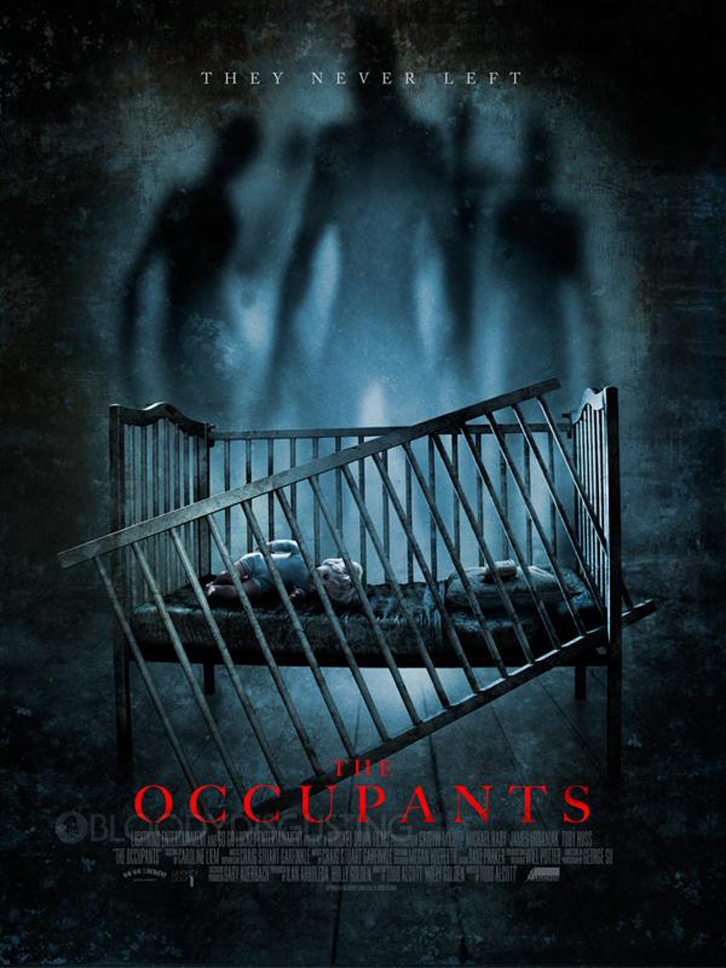
Keen readers of this journal will recall that, a couple of years ago, I wrote and directed a low-budget horror movie called Blood Relative. Things being as they are in the world of low-budget horror, it took a while to finish the thing and then it took another while to get a distributor. Now it has one, and boy are they doing their job! They’ve changed the title (which I like) and they’re taking it to Cannes! You can watch the sales trailer here!
Snow White: The Missing Scene
Finally, a key scene from Walt Disney’s classic is presented, filling in the missing piece of “the fairest movie of them all.”
Spielberg on Bond
Spielberg is in India at the moment, talking about things Indian (India, like China, is becoming increasingly important to international financing for movies), but took a moment to talk about his ambitions to direct a Bond movie:
Spielberg waxed on his earlier ambitions to make a James Bond movie. According to The Times, Spielberg said he twice offered to direct a 007 pic, but was turned down by producer Albert ‘Cubby’ Broccoli. “I spoke to him after making Jaws, which was a huge hit, but Cubby said I wasn’t experienced enough and they’d call me if they did a Bond film on water. After Close Encounters, I told him that by now I had two Oscar nominations. And he asked ‘Did you win’? And I hadn’t. So that was that.”
James Bond: Skyfall part 9
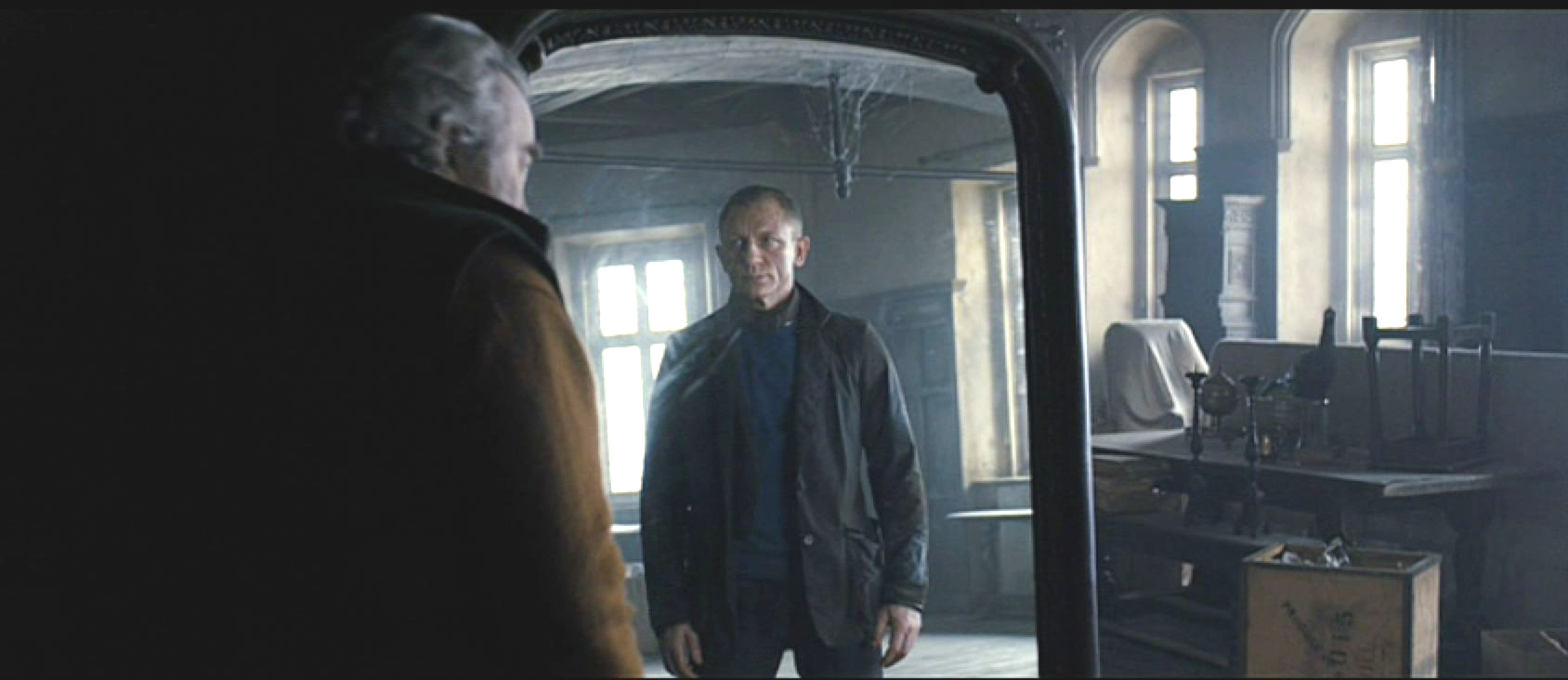
In case the reflective nature of Skyfall were not already apparent, the “preparation montage” begins with a shot of Bond revealed in a full-length mirror. The mirror will later be used in a trap, the classic “fooling the bad guys with a full-length mirror” trick. As Kincade says, “Sometimes the old ways are the best.” We see some traps laid out, others are merely hinted at. All of them (spoiler alert) work exactly as planned.
Bond grosses
I watched Live and Let Die with my son Sam (11) this evening. It was his first Roger Moore Bond movie. Moore, for me, is charming and light, but Sam, quite rightly I think, greatly prefers Daniel Craig. Watching Moore pretend to kick and karate-chop bad guys in the streets of Harlem and the bayous of Louisiana is thoroughly unconvincing, it doesn’t look like Moore would care to ruin the drape of his slacks. Although we both got a healthy laugh out of his expertly delivered line: “Don’t worry darling, its just a small hat, belonging to a man of limited means, who lost a fight with a chicken.” I had also forgotten that the bad-guy plot of Live and Let Die was, at the time, a ripped-from-the-headlines adaptation of the story of Frank Lucas, the real-life Harlem drug lord who really did take over the heroin trade from the Mafia, a tale well-told in the movie American Gangster.
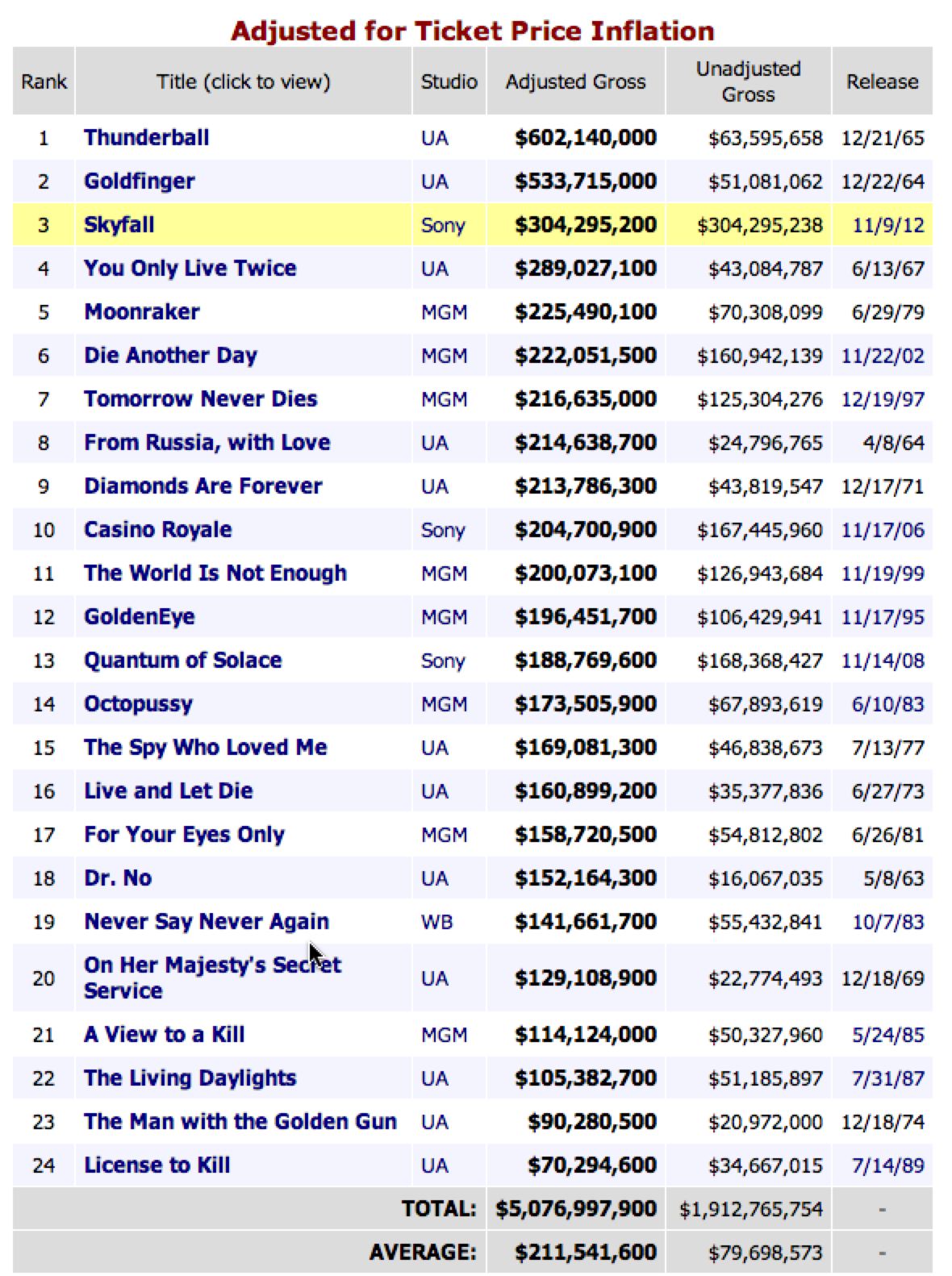
Nevertheless, Sam is of an age enough to want to know the facts of life — by which I mean “How did the movie do?” For this, I turn to Box Office Mojo, which not only keeps track of these things but also goes so far as to adjust grosses for inflation. (Their list of all-time grosses, adjusted for inflation, is particularly edifying.)
I’m shocked to find that Live and Let Die is one of the least popular of the Moore years. The Looney Tunes cartoon Moonraker is number 1, and the truly bizarre Octopussy is number 2! (No pun intended.) The trajectory seems to be: People weren’t ready to embrace Moore when Live and Let Die came out, then there was the unfortunate Man with the Golden Gun, which would turn anyone off of the series, but then there was the going-all-out Spy Who Loved Me, which saved the franchise and allowed Moore to do five more of them. It’s hard to imagine a studio today saying “Well, the grosses were way down on the first movie, but let’s let the guy do two more and see if things pick up.” Which of course goes back to the Bond movies being producer’s movies, the Broccolis own the property and no studio can tell them what to do. At this point, the Bond movies could justify their production on ancillary rights alone, it’s not like people are going to suddenly stop watching James Bond movies in endless rotation on cable networks.
As for the superior You Only Live Twice doing less than half of the turgid, bloated Thunderball, YOLT had the misfortune of splitting the Bond dollar in 1967 with the ersatz Bond parody Casino Royale, which was a huge hit that year but is not listed here for some reason.
James Bond: Skyfall part 8
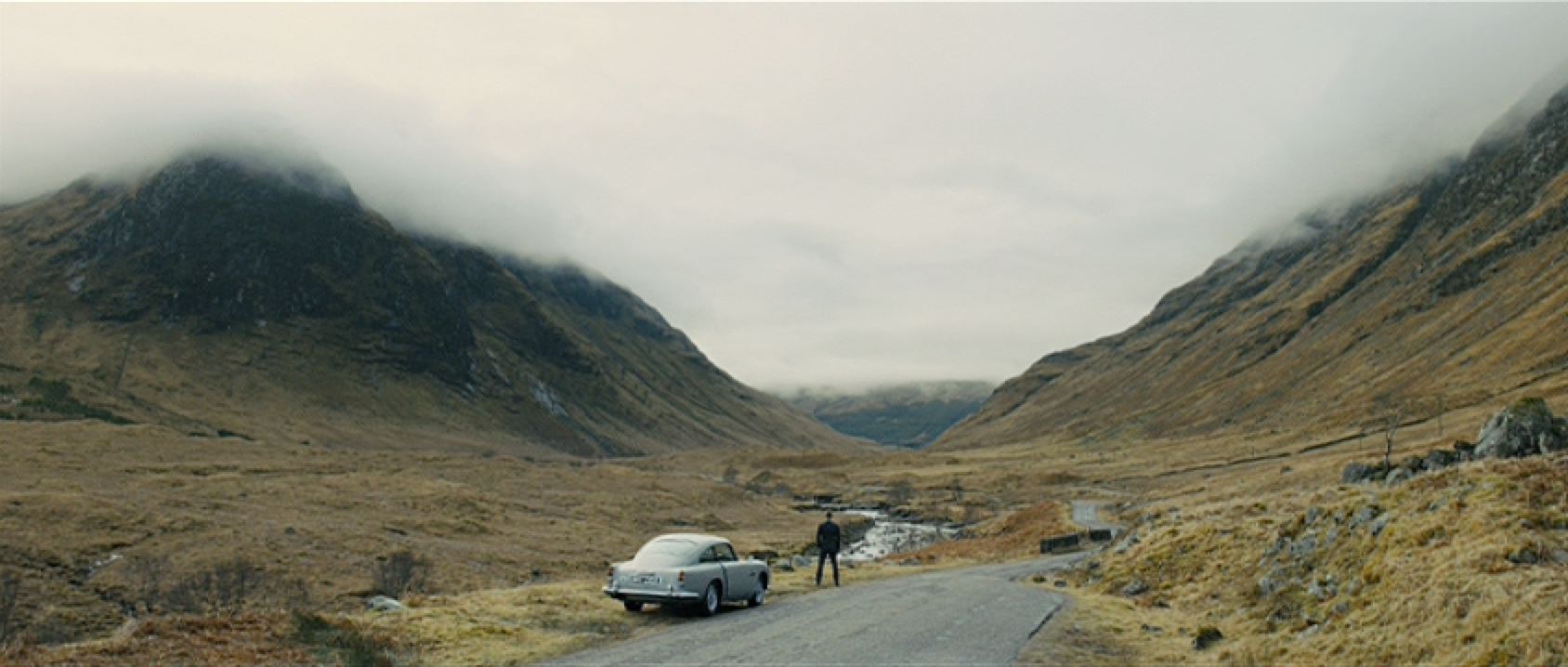
Act IV of Skyfall begins at 1:45:49 and opens with a stunning shot of Bond, with his Goldfinger car, as a tiny figure in a huge landscape, fitting as Skyfall‘s primary goal is to place the Craig Bond in context, not just in the Bond-verse but in the cultural landscape. The narrative asks “How does James Bond fit into the modern world of espionage?” but what it’s really asking is how he fits into the modern world at all. And I don’t think I’m “bringing this” to the movie, I think it’s quite intentional. The Bond movies have never, ever seriously asked us to consider the world of real-life espionage at all, they’ve always been colorful, absurd, high-flown escapist spectacles, the Batman of espionage thrillers. They didn’t offer a solution to the Cold War, they offered escape from it, they goofed on it.
And so, as with Batman, Bond must now be re-imagined, brought to earth, scaled back and made a resonant character. I’m not a grade-A cultural analyst, but one thing I’ve noticed in the past decade is that everyone has an opinion on Bond, and must have an opinion on Bond, and must be prepared to discuss and defend those opinions, and must be prepared to offer logical reasons why they prefer Dalton to Brosnan or why The Spy Who Loved Me is better than Thunderball or why Nick Nack is better than Tee Hee, all in spite of the fact that it’s all quite silly. James Bond, for some bizarre reason, bless his heart, matters to us as a culture. He obviously means something.
I think the cultural shift regarding Bond is the same shift that has presented itself to straight white men everywhere: he’s no longer in charge of everything, and the world is no longer his red carpet. Watching You Only Live Twice the other day, I was struck by how the whole narrative just unrolls for Bond to step into. There’s a scene where Japanese super-spy Tiger Tanaka takes Bond to his gigantic Ninja Training Camp, an idea silly enough by itself, but sillier still is the way it’s presented to Bond: here is a gigantic ninja training camp, we are all here to help you, do what you like with us. Guns, gadgets, vehicles, women, travel are all thrust toward the Connery Bond with the flourish of a fruit basket in a penthouse suite for a VIP. “Right this way, Mr. Bond, your fantasy adventure awaits you for you to partake.”
With rare exceptions, the Bond movies are nothing but fantasy comedies for middle-aged men with adolescent minds (which is why Roger Moore kept being cast long past his sell-by date – Bond on paper may be a young man, but Moore was the audience). The typical Bond plot falls apart with only a cursory glance and has the visual panache of a 50s Batman story: giant props, garish villains, shark tanks, volcano strongholds, indestructible henchmen. In On Her Majesty’s Secret Service Bond leads a chase into a stock-car race and no one bats an eye. The climax of You Only Live Twice hinges on a self-destruct device called “The Exploder Button.” They are movies made to entertain Don Draper, and, lest we forget, Don Drapers used to run the world.
Now the president is a black man and Bond’s boss is a woman and the Bond brand of leering sexism and casual misogyny is repugnant and off-putting. That’s why the Craig Bond has been re-imagined, brilliantly, as an underdog, a shadow living in a shadow, a grown child who dreads a trip home: he can’t escape his past, he must go home — in order to burn it to the ground. In fact, we could say that the plot of Skyfall exists as an excuse for Bond to go home and destroy it, to shed his past. Like Silva, he wants to finally be his own man.
Nota bene
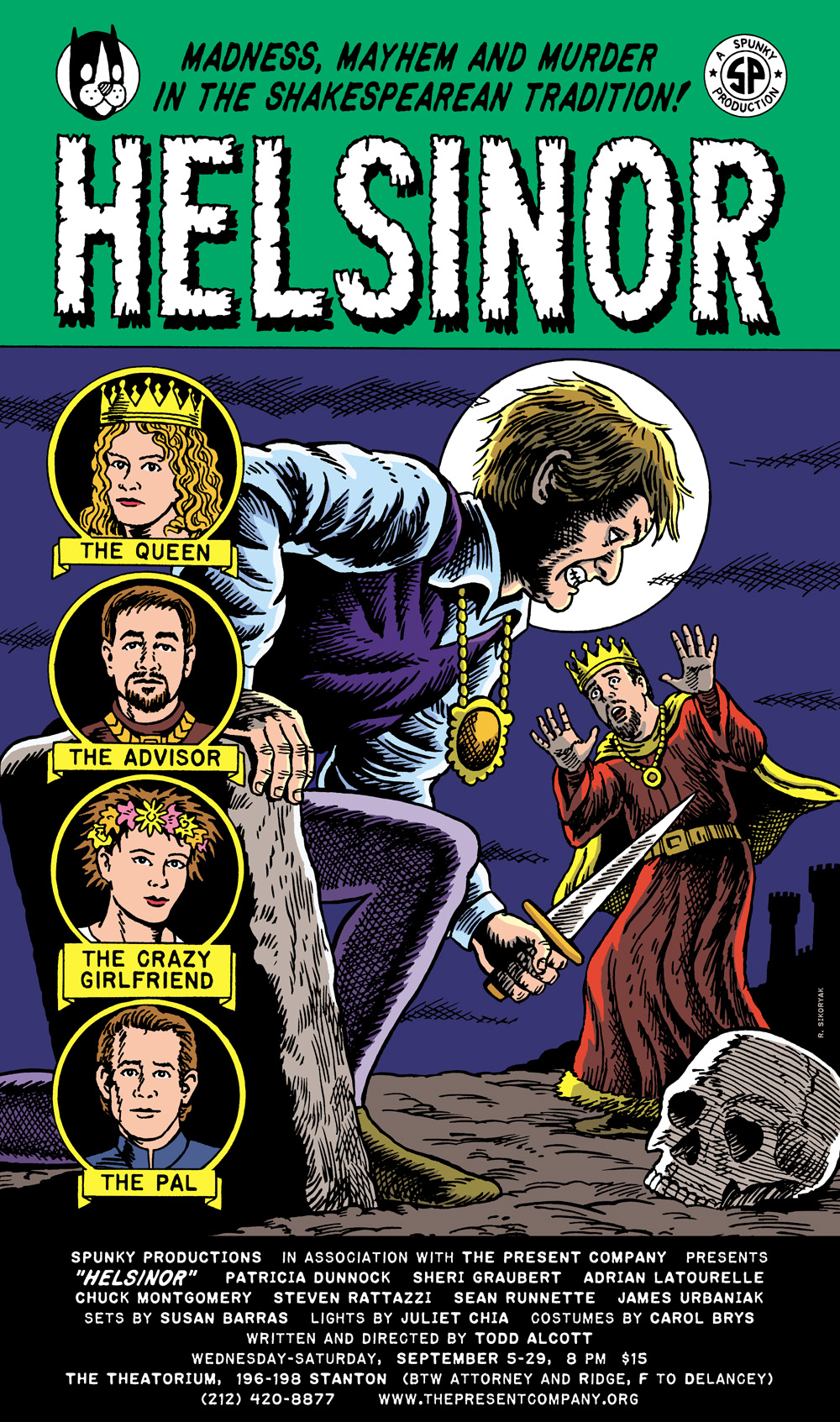
Helsinor, my 2001 play that tells Hamlet from the point of view of his uncle Claudius, is now for sale through the Indie Theater Now! archive.
The original production starred Vine Superstar Mr. James Urbaniak as the mad prince and Mr. Steven “Dr. Orpheus” Rattazzi as Polonius. It debuted in the first week of September 2001 at the Theatorium on Stanton Street in NYC. On 9/11, New York was put on lockdown south of Houston Street, so it actually became illegal to see my show. The terrorists won.
(The fabulous poster design, above, was drawn by the great cartoonist R. Sikoryak. You should buy his book.)
James Bond: Skyfall part 7
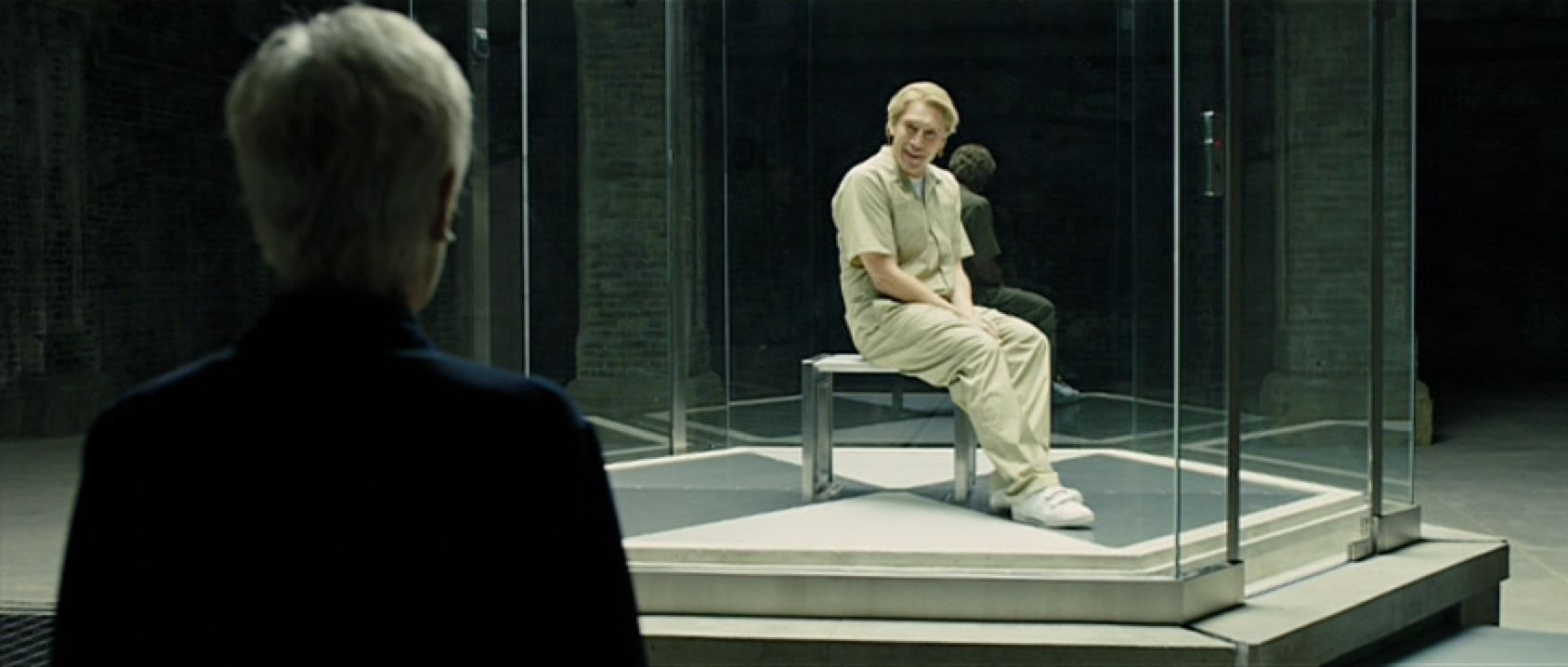
Skyfall, up to this point, has been eerily linked to The Dark Knight Rises in many ways, but now suddenly it links itself to The Avengers, or, rather, to Silence of the Lambs, with Silva brought to justice mid-movie and placed in what can only be an escape-proof glass cage. (How odd that MI6, just recently relocated, nevertheless had the foresight to build an escape-proof glass cage in their offices.) The glass cage, because of its cinematic echoes, dramatically ramps up our fear of Silva — up ’til now his threat has always been cyber-specific, but suddenly he’s being treated like a dangerous animal, as though he might bite. (Ironic that his Bond-villain deformity is a damaged jaw.)
“You’re smaller than I remember!” beams Silva as M comes to visit him, exactly what a son returned home from a long absence says to his mother. Silva wants to press the mommy button, but M counters brilliantly with “Whereas I don’t remember you at all.” Silva, he reports, was left for dead with some enemy spies who tortured him for months (shades of Die Another Day) and his only recourse was his cyanide tooth, which — damn British manufacturing! — was defective and only disfigured him. Silva’s egotism is directly related to his hatred of M, in the way of growing boys everywhere: he seeks, in his own way, to cut the apron strings, to wipe his mother off the earth so that he can finally be his own man.
James Bond: Skyfall part 6
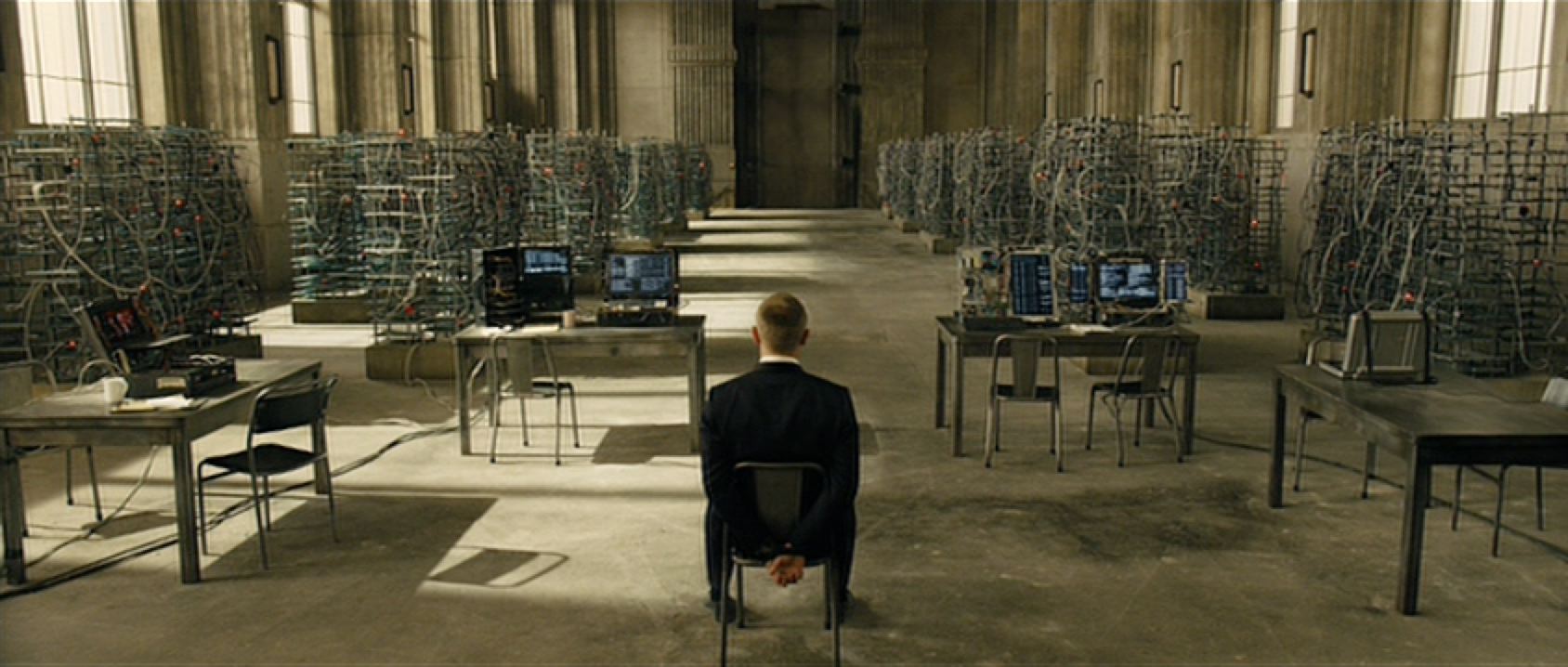
After we check in with M and a minor contretemps with Mallory, where again old and new clash (Mallory insists M’s methods are outdated, M insists that this threat must be matched by a similar answer — a shadow against a shadow), we swoop back to the South Pacific, where Bond and Severine arrive at Bad Guy Deserted Island (looking a little bit like Mol’s Dream World from Inception). Bond is strapped to a chair (evoking painful memories of Casino Royale?) in what appears to be a server room, facing rows and rows of data — the modern weapon. And here’s our Bad Guy, Silva, monologuing straight out of the box, literally (he steps out of an elevator), which the director handles beautifully by combining the monologue with a Lawrence of Arabia-length introductory shot of Silva walking towards camera. So that Silva literally comes into focus as the monologue goes on (it’s also an echo of the first shot of the movie, with Bond coming into focus as he comes down the apartment corridor in Turkey). The monologue, of course, is Silva’s story about Rat Island, and his grandmother’s solution for killing the rats, turning them into cannibals, changing their nature. Bond says “I made my own choices,” Silva counters with “You think you did.” Fate and determinism seem a little heavy for a Bond movie, but then it fits the Craig Bond well, with the enormous shadow of Bond History looming over him. Character is habitual action, and James Bond is nothing if not end-to-end habitual action, and the question of the motivator behind that action is central to the Craig reboot. The Bonds of yesteryear are pure fantasy, stylish assassins who travel the world, stay at expensive resorts, gamble in stodgy establishments. Craig does all that, but when he goes to the expensive resort he gets in by stealing someone’s car at the valet stand and when he gambles in Monte Carlo it’s on business. You get the impression that the Connery Bond does nothing but read Esquire on his off-hours, but Craig looks like he’s never read a magazine in his life. He’s a thug who has lucked into a job where he gets to pretend to be stylish, and learns he’s good at it. That, all by itself, is more “character” than Bond has ever been invested with. When Connery quit, the producers replaced him with a male model, which shows exactly what they thought of the character: a stylish, attractive form, useful for selling products: cars, clothes, accessories, James Bond movies.
James Bond: Skyfall part 5

Now that the pieces have been put into place, James Bond can finally embark on an adventure. In short order he will visit a skyscraper in Shanghai, a ritzy casino in Macau and an abandoned island in Japan. This is Act II, which is largely procedural, the thrust of which is Bond Finds the Guy Who Took the List. Step 1 of “Find the Guy” is “Find Patrice,” who is in Shanghai on a job.