Sam’s first love letter
click for larger view.

A dad can’t help but be proud when his son comes home from kindergarden with a note like this.
“Dear Sam” writes his admiratrix “I left you a penny and two dimes I love you because you gave me a stick. Love, _____.” (name omitted so that the young lady in question might one day still become a supreme court justice).
What, ahem, stick, you ask, did my son give her that was worth 21 cents and a love letter? No special stick, insists Sam, just a Y-shaped stick “you know, like for a slingshot,” that he found in the schoolyard and gave to her because she admired it.
Why is her declaration of love crossed out? I wasn’t sure how to dance around this subject with Sam, who has already had his 5-year-old heart broken once by the fickle wiles of the pre-teen female heart. But it turns out there is a perfectly rational explanation, at least in Sam’s mind. “She still loves me,” says Sam, noting that she repeats her declaration at the bottom of the letter, “it’s just that she must have read the letter again and thought ‘I love you because you gave me a stick?’ That doesn’t make any sense, that sounds crazy.”
The last time we were talking about career paths, Sam said that he does not think he would make a very good soldier (good for you, Sam) and that he still plans to become an artist (good for you, Sam), but based on this letter, it seems like he will always have “gigolo” as a fallback position.

A tale of two magazine covers

Rolling Stone continues its investigation into the exciting, glamorous, dangerous world of this new music called “rock and roll” with their blistering expose of a band that broke up before most of their readers were born. As they did last September with their revealing “Led Zepplin Was A Good Band” story, RS pushes constantly forward through seas of journalistic valor, delivering us the news on the excessive lives of 70s rock stars. To whom the story “Pink Floyd Did Not Get Along All The Time” is news is a mystery yet to be solved by this humble investigator. Is there a new Pink Floyd album on the way? An important new book? Did Mikal Gilmore (who really should have better things to do) honestly want to write a report on how Pink Floyd broke up, or did orders come from above that this important, emerging story demanded the attention of Rolling Stone? And the cover is, perhaps, the worst in the magazine’s history. I know the guys in Pink Floyd were ugly, but is that really the best available photo of them? It doesn’t even have a credit, only that it is from the Michael Ochs Archives and is owned by Getty Images. The flames in the background, however, are credited, to one Michael Elins.
Jann Wenner: Can you do something to jazz up this drab, ugly photo? We really need it for the cover. People have a driving need to know why this band broke up 25 years ago, and no one else will tell this story. Can you help me?
Michael Elins: Is that Lynyrd Skynyrd?
JW: No, it’s Pink Floyd.
ME: Oh. Damn. ‘Cause, you know, if it was Lynyrd Skynyrd, I could put, like, flames or something in the background.
JW: I like it. Flames, right. Because it’s Pink Fl — wait.
ME: What?
JW: That doesn’t make any sense. Pink Floyd, flames, it doesn’t — we need something else.
ME: Hm. Well, flames is what I’ve got. Hang on. (ME, who has never heard of Pink Floyd before, checks their discography at CDNow) I see one of their albums has a cartoon brick wall on the cover. How about if they stand in front of a cartoon brick wall?
JW: No, no, I like the flames, I just — it needs something else.
ME: How about that prism thing?
JW: Prism?
ME: Um, okay, um, how about a floating pig?
JW: Perfect! Where?
ME: I dunno, stick it on the logo or something.
JW: I love it.
MEANWHILE,

I’m sympathetic to the plight of the American soldier, but this cover falls like a lead piano. And it’s by Barry Blitt, who should know better. Remnicked again!
very subtle
spambot waves hello.

A brand new comment left on my Tower Records post, from several months ago:
The question from a new user
Hello everybody! I am new to the site toddalcott.livejournal.com
Could anyone, please, advise if there is a lot of
spam and unscrupulous advertising. Can I trust
all this information, which is present at this forum?
Sorry for stupid questions, I just really want know which
information I should trust or even pay attention.
No, spambot. Please do not pay attention. You cannot trust all the information, which is present in this forum. This forum is filled to the brim with unscrupulous advertising.
I get two or three of these a week, but this is, so far, the most, shall we say, "character driven." Gotta love the viral advertising.
My dream


Attention armchair psychologists:
I didn’t use to be this way, but, for whatever reason, I am this way now.
I have only one dream. Over and over again, every night. The details are always different, but the scenario is always the same.
It’s a variation on The Actor’s Nightmare. The Actor’s Nightmare is that you go out onstage and you don’t know your lines.
This is the dream: I am who I am, Todd Alcott, and my life (or at least my personality) is that of my waking hours. I dress how I dress, I talk to people as I talk to people, I think as I think.
As the dream begins, I have, every night, contracted, somehow, to engage in some sort of a performance — a speech, a monologue show, a TV interview, a play, a symposium. Endless permutations, I don’t know how my brain comes up with them all. Some elements seem pulled from my past, some don’t.
I have contracted to engage in this performance and I am unprepared. Or, actually, it’s not that I’m unprepared, exactly, it’s that, every night, things have been scheduled in such a way so that there is no time for me to prepare. Instead, there is always some kind of complicated hassle about lodging, transportation, costume, location, directions. These complications can become baroque in the extreme.
don’t tell me you don’t want to know how the rest of this goes
Sam hits the nub
Conversation in the car this afternoon with Sam (5):
SAM. Dad?
DAD. Yeah?
S. You know what my favorite food is?
D. What.
S. Lox.
D. I was going to say burritos.
S. I like burritos.
D. How about burritos with lox in them?
S. Eugh! That would be awful!
D. In New York, there used to be a restaurant near our house, they served crabmeat enchiladas. That was my favorite food for a long time.
S. Crabmeat?
D. Yeah, they —
S. Meat? From a crab?
D. Sure, and —
S. How is that fair?
D. What do you mean?
S. You mean they would kill a crab? Just to get it’s meat?
D. Well —
S. That’s not fair! The crab wasn’t hurting anybody!
D. But —
S. I don’t think it’s fair to kill animals just to eat them!
D. O-okay, then —
S. How can people do that, destroy nature, I —
D. But Sam —
S. I don’t like killing animals! It’s not fair and it’s not what nature wants!
D. Okay, sure. Okay. So you think it’s okay to eat fish but not, like, chickens and cows and pigs?
S. No! I don’t think it’s okay to kill animals at all! Nature wants animals to be out in it, to live, and have fun, and make more animals! Nature doesn’t want people to kill all the animals!
D. Um, okay. Okay. (pause) Do you know what lox is?
S. Yeah, it’s salmon.
D. Well, salmon is a fish.
S. Yeah, but those fish are already dead, there’s nothing I can do about that. And, and chicken nuggets, and hamburgers, and bacon, those animals are already dead. What I’m talking about is killing animals.
Rest in peace, Larry “Bud” Melman

It’s difficult to imagine now, 25 years later, the impact the early days of the NBC Letterman show had on us young hipsters. Cable was still a rarity and TV comedy in the days after Monty Python was Mork and Mindy. The 1982 Letterman show was a bizarre, cathartic psychotic freakout of TV culture, a show that took everything that had preceded it and turned it inside-out, and then devoured it, and then shat it out and devoured it again. You could turn on Letterman in 1982 and, quite literally, have no idea what to expect.
(I remember, early on, there was a “wheel of fortune” bit they did where Letterman would spin the wheel to see what would happen next. Selections were all mundane or ridiculous things, but then one choice was “Surprise Visit From Mick Jagger,” and there was a booth onstage with the hand of “Mick Jagger” waving out the top. In 1982, the idea of Mick Jagger showing up for Letterman was a cruel joke; now it would be commonplace.)
One of the high-water marks of the period was the character of Larry “Bud” Melman, a cranky, befuddled old man who was too real to be fake (although, of course, he was fake, an actor named Calvert DeForest). His timing, whether produced by comic brilliance or simple ineptitude, was absolutely stunning, and he could destroy a routine in the blink of an eye, then resurrect it into another realm in the following breath. Letterman would thrust him into situations clearly beyond his comprehension, seemingly to make fun of a sorry old man on national television, and Melman’s palpable haplessness, rage and desperation could become almost unbearable. You couldn’t figure out why Letterman kept using this guy except to make fun of his ineptitude, and you couldn’t figure out why Melman would keep showing up for the gig when he was only there to be laughed at. His every appearance in the early days was a high-wire act, with the audience not knowing quite what to make of this cranky, easily distracted and opaque old man. He couldn’t tell a joke — Christ, he could barely read his cue-cards — but the electricity between him and Letterman was astonishing. Routines would fall apart or turn into horrifying, cruel shouting matches and you didn’t know whether you wanted to laugh or cry but you certainly weren’t going to change the channel.
It turned out it was all a joke, but I never knew to what extent the joke was on Melman, DeForest, Letterman or the audience.
Nowadays, Letterman’s art of spinning comedy gold from the common man (Rupert Gee, Sirajul and Mujibar, et alia) is the norm on the show and everyone is in on the joke, but in the beginning, it was untested, even dangerous ground he was treading and the volatile Larry “Bud” Melman was his advance scout.
This is why I don’t watch TV news
“Is Wall Street worried about the Far Left hijacking the Democratic party?”
Listen carefully. The anchor is not making a statement, just asking a question. A question is not news, nor does it need to be supported by evidence. She could just as easily have begun the show by asking “Is Wall Street worried about clowns on Mars?”
The anchor raises the question, then turns to her colleagues and they talk about the question. For a few minutes they create the illusion that there is no other question worth thinking about. And soon the viewer starts to wonder, “gee, is this something that should concern me?”
Then they turn to an actual Wall Street analyst and ask the question again. “Is Wall Street worried about the Far Left hijacking the Democratic party?” and the actual Wall Street analyst looks baffled and says, basically, “WTF?” as though he just walked into the room.
So, no. Wall Street is not worried about the Far Left hijacking the Democratic party, Wall Street hasn’t even given a moment’s thought to the question. In fact, no one has worried about the Far Left hijacking the Democratic party except these people at Fox News, and of course, they are not worried about the Far Left hijacking the Democratic party, they would be thrilled if the Far Left hijacked the Democratic party. Because, in fact, the Far Left has not hijacked the Democratic party; this broadcast exists solely to raise the question in the minds of the vast majority of Americans who are currently sick to death of the way the country is currently being run.
Apparently Fox News does this sort of thing 24 hours a day.
The (other) Man Who Knew Too Much
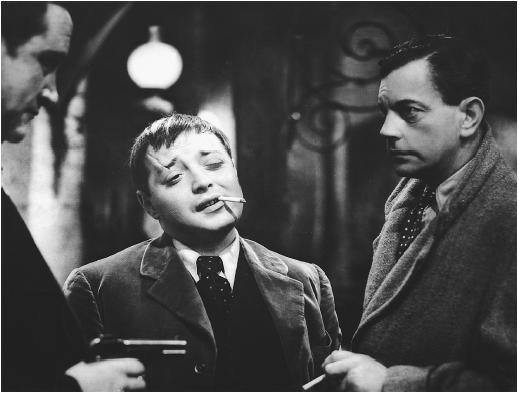
While it’s too much to say that the 1934 version of The Man Who Knew Too Much is “better” than the better-known 1956 version, there are areas where the original is a substantially better work.
The biggest tonal shift is the married couple. In 1956 they are middle-class Americans, Christian, uptight and oblivious to their surroundings, blundering around foreign countries at a loss. In 1934 they are wealthy, white-tie sophisticates, world-travelers who drink, trade bon mots with celebrities and joke about sleeping around. The shift makes the 1934 version both more giddy and more exotic — this couple seems to take the kidnapping of their child in stride, a simple problem to be solved with reserve, pluck and stiff upper lips, and there is plenty of time for banter and hijinx, and instead of recognizing the couple as people we know, we wonder what their private life must be like when they’re not dashing about Europe and participating in skeet-shooting competitions.
The Man Who Knew Too Much
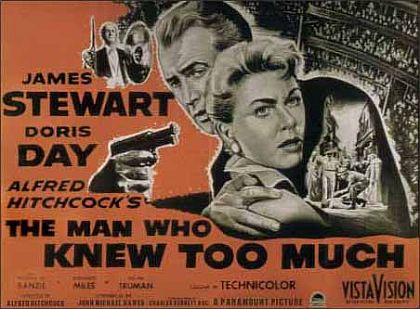
The Man Who Knew Too Much could be one of the most influential movies in history, although it may not seem like it at first.
In the first 20 minutes alone, we see an American couple whose marriage is on the rocks trying to patch things up with a bus ride through Morrocco (which showed up later in Babel) an American doctor and his wife attending a medical conference in a foreign country getting tangled up in international intrigue (which showed up later in the echt-Hitchcockian Frantic) and a hectic chase through a crowded Morroccan marketplace (which showed up later in Raiders of the Lost Ark). For good measure, Jimmy Stewart also mentions that he was stationed in Casablanca during WWII. With movies like these flooding the culture it’s amazing that Americans ever leave home at all.
(And of course the whole “assassination at the concert” sequence was lifted for the 70s Hitchcock pastiche Foul Play.)