The Princess Bride


Young’ns will hardly believe it, but 20 years ago Rob Reiner was once one of the most interesting and vital directors of commercial cinema in the US.
Check out this string of hits: This is Spinal Tap, The Sure Thing, Stand By Me, The Princess Bride, When Harry Met Sally, Misery, A Few Good Men, each one unusual for its time, innovative in some unexpected way, smart, and unerringly commercial. Usually if a director has three hits in a row he would be considered a master; this run is impressive by any definition.
The Princess Bride sits smack in the middle of this run and simultaneously the most old-fashioned and post-modern of these movies. The script, by “Nobody Knows Anything” William Goldman, manages to be both a loving send-up of old-fashioned adventure tales and a straight-ahead telling of those conventions at the same time.
A grandfather reads to a sick boy a book his father once read to him. The book is called The Princess Bride and the boy isn’t sure if he’s interested — it sounds like it’s for girls. And in the audience we’re not sure if we want to hear the story either — it sounds quaint, old-fashioned and soft. And in 1987, in the time of The Terminator at the box office, it was hardly the kind of story designed to sell mass quantities of tickets.
The story gets started and, indeed, it seems like it’s a girl story, a gothic tale of princes and princesses, trusty stablehands, pirates, giants and so forth. There is an over-the-top “kidding” aspect to the story and performances (which are scary good, Robin Wright and Cary Elwes being particularly perfect playing the delicate balance of camp and straight). But then something happens. In spite of the kidding nature, in spite of how silly the story is, in spite of the plot machinations being laid bare and discussed, the narrative takes hold. What the writer and director do is tell you “I’m going to tell you a story, it’ll be great, here’s how it will work, this is what you’ll think of this guy, this is what you’ll think of that guy, here’s how you’ll feel by the end,” and the jaded, seen-it-all viewer lets one’s guard down because one thinks that one is, like the kid, above the material. Then, amazingly, it turns out one is not above the material, in fact one can barely keep track of the plot as it changes direction so quickly. And it’s all stuff you’ve seen before but somehow you’ve never seen it quite this way before and before long, like the kid in the movie, one finds oneself completely wrapped up in a story that simultaneously feels ridiculously absurd and vitally true.
It’s like a magician who comes out and says “I’m going to do a trick for you, but first I want to show you how the trick is built, and how it works, and how it fools the audience, and how it’s going to fool you too,” and then goes ahead and performs the trick and it does fool you, even though you know how it works.
It works because, as storytellers have known for millenia, there are a number of fundamental principles that apply to good stories no matter what the genre, the format or the age of the audience. Master those principles and you can tell a story and take it apart at the same time, you can even chide the audience for getting involved in the story, the audience will still feel the same thrills and emotions.
The characters in The Princess Bride know this, certainly, that’s why they all have stories at the ready with which to justify themselves and deceive others. Westley has a story to convince people he’s a fearsome pirate, Vizzini has a story he’s beentelling himself for years about how a brilliant arch-criminal he is, Fezzig had a story he used to get the job working for Vizzini, Inigo has a story he’s been telling himself for years about the death of his father. Story has a vital and central place in the lives of these adventure-tale characters, and the filmmakers show that it has a vital and central place in our own lives as well.
Try this exercise at home: read Robert McKee’s Story, then watch The Princess Bride. For the young storyteller, few experiences will be more eye-opening and rewarding.

Justice League of America

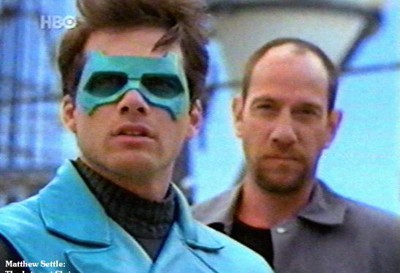
Martian Manhunter David Odgen Stiers fights middle-aged spread, while Green Lantern wonders if he can turn to confront Miguel Ferrer with a straight face.
Strangely enough, in 1997, while the world was waiting for Bruce Timm to create the show Justice League, CBS commissioned a pilot for a live-action Justice League of America. And as it happens, my local video store happened to have a copy of this little-seen pilot. As a “free rental,” no less. How could I resist?
A perfect example of how wrong a thing can go, Justice League of America shows what can happen when a decent idea falls into the hands of the uncaring. Now mind you, I never thought the original comic books (that is, in 1960) were any kind of ground-breaking miracle (they are mostly busy-work potboilers), but the makers of Justice League of America do not seem to have given a thought as to what their show is even about.
The lineup of this particular Justice League, for those interested, is Martian Manhunter, Atom, Flash, Green Lantern, Fire and Ice. The key thrust of the show seems to be “What if the Justice League were ordinary people, trying to lead their ordinary lives, trying to love and work and make friends, but then periodically having to dash off to save the world?”
Now, I’m all for superheroes behaving like human beings (that is, in fact, what makes the Bruce Timm show so successful), but there are limits. In Justice League of America, the superheroes aren’t just ordinary, they are desperately ordinary — sub-par slackers, halfway between The Incredibles and Mystery Men.
Take the Atom, for instance. In the comics, the Atom, Ray Palmer, is a brilliant physicist. That isn’t just a plot convenience, it’s the whole character. Ray Palmer must be a brilliant physicist because he invented the suit that enables him to get microscopic. In Justice League of America, Ray Palmer is a doughy, dull-witted, bespectacled high-school science teacher, unable to fix a television, much less rearrange the molecules of, say, an alien menace’s brainwaves.
Or the Flash. For the purposes of this show, it has been decided that Barry Allen can’t get his life together, attract women, or hold down a job. And so there is much “comedy” mined from Barry’s job misfortunes, lack of money and boredom. Why can’t he hold down a job? Well, because he moves too quickly, of course. Because apparently, in the world of this show, speed in one’s work is something that is frowned upon.
Or Green Lantern Guy Gardner (well, he’s called Guy Gardner, but he wears Kyle Rayner’s outfit, and of Lanterns, most closely resembles Rayner in temperament). The man who carries the most awesome weapon in the universe is a blithe, jokey ad executive, a man who has never given a moment’s thought to the responsibility he carries or the lineage he serves. I once wrote that Green Lantern is a job, but for Guy Gardner it appears to be more of a hobby.
Instead of watching Earth from their Watchtower up in space, this Justice League lives in a dumpy, retro apartment, where they bicker about chores and their love lives. That’s right, it’s Friends with superpowers. Far from protecting the world from intergalactic menace, it takes the whole team to protect one city from a terrorist with a plan that Dr. Evil would pass on as too absurd.
Now then: there is plenty in comics history to suggest that a group of superheroes with screwed-up personal lives could click — something 2000’s X-Men did beautifully — but what happens here is, disaster of disasters, the protagonists, dull as they are, become less interesting when they don their colorful outfits and fight crime. Their costumes are atrocious and laugh-inducing; they look like idiots dashing around their fake city in their bulky, ill-fitting suits and masks, rescuing tykes and dragging cats out from underneath porches. They have no ideas for fighting a menace or saving the city, they just kind of plod along, putting out fires while they wait for evidence to fall into their laps.
For those interested in viewing some representative clips, they may be found here.
The cast and crew of the pilot is a solid bunch of TV professionals, which makes it all the more perpexing that the show feels more like the production of some enthusiastic amateurs, not quite as polished as this.
Star Trek: The Motion Picture


Bald Chick reacts — or, more precisely, doesn’t react, to the Enterprise entering a field of Cheap Special Effects.
A film of staggering, almost monumental tedium, Star Trek: The Motion Picture is practically an oxymoron. Why title something The Motion Picture when motion is the thing most signally lacking?
In the future, everyone on Earth is required to wear a miniskirt. In space, everyone is required to wear pajamas.
In the future, everything takes a very long time. Especially in narrative terms. A gigantic space-thing is heading for Earth, and it takes the movie a full 40 minutes to get the goddamned spaceship launched.
(I have learned from Wikipedia that I am actually watching the new, improved “Director’s Cut” which reportedly flies like the wind. It is my sad duty to inform the public it does not.)
But, oh boy! Now that the ship is launched, I bet we’ll come in contact with the gigantic space-thing, right? Sadly, no. First, the ship must encounter a wormhole, a terrifying outer-space danger that bears a striking resemblance to cheap 1970s special effects.
In fact, I would say that fully half of Star Trek: The Motion Picture consists of the ship encountering cheap 1970s special effects. A typical sequence goes like this:
1. Someone looks at a screen.
2. On the screen is a cheap 1970s special effect.
3. Cut to: exterior of the ship, encountering the cheap 1970s special effect.
4. Cut to: group of people staring.
5. Cut to: another shot of the cheap 1970s special effect.
6. Cut to: someone else staring. Perhaps a jaw falls open.
7. The principles gather to discuss and theorize about the nature of the cheap 1970s special effect.
8. Repeat every ten minutes.
After taking 40 minutes to get started, the movie marks time for another twenty minutes, until we finally make contact with the gigantic space thing. Director Robert Wise brings to Star Trek: The Motion Picture the light, lyrical touch he brought to The Andromeda Strain and the stolid, grim determination he brought to The Sound of Music.
The theme of the movie is desire. Kirk desires command of the Enterprise, Spock desires to be free of emotion, Stephen Collins desires a bald chick. More to the point, everyone on the ship seems to want to have sex with everyone else. There are more meaningful glances, knowing smiles, wistful exchanges and heartfelt handshakes in any given hour of Star Trek: The Motion Picture than in the totality of The Way We Were.
So it is perhaps appropriate that the gigantic space thing has a gigantic space anus (or, as Spock calls it, “the orifice”) through which one must pass in order to gain the thing one desires. Spock, in a fit of passion, steals a spacesuit in order to pass through the space anus, and eventually Kirk pilots the whole spaceship through, sublimating, no doubt, his desire to pilot his spaceship through the anuses of his beloved crew members.
The gigantic space thing snatches a crew member off the ship, the Bald Chick. Why she is snatched is unexplained. Why she is returned, looking like the bald chick but transformed into a dull-witted robot, in a revealing mini-robe, is unexplained. Why the crew spend a good hunk of time trying to awaken her inner Bald-Chick-ness is unexplained.
Eventually, the plot conspires to have the Bald Chick express the desires of the gigantic space thing, which is to “touch the creator,” which in this case means covering Stephen Collins with sparkly blue lights and self-destructing. If this is how machines have sex, I don’t want to live in the future.
So the gigantic space thing disappears, taking the lives of Stephen Collins and Bald Chick, who get mentioned, and the lives of three ships of Klingons and a bunch of people on a space station, who don’t. Then Kirk, appropos of nothing, decides, on no authority whatsoever, to steal the spaceship and leave. In the future, apparently, there is less accountability necessary than today.
Things pick up in the final half-hour or so, as a handful of acceptable, middle-brow sci-fi “ideas” take hold and the tedium momentarily transforms into viewer interest. These ideas, I’m told, were adapted from earlier, cheaper episodes of the Star Trek TV show (which I have , regrettably, never watched) and would be later presented, in compact, exciting, character-driven, 22-minute form, as “The Return,” a tremendous episode of Justice League Unlimited.
Artist of the day: Carlo Barberi
As I’ve noted in the past, my son Sam’s favorite TV show is Justice League Unlimited. The problem is, there are only a couple dozen episodes of Justice League Unlimited, and there are 365 days in a year. This creates a gap for Sam of Justice League Unlimited stories.
This gap is filled, somewhat, by the existence of Justice League Unlimited comics, which keep coming out even though the TV show ended its run last year. These comics, more often than not, are what I read to Sam at bedtime.
I know relatively little about the superhero comics biz, but I’m guessing that the job of “imitating the character designs of a TV show for a superhero pamphlet” is not the prime job for most comics artists. And it often shows in the sloppiness, abrasiveness and lack of coherence in these titles, which may seem like simple product to many artists and readers, but which form a vital link to another world for people like my son.
An exception, I’ve found, is Carlo Barberi, an artist I’d never heard of before buying Justice League Unlimited for my son, but who has quickly become one of my favorites. Click for larger views.


There’s something about the “plastic” qualities of the characters that matches the subject matter well, invites the reader in. It’s light, brightly lit and colorful. The poses are dynamic without being emphatic. There’s something a little “freeze-dried” about the line that makes it fun and pliable. And I like his page layouts; they have a fluidity and spareness of design that makes the action clear and lucid. Look at all that blank space; and yet it doesn’t feel “blank,” it lets the reader follow the action swiftly and easily (believe me, I’ve gotten such headaches from trying to follow the action in some comic books myself, much less trying to explain what’s going on to my son).

I love this panel of Dr. Fate in his office, the camera angle, the big blank ceiling, the magical, mystical objects floating in air, the colors, and then the humor of it being sold with Dr. Fate’s petty concerns.

Even better is this page where Blue Beetle is left on monitor duty. Bored to tears, he tries paddle-ball, trying on the other hero’s outfits (note that he’s already tried on Wonder Woman’s clothes before moving on to the Flash’s), and, finally, the purest expression of superhero boredom, googling himself. Again, the elegance and cleanliness of the designs helps sell the action. This page made me laugh out loud, even if Sam didn’t quite get all the jokes.


Speaking of action, here are two terrific pages. I love how Parasite is flinging Wonder Woman clear off the page (Barberi will often have characters’ faces disappear off-panel to create tension) and how he’s tilted the camera to make the action more chaotic. Then, at the other end of the story, the dry, unemphatic line and empty space provides an ironic counterpoint to the cataclysmic action of Steel crushing Parasite with the Daily Planet globe.


Finally, he seems to be a master at these moment-to-moment kind of exchanges. Sometimes for comic effect, sometimes for silent, understated drama, all these exchanges leave it to the reader to fill in the blanks (no small feat in this often frantic, overstated genre, believe me). Best of all (and I realize these are script issues, not drafting issues), all these beats work for character reasons — these beats arise out of conflict between personalities, not machinations of plot.
Q: How do you get a 5-year-old boy interested in chess?
A:


Yes, it’s a Justice League chess set, and my son Sam has instantly learned chess.
I’m not the kind of dad who insists that his 5-year-old play chess, but Sam has been playing this Justice League video game, “Halls of Injustice,” in which his heroes move on a grid and make specific actions to defeat their opponents, and it’s about five time more complicated than chess, so I thought I’d give it a shot. No problem at all. He grasps the principles without a second thought. I doubt I have another Mac Pomeranc on my hands — although I would not complain if I did — but it’s a huge leap forward for the boy and, as usual, I have the Justice League to thank for it.
The players, for those curious, are:
White (let’s call them white, even though they’re silver) Superman is King, Wonder Woman is Queen, Flash is Bishop, Batman is (Dark) Knight, and Hawkgirl is Rook. Green Lantern is the Pawn.
Black (gold) are: Shade is King (What? No Lex Luthor? I guess he’s too much of a Superman villain), Star Sapphire is Queen (well, better than Cheetah, I guess) , Solomon Grundy is Bishop (Solomon Grundy? They let him run the diagonal length of the board? Solomon Grundy?) Ultra-Humanite is Knight, Copperhead is Rook (Copperhead, right — guy in a snake suit is going to go up against a flying alien with an indestructible weapon), and an alien robot called a Manhunter (Sam had to remind me which episode they appear in) is the Pawn.
All of this makes sense to me except Hawkgirl, who doesn’t seem to be very rook-like in her attitude. But it was either her or Martian Manhunter, and someone had to get the axe — might as well be the creepy green guy from another planet no one likes.
Martian Manhunter’s mother: “You can change your shape, J’onn, why don’t you change it to look more like that nice Superman boy? I’d bet you’d get your own chess piece then.”
J’onn J’onnz: “Moo-oommm…”

Captured on the sidelines, the Amazon queen steals some time with her Dark Knight. Batman, of course, plays it cool.

John Stewart: “Wait a minute, why is the black guy a pawn? What are you trying to teach kids?”

Superman, for some reason, looks a little put out at having been made King. Little pouty. Like maybe he said “Ooh! I’ll be King!” And then he found out that he can only move one space and everyone wants to kill him.
It’s a little weird to hear things like “Are you sure you want to move your Wonder Woman there? Because my Copperhead could capture her and that would put your Superman in Check. Why don’t you move your Batman there, ’cause that would block my Ultra-Humanite from capturing your Flash,” but one gets used to it quickly.
Charlie and the Chocolate Factory


A charming fairy-land of playfulness, whimsy and possibility, and the interior of Willy Wonka’s chocolate factory.
Charlie and the Chocolate Factory is a richly realized, imaginatively produced meditation on art, creativity and irrationality, and how those unpredictable, untameable, wild qualities can be used to make a lot of money. In this regard it is a summation not only of Tim Burton’s career but of the movie business in general.
Early on in the movie, a story is told about Willy Wonka building a chocolate palace for a vain Indian prince. Wonka warns the prince that the palace won’t last, but the prince disdains his advice; eat his beautiful palace? The idea is absurd. Sure enough, the palace melts and the prince is left with nothing. This anecdote sets the tone for the rest of the story — Wonka built the palace to be consumed and destroyed, but the prince wants it to stand as a tribute to his own extravagance. Wonka knows that the power of his art lies in the fact that it will not, cannot last; the prince demands that the art last forever.
Charlie wants to get one of the golden tickets that will admit him entrance to the mysterious, magical factory — that is, he wants access to the creative center, the act of creation. A budding artist himself (he’s built a model of the factory out of deformed toothpaste caps), he seeks the locus of inspiration. Since Charlie is a desperately poor child, how shall he obtain this ticket?
The other children get their tickets through a variety of methods: Augustus Gloop gets his because he naturally eats a great deal of chocolate, Veruca Salt forces her father to enslave his factory workers into unwrapping millions of chocolate bars, Violet Beauregard gets hers seemingly through blind determination to win, and Mike Teevee gets his through “cracking the code,” using a complicated formula to determine where the next golden ticket might appear. Of these approaches, Augustus’s seems to be the most innocent and related to the natural function of chocolate (that is, to be eaten); Augustus’s problem seems to be that he enjoys his natural state a little too much.
How shall Charlie get his ticket? His parents buy him a bar for his birthday, but there is no ticket there. So parental love, generosity, legacy, inheritance — those won’t get Charlie what he wants. His grandfather gives him money from a secret stash, his last money in the world, to go buy a bar, but that bar contains no ticket either. So faith and lack of caution won’t work either. No, Charlie gets his golden ticket through sheer dumb luck — he finds a ten-dollar bill in the street (in England, but let’s set that aside for now), and buys a bar from the first newsstand he comes to. He uses no system and has no determination — he’s not a “special child,” he is not blessed. As Willy Wonka says when he meets Charlie, “Well, you’re just lucky to be here, aren’t you?”
After getting his golden ticket, after achieving his entry into the heart of inspiration, Charlie is tempted to sell out. His family, he reasons, could get thousands of dollars for the ticket, he shouldn’t be so foolish as to trade a day of inspiration for months of sustanence. His grandpa George sets him straight, tells him that money is the most common thing there is, they’re always printing more of it, but the golden ticket is rare and precious, almost unique, and so Charlie narrowly avoids losing his inspiration for something as banal as comfort.
The first stop on the tour is Wonka’s own center of creation itself, a virtual Garden of Eden of candy (the Eden parallel made explicit by Violet greedily snatching a candy apple off a tree — and lest we forget, “inspiration” means to have God breathe into you). Wonka, like God, invites the children to eat anything they want with one exception. Set free in Eden, Mike Teevee destroys as his father (who bears an uncanny resemblance to renowned subway vigilante Bernard Goetz) looks on helplessly and Mrs. Gloop is seen stealing what is being given away for free. Augustus breaks the one rule set down and gets expelled from Eden.
This is the third time I’ve watched the movie, but only the first time Johnny Depp’s performance made any sense to me. This time around, I was struck by when his speech is fluid, when he has trouble expressing himself and when he actually must rely on pre-printed cheat-sheets to say something. Since Wonka makes and sells candy for a living, it is assumed that he is a wholesome, child-friendly man, but of course nothing could be further from the truth.
The imitation “Small World” robot puppet number, meant to herald the arrival of Wonka, backfires and melts down as it invites the guests into the factory. It’s an imitation “Small World” number because Wonka is trying to match his public image as a children’s entertainer, a la Walt Disney. It melts down because it cannot disguise the fact that he is not. It’s notable for being an introduction to a character who, of course, turns out to not be part of the introduction. Wonka is happy to put on the show, but it does not occur to him that he would actually be introduced by his own introduction. That would make too much sense, and Wonka is not capable of making sense.
Little Wonka says makes sense in any practical sense of the term, and that is of course the point, or rather the pointlessness. (“Why is everything in this factory completely pointless?” complains Mike Teevee. “Candy doesn’t have to have a point,” answers Charlie, “that’s why it’s candy.”) I am reminded of conversations I’ve had with artists where I’ve tried to get them to give up the secrets of their work. They can rarely explain why they chose one concept over another, get vague and visibly uncomfortable when pressed, and either completely shut down (as Wonka does several times in this movie) or else start reciting reams of incomprehensible theory they remember from art school (which is what Wonka has the cheat-sheets for). Wonka doesn’t have a scheme or a formula or a plan; he just is.
(The most controversial aspect of the movie is its attempt to “explain” Wonka, which Burton and Depp put over in the most ironic, eye-rolling terms possible. “Okay,” they seem to be saying, “we’ll give you ‘meaning,’ but we’re not going to mean it.”)
Several things in the movie stick out amid the elaborate production design and the sumptuous photography. First is the performance of Deep Roy as every Oompa-Loompa in the movie, which is both a triumph of special effects and a triumph of acting, insofar as one quickly accepts the idea of thousands of Oompa-Loompas living in the factory and quickly forgets the fact that they’re all being played by the same guy. Second is the makeup, which seemingly transforms several of the characters into something a little more than plastic and a little less than human. Third is the trained squirrels, another special-effects triumph and the result of thousands of hours of squirrel training.
A couple of winters ago, the artist Christo finally got to install his “Gates” project in Central Park for two weeks in February. He had been trying to get it installed since 1979 and finally succeeded in 2005. There was a great deal of resistance to the project (over 25 years of resistance, in fact), both before it was put up and afterwards. I remember walking through Central Park amid the gorgeous, inspiring, completely pointless saffron banners, and being accosted by a total stranger, an older man who was furious, furious that this artwork had been put up. “Why couldn’t they use the money for something useful?” he demanded to know, from me, for some reason. To which I said “What does it matter? It was his money, he can do what he wants with it.” “Yes,” said the man, “But we have to pay for it!” To which I said “But we don’t have to pay for it. Christo used his own money to put it up, paid all the workers to maintain it, and will pay to have it taken down. In addition, he’ll pay to have the park restored to its previous condition and make a large donation to the Central Park Conservancy. In addtion, the tourists coming into the city to see the piece will bring more money in, so not only are we not paying for it, we’re in fact making money off it.” But the man would not be placated. He knew, he knew that Christo had to be making a fool out him somehow, that there had to be some kind of a scam to it, one doesn’t just spend millions of dollars on something as pointless as, as this.
I walked on through the park and came to the Sheep Meadow, where hundreds of New Yorkers and tourists roamed in a state of weird, elevated giddiness. The park had been transformed into a wild playground of irrationality; the Gates, finally, didn’t “mean” anything at all. If anything, they removed meaning from the park; they were a meaningless hoot, a shout of joy in the chill February air (I wonder if it’s symbolic that Charlie visits Wonka’s factory on February 1st, literally the middle of winter). Three years after 9/11, New Yorkers defied depression with an embrace of the exuberantly irrational. Like the palace Wonka made for the Indian prince, “The Gates” didn’t last long, by design. If it had stayed around forever, or had been brought back for an encore, it would defeat the purpose of the piece, which is to be transitory and as sensual as a bite of chocolate. To keep “The Gates” around would be to want to have one’s cake and eat it too.
Low-lifes and little girls: Paper Moon and Little Miss Marker


Two Depression-era comedies made seven years apart (Paper Moon 1973, Little Miss Marker 1980), with the same setup — a man living on the outskirts of the law has an orphaned little girl thrust into his life. Here is an object lesson about how to do a thing and how not to do a thing.
Peter Bogdanovich was a young man when he made Paper Moon, it was his third film (after the luminous Last Picture Show and the delightful What’s Up, Doc?). Walter Bernstein was not a young man when he made Little Miss Marker, and although he was a hugely accomplished, well-respected screenwriter at the time, this was his first (and only) theatrical feature.
Essentially, everything Paper Moon does right, Little Miss Marker does wrong. Paper Moon is acutely observed, stark and heartfelt while Little Miss Marker is shallow, limp and sentimental.
Little Miss Marker should have everything going for it — a classic, cast-iron story (by Damon Runyon) that had already been filmed twice before (in 1934 with Adolphe Menjou and Shirley Temple and in 1949 [as Sorrowful Jones] with Bob Hope and Lucille Ball), a heavyweight, almost Wilderesque cast (Walter Matthau, Tony Curtis, Julie Andrews), a budget big enough to create the streets of New York on the Universal lot. In contrast, Paper Moon is based on a relatively obscure novel, has a decidedly lightweight lead (Ryan O’Neal), and a series of bleak Kansas locations.
Plot: Paper Moon is a road picture. The little girl’s mother has died, and her probable father, a drifting grifter, is given the task of getting the little girl to a “respectable” home in the next state. He tries to get rid of her but she won’t be put off. They embark on a life of petty crime together on their journey across the Midwest. Little Miss Marker is an “urban” comedy, where a gambler leaves his little girl with his bookie, then goes off and kills himself, leaving the hard-bitten, cynical bookie to care for her. He gets involved in a B-story that has nothing to do with the little girl and a romance that has nothing to do with the B-story. All the plot lines come to an end but do not all come together.
Photography and sets: Paper Moon is shot in gritty, high-contrast black and white, which makes this 70s comedy look like a John Ford picture and also lends a great deal of gravitas to his genial, blonde-haired, blue-eyed Californian leads. Its location exteriors are all authentically weathered and withered, its interiors are spare and bleak. It’s a movie about a nation with no money and it shows in every aspect of the production design. Little Miss Marker, on the other hand, is shot in pretty, high-key general lighting, intended to make the movie a happy escape into a simpler time, but which now makes it look like 60s television or a filmed play, shot on backlot sets that look desperately back-lot; every street ends in a T, pavement is flat and even, grime is painted on in pretty, even coats.
Music: Paper Moon has no score; it uses occasional period songs to set its time and underscore the emotional terrain. Little Miss Marker has a cutesy-pie fake-“thirties” score by Henry Mancini, intended to evoke nostalgia but serving only to move the story into a kind of fairy-story Depression where colorful characters talked like wise guys and nothing bad really ever happened.
Casting: Paper Moon, as noted above, would seem to be the movie at a loss here. Who is going to play a better low-life, Walter Matthau or Ryan O’Neal? And yet, Matthau’s performance in Little Miss Marker is mannered, labored and fussy while O’Neal’s, although insubstantial, is breezy and blithe, it breathes and connects on a more human level. The cast of Paper Moon is filled with picture-perfect unknowns, while Little Miss Marker has a miscast Bob Newhart, an overplayed Brian Dennehy, a stiff Kenneth McMillan and a mugging Tony Curtis.
The Little Girl: Paper Moon, of course, cast 10-year-old Tatum O’Neal as the little girl and she won an Oscar for her work, which, although not as genuine as, say, anything from Dakota Fanning, is still winning and affecting. Little Miss Marker, on the other hand, seems to have picked a six-year-old from the “Adorable Moppet” bin and left it at that.
The Dame: there’s always a Dame, of course, and here’s perhaps where the real difference in the movies appears. In Little Miss Marker, the adorable moppet brings together Walter Matthau, the heartless curmudgeon, and Julie Andrews, a fallen society lady, to replace the family she has lost. The romance between Matthau and Andrews makes no sense and feels completely forced, and the movie ends with both of them giving up their wicked ways for the good of the child. In Paper Moon, on the other hand, Ryan O’Neal falls in lust with a giggling, insincere whore (Madeleine Kahn), and the little girl spends the second act of the movie trying to break up their romance because she’s cutting into their grifting time.
Script: Damon Runyon, one of the most instantly identifiable writers in American literature, has never been captured well on film. Like Mamet, he has a clear, definite dialogue style, one demanding committed actors capable of breathing life into his heavily stylized rhythms. Matthau tries to do so but can’t, Curtis and Newhart don’t even try, and Andrews’ dialogue has been written to completely ignore the issue. The affectionate view of gamblers and gangsters that Runyon wrote is made cartoonish, silly and harmless here; the result is a plastic, fake Runyon that doesn’t evoke Guys and Dolls, much less the New York of the 1930s. Meanwhile, Paper Moon, while slightly episodic and far from “realistic,” nevertheless teems with authenticity and well-observed details of daily life.
At the end of Paper Moon, the man makes good on his promise and delivers the little girl to her “respectable” home. The little girl takes one look around and high-tails it out of there; she realizes that a house is not a home and respectability is not fulfillment. And in a phiosophical sense, she sees that life is not a destination you arrive at, it is a journey you take. At the end of Little Miss Marker, the gambler and the fallen sophisticate get married for no reason at all and, although both are middle-aged and broke, decide to “go straight” for the sake of the little girl (whom no one asks, and who seems to be perfectly content to play cards, pick pockets and bet on horses for money). Paper Moon disdains conclusion and becomes evocative and moving, Little Miss Marker ties everything up in a neat bow and evaporates before the credits have run.
Todd’s Oscar picks
Note: although I am a member of the Writer’s Guild, I am not a member of the Academy. I’m just a guesser like anybody.
Further, note that I have never won an Oscar pool in my life. If you want to know who is going to win at the Oscars, ask Mrs. James urbaniak. She has won every Oscar pool I’ve ever entered.
Performance by an actor in a leading role
Leonardo DiCaprio – BLOOD DIAMOND
Ryan Gosling – HALF NELSON
Peter O’Toole – VENUS
Will Smith – THE PURSUIT OF HAPPYNESS
Forest Whitaker – THE LAST KING OF SCOTLAND
I actually haven’t seen any of these movies. I’m going to say Forest Whitaker, because the trailer for Venus set my teeth on edge.
Performance by an actor in a supporting role
Alan Arkin – LITTLE MISS SUNSHINE
Jackie Earle Haley – LITTLE CHILDREN
Djimon Hounsou – BLOOD DIAMOND
Eddie Murphy – DREAMGIRLS
Mark Wahlberg – THE DEPARTED
A strong field, but Eddie Murphy is due. He is one of our greatest actors and a national treasure. I am astonished he was not nominated for The Nutty Professor.
Performance by an actress in a leading role
Penélope Cruz – VOLVER
Judi Dench – NOTES ON A SCANDAL
Helen Mirren – THE QUEEN
Meryl Streep – THE DEVIL WEARS PRADA
Kate Winslet – LITTLE CHILDREN
These are all extraordinary performances. I wish Cate Blanchett was in this category so we could have three Queen Elizabeths fighting against each other.
Everyone is saying Helen Mirren is going to win it, but I preferred Meryl Streep’s performance. She was astonishing in that movie.
Performance by an actress in a supporting role
Adriana Barraza – BABEL
Cate Blanchett – NOTES ON A SCANDAL
Abigail Breslin – LITTLE MISS SUNSHINE
Jennifer Hudson – DREAMGIRLS
Rinko Kikuchi – BABEL
I’m baffled by Cate Blanchett in this category — she’s easily the co-lead in Notes, and extraordinary as always, easily the most gifted actress of her generation. Abigail Breslin gives one of several excellent kid performances of the year. But Jennifer Hudson is the walk-away favorite here.
Best animated feature film of the year
CARS
HAPPY FEET
MONSTER HOUSE
Happy Feet, although it gets weighted down with a “message” in Act III, is by far the best animated film of the year. Utterly original in a year of achingly similar talking-animal movies, character design that is authentic and subtle without sacrificing kid appeal, an organic, felt storyline instead of a forced, programmatic formula, and living, breathing characters.
Achievement in art direction
DREAMGIRLS
THE GOOD SHEPHERD
PAN’S LABYRINTH
PIRATES OF THE CARIBBEAN: DEAD MAN’S CHEST
THE PRESTIGE
Dreamgirls.
Achievement in cinematography
THE BLACK DAHLIA
CHILDREN OF MEN
THE ILLUSIONIST
PAN’S LABYRINTH
THE PRESTIGE
All of these movies are really well shot. Children of Men has two sequences which count as two of the most jaw-dropping action sequences ever shot, but I’ll say Pan’s Labyrinth.
Achievement in costume design
CURSE OF THE GOLDEN FLOWER
THE DEVIL WEARS PRADA
DREAMGIRLS
MARIE ANTOINETTE
THE QUEEN
Dreamgirls.
Achievement in directing
BABEL
THE DEPARTED
LETTERS FROM IWO JIMA
THE QUEEN
UNITED 93
Has to be Scorsese. Has to be. Babel and Iwo Jima feel like homework, The Queen feels too performance driven, United 93, while amazingly directed, far too painful to sit through. Has to be Scorsese.
Best documentary feature
DELIVER US FROM EVIL
AN INCONVENIENT TRUTH
IRAQ IN FRAGMENTS
JESUS CAMP
MY COUNTRY, MY COUNTRY
Inconvenient Truth. They can’t pass it up. Plus I don’t think any of the others are about the Holocaust.
Best documentary short subject
THE BLOOD OF YINGZHOU DISTRICT
RECYCLED LIFE
REHEARSING A DREAM
TWO HANDS
No idea.
Achievement in film editing
BABEL
BLOOD DIAMOND
CHILDREN OF MEN
THE DEPARTED
UNITED 93
I’m going to say United 93.
Best foreign language film of the year
AFTER THE WEDDING
DAYS OF GLORY (INDIGÈNES)
THE LIVES OF OTHERS
PAN’S LABYRINTH
WATER
Oh, Pan’s Labyrinth. Definitely.
Achievement in makeup
APOCALYPTO
CLICK
PAN’S LABYRINTH
The makeup in Apocalypto is quite an achievement, but I don’t think the Academy can give it an award. And if they can’t give it to Apocalypto, they can’t give it to an Adam Sandler movie. A lot of the makeup effects in Pan’s Labyrinth are computer generated, but I still say it will win.
Achievement in music written for motion pictures (Original score)
BABEL
THE GOOD GERMAN
NOTES ON A SCANDAL
PAN’S LABYRINTH
THE QUEEN
I’m going to say Notes on a Scandal, only because it’s by my favorite living composer, Philip Glass, and I want to see him win.
Achievement in music written for motion pictures (Original song)
“I Need to Wake Up” – AN INCONVENIENT TRUTH
“Listen” – DREAMGIRLS
“Love You I Do” – DREAMGIRLS
“Our Town” – CARS
“Patience” – DREAMGIRLS
I’m going to say one of the songs from Dreamgirls. But I could be wrong.
Best motion picture of the year
BABEL
THE DEPARTED
LETTERS FROM IWO JIMA
LITTLE MISS SUNSHINE
THE QUEEN
Has to be The Departed. The other ones on this list don’t even come close.
Best animated short film
THE DANISH POET
LIFTED
THE LITTLE MATCHGIRL
MAESTRO
NO TIME FOR NUTS
Not a clue.
Best live action short film
BINTA AND THE GREAT IDEA (BINTA Y LA GRAN IDEA)
ÉRAMOS POCOS (ONE TOO MANY)
HELMER & SON
THE SAVIOUR
WEST BANK STORY
West Bank Story. (It’s about Israel, right?)
Achievement in sound editing
APOCALYPTO
BLOOD DIAMOND
FLAGS OF OUR FATHERS
LETTERS FROM IWO JIMA
PIRATES OF THE CARIBBEAN: DEAD MAN’S CHEST
Hmmm — a toss up. I’m going to say Flags, just because that’s the only one where I remember being impressed by the sound effects editing. (Last time I used this logic was for Dances With Wolves, and I was right then too.)
Achievement in sound mixing
APOCALYPTO
BLOOD DIAMOND
DREAMGIRLS
FLAGS OF OUR FATHERS
PIRATES OF THE CARIBBEAN: DEAD MAN’S CHEST
Dreamgirls.
Achievement in visual effects
PIRATES OF THE CARIBBEAN: DEAD MAN’S CHEST
POSEIDON
SUPERMAN RETURNS
Pirates. Bill Nighy with an octopus on his face is, hands down, the greatest, most sophisticated, most successful, most daring visual effect of the year.
Adapted screenplay
BORAT CULTURAL LEARNINGS OF AMERICA FOR MAKE BENEFIT GLORIOUS NATION OF KAZAKHSTAN
CHILDREN OF MEN
THE DEPARTED
LITTLE CHILDREN
NOTES ON A SCANDAL
Not sure what makes Borat an “adapted screenplay,” but whatever. Little Children is the best screenplay of the year.
Original screenplay
BABEL
LETTERS FROM IWO JIMA
LITTLE MISS SUNSHINE
PAN’S LABYRINTH
THE QUEEN
Gosh. I’m actually going to say Little Miss Sunshine, only because I don’t think they’ll give it to Pan’s Labyrinth. Plus, Little Miss Sunshine was, you know, this year’s “little movie that could,” and otherwise won’t win anything.
There you go. And remember, I’m always wrong about these things.
Kit’s corner

It’s not my intention to turn this journal into a “kids art” blog, but I would be remiss if I didn’t include some drawings by my daughter Kit (4). Kit does not have her older brother Sam’s single-minded, monomaniacal drive regarding superheroes, but she does have a healthy interest in them, leavened by interests in other things, like, say, Maisy, Speed Racer, Tom and Jerry, Polly Pocket and so forth.
Above are two of her drawings, of Wonder Woman (with her tiara) and Cinderella (with her beehive and bow). The thick black line sticking out of WW’s head is her hair — Kit doesn’t quite get the whole gravity thing yet. And Cinderella’s hands are not on fire; those are her fingers.
Sam’s cosmology
The pantheon. Click for much larger view.

As we see, the Justice League takes up the top shelf, as befitting their status as supreme beings. The order of the seven is taken from Justice League publicity materials, which always order them in this way.
But then, curiously, the Justice Lords (the evil Justice League from an alternate time-stream) are placed on the same shelf, and in the same order (minus Justice Lord Flash [or Reverse Flash], who is not featured as a member of the Justice Lords proper [except for the false Justice Lords generated by the Luthor/Brainiac monster]).
Below the Justice League are the second-tier Leaguers: Plastic Man (a custom job bought on eBay), Vixen (posed below her current boyfriend, Green Lantern) Shining Knight (who should be posed beside Vigilante, who has not yet been acquired), Black Lightning and Isis (two more eBay custom jobs), Robin (Robin? The hell is he doing here?), Atom Smasher (the lone Justice Leaguer who claims Jewishness as part of his identity in this otherwise areligious team), Green Arrow (mysteriously, not posed next to Black Canary), Aquaman (note that the Aquaman posed here is the one without the cape; this is the real Aquaman), Batgirl (partially obscured) (Batgirl?!), Huntress, Atom, Red Tornado, Hawk, Dove, Metamorpho and Zatanna.
(Sam is loath to place one character in front of the other — they are all equal [on their shelves] to each other. It pained him to place Aquaman in front of Batgirl but he was forced to due to space considerations.)
Then, we have the third-stringers, or supporting characters: Supergirl (whom I would have placed in the second tier), Orion, Black Canary (another second-level hero, imho), Starman, Booster Gold (a third-shelfer, even though he has his own episode of JLU, Elongated Man (yes, the official Elongated Man is trumped by a custom Plastic Man, as he should be), Nightwing (Nightwing?) Steel, Wildcat, Waverider, Dr. Light (that’s Dr. Light II, not the rapist of Elongated Man’s wife), Aztek, Dr. Fate, Rocket Red, The Creeper.
I do not know what system Sam uses to rank these figures. Black Lightning is a second-shelfer, even though Sam knows very little about him and has not seen him featured on the show, and while he’s never seen a Plastic Man comic and he is not featured on any of the Justice League shows, Sam somehow understands thathe outranks Elongated Man (comics fans, of course, know that Plastic Man did not begin his life as a DC hero, he was purchased from another publisher; Elongated Man was the pale imitation DC cooked up so they could have their own stretchy guy). Isis has never been featured on the show or even in the tie-in comics; Red Tornado he finds compelling enough to put on the second shelf, even though the character only has the most passing moments on the show. Robin, Nightwing and Batgirl get included, even though they are not part of the League (and are presumably either off with the Teen Titans or guarding Gotham City, dating Bruce Wayne (Batgirl only) (I think) and growing old while waiting for Terry McGuiness to take up the Batman mantle). (And before anyone starts complaining about Robin and Nightwing being featured at the same time, the Robin featured here is Tim Drake, not Dick Grayson.) The Green Lantern Corps (Katma Tui, Kyle Raynor, Arkkis Chummuck, Tomar Re, Kilowog), although they dominate several key episodes, currently reside in a bench on the other side of the room (presumably the bench is the same relative distance from the shelf as Oa is to Earth). Vixen is posed beneath Green Lantern, but Zatanna is not posed beneath Batman, although they have been romantically linked.
The underworld. Click for much larger view.

On the bottom shelf, crammed together, we have the villains, with the most powerful in the center, growing less powerful (or relevant) as we move to the edges. Thus, Lex Luthor, Joker and Brainiac take center stage (with the Very Tall Darkseid, Doomsday and Bane behind), flanked by Poison Ivy, Amazo, Mr. Freeze and the ultra-lame Copperhead to the left, and Catwoman (seated), Sinestro, Two-Face, Bizarro, Harley Quinn (obscured by Bizarro), and the ultra-lame Mirror Master to the right.
Even casual Justice League viewers will note the preponderance of Batman villains here. Strictly speaking, Joker, Bane, Mr. Freeze, Catwoman, Poison Ivy and Harley Quinn shouldn’t be here at all (although some of them put in a brief appearance in a couple of episodes). It is, I’m guessing, their overwhelming importance to the Batman/Gotham City mythos that warrant their inclusion in the Legion of Doom.
I cannot explain Poison Ivy’s outranking of Amazo. The Amazo character in Justice League is one of the key stories of the whole series, second only to the Justice Lords scenario. We even have two other Amazo figures (one gold and one clear, symbolizing different levels of Amazo’s evolution), which have been banished along with the Green Lantern Corps (perhaps for similar thematic reasons — Amazo does, after all, leave Earth when it has nothing more to offer him). Similarly, I cannot explain why Catwoman is seated; Sam is adamant about this point however and has corrected her posture on more than one occasion. The Joker’s distance from Harley can be explained for character reasons (Joker seems to spend half his time distancing himself from Harley) (He’s even gotten Bizarro to hold her off).
Reverse Flash, who until recently lived between Harley Quinn and Mirror Master, now mysteriously resides in a box under the desk.