The Proposition

A gang of outlaws is trapped by the authorities and overwhelmed in a tin shack somewhere in the Australian outback in (I’m guessing) the late 1800s. The gang of outlaws is led by the trim, scruffy Guy Pearce. The sheriff is the not-trim-but-almost-as-scruffy Ray Winstone. Both actors draw vivid, exciting portraits of their characters, men on opposite sides of the law in a savage land suffering the birth-pangs of civilization.
The sheriff gives the outlaw the proposition of the title: I will let you go if you will hunt down your brother and kill him before Christmas. This brother is, apparently, living out in the wasteland, some kind of psychopathic monster, feared by whites and aborigines alike. The sheriff takes the outlaw’s mentally-retarded little brother custody as surety.
This is a terrific setup for a western, with two wonderful actors given parts to sink their considerable teeth into. We can’t wait to see the fireworks between these two characters, the outlaw with a conscience and the sheriff who will commit savage acts in order to civilize a wilderness.
So it’s a little strange when, ten minutes into the movie, the narrative sends the outlaw off in one direction and the sheriff off in another, and doesn’t bring them back together until the very end. What follows is two parallel narrative tracks, with neither track carrying much burden in terms of plot.
The outlaw wanders in the desert, meets a drunken racist and is attacked by aborigines. The sheriff goes home, hangs out with his wife, deals with his subordinates, supervises the simple brother, suffers attacks from his superior, and begins to regret his decision to let the outlaw go. The outlaw meets up with his brother, thinks about killing him, then doesn’t, then decides they should all go get the simple brother out of prison.
The movie is never boring. The scenes are staged with great skill, ingenuity and attention to detail. The photography, acting and production design are skillful and evocative of a blunt, brutal time (the flies covering everything are a particularly vivid detail), but I can’t help think there was a narrative opportunity passed up somewhere. The sheriff’s proposition makes no sense — let a notorious outlaw go to go fetch his more notorious brother, and we’ll keep your simple brother as collateral? That’s his plan? He has been looking for this outlaw gang for a long time and has spent considerable resources on their capture, and the first thing he does is let the leader go? What makes him think he’ll return?
(He says that the outlaw would do anything to save his little brother, but it’s weak — we have only the sheriff’s word on the filial affection, and what, indeed would stop him from coming back with a plan to bust the brother out of prison and kill everybody, which is, indeed, what ends up happening?)
For a while it seems that the outlaw’s journey through the wasteland is going to be an odyssey through the layers of civilization, or perhaps an interior journey into madness and betrayal, but it seems to take no time for the outlaw to meet up with his brother, and even then he gets let off the narrative hook by a spear through the chest, a smashing image that turns the character into a passive protagonist for an entire act.
Why separate the protagonist and antagonist for the entire movie? Where are the stakes? The simple brother is bedeviled in the prison, but the outlaw doesn’t know that, and the “bad brother” doesn’t know anything about the simple brother’s predicament until the end of the second act. There is much brutality and ugliness on display in this angry indictment of nation-building, but little in the way of suspense or narrative drive.
Imagine if in Jaws, the sheriff caught the shark, then let it go, then told everyone that he’d caught it, and then we cut back and forth from the shark swimming around to the sheriff gradually coming to accept that he’d better go kill that shark after all and you have a sense of the powerful, yet curiously static, effect of The Proposition.
Movie Night With Urbaniak: Chinatown
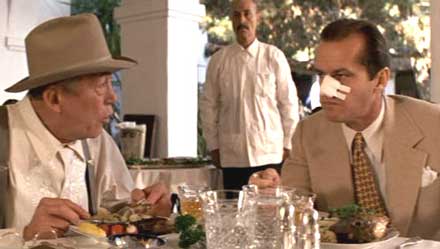
, as you may know, has recently moved to LA. Like any bizzer who moves to LA, he has felt compelled to watch Chinatown. It’s like a trip to the LA History Museum, but entertaining, with sex and murder and incest, which is the way us Neo-Angelenos like our LA history.
I, being an ace Hollywood screenwriter, have watched Chinatown many times, mostly to unravel all the different plot threads. Last time around, for instance, I noticed for the first time that there are, in fact, two mysteries to be solved in Chinatown, which have nothing to do with each other, in spite of involving all the principle characters. There’s the one everyone remembers, about “the girl,” and then there’s the one about “the water thing,” which forms the bulk of the story, but which has nothing to do with the central murder. Chinatown, like any classic noir, is about a jaded detective who stumbles onto a case, which leads him to uncover corruption in the highest corridors of power. But along his way to cracking the first case, this detective also stumbles across a more interesting case. It’s like if the investigators of the 9/11 commission, on their way to investigating Osama bin Laden, found out that George Bush once had an affair with Larry Craig.
Which I’m guessing probably didn’t happen, but I’m wondering now how many hits my blog will now get just for me typing those words.
In any case, it was a change of pace, this time around, to watch Chinatown not so much for story but for the performances.
Our verdict: pretty damn good.
Thinking back over my personal experience of Jack Nicholson’s performances over the decades, and watching this movie on a scene-by-scene basis, I think I have to say that this is probably the best, most detailed, least affected, most well-modulated performance of his career. Just prior to this, Nicholson was a rising star, giving strong character performances in Carnal Knowledge and The Last Detail, and soon after this he gave his career-defining performance in One Flew Over the Cuckoo’s Nest. The “crazy Jack” performance came to its fullest fruition in The Shining, and then in the 80s he veered from character parts to ever-more “crazy Jack” performances, culminating in 1989’s Batman. But here in Chinatown he’s playing someone very close to himself, yet removed by time and profession. There isn’t a single moment where he calls attention to himself, showboats or plays a “character.” The result is a natural, self-possessed performance that lives and breathes, which is all the more spectacular when you consider that he’s playing one of the oldest roles in movies, the jaded, cynical LA private dick. Plot-wise and tone-wise, Jake Gittes is not too far down the road from Philip Marlowe and Sam Spade, and yet Jake is a completely different kind of guy, neat and dapper, ambitious and funny, smart and inventive and nobody’s fool.
Faye Dunaway, on the other hand, seems to be playing someone completely unlike herself, and vanishes into the part. I watched her closely throughout, trying to figure out just what was so strange about her characterization, how different it is from her work in, say, Bonnie and Clyde or Network, how she manages to be so cold, so remote and yet still recognizably human and three-dimensional. Then it occurred to me that it might be her eyebrows, her plucked-out, painted-on eyebrows, such a specific period detail that it removes her character from the 1970s and places her forty years earlier, changes the shape of her face enough to remove memories of past performances, and gives the character the fragile, china-doll (china-doll!) look she requires.
John Huston plays the heavy with such easy grace and sureness, such attention to detail and such confident naturalism, you have no trouble believing that Noah Cross is capable of just about whatever whim crosses his mind. Late in the movie I suddenly thought of Touch of Evil and tried to imagine how Welles would have played Noah Cross, and how very different Chinatown might have played under those circumstances.
At one point in Act III there’s a scene with Nicholson and Dunaway in the front seat of a car. And he’s pressing her on something and she’s being evasive and wrought, and they’ve just had sex a few scenes before, and all the things that have been happening in the story are seeping in between the lines of dialogue, and the actors merge with their characters so completely and I just had to shake my head and think “You know, they really don’t make movies like this any more.”
3:10 to Yuma v The Assassination of Jesse James by the Coward Robert Ford


I liked both of these movies immensely and recommend each highly. They are both exceedingly well-acted, well-shot, well-directed and well-written. But it’s a bad idea to go into one expecting the other. 3:10 to Yuma is a serious, thoughtful, intricately structured, multi-layered yarn of the Olde West, very conscious of its burden of resurrecting an outmoded genre, full of gorgeous landscapes, men on horses, sunlight on hat-brims, railroads under construction, ranchers being forced off their lands, stagecoach robberies, Pinkertons, encroaching civilization, outlaw gangs, cattle drives, a boy who goes on a journey and learns to be a man, Chinese coolies, black hats and white hats and deep thoughts about the delicate razor’s edge the law must walk in a lawless land. It’s not just a classic Western, it attempts to be all classic Westerns, with a dozen different plot turns, smashing character work from all the principles, every scene packed with terrific production design, period detail and realistic lighting. It’s an exciting drama, a rousing Wild West thriller and a well-written character study.
The Assassination of Jesse James is a whole different ball of wax. It has a few gorgeous landscapes, and it does have men on horses, but there is very little sunlight on hat-brims. The railroads are already built, no ranchers are being forced off their lands, there is not a single stagecoach robbery (although there is a wonderful train robbery) or Pinkerton in evidence. A boy does go on a journey and learns to be a man, but in this case the boy is Robert Ford and manhood turns out to be not all it’s cracked up to be. There is, of necessity, an outlaw gang, but the gang is examined so closely, in such minute, well-chosen detail that it never seems like a recapitulation of cliche. In fact, if there is a cliche contained within the execution of The Assassination of Jesse James I am hard-pressed to remember it. Let’s face it, it’s barely even a Western at all, more like a character study, a psychological portrait, a close reading of the last days of an American legend. “Elegaic” and “lyrical” don’t really cover the unsettling beauty and spectral weirdness of this deeply original movie.
If you go to see The Assassination of Jesse James expecting it to be like 3:10 to Yuma, it will probably seem sluggish, tedious and pretentious in comparison. If, however, you go to see 3:10 to Yuma expecting it to be like The Assassination of Jesse James, Yuma will seem shallow, busy and over-plotted in comparison.
THE DIRECTION: I’ve enjoyed most of the James Mangold movies I’ve seen, but the direction in Yuma far surpasses what I’ve seen so far in his work. The shootouts and confrontations are exciting and suspenseful, the actors are all well-directed, the narrative never feels forced or cliched (in spite of containing every Western cliche in the book). I’ve never seen Andrew Dominik’s other movie, Chopper, but the direction of Assassination, as I say, is one of the most original things I’ve seen in movies recently. There wasn’t a single moment where I thought “Ah, and this is the scene where _____ happens.” In spite of the fact that I know the story of Jesse James and have seen it told on screen at least a half-dozen times, I never had the slightest clue what was going to happen next, except that, eventually, Jesse would have to get shot in the back by Robert Ford while adjusting a picture in his house. Big scenes and little scenes are given equal weight, narrative strands come together in beautiful, unexpected ways, surreal beauty haunts the slightest of inserts.
THE ACTING: Wonderful throughout, but again I’m giving the edge to Assassination, partly because, goddamn it, why are two parts as good as the leads in Yuma being played by an Englishman and an Australian? (UPDATE: a Welshman and a Kiwi. I stand corrected. Damn furners.) The leads in Assassination are played by two nice American boys, Brad Pitt is even from the same state as the character he portrays. Pitt’s finely detailed, intelligent, multi-layered portrait of James didn’t surprise me, he’s been blowing me away on a regular basis since Fight Club, but Casey Affleck as Robert Ford is truly astonishing. Russell Crowe and Christian Bale in Yuma are playing “characters,” iconicfigures playing out a grand drama in the West of our consciences, but Pitt and Affleck actually bring Real People to life and add something new and interesting to our understanding of figures who have been examined many times in the past.
THE MUSIC: I was a little disappointed by the score of Yuma — like a lot about the movie, it seemed like an expert recapitulation of classic themes instead of an invention. Whereas the score of Assassination seems both more “authentic” to the time period and more original in its conceit.
Finally, I have to say that the sound design on Assassination is superb, and warrants seeing it in a theater for that reason alone. It’s a very quiet movie about a time before cars, stereos and air conditioners. Far-off laughter, girls singing two houses over, horses hooves in mud, gunshots echoing in a snowy landscape and trains in the misty night are all given detailed, loving attention and go a long way to bringing a lost time to life.
Movie Night With Urbaniak: One-Eyed Jacks

WHITE HAT: “Kid” Rio is a bank robber in Mexico. He steals gold, shoots people and is a pathological liar.
BLACK HAT: Dad Longworth is Rio’s ex-partner. He left Rio to rot in a Mexico prison when a robbery job went south. He took the loot, headed north, bought himself a wife, a daughter, a job (as sheriff, no less) and some respectability.
Kid’s revenge: to rob the bank in the city where Dad’s sheriff and murder Dad for leaving him.
On the way to his revenge, Rio decides to deflower Dad’s adopted daughter Louisa. In the course of the deflowering, Rio is suddenly turned from Max-Cady-like revenge machine to sincere, sensitive soul. Rio lies to get a leg over with Louisa, but by morning he’s confessed all his lies, and by the end of the movie he’s decided against revenge altogether. Such is the power of a young woman’s, um, heart.
LOCATION, LOCATION, LOCATION: Rare for a western, the city in question is Monterey, California. I don’t know why a western on the beach seems unusual, but it does.
WOMEN? There are two major women in One-Eyed Jacks. One is Dad’s Mexican wife (the Madonna), the other is his step-daughter (the virgin). There are also assorted garden-variety barmaids, prostitutes, senoritas and a contessa. Well, the movie is called One-Eyed Jacks, after all (apparently Penises was considered too on-the-nose). Oh, and the Mona Lisa is seen hanging over a bar.
THE STATE OF CIVILIZATION: No doubt about it, Rio escapes from prison to find that civilization is rotten to the core. Thieves put on stars and become law enforcers, hire buck-toothed yahoos for muscle, and use their position to protect themselves from their own guilty past. Rio (spoiler alert) is put through the ringer by this system, but finally figures out a way to escape. Trouble is, he must leave his love, and unborn child, behind, with only the promise to return. Which, given Rio’s luck through most of the movie, doesn’t look too likely. So it seems that civilization is so rotten that living in it is impossible, change only makes things worse. One can only flee. A very Brando attitude.
WESTERN CLICHE ALERT: Outlaws on the run through a desert, chased by a posse. Shootout on a high desert plain. Prison escapees chained at the ankles. Bank job goes south, leading to wasted lives. Protagonist and antagonist switching sides of the law, the criminal becoming moral and the respectable man turning hypocrite. Protagonist and antagonist break bread at the family table, and saying grace before dinner is used as a yardstick of measuring good, and hypocrisy. Protagonist tied to a hitching post and whipped in town square by antagonist. Protagonist is the strong, silent, sly type, until he falls in love, then he becomes earnest, confused and talky, jabbering on and on about his childhood, his lack of direction, his treatment at the hands of the Mexican justice system.
NOTES:I was quite excited to sit down to watch a western directed by Marlon Brando, and was surprised to see that he didn’t seem to have any particular point of view on the material. The direction seems rather anonymous, workmanlike even, and occasionally there are even rookie technical blunders. There are few Brando-ish idiosyncrasies (although the movie opens with Brando sitting on a counter during a bank robbery, tossing banana peels onto a scales, which strikes me as a very Brando-esque way of introducing a theme), the acting is solid but unremarkable by his standards (although Slim Pickens shines as a thoroughly unpleasant sleazeball deputy), there are no daring stylistic moves. There is occasional wit in the screenplay (Dad: “How you doing, kid?” Rio: “Oh, I’m sneakin’ by.”) The sets and lighting look standard-issue, and one prison set looks utterly fake even on the disastrous transfer currently available (see below).
Stanley Kubrick was the original director on the project and it’s hard for me to see what would have attracted him to the material — the story is told in a resolutely un-Kubrickian fashion (which may explain why he ultimately left).
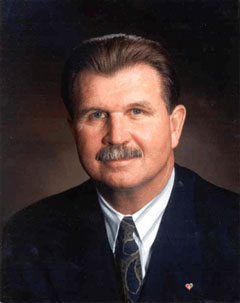
In the course of the narrative, Karl Malden grows a moustache and suddenly looks like Mike Ditka.
The story is told in four acts: Act I, Rio and Dad rob a bank, get chased, Rio is abandoned and taken capture. Act II, Rio vows revenge on Dad and sets about it, planning a bank robbery and deflowering Dad’s step-daughter. Dad gets wind of all this, beats Rio mercilessly and drives him out of town. Act III, Rio licks his wounds and ponders what to do with the rest of his life. Act IV, Rio’s gang goes rogue on him, robs the bank, blows the job, Rio is arrested, escapes from jail, has a shootout with Dad, flees the country.
This structure makes the movie seem quite long. Generally, the action in a motion picture speeds up at the beginning of Act III as the characters’ motivations come into sharp relief and agendas clash, but here the action slows down to a crawl and the protagonist’s goals become fuzzy and confused.
I am told that Brando’s original cut of the movie ran over five hours and was greatly concerned with the shades of gray in all the characters’ lives. Touches of that ambiguity still remain, but as it is, One-Eyed Jacks seems very much like a typical early-60s studio product. The score, too, seems rote and uninspired. The movie was, apparently, a hit, but Brando disowned it and never directed again.
I’d like to note that the DVD Urbaniak and I watched, issued by an outfit calling themselves “St. Clair Vision,” is, by a long stretch, the crappiest DVD transfer I’ve ever encountered. I once wrote that the DVD transfer of Spielberg’s 1941 looked like it had been made by pointing a video camera at a TV playing an old VHS copy of the movie. Well, One-Eyed Jacks looks like it was made by pointing a video camera at a TV playing a VHS copy of the movie, through an aquarium smeared with petroleum jelly. The movie, which has apparently fallen out of copyright for some reason, can be watched in its entirety here, in quality no worse than what we’ve just watched.
Query


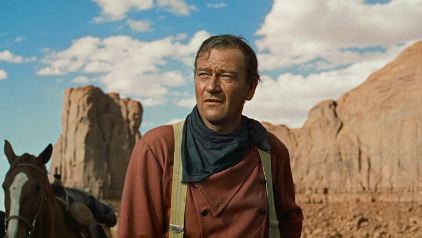


Let’s say I’m thinking of writing a western. In actual fact, I am thinking of writing a western, an idea I’ve had for a long time now, a western based on a classic work of literature. To say more would be to give it away.
If it is not too much trouble, I would greatly appreciate hearing your favorites, and why they are your favorites. Why do they work, why are they better than others, what do they all have in common (besides taking place in the Old West), where do they diverge, and why.
I thank you in advance for your cooperation.
Movie Night With Urbaniak: Zodiac

In the late 1980s, I became interested in serial killers as I was working on my play One Neck. I read dozens of books on the subject, trying to tie them all together, trying to find a grand, unifying theory that would explain the actions of serial killers. Worst of all, I would need to approximate the mindset of a serial killer in order to write the antagonist of my play. This led me, as you can imagine, to some very dark places, places I found I do not like. My fascination with serial murder turned to revulsion and disgust. The more I learned about these guys (and they are almost all guys), the more I wished I could make it back to some plateau where I could un-learn all the things I had learned. Ted Bundy, Jeffrey Dahmer, John Wayne Gacy, Ed Gein, Edmund Kemper, there was nothing “cool” or even very interesting about these individuals — they were monstrously sick, pathetically horrible men undeserving of the media space our culture, me included, have heaped upon their actions.
Of course, that didn’t stop me from writing my play, which later became a screenplay, which is now, twenty years later, becoming a graphic novel.
Except, of course, that for a very long time, the Zodiac killer made it all seem possible. Letters filled with elaborate codes, taunting the police, taking credit for some murders but not others, creating a gigantic media frenzy that ensnared policemen, newspapermen and all manner of civilians from every walk of life.
In any case, I wrote my serial killer play, Silence of the Lambs was a huge hit and legitimized the genre, spawning a thousand serial-killer movies (Seven among them), and serial killers became ever-more brilliant, peculiar and fascinating. No serial-killer movie has ever captured the sick, sinking, thoroughly awful feeling I got reading the actual case studies of these thoroughly rotten, soulless people.
Until now.
It is altogether fitting that David Fincher, director of Seven, the slickest, most somber and and well-appointed of serial-killer movies, should return to the scene of the crime and make Zodiac, a movie completely opposite in tone and structure, that finally puts to bed the fantasy that movies like Seven help to create. Zodiac gets everything regarding serial murder completely right, and is, in every respect, a stunning, shocking, daring, visually sumptuous work of American filmmaking.
Just about anyone would have a good time watching Zodiac, but for anyone who knows something about how movies are made it is a non-stop feast of technique, prowess, and elegant sophistication. This is a 2 1/2-hour movie that could get by on production design alone, and yet that production design, far from being flashy or overwhelming, conquers expressly by not calling attention to itself.
(Strangely enough, the only piece of production design I could identify as being mis-handled was the posters for Dirty Harry shown in a theater lobby. Stranger still, Zodiac is co-produced by Warner Bros, so at least theoretically they could have located a poster for the movie. This bothered me for a long time until I decided that it must have been Clint Eastwood who didn’t, for whatever reason, want his name or likeness associated with Zodiac, in spite of Dirty Harry being directly inspired by the Zodiac killings.)
When I say the movie is “shocking” and “daring,” I mean that it shocks and dares in ways that no other Hollywood serial-killer movie would even consider trying. Fincher’s obsessive attention to detail, his compulsion to get everything exactly right, begins on the script level. Zodiac astounds by having its script flow in the opposite direction of conventional thrillers, where a collection of disparate, contridictory facts coalesces into a compelling case against the killer. Here, the case against the killer remains maddeningly elusive throughout — every time you think they’ve got the guy nailed, the evidence proves they’ve got the wrong guy. In the conventional Hollywood thriller, the “one man” prevails over a society of slackers and nincompoops — here, we have multiple protagonists who all try, and fail, in different combinations, to track down the killer, and in fact never succeed. Even All the President’s Men, which Zodiac pays conscious homage to, still had the cliche of a pair of mismatched detectives gathering the evidence that will bring down the bad guy — Zodiac goes even further, insisting that there were no mismatched detectives, no single defining moment of glory, no “follow the money” revelations. Because that’s not how these stories go. And yet Zodiac remains gripping, thrilling even, throughout its long running time (and I am told there is an even longer cut on the way).
Like Scorsese’s Casino, Zodiac shuns cliche and refuses simplification at every turn, taking a complex, multi-faceted, true story and tells it with all its weird, unique complications intact (or seemingly so — I haven’t read Robert Graysmith’s book Zodiac, but I did read the book Casino, and was shocked to learn that, as complex as the story in Casino is, the reality is at least three times more complex. It wouldn’t surprise me if Zodiac had been similarly, if expertly, simplified).
Anyone who’s ever been on a movie shoot cannot help but marvel at the monumental technique that Fincher wields at every turn. There are hundreds of scenes in Zodiac, some no more than a few lines of dialogue long, all requiring huge sets of exacting, lived-in detail, dozens of extras and sophisticated computer-generated imagery, all to make the movie feel like it was actually shot in the time period it is set in. Fincher refuses to cut corners. A car pulls up to a curb — what could be simpler? The shot lasts maybe a second. And yet the shot requires a street full of vintage automobiles, streetfronts either convincingly re-dressed to period or re-created on a soundstage, and buildings created in a computer to fill in the gaps created by the intervening 30 years of history. Repeat this process hundreds of times and you begin to see the magnitude of Fincher’s accomplishment here.
Even better is an overhead shot following a taxicab through the streets of San Francisco. The camera looks directly down upon the car, following it so closely as to appear to be bolted to it, even though it seems to be about 100 feet above. The taxi goes around corners and the camera moves precisely to follow it, showing that it’s not a helicopter shot — no helicopter could be so exact. Then one realizes that it must be all CG, a CG taxi traveling through a CG San Francisco, all rendered with an incredible attention to realism and detail. Over and over again, shots that would be routine in other movies, second-unit shots even, simple establishing shots, driving shots, night-time road scenes, on and on, Fincher gives each one an elegant, understated, technically sophisticated spin.
The imagination brought to bear on the technique of the movie extends to the casting, with a huge cast of actors giving great performances in roles that require them to talk on the phone, point to boxes, write things down and ask each other questions. There isn’t a single chase scene, gross-out or moment of fake suspense — all the scenes involving Zodiac are claustrophobic, sickening and distressingly real. Major stars are rendered impotent and irrelevant by the plot’s end, yet we believe every step of the way the characters’ drive,compulsion and obsession.
Speaking of obsession, early on in the movie
made a joke comparing Zodiac to Close Encounters, which also used soundstage sets for convincingly real exterior locations. Later on, as the movie became about a man obsessed with a phenomenon to the exclusion of his family, the Close Encounters parallel became more startling. Especially as the character, through the writing his book, pushes through his obsession and, in his own way, gets invited up into the aliens’ spaceship at the end.
Hollywood has been very kind to audiences this year, and audiences failed to reciprocate. Two of the year’s most brilliant, most spectacular, most sophisticated entertainments, Zodiac and Grindhouse, failed to find audiences. When crap fills the multiplexes next year, audiences will have to accept part of the blame themselves.
A note on the transfer: Zodiac is one of the most handsomely shot movies of recent memory. It was, I am told, shot on high-definition video, which looked spectacular when projected digitally in theaters, and yet there is a peculiar digital shimmer, a moire effect, to any scene on the DVD with too many horizontal lines, at least on my high-definition projector. I am curious to know if anyone else out there has this problem. I know that Fincher is a maniac about the way his movies look, which is why it surprised me to see his most elegant, gripping movie rendered in this rather odd, substandard way.
Movie Night With Urbaniak: A Streetcar Named Desire
Mr. ![[info]](http://stat.livejournal.com/img/userinfo.gif) urbaniak came over to borrow my copy of Numbers, Season 2 and stayed to talk about A Face in the Crowd, which I had just watched earlier in the day, and then watch this earlier Kazan picture, A Streetcar Named Desire, solely for its landmark, breakthrough performance by Marlon Brando.
urbaniak came over to borrow my copy of Numbers, Season 2 and stayed to talk about A Face in the Crowd, which I had just watched earlier in the day, and then watch this earlier Kazan picture, A Streetcar Named Desire, solely for its landmark, breakthrough performance by Marlon Brando.
This movie is so bad.
The plot involves Leigh’s character, Blanche, having her mind annihilated by Brando’s Stanley, but let’s face it, the movie’s true subject is Brando’s style of acting annihilating everything that Leigh’s generation stood for — show-offy, self-conscious, grandstanding, fake, ungenerous emoting. She doesn’t stand a chance against Brando, who finds something interesting, unexpected, real, truthful and uninflected to do with every line and gesture he has. Tennessee Williams’s dialogue is as purple as the day is long, and Leigh leans into the purpleness, wringing each of her long, tedious speeches dry with swooping, keening, whispering “drama,” while Brando just kind of takes the language at face value and plays against all the high-flown poetry, coming up with something much more interesting and vital.
Brando, of course, has ruined Stanley for every other actor who would choose to play the role — to take it on at this point is to invite catcalls and hoots of derision. Blanche offers no similar forbidding challenge — Leigh is about as awful as an actress could be in this role.
In a way, I find every role in the movie miscast. I don’t believe for a second that any of the actors are from New Orleans, new South, old South or any other kind of South. They all seem to be either New York or Hollywood people to me, and one of the things Urbaniak and I did to keep ourselves amused while watching the movie was to think who we could cast today in the various roles to make a watchable movie.
We had a hard time coming up with a Blanche until I hit on the idea of Holly Hunter. Holly Hunter would be fabulous in this part. We spent a long time talking about how great Shirley Maclaine was in The Apartment and how she played a variation on Blanche in both Terms of Endearment and Postcards From the Edge. Frances MacDormand would make a great Blanche — she and Holly Hunter could play Blanche and Stella in repertory, like Philip Seymour Hoffman and John C. Reilly did in True West a few years back. Urbaniak nailed the best possible Mitch by offering John C. Reilly, which I countered by suggesting Philip Seymour Hoffman as Stanley. I couldn’t figure out why Bette Davis wasn’t playing Blanche in the movie — as long as you’re casting Scarlett O’Hara as a faded Southern belle, why not Jezebel? Because Davis ended up playing something very close to Blanche in Whatever Happened to Baby Jane? anyway. Which brought us to Jennifer Jason Leigh, or Julianne Moore, or for that matter Jessica Tandy, who was in the Broadway production with Brando. By the end of the evening Urbaniak was saying that any living actress would be better in this part than Leigh, then amended that statement to include all living women — “the girl at the counter at Barnes and Noble on the Santa Monica Promenade would be better than Vivian Leigh in this movie.”
Don’t get me wrong — Blanche is a great part and should, by all rights, make for a moving, heartbreaking performance. But Leigh is an irritating bore from the second she walks onscreen, all tics and effects and calculated gestures designed to call attention to how “good” an actress she is — “Look how hard I’m working! Aren’t I a great actress?” She wears out her welcome fast and you can’t wait for her to get carted off by the loony-bin folk.
Next we’re thinking of watching Zodiac.
iTunes Catch of the Day: John Zorn


click to make bigger.

We’ve seen which songs, for whatever reason, I’ve played the most in the last three years, but what actually takes up the most real estate in the sprawling fairgrounds of my iPod?
The winner, the greediest, most space-hungry artist in my library, hands down, is John Zorn, with over 1400 songs on 110 different albums. Zorn is, in fact, a primary reason why I jumped from the 40GB iPod to the 80GB — to include not just my favorites, but to include every god-damned blast, squeak, skronk and squiggle I own from Mr. John Zorn.
Zorn is a true American original — a distinctive sax player, a flamboyantly avant-garde composer, an incredible bandleader and a master of all he surveys. He’s also made himself a legend in the music wars by creating his own label, releasing hundreds of first-class albums in what would ordinarily be a marketing man’s nightmare and insisting upon absolute control of his career. If that were not enough, he’s also acted as mentor and presenter of a whole host of musical outlaws on his Tzadik label.
I came to Zorn through his 1990 album Naked City, which was handed to me by a mentor of my own who had been trying to get me to listen to folks like Sonny Rollins to no avail. It was a good choice for my mentor, who knew that I needed something immediate and demanding to get me interested in a whole new genre of music. Naked City is more than jazz, it’s an encyclopedic engulfing of a century of American music (with some Europeans thrown in for good measure) chewed up in the fevered New York mind of Zorn, played with the intensity of hardcore punk by a crack band of some of the greatest jazz musicians alive. Naked City hit my brain like the Hindenburg at Lakehurst and remains one of my top ten albums of all time. I worked from Naked City (and the seven or so subsequent albums by the same team) to The Big Gundown, his chopping and splicing of the film music of Ennio Morricone, and Spillane, his sprawling, half-hour musical film noir (which he has since expanded into a full-length CD). From there I investigated his game pieces, where large ensembles participate in structured, spirited improvisations, his jittery, menacing, occasionally terrifying classical pieces, his stunning film soundtracks (he is my number one choice for composer when I make my first feature) and his career-in-themselves Masada albums, 17 or so and counting, where, for the first time to my knowledge, a composer has succeeded in wedding jazz to the Jewish musical tradition.
Movie Night With Urbaniak: Death Proof

For Movie Night With
, a rare treat: a movie in color starring actors who are still alive.
I saw Grindhouse three times in the theater, partly because I liked it and partly because, for the first time in a long time, I walked out of a big-budget American movie and didn’t know quite what to make of it — I didn’t actually understand what it was. It threw me completely off-balance, the structure of the thing seemed so odd and lopsided and peculiar. The first time around I was excited but baffled, the second time around I knew what was coming and loved it, the third time I started to actually put together the complexities that lay beneath the surface. For my money, Grindhouse is still the movie to beat for the American movie of the year.
That said, Death Proof works fine on its own as a stand-alone feature. It’s about 25 minutes longer, which may sound padded, even bloated, to someone who hasn’t seen the “extended cut,” but those 25 minutes actually make the movie breathe in a more natural, interesting way and include a number of suspense beats that weren’t in the theatrical version that help the movie work as a horror thriller.
Did I say horror thriller? That’s too limiting and gets to the heart of Tarantino’s accomplishment here. He starts out promising a horror thriller, a slasher movie precisely, but repeatedly and consistently upends and quashes your expectations until, by the end, you have no idea what might be comingnext.
SPOILER ALERT
In the slasher movie, the dumb teenagers head up to the secluded house by the lake and get picked off by the serial killer one by one. I once sat in a theater and timed one of those movies, and a teenager died, literally, every 11 minutes — about once a reel. You could set your watch by it. Tarantino introduces his comely young things, then tells us he’s making a slasher movie, then has us wait for about 45 minutes until anyone gets killed. Like Stuntman Mike, the audience is kept in a state of frustrated desire, and Tarantino keeps us there so long that when the shocking, unspeakable horror finally happens, you really don’t want it to happen any more. He takes the conventions of the slasher movie, the dumb kids who deserve to get killed, and turns them into human beings whose deaths are ugly, tragic and truly horrifying. You start out liking Stuntman Mike because he’s a movie geek like you (and like Tarantino) and you’re just aching for some action, then he gives you the action and you feel sick to your stomach because you realize that identifying with Stuntman Mike implicates you in the murders, and not in a fun way.
Then, with his movie halfway done, he starts the whole thing over again. Another group of women, all having the exact same conversations as the first group, being stalked by Stuntman Mike again. The difference is, this second group is also a group of movie geeks, which is what makes them more than Stuntman Mike bargained for. In Death Proof, being a movie geek is literally the difference between life and death, between dying and killing.
Then, again, just when you’re getting used to the movie being a horror movie, he goes and pulls the same trick again, and it becomes a chick flick again, except these chicks eventually stop talking about men and start talking about cars and stunts. And the adventure they head off on is so peculiar and singular that, by the time Stuntman Mike shows up again, Tarantino has, somehow, made you forget all about him again, so that his re-appearance is yet another surprise. With the simplest of tools in a movie with very few, very long scenes (some go on for ten minutes or more), Tarantino manages, again, to construct something very deceptive, unique and unexpectedly deep and convincing.
Urbaniak says “Stuntman Mike is a man out of time. His way of life is over (no one knows about the TV shows he was on, and no one makes car-crash movies the way they used to), and he wants to destroy the world.” And that’s one level of Death Proof, but there’s more to it than that. “It’s weird, because on the one hand it feels like a very minor work,” says Urbaniak, “but on the other hand he’s really pushing the envelope, making a movie that is so unreal, so full of devices, so much a movie about making movies, but on the other hand he’s making a real thing about the human condition. It’s almost like a French New Wave movie, a movie made in reaction to and critiquing Hollywood movies, and yet also saying something new and fresh and interesting on its own. There’s something very Godardian about it, how he’s both in love with these conventions and trying to subvert them at the same time. It’s utterly full of artifice and yet completely real.”
For me, my favorite level of Death Proof is the parts about the objectification of women. It was a great joke in the Grindhouse cut when thelap dance was deleted with a “REEL MISSING” message, since the movie spends a great deal of time building up to that lapdance and then chides you for being upset when it goes missing. Well, the lap dance is back in the movie for the DVD and while I miss that joke, the lapdance scene does help build the sexual tension. Stuntman Mike photographs the women he kills, and Tarantino makes explicit the connection between Stuntman Mike’s view of women and Hollywood’s view of women both by constantly fooling with our notions of how the female characters are “supposed” to act, and then for the ending credits, inserting the vintage “color test” frames on the vamps of the insanely catchy closing song “Chick Habit” (chick habit, indeed). Film, Tarantino seems to be saying, exists to objectify women — no color test frame ever included a photo of a handsome man. He teases and cajoles us with his parody/tribute to objectified women of movies gone by, then gives us a group of women who refuse to play by Hollywood rules.
Tarantino is the George Cukor of the 21st century — who knew?
There’s more to say, there generally is about a Tarantino movie, but it’s late. Let me just add that the day after I saw Grindhouse I went to my local video store to rent Vanishing Point, one of the classic car-chase movies cited within Death Proof, but the clerk just scoffed at me — “Dude, you picked the worst day in history to try to rent that movie.” That was five months ago, and Vanishing Point hasn’t come back in yet.
Across the Universe

The stars of Across the Universe. Not pictured: James Urbaniak.
Since no one else seems to be saying it, I just want to get this out there:
Indie vet James
is a revelation as a lizard-like 60s rock-promoter Svengali in Julie Taymor’s mind-blowing head-trip freakout Across the Universe! He slyly takes everything you thought you knew about lizard-like 60s rock-promoter Svengalis and explodes it into a million tiny pieces, then stuffs the pieces into a psychedelic pipe made of strawberries and blood, lights it afire with the flame of self-knowledge and puffs out multi-colored clouds of your brain!!
Seriously, my friend Mr. Urbaniak is in this new movie and you should go see it for that reason.
Not a single review has mentioned his performance, but then it’s a very big, very long movie with a whole lot of wonderful performers in it. Mr. Urbaniak shares his anonymity with, to name a few, Joe Cocker, Harry J. Lennix and a strangely uncredited Dylan Baker.
Time and current level of energy do not permit me at this moment to get across what this movie is, but let me just say two things: none of the reviews I’ve read of it have captured what it tries to do, and the show I was at last night (at the Arclight) was sold out. Which, for a movie this deeply weird, is pretty freaking impressive.
I will say this: not everything in the movie works (I’m looking at you, Eddie-Izzard-talking-his-way-through-“Mr.-Kite”), but even when concepts fall on their faces, they never do it in quite the way you expect them to and it turns out that, to continue the metaphor, when they fall on their faces there’s always something interesting on their backsides as well. It’s a big, ambitious, difficult-to-dismiss movie and the first movie in a long, long time that actually kept my wife and I talking about it for the entire drive back to Santa Monica.
I will say another thing: it shocks me, shocks me, that, at this late date, I can happen upon a movie that actually makes me hear Beatles songs in a new light. I’ve heard these songs literally thousands of times, in both the original recordings and dozens of cover versions, and time after time during Across the Universe I found myself thinking “Hey, that song’s a lot better than I thought it was” or “Wow, this song works on a whole different level than I thought it was going to,” or even “You know, I thought I knew this song, but Julie Taymor somehow just made me hear it again for the first time.” Which strikes me as something of a miracle just by itself.
The movie leaps and pounces wildly from idea to idea. Some of the ideas are kind of jaw-droppingly brilliant and inspired, and others make you want to jump up onto the screen and punch the director in the face. Sometimes both at once. I kind of mean this as a compliment.
The story, let me just say, is, erm, quite simple. But I would argue that Taymor wishes it so, the better to get at her real subject. What is her real subject? Well that’s the part I can’t quite put my finger on. She gives equal time to Vietnam, the protest movement, the Detroit riots and the assassination of Martin Luther King on the one hand, and on the other wishes to tell a love story and the tale of struggling artists dealing with issues of commercial success (with the incandescent James Urbaniak as the terminus of 60s commercialism — the “bad guy” of the piece, come to think of it). The movie, it seems to me, takes place in the weird area where the artistic shapes the personal and the personal shapes the political, which is something I haven’t seen presented in a movie in quite this explosive, unpredictable a way before.
I’m told that this movie has been butchered by craven, cruel, Mammon-worshipping demon studio executives, and while I’m curious to see how the original cut went, the movie is also quite long (2 1/2 hours) and doesn’t feel “cut down” at all — quite the opposite, ideas and motifs are given plenty of room to simmer and develop and murmur, submerging in one place and then bobbing up again in another.
UPDATE:
tells me that this is, indeed, Ms. Taymor’s cut. Bully for her!