The Whale part 4
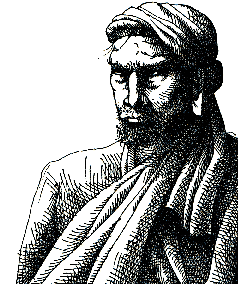
(Ishmael addresses the audience. In the background, Ahab confers with Fedallah.)
ISHMAEL. We sail on. Days, weeks, months. Calm and storm, fog and sun. The sailors gossip about Ahab’s harpooneer
Fedallah. Some say he’s the devil, keeps his tail curled up around his leg. Some say he’s a million years old. Some say that he is the real captain of the ship, his mouth clamped to Ahab’s ear. Ahab says he’s using science to find the whales, but others say that it’s just Fedallah, guiding his hand, pushing him toward the darkness.
One night, we see a spout. Big one. On the horizon. We think, this is it. Our hunt is over. We sail out to the spout, but then it’s gone. Next night, the same thing. And the next. Every night. Midnight of course. And all over again. Ever on, into the night.
Many things happen. One day we come by a ship, the Albatross, that glides by as if we aren’t there. One day we find a giant squid. One day we come by a ship called the Town-Ho. They have a story about the white whale. You can bet Ahab is pleased about that.
And then one day we kill a whale. Stubb kills a whale. We hang its head from one side of the ship. As the killer, Stubb gets to have the first steak.
(Night. Stubb at the capstan, waiting for dinner. A sperm whale head hangs from one side of the ship.)
STUBB. Cook! Come on, bring me my steak out here, I’m freezin’ to death!
(Cook, an elderly black man, enters with a steak on a plate.)
Well, please don’t break your back or strain yourself in any way, cook, it’s only my dinner that you’re keeping me from, just get it the hell over here sometime before nineteen-hundred! Come on, I’m starving here, I’m going to keel over here, come on!
COOK. Sorry Mr. Stubb. Here you go.
STUBB. First cut off the whale is always the most tasty, eh cook? I guess you wouldn’t know.
COOK. I don’t catch ’em sir, I only cook ’em.
STUBB. Well let’s see how you cooked this one – uh, no. No. Cook, this is no good. What did you – no. I’m sorry.
This is no – I am so sorry you were born without a BRAIN, but if I’ve told you once, I mean come on –
COOK. Excuse me?
STUBB. Look at this! You ruined it! It’s a piece of charcoal here!
COOK. I barely –
STUBB. You barely thought is what you – Look. Here is the way you cook a whale-steak. You take the piece of meat – this, by the way, is the piece of meat – and you show it the fire. Then you put it on a plate. Do you got that? Is that so hard? Can you even conceive of – what the hell is that noise?
COOK. The sharks, sir, at the carcass –
STUBB. You blithering idiot, I know what it is, why do they have to be so God-damned loud? I’m trying to eat here like a decent civilized human being and I can’t even hear myself chew –
COOK. Sorry –
STUBB. Well go and talk to ’em, would ya?
COOK. What?
STUBB. Are you going deaf now too? Go talk to them, tell ’em to shut the hell up for a few minutes, Christ!
COOK. T-talk to the sharks?
STUBB. You are going deaf. Yes! God damn it, tell the fucking sharks to shut up! Move!
(Pause.)
COOK. All right…
(He goes to the rail, addresses the sharks.)
Hey! Sharks! Knock it off with the racket! Mr. Stubb’s trying to eat!
STUBB. They can eat all they want, but they have to keep it down.
COOK. You can eat all you want, but stop smackin’ your lips so damn loud!
STUBB. Cook! Hey!
COOK. Yes?
STUBB. You can’t swear at them.
COOK. Excuse me?
STUBB. “Excuse me”, listen to this guy – You can’t convert sinners by swearing at them.
(Pause.)
COOK. I’m going.
STUBB. No, keep talking to them. Coax them.
(Pause. Cook tries again.)
COOK. Look. Sharks. Um, beloved sharks. Um, I know that, um, you are by nature, um, voracious. But you’ve got to – hey! Stop the damn tail-slapping when I’m talking to you! You can’t hear me if you’re slappin’ your damn tail!
STUBB. Not with the swearing! Come on. Convince them.
(Pause. Cook tries again.)
COOK. Ahem. My, my dear voracious creatures. Um, I, I don’t blame you for your, your nature, but, but you’ve got to learn to control your, your nature. If you can, can control the, the shark inside you, you will be like, like angels. An angel is only a shark under control. Don’t tear that blubber out of your neighbor’s mouth. That’s wrong. This whale, this whale doesn’t even belong to you! Some of you bigger sharks, tear off some meat for the smaller boys!
STUBB. Now that’s Christianity! Keep going!
COOK. B-but they’re not listening.
STUBB. No?
COOK. They don’t have ears to hear, Mr. Stubb. They only have bellies. And when their bellies are full, they go to sleep on the coral and then they never hear anything.
STUBB. True. True. Then give the benediction and let me eat.
COOK. Cursed creatures! Make all the noise of hell! Eat your fill, burst your bellies and die!
STUBB. Amen.
COOK. (to Stubb) You’re more shark than them.
STUBB. And good night.
(Blackout.)
ELEVEN
(Ishmael addresses the audience.)
ISHMAEL. A while later, we come across another ship. The Jeroboam. This boat has a crazy man on board. The crazy man is under the impression that he is the archangel Gabriel. The funny part is that everyone else on the ship believes him. Seems a plague broke out on the ship and everyone who believed him didn’t die. So now this Gabriel fella is kind of running things on this boat.
They sent a boat out to us, and Ahab went to meet them.
(Two whaling boats on the ocean. Captain Mayhew, oarsman, Gabriel in one, Ahab and oarsman in the other. The sound of waves is loud; they have to shout to hear each other.)
MAYHEW. Don’t come any closer! Infection!
AHAB. I’m not scared of your epidemic, come aboard!
GABRIEL. Think of the fevers! Yellow and bilious! Beware of the plague!
MAYHEW. I’ll handle this, Gabriel –
AHAB. Have you seen the white whale?
GABRIEL. Think of your whale-boat! Stoven and sunk! Beware the tail!
MAYHEW. Gabriel, please –
AHAB. Have you seen the white whale!
MAYHEW. I have seen the white whale!
GABRIEL. Turn back! I warned him and he didn’t listen! Now I’m warning you!
AHAB. Tell that miserable cretin to shut up and finish your story!
MAYHEW. Two years out we saw him!
GABRIEL. I told him not to go after the white whale!
MAYHEW. I got five men to go out with me! I finally got an iron in him!
AHAB. Then what?
GABRIEL. He’s the incarnation of the Shaker God!
AHAB. Shut up, you moron! — Then what?
MAYHEW. My mate, Macey, had him in his sights! He was just about to hurl when the whale knocked him clear out of the boat! We never saw him again! Are you hunting the white whale?
AHAB. Until I die!
GABRIEL. Think of the blasphemer! Drowned and dead! Beware the wrath of God!
MAYHEW. We have to get back to the ship!
AHAB. Wait! Before you go, we got a letter when we left Nantucket! It’s addressed to someone on your ship!
MAYHEW. Who is it for?
AHAB. It’s – oarsman, give me that letter – it says “Mr. Harry…Mr. Harry, yes, Macey, Ship Jeroboam…” What?
MAYHEW. Macey! That was my mate! That’s the man who went over!
AHAB. It’s from his wife! Do you want it?
GABRIEL. You keep it! You’ll be seeing him sooner than us! (to oarsman) Back to the ship!
(They pull away.)
AHAB. Damn you! Damn you Gabriel! I’ll see you in Hell!
(Blackout.)
TWELVE
(Stubb, Flask, others, hoist a right whale head up the other side of the ship. Fedallah and Ahab confer to one side.)
STUBB. What does Ahab want with this thing? We’re a sperm whale fishery, we don’t have time to go after these useless things!
FLASK. Don’t you know? They say that a ship that hoists the head of a spermaceti on its starboard side and the head of a right whale on the port, that ship will never capsize.
STUBB. No. I’ve never heard that. In all my years I never heard that particular nugget of maritime folklore. Where did you hear it?
FLASK. I heard it from Fedallah. He told Ahab.
STUBB. Fedallah? This is his idea?
FLASK. He seems to know a lot about whales…
STUBB. Of course he does, he’s evil incarnate, why not?
FLASK. Oh, he gives me the creeps, that’s for sure. You ever notice that tusk of his is carved into, looks like a snake head?
STUBB. Hell, I don’t even look at him. His tail down his pants like it is, you know he sleeps in his boots so we can’t see the hoofs.
FLASK. What’s the old man see in him?
STUBB. I suppose one could say they have a bargain.
FLASK. What kind of – oh. Never mind. How old do you think he is, Fedallah?
STUBB. Old as time, Flask. That’s the whole point. I say we throw him overboard.
FLASK. But if he’s the devil, what good is –
STUBB. Give him a good dunking anyway.
FLASK. Yeah, but he’d come back and dunk you for good.
STUBB. He tries it, I’ll knock his tooth out.
(Unseen by Stubb, Fedallah comes to stand right next to the pair.)
Give him a pair of black eyes. You think I’m afraid of him? I’ll wrap his tail around the capstan so tight it’ll snap off – Oh hi, Fedallah.
(Blackout.)
THIRTEEN
(Ishmael addresses the audience.)
ISHMAEL. Now I could tell you about whales. I know about whales. I’ve read all about whales. I’ve seen them, I’ve touched them, I’ve swam with them, I’ve dissected them, I’ve hacked them into pieces and melted down their blubber. I could tell you about whales. I could talk your ear off about whales. I could go on for a good long time about whales: how to catch them, how to kill them, how to turn them into oil, what they eat, how they swim, peculiarities of their behavior, everything.
But in the end, the fact remains: I know nothing about whales. No one knows anything about whales. Whales are, unfortunately, unknowable. That fish we haul up the side of the ship, that’s not a whale, that’s just a husk, just a shell. Even that fish that we chase
through the foaming seas, risking our necks ten times a second, that’s not a whale, that’s not what a whale is, that’s only the time that we see them.
So no. I can’t tell you about the whale, about leviathan. It can’t be told. I don’t know how they act, what they think or feel, or even, truly, what they look like, since I never see them where they live. Leviathan is the one creature that must remain unpainted to the last.
SAILOR. (oov) WHALES!! WHALES!!
(Lights up. Stubb and crew in a whale boat, including Pip and Dagoo. They have an iron in the whale and are being towed by it.)
STUBB. Row! Row, you sons-of-bachelors! For God’s sake please don’t hurt yourselves, ladies! Please don’t get any blisters on your poor delicate fingers or you won’t be able to work the crochet hooks! Just break your fucking backs and kill that fucking whale! Who the hell are you?
OARSMAN. That’s Pip, Mr. Stubb.
STUBB. What the hell is this boy doing steering my fucking whale-boat?
OARSMAN. Regular man is sick, Mr. Stubb.
STUBB. So they give me a boy?
OARSMAN. He’ll be fine, Mr. Stubb.
PIP. I can do it, Mr. Stubb.
STUBB. You’d better, I don’t have time to bother! Row, you lazy bastards! The whale is over there, morons! Faster! Faster! Oh please don’t break a sweat or anything just because your life depends on it –
(The boat pitches. Pip falls overboard.)
DAGOO. Cut! Cut!
STUBB. Cut what? What the fuck!
DAGOO. Man overboard!
STUBB. Where? Who?
OARSMAN. Pip, Mr. Stubb!
STUBB. I thought you said man, Dagoo! Keep rowing, you bastards!
OARSMAN. We should stop for him, Mr. Stubb! He won’t last long out here!
STUBB. You’re joking. Right? You’re joking with me. You’re having a little joke at my expense. You’re dallying with my sense of propriety for the sake of humor.
OARSMAN. We really should, Mr. –
STUBB. Oh, Fuck it then! Cut! Cut the line! Let’s stop to pick up the black child!
(They cut the line and pull Pip out of the water.)
DAGOO. Here you go, Pip. That will do it.
PIP. Thank you sir. Thank you Mr. Stubb.
STUBB. Let’s get one thing straight here, son. This time I was intoxicated by the milk of human kindness. Next time you die. Just one barrel of oil from that whale is worth more than what I’d get for you on an auction block in Alabama. Do you understand?
PIP. Yes Mr. Stubb. I’m sorry Mr. Stubb.
STUBB. Now sit down and hang on. (to others) ROW, YOU COCKSUCKERS! We ain’t got all day!
(They row. Pip, who has not had time to sit down, immediately falls overboard.)
DAGOO. Man overboard!
STUBB. What?!
DAGOO. Pip, Mr. Stubb!
STUBB. What the – keep going!
DAGOO. Mr. Stubb –
STUBB. Keep rowing, you motherfuckers! I told him the deal, Dagoo! It’s his own fucking fault! Now if you want to jump out and save him, do it now and lighten my fucking load! If not, sit the fuck down and shut the fuck up!
(Dagoo starts, then thinks better of it. The boat is rowed off. Pip bobs up and down in the water.)
PIP. Hello? Mr. Stubb? I’m sorry. Pip’s sorry. Hello? Mr. Stubb? Mr. Stubb? Anybody? Hello?
(Blackout.)
The Whale part 3

(Sunset. Ahab at the rail.)
AHAB. Water, water everywhere. No land. No land out here. No land, no towns, no government, no law, no God. Just water.
The sun comes up out of the water and then dives back in. At noon, it sits on my head. My crown. My shining crown, driving spikes into my brain.
I used to like the sun. Not any more. The sun mocks me now. The sun offends me. It lights up the world, this paradise, shows me everything I can no longer enjoy, shoves my face in it, grinds my face against the world.
I thought it would be harder. The men. But they went off like a string of firecrackers. Of course, to light a fire you have to waste a match. That would be me.
But I have the thought, I have the will, and my will be done.
Starbuck thinks I’m crazy. The poor sap – he has no idea. I am madness maddened. I am nutty, I am loco, pazzo, krank, meshuganeh. I am stupidcrazy out-of-my-skull.
But I am also a prophet. And I prophesize this: who tears me, I tear. So I am both the prophet and the fulfiller, which is more than the Gods ever were.
Cricket-players! Blind boxers! If I was a schoolboy, I’d scream at the sky “Pick on someone your own size!” But I don’t say that. You knock me down, I get back up, and now you run and hide.
This is who I am. This is what I will do. It’s fixed now. I couldn’t change it if I tried.
SEVEN
(Men drink and clap their hands. Pip dances with his tambourine. Ad lib.)
1. Dance Pip! Dance!
2. Faster!
3. Look at him go!
4. Bang your tambourine, Pip!
5. Ring it, Pip! Dance dance dance!
(The men continue, in dumbshow. Lights up on Ishmael, who addresses the audience.)
ISHMAEL. Yes, I was there. I was standing right there with all the others. I shouted. I drank. I vowed to kill the white whale. I knew it was stupid, I knew it was crazy, I knew it was wrong, and I did it anyway. Ahab’s revenge became my revenge.
And Moby-Dick became a monster. Turns out everyone on board had a Moby-Dick story, first-hand, second-hand, third-hand. He was famous. There was no end of stories about Moby-Dick. And, in the manner of fish stories, some were true and some, I’d say, were not.
One story was that Moby-Dick could be everywhere at once. That he could dive down off the coast of Greenland and be seen off the coast of Australia a day later. And maybe that’s true, maybe there are secret passages under the sea we know nothing about.
One story said that Moby-Dick is immortal, that he’s always been here, old as time, and cannot be killed.
He’s huge, they said. The biggest ever, they said. Stuck with a dozen harpoons, still in him, they said.
They said he attacks whaling boats. He knows what they are, they are his enemy, and attacks them. People have been killed, they said. And not by a brute, not by a beast, not by a fish, they said, but by an intelligence.
He stove in Ahab’s boat, and Ahab, brave man, dove after him, knife in hand, ready to die if he had to.
But he didn’t have to. Moby-Dick took his leg and let him go. Let him go to live a life that would always be damaged, always crippled, always be a little smaller. Moby-Dick turned Ahab from a man to something less than a man.
Why white? So the whale is white, so what? Why is that important? I could tell you – I’ve certainly thought about it – but it’s not important. For the men on the ship it was just something to add to the dread. Something’s white, it seems mystical, seems beyond your grasp, seems unimaginable, ineffable.
So everyone was absolutely drunk on this idea. We were going to kill the white whale. It was dangerous, uneconomical, and made no sense, but we were going to do it. We were going to make the white whale spout black blood. And then that whale, that unknowable
white whale, he would be ours. We would have him. It was worth nothing. But to us it was worth everything.
(The men can be heard again. Ad lib.)
1. You call that dancing? I’ll dance on your grave!
2. Give over that pipe, Tash!
3. Pip Pip Pip! Dance and dance and dance again!
4. More grog! Where’s the grog?
5. (to 6) C’mon! Join in!
6. Don’t want to.
5. Why not?
6. I want to go home.
(General mood kill. 5 tries to pick it up.)
5. Home? Fuck home! Sail on, ship! Into the black night!
(It doesn’t work. The mood is dead. Quiet.)
1. Weather’s picking up.
2. Storm.
3. Storm.
5. Don’t worry about a storm. Ahab kills storms! Sail the ship right into ’em, split ’em apart.
4. God! Feel that wind!
5. Don’t stop dancing, Pip! Damn you!
2. The sky is so black.
4. See that? Lightning!
5. Shit.
(They listen. Thunder.)
6. Stations.
(They scatter.)
EIGHT
(Starbuck and Ahab in Ahab’s cabin.)
STARBUCK. Sir, I must ask you –
AHAB. I have your answer already, Starbuck.
STARBUCK. But –
AHAB. “Sir, do you really think it’s practical to spend an entire three-year whaling voyage searching for one whale? In all the oceans of the world, really sir, do you think that’s prudent?” Am I close?
STARBUCK. Well –
AHAB. And here is your answer.
(He produces a chart of the oceans.)
This is science, Mr. Starbuck. Look. I’ve charted on this map every place that sperm whales have been reported killed according to the place and date of their deaths. Look at these patterns. This is science. I can predict where whales can be found, when they can be found there, how many can be found there, even in which direction they will be swimming. This red line here is Moby-Dick. This is us right now. And right – here – is where we’re going to kill him.
STARBUCK. There? But sir, we won’t get there for eighteen months.
AHAB. I don’t care if it takes eighteen years, Mr. Starbuck. We will find Moby-Dick. We will find him, we will catch him, we will kill him. Do you understand?
STARBUCK. But sir, to the exclusion of –
AHAB. Oh, Starbuck, Starbuck. We will still hunt whales, don’t get me wrong. I have the men now, but I’m not so stupid as to think I could hang on to them ’til the South Pacific. Crazy but not stupid, eh Starbuck?
STARBUCK. Yes sir. I’ll remember that.
NINE
(The deck.)
SAILOR. WHALES!!
(Alarum. Men prepare to lower the boats. A bustle of shouts and activity.)
AHAB. Lower the boats! Kill the whales!
(He bangs on a hatch. A group of sinister-looking Chinese men clamber out.)
Fedallah! Let’s go! Lower away!
(They exit, clambering to their boat. Stubb and Flask, at the head of their own crews, watch incredulously.)
FLASK. Who the hell is that?
STUBB. I think you just answered your own question.
FLASK. Where did they come from?
STUBB. The Manillas, from the look of them.
FLASK. They’re stowaways?
STUBB. Wouldn’t go that far.
FLASK. Who are they?
STUBB. Ahab’s crew, I’d say.
FLASK. He brought his own crew?
STUBB. Looks like it.
FLASK. Stowed in the hold?
STUBB. Looks like it.
FLASK. He had five Chinamen in the hold for six months?
STUBB. Stretches the old credulity, doesn’t it?
FLASK. He can do that?
STUBB. He’s the captain. He can do anything he wants.
FLASK. He can do that?
STUBB. He’s done it.
FLASK. Bring his own men? He can do that?
STUBB. They’re not men, Flask. Let’s get lowered before the whales die of old age.
(Action sequence. They chase whales. The whales escape.)
The Whale part 2

(Ishmael addresses the audience.)
ISHMAEL. And we’re off. Christmas day, for those keen on symbolism.
Now here’s something interesting about the Pequod. Ahab, the captain, is white. Starbuck and Stubb and Flask, the mates, are white. But the harpooneers? The ones who actually kill the whales? Not white. Listen:
(Queequeg addresses the audience.)
QUEEQUEG. My name is Queequeg. I come from an island in the South Pacific. I was a prince of my people, the first son of the King. I would have been King. But when I saw my first whaler? That was it for me. I climbed on board and never looked back.
(Tashtego addresses the audience.)
TASHTEGO. My name is Tashtego. I’m an Indian from Martha’s Vineyard, the Western part, Gay Head, one of the last villages left. There’s a lot of us in Nantucket now, in whaling. The white people call us “Gayheaders”. Men in my village used to hunt moose, but we can’t do that any more. Now we climb aboard ships and hunt whales.
(Dagoo addresses the audience.)
DAGOO. My name is Dagoo. I’ve never been anywhere except Africa, Nantucket, and wherever my ship puts into harbor. I’m six-foot-five. My earrings are solid gold. I don’t wear shoes. Never could. For some reason, white people are scared of me.
ISHMAEL. We have a number of Negroes. Pip is from Alabama, but many others are Islanders: Jamaicans, Haitians, Bahamians, what have you. Islanders make good whalers, I don’t know why. What else do we have? On a purely informal investigation, I found a Dutchman, a Frenchman, a Icelander, a Maltese, a Sicilian, a Long Islander, an Azorean, a Chinese, a Manxman, a Lascarian, a Tahitian, a Portuguese, a Dane, an Englishman, a Spaniard, and one guy from Belfast.
Now I want to clear something up. People have this “idea” about whaling, that we’re “butchers”, that we’re somehow “below” decent society. Yes, we’re butchers. We kill noble beasts. But so do armies. So do generals. When a general wipes out a thousand men,
he’s a hero. But when a harpooneer brings down a whale, brings you oil and spermaceti, brings you jobs and income and trade by putting his life on the line by facing the most terrifying creature on the planet, he’s a “butcher”. Your candles, your lanterns, every light burning on this planet, your perfume, your skin cream, the bones in your pretty corsets, seven million dollars in trade in 1851 in America alone. That’s what whaling is.
But of course what you want to see is Ahab. “Where’s Ahab? The mysterious Ahab? We don’t care about you, we don’t care about the demographics of the crew, the economics of whaling. We want to see crazy old Ahab!”
You’re not alone. I have the same problem. Where’s Ahab? He’s not around. Days, weeks go by, no Ahab. I’m thinking we don’t have a captain.
But then one morning, there he is. Standing on the quarter-deck, looking out to sea.
(And there he is, standing on the quarter-deck, looking out to sea.)
Silent. He talks to no one, no one talks to him. He’s not sick, he doesn’t look sick, but he doesn’t look well either. He doesn’t look…all…there, really. If you pull a man off the stake? He’s still alive but his spirit is gone? That’s Ahab.
He’s bronze. He’s made of bronze. There’s a white mark that starts in his hair and goes all the way down his face. Some say it’s a scar, some say it’s a birthmark, some say it goes all the way down to his toes.
And then of course there’s his leg. His leg. Which, of course, is not there. Missing; replaced. Made of whale-bone. So it’s no surprise that he’s not all there; he really isn’t all there.
And that’s the way it is: days, weeks, months. We take care of the ship, Ahab watches the sea. The men eat and dance and work and swear and shit and sing and piss and prepare to kill whales, and Ahab watches the sea.
And then, finally, April comes, and then May, and Ahab starts to move. A little. Not much. Not his body. But his face. His face moves. A little. In May, his face does something – on another man it might be called a smile.
And then, what do you know. He paces.
(Ahab paces.)
Up and down. All day, all night. Rarely sleeps. Up and down. Weeks. Paces. Up and down. Up and down.
(Night falls. Ahab paces. Stubb approaches.)
STUBB. Captain Ahab sir?
AHAB. Mr. Stubb?
STUBB. You think maybe you could muffle the leg, sir? We’re trying to sleep.
AHAB. Oh yes. The leg. Yes. You need to sleep, yes. I forgot. Your nightly grave, yes. Fine. Back to your kennel.
STUBB. My kennel sir?
AHAB. Go away, Mr. Stubb.
STUBB. Are you calling me a dog, sir?
AHAB. No Mr. Stubb, I’m calling you a jackass. Go away.
STUBB. Captain –
AHAB. Down below or over the side, Mr. Stubb.
STUBB. Now wait just a –
AHAB. GET OUT OF HERE!!
(Blackout.)
THREE
(Stubb with Flask.)
STUBB. He called me a dog. And a jackass. I want to hit him. I want to pray for him. I want to pray for him but I’ve never prayed before. Very strange. He’s very strange. He’s the strangest man I’ve ever met. He’s crazy, that’s it. He’s crazy, he’s mad. Doesn’t sleep. And when he sleeps he doesn’t sleep. He’s fevered is what. He’s a, he’s a, he’s a, I don’t know what he is.
FLASK. Hm.
STUBB. I dreamed he kicked me.
FLASK. Yeah?
STUBB. But not with his foot.
FLASK. No?
STUBB. No, with his other foot.
FLASK. What? Oh.
STUBB. You know.
FLASK. Right.
STUBB. And I thought “What’s worse? A man kicks you with his real leg or his fake leg?”
FLASK. I’m sure I don’t know the answer to that.
STUBB. And I thought “Well it’s only a fake leg. See? It’s not a real leg.”
FLASK. Uh huh.
STUBB. So it’s not so bad.
FLASK. Right.
STUBB. So I kick him back. I kick him in the leg. The fake leg.
FLASK. Uh huh –
STUBB. And I – did I mention that he’s like twenty feet tall?
FLASK. No.
STUBB. He is. And I’m kicking his fake leg, and he’s like “Stop that!” Right? And I’m like “But you kicked me,” right, and he says “You should be honored to be kicked by such a great man.” See?
FLASK. Huh. And did you tell him about this dream?
STUBB. Are you out of your fucking mind?
FIVE
(The deck. Men mill about. Ahab calls to Starbuck.)
AHAB. Starbuck! Everyone aft!
STARBUCK. Yes sir! (calling) All men assemble on the aft deck!
(Ad lib as necessary.)
AHAB. You! Mast-heads! You too!
(The men assemble while Ahab paces. Finally, he stops.)
What do you do when you see a whale?
TASHTEGO. Sing out!
AHAB. Good! Then what?
DAGOO. Lower the boats!
AHAB. Good! And then?
QUEEQUEG. Chase after him!
AHAB. And then?
ALL. KILL HIM!
AHAB. Or?
ALL. OR HE KILLS US!
AHAB. Right. That is right. A dead whale or a stove boat. Good. Mr. Starbuck, get me a hammer. Men, the time has come to reveal to you your very special purpose.
You’re all whalers. And I know that. You’re the best, the finest, probably, in the world. And you signed onto the Pequod because you knew she was the finest in the world. And I know that.
But the time has come to tell you what you’re really doing here. What I’m doing, what the Pequod is doing here.
Because this is not your average whale trip. We are not hunting your average whales. No. Men, you have come to hunt only one. Only one whale. A unique whale. A one-of-a-kind whale. The largest, the meanest, the most dangerous creature in the sea.
(He produces a large gold coin.)
This is a Spanish gold ounce. See? This is worth sixteen dollars. Do you see it?
Now listen: there is a whale. A white whale. With a wrinkled brow and a crooked jaw. With three holes in his starboard fluke. Whoever sees that white whale first gets this ounce of gold.
(He nails the coin to the mast.)
TASHTEGO. Are, are you talking about Moby-Dick?
AHAB. Have you seen him?
TASHTEGO. He has an unusual fan tail.
AHAB. Yes!
DAGOO. And is spout is bushy, like a plume.
AHAB. Yes!
QUEEQUEG. And he’s all stuck up with irons.
AHAB. Yes!
QUEEQUEG. Twisted up like a corkscrew.
AHAB. Yes! You’ve seen him! You’ve seen him!
STARBUCK. Captain? Forgive me – isn’t Moby-Dick the fish that took your leg?
AHAB.(to Starbuck) Yes. Yes it is. (to all) Yes it is. Moby-Dick took my leg. Yes. Yes, and gave me this stump, yes. Moby-Dick made me a cripple, a monster, a freak. Yes he did. And yes, I am hunting him. Around Good Hope, around the Horn, around the Norway Maelstrom, and around the flames of Hell if that’s what it takes to kill him. And that, men, is what you’re doing here. To do one thing and one thing
only. Kill the white whale! Can you do it?
ALL. YES!!
AHAB. We will not stop until he spouts black blood and rolls fin out! Are you with me?!
ALL. Huzzah! Huzzah! Kill Moby-Dick! Kill Moby-Dick!
AHAB. Grog for everyone!
ALL. Huzzah!!
(Grog is poured. The men all drink.)
STARBUCK. Captain?
AHAB. Mr. Starbuck?
STARBUCK. Captain, you know that I’m not afraid of a whale.
AHAB. God yes of course!
STARBUCK. I kill whales. That’s what I do. I’m a whale killer.
AHAB. Glad to hear it.
STARBUCK. It’s my business. You could say. I am in the business of killing whales.
AHAB. I smell a “point” brewing somewhere, Mr. Starbuck.
STARBUCK. My business – this ship’s business – is killing whales, sir. Not the captain’s revenge. Sir. You understand, sir.
AHAB. Well Mr. Starbuck, you call me “captain”, so I presume you have a basic understanding of maritime tradition, yes? That the “captain” is the guy in charge on a boat?
STARBUCK. Pardon. Sir. But the white whale – we have orders from Mr. Peleg, Mr. –
AHAB. Phuh! Those idiots –
STARBUCK. From the widows and children with shares in this ship – one whale is worthless –
AHAB. To them, yes. To me it’s everything.
STARBUCK. Pardon sir. Again. But you don’t vow revenge on a fish. The whale – he didn’t know it was your leg, sir.
You don’t vow revenge on a table because you bark your shin on it.
AHAB. Appears to be.
STARBUCK. Excuse me?
AHAB. Appears to be a fish. To you and me. Less so to me. Appears to be. My job, Mr. Starbuck? “My business”? To take away that mask. To cut through that veil. We know what the whale appears to be. I am going to find out what he is.
STARBUCK. It’s blasphemy, sir.
AHAB. To want revenge on a fish? Starbuck, I would have revenge on the sun if it insulted me. What are you staring at? Wait, don’t go. All right. I’ve made you angry. Don’t take everything so personally.
Look at the crew, Mr. Starbuck. Look at them. They want to hunt the whale, that’s what they came for. Look at them. Savages. Cannibals. Catholics. Blunt, stupid, glorious animals, who live and eat and die and never give anything a second thought. They love me now. Look at them laughing. They’re ready to do this. They’re ready to follow me to the end of the world.
STARBUCK. They are bored, sir. They are looking for something to do.
AHAB. But that’s fine, Starbuck, who isn’t? Who doesn’t want to be special? Who doesn’t want to feel that they’re involved in a grand enterprise, a grand scheme, who doesn’t want to be on the team that dares the impossible? Look at you, you wish to “know God’s
will”. And you call me a blasphemer? All I want to do is kill a whale. Look at the crew, at what I’ve done to them, the fire I’ve lit. Now tell them you defy me.
STARBUCK. Sir –
AHAB. Go on. Tell them. Tell them what a bad idea this is. How wasteful, how impertinent, how wrong. Tell them they’re going to Hell. Tell them they’re going against God. Mr. Starbuck, I am their God. The heathens; I am their God.
STARBUCK. Then God help us.
(He exits.)
AHAB. Harpooneers! Bring me your weapons! Cross them! All of you! Now let me touch them. These are the blades that will kill Moby-Dick!
ALL. DEATH TO MOBY-DICK!
AHAB. Drink! Drink men! To the death of Moby-Dick!
ALL. DEATH TO MOBY-DICK!
AHAB. God hunt us if we don’t hunt Moby-Dick!
ALL. DEATH TO MOBY-DICK! DEATH! DEATH! DEATH! DEATH! DEATH!
R.I.P. Roy Scheider

I am greatly saddened by the news of the passing of Roy Scheider.
I was about to say that the first time I saw Mr. Scheider was in the police thriller The Seven-Ups, but that’s not quite true. I first saw Roy Scheider in the Mad magazine parody of The French Connection, which was entitled What’s The Connection?
In any case, by the time Jaws came out in 1975 I was looking forward to it almost as much as a Roy Scheider vehicle as a Steven Spielberg movie. I enjoyed his work in Marathon Man, Sorcerer, Still of the Night, Blue Thunder, Naked Lunch, The Punisher and especially, of course, All That Jazz.
Few people probably know about his work as the voice of Japanese author Yukio Mishima in Paul Schrader’s Mishima: A Life in Four Chapters. That movie blew me away — I was working at a theater it was playing at when it was released and would watch it several times a day for weeks. When the DVD was released, I was shocked and dismayed to find that Scheider’s precise, measured readings of Mishima’s texts were gone, replaced with voiceovers by Paul Schrader. They’re not the same, and to me the movie is greatly diminished because of the change. I’ve never figured out why that change was made (I have read somewhere that there was a rights issue with the translations used), but it is definitely a loss.
The Whale part 1

from Moby-Dick by Herman Melville
ONE
(Ahab’s cabin, night. There is a scream, off. Starbuck, Stubb and Flask carry in a thrashing Ahab, who has just been fished out of the ocean. He lacks a leg. They put him into his bed.)
AHAB. Aaaagh! Aaaagh!
STARBUCK. It’s all right, Captain. You’re all right.
AHAB. Is he dead? Did I kill him?
STARBUCK. He got away, captain.
AHAB. Got away? Got away?
STUBB. He’s a big fish, sir, he –
AHAB. We have to go after him! Set sails!
FLASK. We’re not going anywhere tonight, sir –
STARBUCK. Just lie down, captain.
AHAB. He, he smashed by boat! Is my harpooneer –
STUBB. He’s fine.
STARBUCK. Just lie down, sir –
AHAB. Did you see him? Did you – tell me you saw him!
FLASK. We saw him.
STARBUCK. We’ll go after him tomorrow.
AHAB. He, he, he thought he had me. But he didn’t. He thought he did but he didn’t.
STARBUCK. No sir.
AHAB. Bastard thought he had me. But not Ahab. He didn’t have Ahab. No.
STUBB. No sir.
AHAB. There isn’t a whale alive who can get Ahab. No one – AAGHH! WHERE’S MY LEG?! WHAT HAPPENED TO MY LEG?! MR. STARBUCK? WHAT HAPPENED TO MY LEG?!! AAAAGH!
(Blackout.)
TWO
(Ishmael addresses the audience.)
ISHMAEL. So I thought I’d go to sea. There’s nothing “weird” about that, nothing “strange”, nothing “peculiar” about that. People go to sea. Men are drawn to the sea. The sea, water –
New York City, lunch hour. What happens? Battery Park, people go and stand by the water. Look at a map: where do they put the cities? By the water. Guy paints a picture, nice bucolic landscape, what’s in the middle of the picture? A lake. A stream. A pond. Why not?
So I thought I’d go to sea. Big deal. It was either that or kill myself. Or kill somebody else.
But that’s not the thing. The thing, the thing is, I am crazy about whales. I am nuts, I am gaga, I am absolutely round the bend about whales. Can’t get enough of them whales. Stories, pictures, books, scrimshaw, if it’s whales I like it.
So perfect: I go to Nantucket to get myself booked on a whaling boat. Me and my new best friend Queequeg – he’s from the South Pacific (it’s a long story) – we decide on this ship the Pequod.
(Lights up on the Pequod. The deck bustles with activity.)
It’s an amazing ship. Not the biggest, not the nicest, not the fastest, but definitely the coolest. Everything on the ship is made of whale-bone! The pins are teeth, hammered into boards of bone. The tiller is a jawbone. It’s a death ship. The thing is a death ship, a cannibal ship, it’s a monster, it’s a flesh-eating zombie ship. It’s a death-ship, and that’s the kind of ship I want to be on.
THREE
(A cabin on the Pequod. Peleg at a desk. Bildad reads the bible.)
ISHMAEL. Are you the captain?
PELEG. What if I was?
ISMAEL. I want to join on.
PELEG. You’re not from Nantucket.
ISMAEL. No.
PELEG. You know whaling?
ISMAEL. No sir. But I’m a quick study. I was in the merchant marines…
PELEG. Merchant marines my ass. Talk to me about the merchant marines, I’ll rip off your leg, I promise. What are you, a pirate? A wanted man? You robbed your last captain? You get to sea, you murder your officers?
ISHMAEL. No sir. No.
PELEG. Then why whaling?
ISHMAEL. I – I don’t – I like – I want to see whales. I want to see whaling.
PELEG. You want to see whaling. Have you seen Ahab?
ISHMAEL. Who?
PELEG. Ahab.
ISMAEL. Who is that?
PELEG. Christ. – Ahab is the captain of the Pequod.
ISHMAEL. I – I’m sorry. I thought you were.
PELEG. Christ no. I’m Peleg – this is Bildad. We own the ship. And before you get all hopped up about
“whaling”, I suggest you take a look at Ahab.
ISHMAEL. W-why is that, sir?
PELEG. You’ll know when you look at him.
ISHMAEL. I-I see sir.
PELEG. He’s got one leg, how’s that?
ISHMAEL. Oh. Really. What happened to the, the – what happened to him?
PELEG. Why don’t you take a guess.
ISHMAEL. Um…a whale? Um, took it?
(Pause.)
PELEG. Ate it. A whale ate it.
ISHMAEL. Yes. Well. Accidents happen, sir.
PELEG. It wasn’t an accident.
ISHMAEL. Excuse me?
PELEG. It wasn’t an accident.
ISHMAEL. Uh, right.
PELEG. You’ve never been to sea –
ISHMAEL. Yes sir I have. Four trips in the merch –
PELEG. Fuck the merchant marines! You want to go whaling?
ISHMAEL. Yes sir!
PELEG. You’re ready to pitch a harpoon down a whale’s throat and jump in after?
ISHMAEL. If it comes to that, yes. Although I’d rather not waste the harpoon.
PELEG. Good answer. Bildad!
(Bildad grunts.)
You readin’ that damn book again? You been readin’ scripture for thirty years now, how far ya got?
(Bildad looks up from the book.)
Guy here says he’s our man.
BILDAD. Yes?
PELEG. Says he’s the one we want. What do you think?
(Pause.)
BILDAD. He’ll do.
(He goes back to reading, murmuring with the text.)
PELEG. Well then that’s that. Sign here. Now: your wage. Bildad?
(Bildad grunts.)
His lay.
BILDAD.(not looking up) One seven hundred seventy-seventh. “Where moth and rust do corrupt, but lay…”
PELEG. For Christ’s sake, Bildad! You want to swindle him?
BILDAD. One seven hundred seventy-seventh. “For where your treasure is, there will your heart be also…”
PELEG.(sighs) He’s ridiculous. I’ll put you down for three hundred. (to Bildad) Three hundred.
(Bildad looks up. Pause.)
BILDAD. Well aren’t you a kindly old fool. And whose money is that you’re so generously giving away? Yours? Mine? No. It belongs to the widows and orphans who have shares in this ship. Your act of benevolence toward this boy you’ve never seen before in your life takes
bread out of their mouths.
PELEG. God damn it Bildad! If I did everything you told me to, I’d have a conscience heavy enough to sink a ship!
BILDAD. Mr. Peleg, the weight of your conscience is not my concern. I suspect, however, from your lack of penitence, that it is heavy enough to drag you down to the fiery pit.
PELEG. Fiery pit! Fiery pit! So I’m going to Hell. Is that it? Go on, say it again. Say it again, I’ll swallow a live goat with his hair and horns on! God damn you! God damn you! (Pause. To Ishmael –) Well. That’s over. I’ll put you down for three hundred.
ISHMAEL. Thank you sir. Could I – do you think maybe I could see Captain Ahab?
PELEG. Why? You’ve already signed on –
ISHMAEL. I know. I just want to – you mentioned –
PELEG. You want to see Ahab?
ISHMAEL. Yes.
PELEG. Well you can’t.
ISHMAEL. Oh.
PELEG. He’s sick.
ISHMAEL. What’s the matter with him?
PELEG. I don’t know. He won’t come out.
ISHMAEL. If he’s sick –
PELEG. He’s not sick –
ISHMAEL. No?
PELEG. No. But he’s not well. He won’t see me, he sure won’t see you. He’s a – he’s a strange man. Don’t get me wrong, he’s a great guy. A great, God-fearing, Godless, Godly son-of-a-bitch. Doesn’t talk much. But when he talks, you listen. He’s done it all, knows colleges and cannibals. He knows things deeper than the ocean. And his lance is the sharpest on the island. He’s not a Peleg and he’s not a Bildad. He’s Ahab. Another Ahab was king, you know.
ISHMAEL. Uh, yes. A, a very bad king, if I remember correctly.
PELEG. Yes. Well.
ISHMAEL. I mean, a really bad king.
PELEG. Come here, boy. Here. Listen: Ahab did not name himself. His mother named him. And she was crazy, died a year after he was born. And maybe that means something and maybe it doesn’t. But I’m telling you Ahab is a good man. Okay: last trip, he went a little crazy; so what? He’d lost his leg, you know? So he’s a little moody. A lot moody. All right, he’s a savage. But I’d rather sail with a moody captain than a laughing one. Besides, he has a wife! Beautiful, and a son, a little boy. So how bad could he be?
(Blackout.)

There Will Be Blood part 2

![[info]](http://stat.livejournal.com/img/userinfo.gif)
has taken a firm stand — Daniel Plainview’s primary motivation, he feels, is greed. There is no doubt that DP is a greedy man — not to mention a pathological liar and a homicidal maniac — but I think he’s more complicated than that, as I will hope to demonstrate as I move forward in my analysis. Yesterday I got as far as the end of Act I, and today I’ll be moving on from there.
The act begins. DP and HW travel to the Sunday ranch, pretending to be campers hunting for quail (DP’s lies are not restricted to his words — he’s also fully capable of lying with actions). He meets Paul Sunday’s identical twin Eli, and here’s where DP’s Gap presents itself. Everything in the movie up to this point has gone pretty much as DP expected it would, a couple of accidents and an impromptu adoption aside (more on that adoption later). DP is caught short by the appearance of Eli, who he first suspects is actually Paul pretending to be someone else.
DP and HW discover oil on the Sunday ranch. They sit on a hillside at sunset and DP tells HW his plans. In a Disney movie, this would be the place for the “I Want” song — “Just Around the Riverbend” or “I Just Can’t Wait to Be King.” DP has a vision of his future, involving digging for oil in Little Boston and piping it to the coast, thus avoiding the railroad’s shipping costs.
So here we have another motivation, not just greed but a need to “prove” something to somebody. It seems endemic to American businessmen, and maybe all pioneers, to not just “succeed” but to prove that they are smarter, wilier and more forward-thinking than those in power. For DP, it’s nice that he’ll save some money by not using the railroads but it seems more important to him to show Standard Oil and the railroads that he’s smarter than them.
And so this circles back to DP’s being alone at the beginning of the movie. He, and he alone, dug the hole that found the silver that made him the money to hire the crew to dig for oil — he’s done it all through hard work and sacrifice (some of it even his own) and he’ll be damned if he’ll let a bunch of three-piece-suited businessmen come along and profit from his hard work (of course, he sees nothing wrong with dramatically underselling the local residents so he can do all this on their land).
DP offers to buy the Sunday ranch, telling the father that he needs a place with dry weather for HW’s health. We’ve now heard three sales pitches from DP, each one tailored to the prejudices of the mark. DP is, essentially, a con man with a talent for digging.
The father is on the hook, but Eli steps in, and here DP’s Gap bursts wide open. Eli, it turns out, thinks of himself as a preacher, divinely chosen to lead people. As much as DP was caught short by Paul Sunday having a brother, he’s struck dumb when Eli announces that he has a church. When he has gathered his wits, he looks Eli in the eye and says “That’s good. That’s a good one.” What he means, of course, is that he recognizes Eli as a fellow con man, who has a good con to play.
In any case, soon DP has bought almost the entire town and “shown” the big oil suits how smart he is. He meets a colleague at the train station and advises him to “look east” for more oil. He says he’d rather his friend drill there than those guys from Standard Oil he hates, but I’m not so sure. We haven’t seen the friend before, and given the way DP treats his competition (with one curious exception, as we shall see) I’d be willing to bet that DP is sending his colleague on a wild goose chase just for laughs.
In his most focused speech yet, DP tells the townsfolk of Little Boston that he and his business are going to transform the town. He’s going to provide roads, employment, agriculture, schools, even bread. DP presents himself, in fact, as a kind of father figure — “Don’t worry about anything, folks, I’m going to take care of everything.” He presents his sales pitch not as “I will take all your valuable resources,” but as “I will give you everything you need.” As the movie goes on, we see that none of his promises are kept in any perceivable way. The town becomes busier, true, but it’s just full of dust and workers and smoke — we never see a school built, a local employed or a farmer’s field bloom.
Eli, of course, sees a missing piece in DP’s plan — he sees that DP’s industry will bring money into the town, which will create sin — drinking and whoring — and thus create a spiritual void. He, essentially, horns in on DP’s con, blows DP’s angle, hoping to make his own fortune from the profitable blight that DP brings with him. DP makes gestures toward providing a spiritual cushion — he promises to build a road to Eli’s church and even says a prayer at the opening of the new well, but they’re only gestures — he not only has no spiritual core, he’s making the gesture to steal Eli’s thunder, lessen his impact on the community, essentially treating Eli as another competitor for the town’s attentions.
In any case, the well is dug and the derrick is put into operation. To sum up the plot for the act:
DP, acting on a tip from Paul Sunday, comes to Little Boston, tries to con the Sunday family out of their ranch but is thrown off by Eli, who sees exactly who DP is and is running his own con. DP promises to buy Eli off, buys the ranch, buys most of the rest of the town, convinces the townsfolk that he’s their new daddy and they’re all going to be a big happy family, and sets about building his first derrick (to seal the deal, he names it after Eli’s sister Mary).
Toward the end of the act HW informs DP, apropos of nothing, that Mary Sunday is beaten by her father. After the derrick opens, there is a celebration and DP hugs Mary to him and tells her, in full view of the father, that there will be “no more hitting.” He repeats this a few times, which makes me think that DP was abused as a child. Given that he’s a cold-blooded sociopath, it’s not surprising, but DP has a peculiar relationship with children all through the movie. To all appearances, he seems to have genuine affection for HW, his adopted son (although he denies it later). He confides in HW and tries to teach him the tricks of the trade, and tomorrow I’ll talk about where I think his affection for HW comes from.
DP pledging “No more hitting” to Mary Sunday, of course, will come to have terrible repercussions later, but I’ll get to that in time.
There Will Be Blood part 1

Faithful reader Kent M. Beeson has asked my advice on how to present a character’s motivation in a screenplay. This is a tricky situation — the best thing to do is not present motivation but rather action, and let the audience wonder about motivation. But motivation does lie close to the heart of the question, the question being, of course, What Does The Protagonist Want?
As Mr. Beeson was composing his question, I, coincidentally, was re-watching There Will Be Blood, in anticipation of a blistering attack from longtime friend and PT Anderson-hater
. Blood presents us with a protagonist who plays his cards very close to his vest — perhaps so close that not even he knows exactly what he’s holding.
Daniel Plainview is not an easy character to figure out. He devotes a fair measure of his energy to concealing his motivations from other people and those people, it follows, includes us. We could say with some certainty that, to an extent, Plainview’s motivations are a mystery even to himself. To suss out the motivations for his actions, we have to add up the clues in his actions and see what we get. As this fine motion picture is still in theaters, I urge my readers to go see it before reading the following.
First of all, let’s see if we can divide Blood up into coherent act breaks. I count six, and they go like this:
ACT ONE: “Plainview makes a name for himself as an oil man.” We see him dig for silver, find silver, dig for oil, strike oil, then set up his oil business. At the end of this act, Paul Sunday shows up in his office and presents to him the discovery that will ultimately make Plainview his fortune.
ACT TWO: “Plainview sets up operations in Little Boston.” We see him travel to this godforsaken town in the middle of nowhere, con some simple folk out of their land, deal with Paul’s brother Eli and his burgeoning church and get his first well underway.
ACT THREE: “Plainview loses his son.” We see Plainview’s well gush, which brings him great wealth but makes his adopted son deaf.
ACT FOUR: “Plainview replaces his son with his brother.” Henry Plainview arrives in Little Boston, claiming to be Plainview’s brother. Plainview takes Henry into his confidence and sends his son HW off to a special school in San Francisco. Plainview is approached by Standard Oil for his land, but he has plans of his own. He and Henry plot out a pipeline, walking 100 miles to the sea, to sell their oil to Union Oil. While at the beach, Plainview realizes that Henry is not his brother but an impostor. He kills him and buries the body.
ACT FIVE: “Plainview gets his son back.” Daniel, having learned his lesson, completed his work and made his fortune, fetches HW back. Eli uses his influence to pressure Daniel into a situation where he (Eli) is able to humiliate Daniel in public. HW grows up and marries Mary Sunday, Eli’s sister.
ACT SIX: “Plainview has the last laugh.” It is some time later. We see Plainview, wealthier and older, disown HW for undergoing what he considers a competitive business venture. Eli, who has beenlaid low by the intervening years. comes to Daniel for a favor. Daniel drinks his milkshake and bludgeons him to death with a bowling pin.
(These last two acts are rather brief, only twenty minutes apiece. This would, ordinarily, suggest that they are, in fact, one act, except that a good deal of time passes between Act V and Act VI, and Act VI is too long, and too explosively climactic, to be considered an epilogue.)
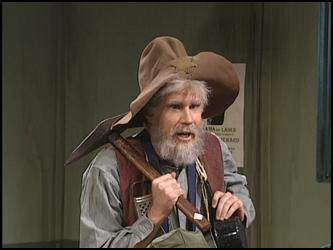
ACT ONE: It is 1898. Daniel Plainview (DP), a grizzled prospector (looking not unlike this guy), digs a hole, alone, in the middle of nowhere, in the desert. In a movie rife with Kubrick references, DP, covered with hair and dirt and swinging his pick, looks like 2001‘s Moon-Watcher with his bone.
Why is he alone? Wouldn’t the job of digging a deep, deep hole in the middle of nowhere be easier, not to mention safer, with a crew or at least a partner? And yet DP goes it alone. Perhaps he’s seen Treasure of the Sierra Madre and knows better than to tell anyone where he’s digging, or it could simply be that he, like Garbo, prefers to be that way. And indeed, we will learn later that DP doesn’t particularly care for people. It is not a “good” or “bad” quality — it is just, we would say, Who He Is.
We could say that this DP is pure DP. Miles away from anyone, his life is not a performance. His actions are simple and direct and uninflected. He’s not asking to be loved or trying to prove his superiority. He’s digging a hole and climbing a ladder and hauling a winch and blowing up some dynamite. PT Anderson, like Kubrick, is interested in examining systems: this is how an atom bomb gets delivered to its target, this is how a group of teenage boys are turned into killing machines, this is how a shuttle docks with an orbiting space station, this is how one gets precious materials out of the ground. We could say that this first part of the movie shows DP in his element. We could say that this is when he is happiest, alone and accountable to no one and on no one’s schedule.
(Speaking of elements, three of the four classical elements get real metaphorical workouts in this movie — Earth, Water and Fire all make dramatic appearances. And I suppose Air gets blown around too, whenever one of the principles needs to sell something to somebody.)
DP finds silver in the hole he’s digging, which gets him enough money to get started in what will be his life’s work, digging for oil. We see him next with a small crew of men, digging another hole in another middle of nowhere. They strike oil — whether through intent or by accident isn’t clear to me. One of the men has a baby boy, HW, who is baptized with the newly found crude.
(This is the first we see of oil-drilling as a kind of belief system, which will become important later.)
A few scenes later, HW’s father is killed in an accident. This is the second accident in the movie — DP broke his leg in the first hole, now HW loses his father in the second hole. To quiet the sobbing infant HW, DP feeds him whiskey. The significance of this becomes important later (and has nothing to do with milkshakes). Oil struck in this hole, DP moves on with HW to greener pastures.
We see DP with HW on a train. HW, though an infant, seems to like DP and DP seems to like HW. So it seems that DP is not a wholly antisocial creature; given the opportunity, he will be nice to a defenseless infant.
Fourteen minutes into the movie, we get our first dialogue. It is 1908 and DP is seen trying to sell his drilling operation, which as grown considerably, to a group of townspeople. The tools of his speech to the townspeople are crucial. He uses words like “family” and “community” and “trust” and “friendship” when what he’s really talking about is stealing these people’s land so he can turn it into an oilfield and make a ton of money. So while DP may prefer to be alone, he apparently has learned somewhere how to work a crowd. Public speaking, the most common of fears, does not seem to slow down DP. When the town meeting breaks down into argumentative shouting, DP gets up and walks out. “Too much confusion,” he says, limping out to his car.
The next thing we see is DP in the kitchen of a middle-aged couple, negotiating to buy their land. He lies to them about HW’s parentage and his status as a family man. This scene, up against the previous one, confused me until I read the screenplay (which can be found here), which indicates that DP, through buying the middle-aged couple’s land, is getting the same oil he would have been getting by leasing the land of the argumentative townspeople of the previous scene. He doesn’t explain it there, but the issue is “drainage,” the same concept he ends up explaining with the “milkshake” metaphor in Act VI. He could, apparently, lease the whole town, which would benefit everyone but involve dealing with a large group of people, or he could lease the land of just the middle-aged couple, get all the same oil eventually, and not have to talk to anyone.
Through this first part of the movie we see that yes, DP is a greedy capitalist, but he is also not afraid of hard work, risking his life and limb, or getting his hands dirty to achieve wealth. He’s even willing, up to a point, to be fair to people — unless there are too many of them with too many agendas, in which case he’d rather just withdraw and make a deal that screws everyone. That is, he’s greedy but his greed is secondary to, I think, his prime motivation — his dislike of people.
In any case, DP gets his well in Signal Hill and takes over the house of the middle-aged couple he was dealing with (this is another tidbit I got from the screenplay. DP transforms the Signal Hill house with so much construction as to make it unrecognizable). It is his success in Signal Hill that brings Paul Sunday to his office. Paul Sunday, a poor but apparently wily young man piques DP’s interest in a tract of land near a town called Little Boston, which brings us to the end of Act I.
So, in plot terms, what we have so far is: DP, alone, digs for silver, which leads to DP making a small fortune, which leads to DP and a crew of men, including the infant HW, digging for oil, which leads to the death of HW’s father, which leads to DP’s adoption of HW. The success of the well that killed HW’s father leads to DP’s business expanding to include, among other sites, a successful well in Signal Hill, which leads to Paul Sunday seeking DP out to offer him his family’s ranch as a potential drilling site. This series of events all lead to DP heading out to Little Boston and the Sunday Ranch, which is where Act II begins.
And this has gone on long enough for one day, I will pick it up anon.
iTunes catch of the day: Cassandra’s Dream and “The River in Reverse”


Few have ventured to see the new Woody Allen movie, so most are unaware that Allen has, for one of the few times in his career, commissioned a score for his soundtrack, from an actual living composer, Philip Glass, no less. And what a corker! I buy all of Glass’s soundtracks whether I’ve seen the movies they’re in or not, and this one has quickly vaulted to the top of my list of favorites. Stormy, melancholy, brooding and propulsive. If you like Glass or have an abiding interest in soundtrack music, this is a real treat. Can’t say I like the cover. You can listen to little bits of it either at iTunes or Amazon.
Meanwhile, Elvis Costello has knocked off a handful of his songs in solo settings for the iTunes market. I enjoy all of these renditions, they are some of my favorites of his songs, but the new recording of “The River in Reverse” is just stunning. I enjoyed the album of the same title when it came out, but to hear Costello snarl his way through this searing, scathing reading is a remarkable experience, even coming from this longtime snarler. His insistent, plangent solo guitar sets lyrics like “In the name of the father and the son/in the name of gasoline and a gun” in bold relief and elevates this song to a classic to stand with “Pills and Soap” in its withering social criticism.