The Big Reveal
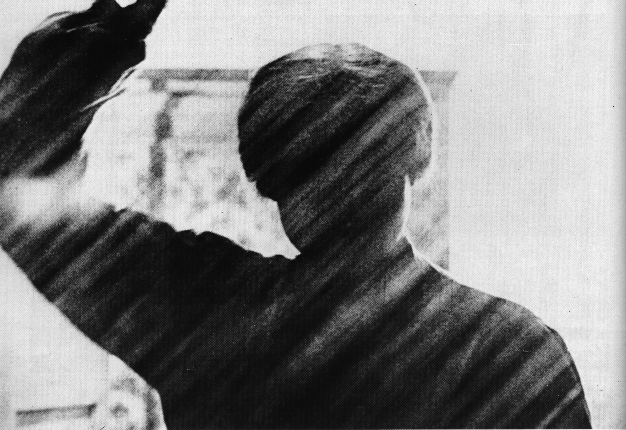


The twist ending, the head-spinner, the fake-out, what M. Night Shamalayan calls “The Paradigm Shift.”
“And it turns out that, the whole time…”
The antagonist is really the protagonist’s other personality. The murderer was in the room from the very beginning. It was all the dream of a man who’s been cryogenically frozen for two hundred years. They were on Earth the whole time. The protagonist is really a ghost. It turns out it’s not the past after all. Everything is happening in the head of a dying man’s last moments.
What are your favorites? When do they work? When do they not? When do they satisfy, when do they frustrate? When are they the final piece of the puzzle and when do they come out of left field? When do they make you want to see the movie again and when do they make you say “What the hell did that have to do with anything?”
And, we’re all professionals here. Spoil away.

28 Days Later

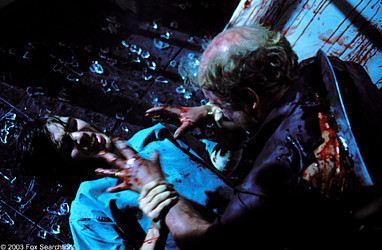
THIS IS THE WAY THE WORLD ENDS: Science project gone wrong. Ultra-contagious CrazySerum set loose by well-meaning animal lovers.
SYMPTOMS: People go crazy and turn into crazypeople. Everyone dies. Cities of England empty.
WHAT ARE WE GOING TO DO ABOUT IT? For now, just try to survive. That’s bleedin’ hard enough, innit?
THE MILITARY, SUCH AS IT IS, HAS A PLAN, SUCH AS IT IS: Lure people to their military base and forcibly impregnate any females who wander by. Who knows? In a few weeks maybe all the crazypeople will keel over from starvation. Good plan, huh? Huh? Hey, where are you going?
WHERE DO WE LEAVE THINGS? We learn, in time, that the crisis is passing, that the crazypeople, if not starving to death, are at least getting weaker and less scary, and that England is, seemingly, the only affected country. Ah well.
NOTES: I love, love, love the first 75 minutes or so of this movie. It’s deeply upsetting, haunting, nerve-shredding entertainment. The creatures are wicked scary and unpredictable and the movie bristles with unexpected moments of beauty and poetry. I love everything up to the point in Act III where the Army Guy In Charge mentions in passing that he intends to toss the women to the army guys. What had, up until that point, been a really, really smart movie about resourceful people doing their best to survive in a really, really fucked-up world then becomes a movie about how the Military Is Bad. Which it is, don’t get me wrong. But for instance, we’ve got the female lead, who has proven herself to be an astonishingly effective badass with a machete, and in Act III she’s reduced to Protecting The Innocent Girl, Wearing a Party Dress (!), and Being Rescued By The Male Protagonist Who Learns To Kill And Thus Proves His Manhood (sigh).
I’m also not sure about the decision to shoot this on video. I think it’s supposed to add “realism” to the event, and it certainly helps with the discomfort level, but for me it just keeps taking me out of the story because it doesn’t look like a movie, even though it is, obviously, a movie. It feels self-conscious.
Day of the Dead

THIS IS THE WAY THE WORLD ENDS: Well, no one knows. It just kind of happens one day.
SYMPTOMS: The dead come back to feast on the living. This creates problems.
WHAT ARE WE GOING TO DO ABOUT IT? A group of scientists have been teamed up with a group of army guys and put into an underground storage-facility-cum-laboratory for the purposes of studying the zombie problem and coming up with some solutions. Solutions have not, as yet, been forthcoming and this is stressing everyone out a little.
THE ARMY GUY IN CHARGE says “Forget about our mission, let’s just get out of here.” (By “us” he means himself and his fellow army guys.)
THE OTHER ARMY GUYS say “Yee haw! Let’s kill some zombies!”
THE MAD SCIENTIST says “Let’s socialize the zombies as we would children or domestic animals.”
THE RATIONAL SCIENTIST says “We have to figure out a way to reverse the process. That will take time and patience.”
THE JAMAICAN HELICOPTER PILOT says “Why you want to waste your time wit’ dat, mon? Scientific knowledge an’ record keepin’ ees pointless mon, let’s jes’ find a nice island somewheres, make some babies an’ enjoy the rest of the time we’s got ‘ere on dis Eart.”
THE IRISH GUY drinks whiskey and says “Jaysus, Mary an’ Joseph” at every opportunity.
WHERE DO WE LEAVE THINGS? George Romero is a populist and secular humanist. His head is with the rational scientist, but his heart is with the Jamaican helicopter pilot and the Irish guy. (Strangely, the Jamaican and the Army Guy both have the same plan, but the Army Guy is a selfish, autocratic bully whose plan includes shooting everyone else before escaping, so we don’t like him.)
AND THE BEST DEATH GOES TO: It’s hard to top the Army Guy whose eyelid gets torn away and the Other Army Guy who keeps screaming after his head is torn away from his body (not to mention the zombie who’s decapitated with a shovel-blade — man, I’ve always wanted to try that — but the winner has to be the Army Guy In Charge who lives to see his own intestines dragged away by zombies and still has the gumption (and the lucidity) to scream “Choke on ’em!” before he succumbs.
NOTES: This movie is a lot more compelling than I remember it being. Especially since it doesn’t have much of a plot, or very good acting. It’s pretty much: Act I: introduce everyone and delineate the situation they’re in, Act II: gather and sort theirconflicting viewpoints and theories, Act III: set the zombies loose and see who survives.
The scenes of zombie carnage still carry an undeniable punch of profane revulsion.
This is the way the world ends


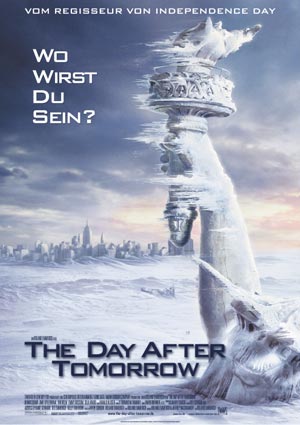
Favorite post-apocalyptic scenarios. Let’s not worry too much about the quality of the movie, what I’m looking for is ideas — is it a virus, a nuclear war, invaders from Mars? What are the symptoms of that apocalypse? Is it flesh-eating bacteria, zombies, intelligent insects, people living underground?
Bonus points for uniqueness.
Extra-special bonus points for a surprise twist ending.
*bonus points not redeemable for cash or merchandise
The Departed casting notes
The Departed, on top of being riveting entertainment and superlative filmmaking, offers an excellent opportunity to look at the casting process and how the right actors can really help to get across the ideas of the movie. Each actor brings a wealth of associations with them to help raise the tension of the narrative and the expectations of the audience.
MATT DAMON, we know, was already a genius Boston guy in Good Will Hunting, so we not only buy his accent, but we know he’s really smart. Plus, he played both Jason Bourne and Tom Ripley so we know he’s good at lying to people and can kill with a cold heart.
LEONARDO DiCAPRIO we know was in Catch Me if You Can so we know he’s good at fooling people, and he was in Gangs of New York so we know he can take care of himself in gangland, and he was in Titanic so we know that he’s operating under a terrible burden of guilt and shame. Kidding. Sort of. But you know, ever since then he’s kept scrunching up his brow and looking really pissed off, never more so than here, where regret and anxiety waft off of him in waves.
JACK NICHOLSON is more sui generis. He carries so much baggage with him that he presents a case all by himself. No one comes within striking distance of Nicholson’s work in Hollywood today, especially since Brando died. He shows up and you pay attention. From Jake Gittes to Randall McMurphy to Jack Torrance to The Joker, he’s a steamroller of associations and innuendo.
MARK WAHLBERG we know is tough from The Perfect Storm and Three Kings, but we know he’s vulnerable too from those same roles. So we know he can hold his own against the stars in the short run, but we don’t know if he can go the distance.
MARTIN SHEEN we know is tough because he killed Marlon Brando, but he was also President Bartlett so we know he’s wise and fair. (This part, I’ve heard, was originally supposed to go to DeNiro, which would have lent a lot more surprise and tension to those scenes. Martin Sheen killed Marlon Brando, but he kvetched a lot about it beforehand and he struck him from behind when it came down to it. DeNiro would take your head off like swatting a fly and not even stick around long enough to watch your corpse drop to the ground.)
RAY WINSTONE we saw stand up to Ben Kingsley in Sexy Beast, so we know he’s tough (they put a scar on his face for extra toughness), but we also saw that he ultimately lost that battle to Sir Ben so we know things can’t end well for him.
VERA FARMIGA we’ve never seen before so we don’t know what the hell she’s gonna do.
ANTHONY ANDERSON we know was in Kangaroo Jack so we know that he’s capable of doing anything.
ALEC BALDWIN we saw chew out Al Pacino in Glengarry Glen Ross and pull the rug out from under Leonardo in The Aviator. We saw him bomb Tokyo in Pearl Harbor, bomb Vietnam in Path to War and boss imaginary trains around in Thomas and the Magic Railroad. He boned Kim Basinger in The Getaway and Teri Hatcher in Heaven’s Prisoners. Alec’s no chump, he can take care of himself. Unless the bear from The Edge comes around, then he’s screwed.
KEVIN CORRIGAN plays fuckups and losers. I mean that as a compliment.
Venture Bros: Showdown at Cremation Creek, Part II


Everyone needs a story; it’s how we define ourselves. Our lives are meaningless without a narrative to transform them. Without a narrative, a human life is seventy years of haphazard coincidences. With a narrative, they become poetry, drenched in meaning and drama.
Some people take this idea further than others.
In this concluding episode, David Bowie fulfills his promise as a symbol of transformation. He transforms all over the place in this episode — into Iggy Pop, Dr. Girlfriend, an eagle, a pack of cigarettes. In real life, Bowie took the idea of narrative as a transformative device to baroque extremes, creating a new persona with each new album. It’s difficult, I imagine, for a modern audience to understand how audacious and exciting this was back then. Madonna puts on a new hat with each of her reinventions, but for her it feels more like a marketing decision, a way to keep the old perpetually new. With Bowie, the transformation was the subject of his art itself. And what’s more, he transformed himself every year for 15 years or more, a decision that would make today’s marketing executives shudder in horror; no sooner would he acquire an audience but would then shed it immediately the next album (or, famously in one instance, even in the middle of the tour promoting the current album/persona). Now he has settled in to his still-current permanent persona of “David Bowie,” classy British guy with a reputation for brilliance. (How ironic that Bowie’s most recent album is titled Reality.)
The woman he’s giving away, Dr. Girlfriend, comes all this way without finally transforming herself: she pointedly never gets to say “I do” to The Monarch. She hasn’t completed the commitment ceremony, she’s still the woman of a half-dozen costumes and personas. Would that make her spiritual father Bowie happy, or would he be saddened to know that his spiritual daughter hasn’t yet found herself, is still gathering meaningless personas, is still, in essence, pretending to be something she’s not? Lady Au Pair, Queen Etheria, Dr. Girlfriend? Who is she, finally? Who could she be if she can’t even settle on a narrative to define her life? If she’s not careful, life will decide her narrative for her.
That is, after all, what has happened to Dr. Venture. He’s decided that narrative is for babies. Burned by narrative at an early age, he’s thrown it on the trash heap and decided to face life on its own terms. As a result, he is in control of nothing in his life. He has no ideas, he’s haunted by the ghost of his father, he’s dominated by his twin brother. In this episode, while everyone else is busy heroically pursuing their narratives, he gripes, carps and eats a sandwich. Thrust into an actual heroic journey, Dr. Venture can only retreat into the most mundane details of life.
(A friend of mine once told me that, in psychoanalytical terms, one has until age 30 to decide who one is. After that, one is stuck, reinvention is impossible. This is how we know that Elvis Presley is dead — one cannot crave wealth and fame for 23 years and then, at age 42, decide one does not care for them after all.) (Elvis Presley — speaking of people who live their life according to an invented narrative — his being Dr. Faustus.)
But look at Dr. Girlfriend’s boyfriend, The Monarch. He has chosen the butterfly, the ultimate symbol of transformation, as his narrative device (which he calls “a theme thing”). Who knows, after all, if his absurd story of being raised by butterflies (back in Season 1) is true or not? It must have seemed true to him at the time; in any case, he’s picked his narrative and he’s sticking by it, regardless of the apparent inconsistencies and the scorn his decision brings. (If The Monarch and Dr. Girlfriend have a baby, that baby’s lullaby can only be David Bowie’s “Kooks.”)
Brock, like Dr. Venture, doesn’t have time for pretense; he just wants to get on with it. Yet he has defined himself by another, more subtle narrative, that of the protector of the innocent. He transforms himself in this episode, donning the hated butterfly wings (Brock gets his wings; his tatoo of Icarus, ironically, does not), to do what, exactly? Not to protect Hank and Dean or Dr. Venture. Hank he only protects as an afterthought, Dean’s protection is left in Hank’s hands (“Am I my brother’s keeper?” quoth Cain) and Dr. Venture is left in the hands of his arch-enemy The Monarch.
(The Monarch, in a telling moment, when faced with certain death, invites Dr. Venture to escape with him. Why? Why not escape by himself and kill his arch-enemy? I’m guessing because, as I’ve said earlier, The Monarch defines himself by who he’s arching; without Dr. Venture, he’s nothing. This is borne out by the end of the show, where The Monarch gripes about Phantom Limb being his “new” arch-enemy — as though he would have it any other way.)
No, Brock drops all his obligations in order to rescue Dr. Girlfriend, the damsel in distress. This is, of course, one of the oldest narratives in existence, which could be why Brock falls back upon it when faced with a crisis.
It certainly explains what happens to poor Dean in this episode. Left alone in the engine room, filled with anxiety and feelings he cannot define or control, Dean conjures up the grandest narrative of all, involving a melange of “heroic journey” tropes, including a damsel in distress, a magic ring, a white, bearded deity, magical animals, enslaved innocents, an evil robot overlord and a giant flying dog. Why does he retreat into this bizarre, ridiculous narrative? Because otherwise his life has no meaning. This all comes out in the final moments of his delusion where he frees the enslaved orphans (symbol of his trapped innocence) and rants not about an evil robot overlord but about his own father and the absurdities heaped upon his young life, the monsters and yetis and evil scientists he must contend with every day. Dean’s “real life” makes no sense and he doesn’t have the tools to fashion a useful narrative for himself. Instead, he fashions an un-useful narrative as a weapon against his doubts and pain (and, interestingly, puts his father’s life in danger as a result). (How Dean manages to change from his butterfly outfit back into his street clothes is another question entirely.) (The dog-dragon, of course, is from The Neverending Story, in which a motherless boy, guess what, disappears into a narrative in order to deal with his grief.)
Meanwhile, Dr. Orpheus and co. have found themselves stuck against reality’s brick wall. How will he and the Order of the Triad rescue Hank and Dean, when Dr. Orpheus can’t even buckle his seatbelt? With the aid, of course, of a fictional character, a minor character from Star Wars, conjured not from the movie but from a trading card. The Alchemist worries that the creature is an abomination that should be killed; Dr. Orpheus opines that, whether the creature fictional or not, it is still a living thing. And, it turns out, their salvation. (Of course, no one in the Venture universe ever really learns the lessons they’ve been taught — no sooner are they rescued by a fictional character than they roll their eyes at Dean for retreating into a world of fantasy.)
The need for a narrative in life reaches its bleakest, most terminal point with the death of the Monarch henchman in Brock’s arms. Spitting blood onto Brock’s shoulder, he confesses that the time he’s spent under his command have been the finest of his life. This is, of course, the narrative that every soldier tells himself as he goes into battle, that his actions have meaning, that he’s risking his life for something meaningful and worthwhile — without it, what he’s doing, throwing his life away, is the ultimate in perversity. The soldier’s lie withers as his body is transformed into a hunk of meat, from a living thing to an object. And Brock, who has no use for pretense in the first place (or sentimentality for that matter), listens to the harmless lie, then uses the body to jam the engine of an approaching aircraft: finally, in death, the unknown soldier becomes useful.
(Or maybe I’m wrong; maybe the henchmen is sincere in his statement to Brock, maybe he finally has found meaning through serving under Brock — after all, one would have to have a pretty empty life indeed in order to find fulfillment dressed up as a butterfly.)
Hank wants that henchmen’s narrative so badly he can taste it. He disobeys Brock’s command to take care of Dean (“Why do you have to be the screen door on my submarine?” he pouts) and joins the henchmen’s fight. When faced with the reality of it, of course, he recoils in horror and screams like a little girl. Hank wants that narrative but in the end he doesn’t have the guts for it. (“Again, again!” he blurts after his near-death experience, clearly not understanding the meaning of the dying henchman’s story.*)
Henchmen 21 and 24 have long functioned as Shakespearean clowns in this show, speaking in malapropisms that nevertheless reveal theme and authorial intent. Here, they talk about a group of lost henchmen and reference the phenonmenon of the “urban myth,” underscoring humanity’s need to make up narratives out of thin air in order to deal with the chaos and absurdities of life.
Dean finds his purpose by recycling a heap of pop-culture detritus and fashioning it into a meaningful narrative. The Venture Bros does something quite similar, turning over bits of trash to find the wriggling, bleeding humanity underneath.
And it’s very funny.
*With the dying henchmen, and Brock’s treatment of him, I keep beingreminded of Snowden, the dying airman in the back of the plane in Catch-22. “Yossarian heard himself scream wildly as Snowden’s insides slithered down to the floor in a soggy pile and just kept dripping out…Yossarian screamed a second time and squeezed both hands over his eyes…He forced himself to look again. Here was God’s plenty, all right, he thought bitterly as he stared — liver, lungs, kidneys, ribs, stomach and bits of the stewed tomatoes Snowden had eaten that day for lunch…He felt goose pimples clacking all over him as he gazed down despondently at the grim secret Snowden had spilled all over the messy floor. It was easy to read the message in his entrails. Man was matter, that was Snowden’s secret. Drop him out a window and he’ll fall. Set fire to him and he’ll burn. Bury him and he’ll rot like other kinds of garbage. The spirit gone, man is garbage. That was Snowden’s secret.” And Snowden (and Yossarian) signed up to fight and die for one of the worst kinds of narratives, that which insisted that the United States was the handsome prince rescuing the princess of Liberty from the evil clutches of the Fascist overlords. Perhaps it all come back to David Bowie, who notes, in his song “Soul Love:”
“Soul love, she kneels before the grave
Her brave son, who gave his life to save a slogan
That hovers between the headstone and her eyes
For to penetrate her grieving.”
The Departed, explained to a 5-year-old

left: DiCaprio and Nicholson, by Scorsese. right: Plastic Man and Hawkgirl, by Sam.

The movie, plus previews, plus travel, is three hours long, so my wife and I don’t get home until 11:15. Sam (the 5-year-old in question) has been left with an untested babysitter. He is still awake, and delighted to see me as I take him back to bed. My wife and I are still kind of buzzed from the movie, which is a feast.
Sam: How was the movie?
Dad: It was great!
Sam: What was it about?
Dad: It’s, it’s for grown-ups, dude. Time for bed.
Sam: But what was it about?
Dad: It was about gangsters and policemen. Cops and robbers. Good guys and bad guys.
Sam: But what happened?
Dad: Sam, it is, currently, three and a half hours past your bedtime.
(Dad can feel that his buzz from the movie is transferring directly to his son, who is picking up on the vibe. And, since the movie is also about fathers and sons — real and metaphorical — it’s hard for Dad to break it off.)
Sam: But what happened in the movie?
Dad: Well. (beat) There are the police, right? And they’re the good guys. And then there are the gangsters, they’re the bad guys. Right?
Sam: Sure. And they wear different outfits.
Dad: That they do. That they do.
(Dad is stunned by this logistical leap from his son. They do, in fact, wear different outfits, but probably not in the way that Sam is thinking. Sam has, for his part, spent the evening watching Batman: Mystery of the Batwoman, which also features gangsters, so he knows all about gangsters.)
Dad: Okay. So the police want to get the gangsters, so they send a policeman dressed up as a gangster to go spy on the gangsters.
Sam: Okay.
Dad: Now: at the same time, the gangsters, they want to know if the police are going to catch them, so they dress one of their guys up like a policeman to go spy on the police. So the police have a spy with the gangsters and the gangsters have a spy with the police.
(Sam’s look is drifting into incomprehension. Dad should probably let it do so. But his status as a storyteller is at stake. He seeks clarity.)
Dad: It’s like, let’s say, the Joker wants to spy on Batman. So he gets one of his guys and dresses him up like Robin and sends him over to spy on the Batcave. Meanwhile, Batman, without knowing what the Joker is doing, takes that ridiculous outfit off of Robin and dresses him up like one of the Joker’s guys and sends him to go spy on the Joker. And so through the whole movie you’re worried about whether both guys are going to get caught.
(Comprehension achieved. Sam’s face swims with the sudden illumination of possibilities.)
Sam: Wow. So what happens?
Dad: Well, what happens is that everybody gets into a whole heap of trouble.
Sam: Yeah, but what happens?
Dad: I’ll tell you what. It’s a great movie, and you can see it when you’re older. Like, when you’re a teenager. Hey, how about you and me go out for a milkshake?
___________
PS. I’ve read a couple of reviews that complain about Jack Nicholson’s performance in this movie. Or worse, they sort of sniff in disdain about some imaginary unhinged, undisciplined “crazy Jack” performance instead of a measured, finely observed characterization. As though they’re disappointed by seeing the greatest movie star of our time, and one of the greatest of all time, give a performance equal to the character’s importance in the story. I have no patience with these people. The acting in the movie (and the casting I might add) is uniformly excellent. In a time with few movie stars, here is a movie filled with movie stars, from the leads down to some blindsiding supporting roles, all doing really great work with a kind of energy I can’t remember seeing before, like they’re all eager to show us what they’ve got.
Living In Flames
ANCIENT HISTORY DEPT: Before I became a screenwriter, I was known in downtown New York circles as a monologuist. This was my signature piece.

LIVING IN FLAMES
I’m, I’m living in flames, I’m living in flames, that’s the only phrase that applies, that’s only phrase that fits, I’m burning up, I’m burning up, it’s not, it’s not, it’s not, it’s not like a fever, a fever, a fever comes from the inside, and this comes from the outside. It’s it’s it’s it’s it’s it’s – I don’t know what it is, but I’m on fire all the time and I can’t stop it.
It’s this city, it’s this city, it’s too much for me, it all comes at me, I can’t take it, I can’t, I can’t, I can’t, I can’t, I can’t DO ONE THING AT A TIME. I have to do TWO things at one time. At least!
I wake up. I get dressed AND listen to music, I eat breakfast AND read the paper, I ride the subway AND read a book, I go to work AND work on a screenplay, I meet with friends AND try a new restaurant, I talk on the phone AND do a crossword puzzle.
I didn’t use to be like this! I used to live in a trailer! I come here, now there’s this constant catching up to do!
I buy clothes, they’re out of style. I want to get tickets to a show, they’re sold out. I want to get into a club, I can’t get in, it’s either too crowded or I’m dressed wrong. It’s like I have to be, like, two and a half TIMES ME, just to keep up!
And then I think things like “If I like this band, they must not be very good.” It’s this whole self hate thing, an inferiority complex.
But you see, here’s the other thing. I can’t stand to wait. If I make a date, and she’s five minutes late, she better not show up at all, because I’m just going to be pissed off for the rest of the night anyway. Keep me waiting? When I’m trying to catch up? I’ll go crazy, I’ll start breaking things.
Here’s how bad it gets. I need cash, I need to get to a cash machine. I get to a cash machine. If there’s a line, forget it. I won’t wait ten minutes on a line. I’ll walk ten minutes to get to another machine, but I won’t wait on that line.
My friends, they say I’m I’m I’m I’m I’m I’m I’m, I don’t know, I’m hyper or something, I’m obsessed, I don’t know, maybe I am, maybe I am obsessed, maybe I am obsessed, I can’t stop it so maybe I am obsessed. I guess I guess I guess I guess I guess –
Well.
But there’s this urge, there’s this drive, to be doing, to be doing something else, to be doing something as well, to be doing something in addition to.
Call waiting? Of course I have call waiting! The phone, that’s the biggest magnet, I should have a phone welded to the side of my head, I should have, I should have a tiny phone implanted in my skull, I should have a tiny phone implanted in my skull so that I don’t have to pick it up, I can just answer, keeps my hands free. The phone, I miss one phone call, that’s it, I’m a basket case, because I know that THAT WAS THE ONE. You know. It’s always THE ONE, there’s no use rationalizing it.
And if I get on the subway? I get on the express train? The express train stops between stations? I sit there and watch local trains go whipping past? You gotta see me. I hit myself in the head, I punch myself in the head, I tear my hair out, I want to break all the windows, I want to kill the brakeman, I want to go up to his little room and kick the door in and scream “MOVE THIS FUCKING TRAIN NOW!” and put his HEAD through the window!
It’s burning me up, I can’t take it, to back off, to relax, it would be admitting defeat, so I have to be in motion, I have to keep moving forward, if not I go crazy, so it’s either burning up or going crazy, I don’t really see that I have a choice!
I wonder sometimes.
I wonder what exactly it is that I am heading to. Why am I in such a hurry to get there? How will I know when I finally arrive? What will it look like? Is it all worth it? Typical questions, but I’M IN NO CONDITION TO ANSWER THEM! I’m burning up, I’m living in flames, that’s the only phrase that fits, I’m burning up, I’m living in flames!
Copyright © 1989 Todd Alcott
Venture Bros: Showdown at Cremation Creek, Part I


As this is the first half of a two-part episode, any attempts at analysis are bound to be premature. But what the hell.
The theme tonight seems to be “commitment.” In the A story, Dr. Girlfriend wants a commitment from The Monarch, while in the B story, Dr. Orpheus wants a commitment from The Alchemist. The Monarch submits to Dr. Girlfriend’s desire, The Alchemist isn’t so sure.
In the C story, Phantom Limb pledges commitment to The Sovereign, then immediately goes back on his word. This cannot end well. The Sovereign is a spooky distorted head in a TV set; one would do well not to cross him.
Both Henchman 24 (or is it 21?) and Brock wish to commit to tattoos. Both attempts are abortive. In the henchman’s case, the abortion is voluntary. This foreshadows the abortion of Dr. Girlfriend’s attempts to get through her wedding to The Monarch. Both the tatoos and the wedding are commitment ceremonies.
A note on The Monarch’s and Dr. Girlfriend’s relationship: if it continues along the lines it is, it’s doomed. It cannot end happily. These two have issues, and I’m not talking about dressing up in costumes and living in a flying cocoon. Dr. Girlfriend wants a commitment, but she wants The Monarch to change who he is in order to get it. This is a common and tragic mistake. Dr. Girlfriend wants The Monarch to give up arching Dr. Venture, but that is all The Monarch knows. He only defines himself in opposition, he has no positive identity. If he’s not arching someone, what is he going to do with himself? Dress up in the costume, fly around in the cocoon and — what, exactly? What kind of a way is that to live? And once his identity is taken away, how will he maintain his appeal to Dr. Girlfriend? What is her attraction to him after all? He’s a whining, petulant, fussbudget. She must be attracted to him for the command and drive that he possesses when arching Dr. Venture. Take away his hatred and his plans for destroying Dr. Venture and what will come to the fore? Where will he direct his energy? Dr. Girlfriend (Dr. Wife? Dr. Life-Partner?) makes the classic mistake of gutting her relationship when she thinks she’s solidifying it, a rare manipulative misstep for this otherwise canny woman.
(Incidentally, this may answer a question from last week. Why wasn’t The Monarch present during the raid on the Venture Compound? He apparenly had a hot date with Dr. Girlfriend in their seedy motel room.)
Dr. Orpheus is disappointed with the Order of the Triad. Jefferson Twilight seems okay with going along with arching Torrid, but The Alchemist is wavering in his commitment to costumed arching (his comment about being “disguised as a paunchy gay man” is a telling moment). The team cannot even perform the Man-Mound without the two lesser team members griping about it (and no wonder — The Alchemist, being the shortest member, should be at the top of the mound, not Dr. Orpheus — what are they thinking?). Dr. Orpheus wants to have a “practice session” (another kind of commitment ceremony), which The Alchemist derails by bringing a treat that Jefferson is susceptible to (thereby demolishing Jefferson’s commitment to sobriety).
While The Monarch is commiting to Dr. Girlfriend by promising to marry her, the henchmen are proving their commitment to The Monarch by capturing Dr. Venture and his family. (Strangely, the henchmen, while ever loyal, are beginning to show signs of independent thought — they gripe about hench-life out in the open now without apparent fear of repercussions — could this represent a more democratic atmosphere around the cocoon?)
Later, Hank and Dean are each becoming seduced by the henchman lifestyle. Hank is attracted by its juvenile, play-acting dress-up side while Dean is interested in the technical aspects. In fact, Dean shows more interest in the flying cocoon than he’s shown in his father’s projects in two seasons. Thematically, these storylines don’t exactly fit: one does not, after all, commit to being a child or a sibling, one is simply born that way. One does, however, commit to being a “Venture Brother,” and if they can be attracted to the hench-life, can the end of the Venture-brand line of adventures be far behind? (At the moment Hank puts on the “evil Hank” beard, he is distracted by the henchman’s alarm clock, a Rusty Venture clock of all things, with Jonas’s voice calling for Rusty to “wake up.” Is Hank experiencing an awakening of a sort by donning his henchman garb and his “evil Hank” beard?)
In the middle of all this, Dr. Venture has a revelation: Dr. Girlfriend is Charlene, the woman who turned him into a caterpillar (I know that everyone reading this knows that, I just enjoy typing phrases like “the woman who turned him into a caterpilar”). And so he does something rather alarming; after an adulthood filled with grumpily harumphing at the whole costumed-arching lifestyle, and at The Monarch in particular, he goes ahead and does something that cannot help but actually make him a genuine enemy of The Monarch. So while The Monarch has hated Dr. Venture all this time for no reason at all, Dr. Venture, on the day The Monarch has vowed to stop arching him, has given him something to really arch about.
The special surprise guest at the wedding is, of course, David Bowie. Which prompts the question, what does David Bowie represent in the Venture Bros cosmos? If the theme of tonight’s episode is commitment, then Bowie, chameleon without peer, would seem to represent the pinnacle of non-commitment. Bowie’s career (and by “career” I mean from 1969 to 1980; I can’t account for the ensuing 26 years of fitfully entertaining product, which puts Bowie more into the “squandered potential” theme of the show) was founded on what we might call “success through transformation.” So then we ask, well, who in The Venture Bros has succeeded through transformation? We could say that The Monarch has succeeded through transformation, if you can call what he does successful. The butterfly is the ultimate symbol of transformation, the ugly creeping worm that becomes the beautiful floating flower. And now he is contemplating another transformation, from arch-villain to, what, house-husband?
Well, at least it’s a step: Rusty and Brock have both refused to transform at all, they have both remained stuck in their adolescent mindsets for over twenty years now, Rusty with his frustration and curdled dreams and Brock with his devotion to Led Zeppelin, which even the butterfly-dressed Monarch puts down as juvenile.
Or maybe the Bowie reference is not to transformation but to masks: many of the characters in Venture Land wear masks, but Dr. Girlfriend has gone through more then most. Is she, like Bowie, a chameleon, or does she just not know who she is? First she’s Lady Au Pair, then she’s Etheria, now she’s Dr. Girlfriend: who is she “really?” Is there a symbolic weight to chameleon David Bowie “giving her away” at the wedding (and quoting “Modern Love” before the ceremony)? Does this represent Dr. Girlfriend’s farewell to masks, to false identities? Will we (and perhaps she) now find out who she “really is?”
(I see that David Bowie’s henchmen, at least for the road, are Iggy Pop and Klaus Nomi. A formidable team — but where are Fripp and Eno? Are they more of a “brain trust,” perhaps, that Bowie keeps in a vat of viscous liquid hooked up to electrodes, or does Eno outrank Bowie at this point?)
(A commenter on urbaniak‘s blog suggests that David Bowie is, in fact, The Sovereign. There is evidence to suggest that this is so. The Sovereign, after all, lets slip to Phantom Limb that he “has a wedding” to get to, and we see no distorted, floating head at the wedding. Unless The Sovereign is Sgt. Hatred, or Miss Littlefeet, both of which seem doubtful.)
UPDATE: Another aspect of Bowie’s work occurs to me, his deep and abiding belief in space aliens. In “Space Oddity,” space seems to be quite empty and lonely, but from Ziggy Stardust through Young Americans’ “Somebody Up There Likes Me,” he turns to the idea of invaders from space as Earth’s only salvation. (It’s not an accident that Ziggy’s band is called the Spiders From Mars.) His interest seems to have peaked with The Man Who Fell to Earth, but the appearance of genuine alien Klaus Nomi as a bodyguard suggests an exciting new avenue exploration in the Venture universe.
Tower Records, RIP

Tower Records has gone bankrupt, been sold, and will be liquidated.
I could write a bunch of stuff about what this indicates about recent shifts in the music business, how Tower’s “deep stocking” policy no longer makes sense in an era where musicphiles can get pretty much anything they want with a few mouseclicks, and worry about what this means for brick-and-mortar music stores in general.
But my initial response is a personal one.
Moving from southern Illinois to New York in 1983, I had, quite literally, never seen anything like Tower Records on Broadway and 4th St. A record store that took up an entire city block? Three stories of it? Unbelievable. Records I had only dreamed of owning were on sale here every day from 9am to midnight, 365 days a year. That’s right, Christmas and New Year’s included. If, on Christmas morning, I suddenly felt the need to own The Minutemen’s Double Nickels on the Dime (maybe because I didn’t get it for Christmas) I could saunter right over and purchase it.
From the moment I saw that store, I vowed that this was the locus solus of the New York experience. My first home was in a far-flung corner of Park Slope, but each year I moved closer to my goal, until finally, in 1999, I was able to afford a loft on Broadway, a half-block away from Tower. An evening’s meditative walk for me would start at Tower Records, move on to Tower Video (and Tower Books, upstairs) when it was across the street on Lafayette, with perhaps a side-trip to Other Music if I was in the market for an Other Music kind of record, then on to St. Mark’s place where I would check to see if any of the new releases I was interested in could be found for used prices. If I was feeling expansive, up to Virgin on Union Square and then, if it wasn’t too late, the Strand. Then, often, I would end up circling back to Tower before heading home.
When I became interested in “downtown” music in the late 80s, your John Zorns and Elliott Sharps, before the Knitting Factory had their fancy digs and their own label, Tower was often the only place those records were available. And they were open late enough that you could see a band at a club (or a Philip Glass concert at BAM), dash right over and buy their record before the place closed (and the urge to purchase wore off).
When I began working in Los Angeles, I found myself overwhelmed, as many are, by the sprawling, anonymous quality of much of this kudzu-like metropolis. I would center myself and get my bearings by visiting the Sunset Blvd store. I used to say that if I ever became a fugitive from justice, the authorities would always be able to find me by staking out Tower Records on a Tuesday afternoon.
I have too many memories of joyous discoveries and artistic connections made in the aisles of Tower to list here, but here’s one that comes to mind as emblematic. On the morning of 9/11, like everyone else in New York, I stood transfixed in my living room watching the horrifying images unfolding on TV (even though they were happening a mere 1.5 miles away). The only thing that interrupted my morning was going downstairs to Tower — hey, it was new releases day, with not only the new Bob Dylan (“Love and Theft”) but also the new Leonard Cohen (Ten New Songs). It was 9:30 or so and neither building had collapsed yet. The aisles were filled with sobbing, wailing office workers, unable to watch the images being broadcast on the monitors lining the first floor, and unable to look away. The street outside was filled with a tide of humanity walking uptown, all the subways being shut down and no cabs available. In the coming days, when Manhattan was shut down south of 14th St, lower Broadway became an eerie, empty pedestrian mall, but Tower remained open.
So long, Tower.