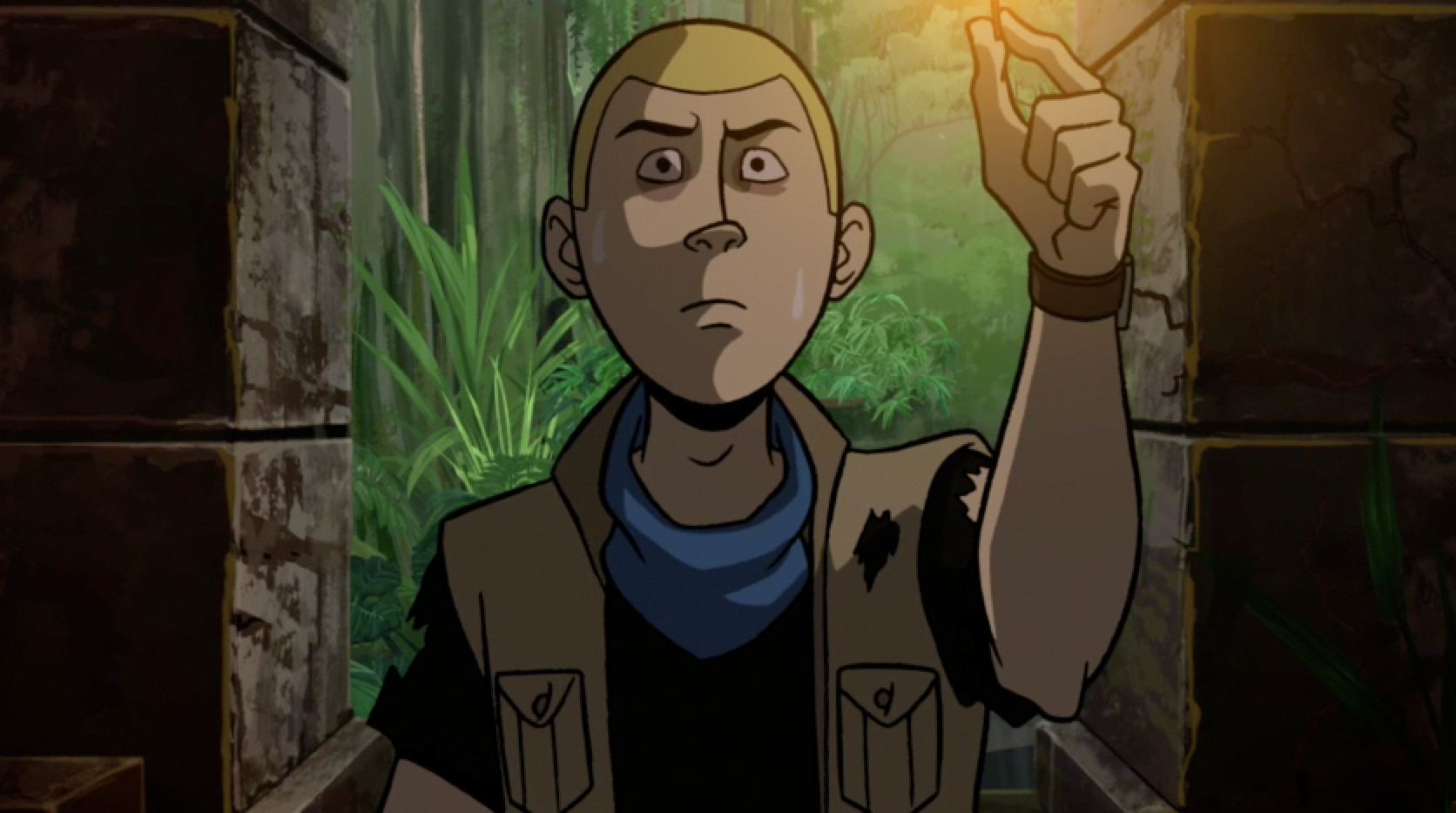
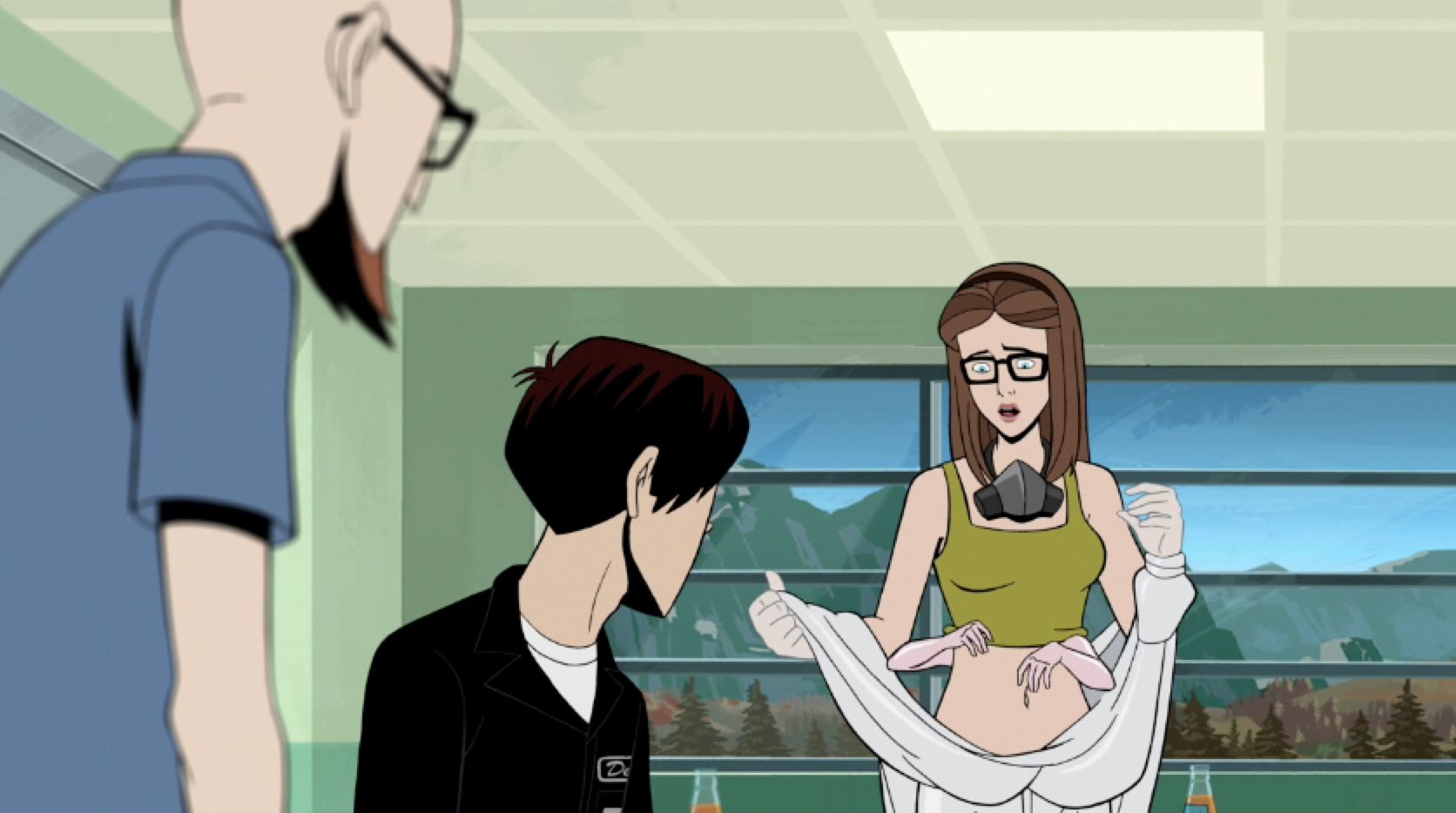
Venture Bros: The Family that Slays Together, Stays Together, Part Two

One thing is certain: no one in this episode knows who is doing what to who why.free stats

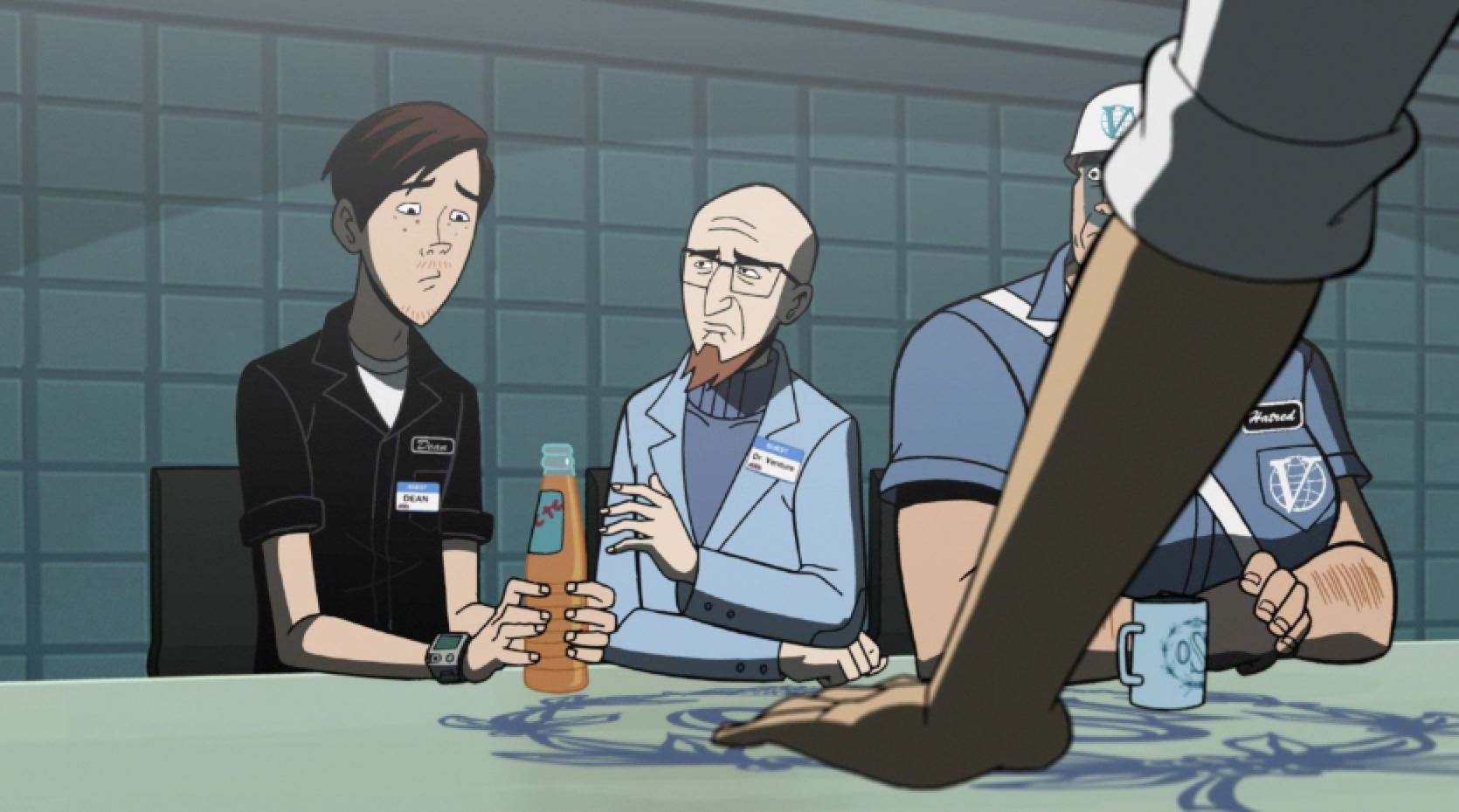
General Treister and agents Doe and Cardholder don’t know why Brock has been killing OSI agents, although we think they do(it’s nice to know that Doe and Cardholder are OSI, I had my doubts earlier). Detectives Heat and Collar not only don’t know why Brock killed La Tueur, they don’t have La Tueur’s body any more. The counselor interviewing Hank and Dean thinks they’ve been kidnapped by the thug with the skinny guy in the other interrogation room. The Cleaner probably doesn’t know anything and probably prefers it that way. The Monarch doesn’t know any of the above has happened and pays no attention the clues offered him — he charges forward blindly, pursuing his single-minded agenda of revenge and suffers catastrophic losses for his hubris (sounds like someone I know). Molotov, Hunter and the Blackhearts know why Brock killed the OSI assassins, but even they have no notion of Treister’s involvement, or the Monarch’s: their agenda was fulifilled by the end of Part 1.

(The counselor thinks that Brock is a figment of Hank and Dean’s imaginations. And, in a way, we will find out he is.)

Identity, typically, asserts itself as a theme. Most importantly, Brock, the “tool” of “Viva Los Muertes!” gets smart and starts to think above his pay cut. Specifically, he stops being the brutal assassin of Part 1 and starts thinking in the manner of his superiors at the OSI. He plots, pretends to be the chess-master, thinking he’s pretty clever as he sits back, lights a cigarette and lets the OSI wipe out the Monarch’s henchmen (presumably the OSI also suffers casualties, but the numbers look pretty grim from where I’m sitting). What Brock does not count on is Hank, who has always taken after him, “opening his Christmas present” and demonstrating a flair for bloodshed himself.

(Exposing children to horror is also a theme here: the counselor at the police station thinks Hank and Dean have been tortured and abused, ironically just as Helper is being tortured and abused, Rusty and Hatred trade stories of childhood abuse, Hatred is, himself, a child molester, The Monarch sends all his “children” into battle, Rusty sends his “backup” children into battle as well — strangely, he shows affection for Hank, a desire to protect him from the harshness of the world that none of the other father-figures of the show seem to posess — with the exception of Gen. Treister, who, we learn, has only fatherly affection for Brock. Hank seems too stupid to understand the horror he’s being shown, but Dean, in the panic room at least, shows signs of a full-scale breakdown. Not that anyone would care about that.)

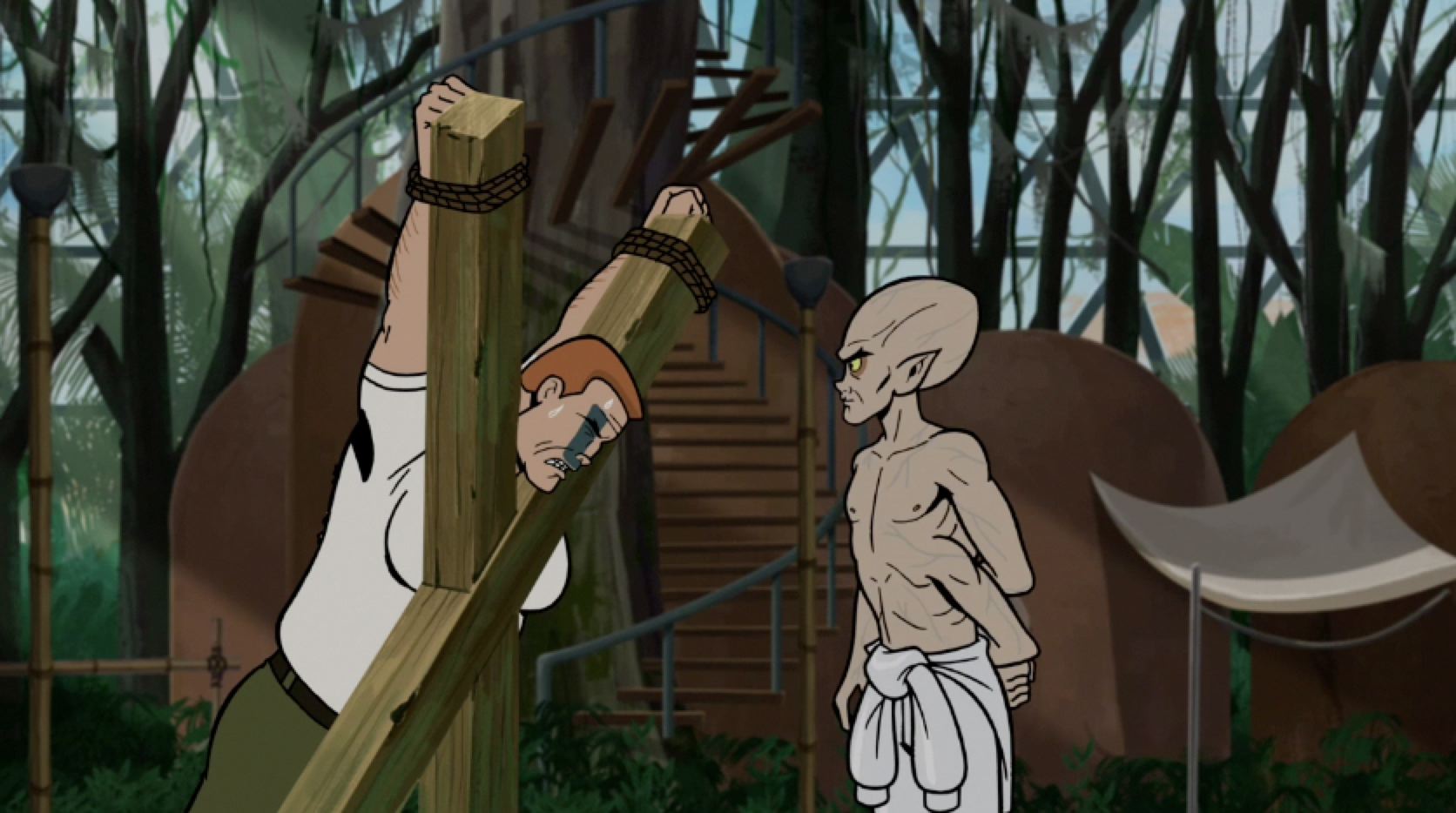
As Brock tries to adjust his identity upward and fails, Sgt Hatred tries to downscale his and also fails. He tries to live the role of a love-struck victim, but comes to the realization that he’s a killer through and through — a realization that allows him to march a platoon of naked teenaged boy-clones (in their Sting-from-Dune metal jockstraps) into the valley of death. What will become of Hatred now? Has he regained his killer instinct, after his suburbanization by the guild and his humiliation at the hands of his wife? At the end of the episode, he asks General Treister if he can have a job — does he mean a job with OSI (which indicates that the barrier between OSI and the Guild is semi-permeable at best and nonexistent at worst) or does he mean, literally, Brock’s job (which involves being the “bodyguard” of a pair of teenaged boys)?

Like Syriana, this episode links governmental actions to familial actions. The Venture Bros is often about father figures, and the government is, after all, the ultimate father figure (at least here on Earth anyway — God, to my memory, hasn’t made it into the show as a character yet). Brock has been trained not to trust his father figure, and who can blame him? Not only does he think the OSI is trying to kill him, the nearest father-figure to hand is Rusty — why would he think a father has his son’s best interests at heart? To make matters worse, his real father figure, the one who Brock thinks does care for him, has “crossed over to the other side” in more ways than one — not only is he no longer a man, he’s joined Brock’s enemy (who is, of course, also his lover).

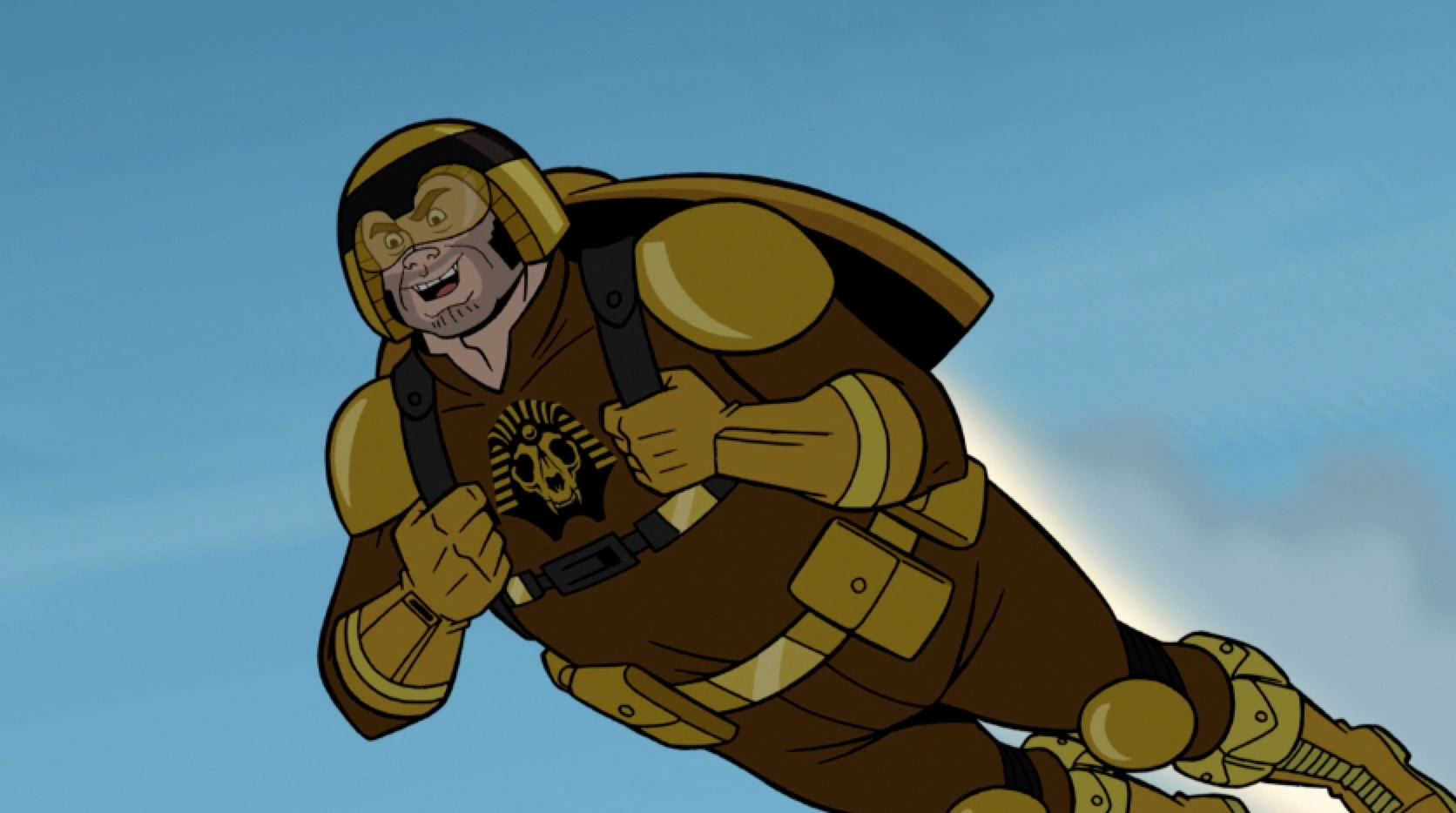
With excellent timing, this episode manages to quote both Iron Man (with the Monarch’s “Death’s Head Panoply” battle suit) and The Dark Knight (with the scenes of torture and interrogation, and their attendent questions of governmental incompetence and the value of individual action). Why Rusty and Brock are dressed as convicts when they haven’t even been arraigned yet is a tougher question, but Rusty’s line about his jumpsuit being the most uncomfortable thing ever is worth it.

One mystery left to solve: who detonated Helper?

NOOOOOOOOOOOOOOOO!!

free stats

NOOOOOOOOOOOO!!

More Sunday after the broadcast. Don’t want to spoil anything.

The Venture Bros: The Family that Slays Together, Stays Together part 1

free stats

One of the most propulsive, dynamic scripts in the series, “The Family that Slays Together” is also one of the most sincere and thematically coherent. Its action scenes rise to a new level of excitement and there is palpable dramatic tension, which makes the bent humor pop that much more.

The twin themes of love and murder are repeated over and over, in increasingly profound and complex ways. The episode begins with Brock killing his car, which, we gather from his emotional state, was his one real true love. As soon as he’s done that, his “family” shows up — Rusty, Hank, Dean and, yes, Helper. This brings up the question of whether Brock “loves” the Venture clan, which the plot will come around to addressing later.

But first, Molotov and her Blackhearts attack. Molotov, it seems, has come to warn Brock of his impending assassination by OSI. She does not try to kill him herself, but rather says she doesn’t want to “share” his assassination with the other OSI assassins. Her love/hate for Brock, and her jealousy for his other “suitors,” will save him — for now.

Brock is on the run with his life in danger, but he’s saddled with the responsibility of family, as the Monarch pursues his love, arching Rusty, while saddled with the responsibility of his family, the Moppets, Dr. Mrs. The Monarch and his henchmen, all of whom behave on this trip as a family — the Moppets are the misbehaving children, Dr. MTM (hey! MTM! And she even has Mary Tyler Moore’s haircut!) is the wayward spouse, the henchmen are the bored, easily-distracted teenagers. Which raises the question of The Monarch’s love for Dr. MTM — is she a stabilizing influence in his life, or is she just another burden that keeps him from his true love, Rusty?

The three assassins sent for Brock have their own love issues. Herr Trigger has a dangerously perverse love for his firearms (I kept expecting him to burn his tongue on one of his just-fired weapons), Go-Fish has his love of the sea and La Tueur develops a brief affair with Hank over their mutual love of Batman.

Brock goes to see Hunter to obtain safe passage. Hunter is, of course, a self-contained love/murder contradiction, a hermaphoditic stripper who gives Brock the tools he needs while giving him a lap dance, a pretend-love ritual which which Brock is deeply uncomfortable. Hunter’s and Brock’s obvious love for each other has, paradoxically, hit a barrier due to Hunter’s sex change. Brock once loved Hunter as a man, but now that he’s a woman there will always be a wall between them.

Under attack from Trigger, Brock orders the Ventures into the X-1. To get them to go, he barks that he never loved them. Hank interprets this as “the Lassie trick,” but I’m not so sure — I could still go either way on Brock’s love of the Ventures. He neither agrees nor disagrees with Hank’s interpretation, but goes to extraordinary lengths to protect Hank anyway (even though Rusty could, theoretically anyway, clone Hank again if he needed to).

(Brock then calls the X-1 to tell Rusty that he forgot his son, and Rusty says “no, Dean’s right here,” fuelling my pet theory that Dean is Rusty’s son and Hank is Brock’s.)

The Monarch finds his love conquest foiled — there’s nobody home at the Venture compound. He shoots his darts into empty rooms — no symbolism intended there, certainly — while Dr MTM prepares herself for an evening of seduction that never occurs. Instead, there is a different love crisis — a heartbroken Sgt Hatred sobbing in the bathroom. Sgt Hatred’s love/murder problem is that his wife Princess Tinyfeet has left him, and he has decided to commit suicide-by-arch by hiding out in the Venture compound and waiting for Rusty to get home.

(And, since Rusty is unlikely to kill Hatred by himself, it’s really Brock Hatred needs to come home. Sgt Hatred’s desire hinges on Brock’s love for the Ventures — if Brock does not love the Ventures, he will solve his OSI problems and, theoretically anyway, no longer have an obligation toward them.)

Even Helper has a love/murder problem in this episode! When Brock kills his car, Helper interprets the act as a salvo in a human/machine war. Once the problem is cleared up, Helper enthusiastically embraces his would-be killer and, later, bravely proves his loyalty to his family by acting as landing gear for the X-1. (The Venture clan, true to form, forget all about him, leaving him, apparently, to the predations of The Monarch in his flying coccoon.)

“The Family that Slays Together,” in its relentless drive to include every love/murder combination possible, includes a pair of ex-OSI agents who have become born-again Christians (or, rather, they have transformed/perverted their love for each other into a love of a deity). When pressed into action, these Jesus-lovers are happy to take up weapons to kill — although they seem to be more in love with the rituals of religious belief than in any kind of reality-based action (fair enough, if you ask me). They futz around with their trappings of holy devotion while Brock, the man of action, saves himself from Go-Fish. (Hey, wait — Jesus-loving agents, a fish-centric assassin…hmmm…)

(Two other things about the Brock/Go-Fish encounter: either Brock, somehow, shaves his head in order to fake-out Go-Fish, or else he’s actually bald and wears the mullet as a wig. Either way, there is a Biblical reference in the idea of “Samson” losing his hair, and thus his power — Brock loses his hair and it gives him more power. And, once the fight is done, he shows that he’s no slouch at Bible study — the implication being that he could keep up with the Soul Mates in the God-love thing, he’s just more firmly rooted in the world of action.)

Rusty, having inadvertently turned The Monarch’s love quest into a dead-end, not just masturbation but masturbation without climax, spends the episode unattached, gripy and bothered by all the tumult around him — altogether appropriate, as he seemingly loves only himself — which is, I suppose, why he needs the conditioner.  For his beard.

The Venture Bros: ORB

Are we doomed?

hitcounterIn her book Dark Age Ahead, the late Jane Jacobs argues, persuasively, that western culture is headed for a new dark age, and that in this dark age the knowledge and expertise we now possess will be lost. She points to Dark Age Europe, where societies that once thrived suddenly collapsed, the people of those societies forgetting how to maintain the bedrock of their cultures: agriculture, irrigation, education, so forth.

How is such a thing possible? How does a society forget how to plant and care for crops? Well, here’s one way: there is a shift at the top of the society’s power structure, wars are started for the benefit of the ruling class, the society’s economic framework is re-purposed to serve the needs of the power-mad, ignoring the needs and interests of the lower classes, there is a societal shift where the caretakers and practitioners of vital knowledge are driven away, or isolated, or killed as knowledge itself is demonized. And inside of a generation, superstition and ignorance become the norm. Suddenly, the center cannot hold and the society collapses, generally overthrown by the next rising power.

(That’s the one thing Idiocracy left out — the fact that, once the US gets as stupid as it is in the movie, they will have been long-before taken over by, say, China.)

Ah, but certainly that can’t happen to us, can it? We couldn’t possibly lose a generation of knowledge overnight, could we? After all, we have the internet, a vast repository of knowledge available to anyone with a computer. But, as “ORB” reminds us, forcefully, a tool for knowledge is limited to the intelligence of the people using it, and the characters populating “ORB” are, by and large, total fucking idiots.

(Another thing to keep in mind, not directly addressed in “ORB,” is the fact that the internet is controlled by very large corporations who are currently champing at the bit to try to figure out how to pry money out of this bonanza of democratization. Once those corporations seize control of the flow of knowledge, I guarantee you that the internet will contain only information unharmful to those in power — and will be used by a generation of people completely incapable of getting information from books, partly because they have never learned to do so and partly because all the libraries will have been shut down by communities that could not afford to keep them open, since their tax base has been eroded by mass real-estate foreclosures and bank failures.)

But what’s all this then? Isn’t this an awful lot of heaviness to load upon a 22-minute cartoon? Well, when the maguffin of that cartoon is a device of “ultimate power,” I’m going to say no.

So there is this orb. And the orb is some kind of remarkable device. It’s not just that no one knows what it does, it’s that everyone has a different idea of what it does. The Guild (or, as I like to call it, The Guild of Extraordinary Gentlemen) has possession of his device, and is under attack. From Tesla, which, lest the reader forget, is just another way of saying David Bowie. I’m going to go ahead and say that the battle in question is actually being waged because of the orb, that Tesla wants to get his hands on it and the Guild has promised to keep it safe.

(There is some sly social commentary in “ORB” regarding the corruption of societies, in this case secret societies, as the do-good Guild has, somehow between then and now, morphed into the Guild of Calamitous Intent, very much, I’m guessing, as the Republic of Star Wars morphed into the Empire. How exactly this happened is yet unexplored, but it’s worth noting that the main difference between The Guild and the later Guild of Calamitous Intent is that the Guild featured not one but two artists, whereas the GCI consists entirely of power-mad costumed freaks — David Bowie notwithstanding. Or, perhaps, now that I think of it, David Bowie inclusive.)

(And, as long as we’re here, it’s worth noting that the Guild includes a number of real-life people. What would Samuel Clemens and Oscar Wilde have to contribute to this secret society? My guess is that their humanist overview helped to keep the Guild on a moral track — and when they were gone and the Guild co-opted, only the power-mad costumed freaks were left. And I’m guessing that Crowley was not killed when Sandow threw him out of the airship, but rather astral-projected or something and ended up with Tesla’s team. Ah, but this is all mere wild speculation on my part.)

The more aggressive members of the Guild, particularly Fantomas, believe the orb is some kind of ultimate weapon, and they cannot wait to activate it, even though they have no idea what form this weapon will take or what its effects are. The more scientific members of the Guild, namely Col. Venture, believe the orb is a benign, problem-solving agent of good.  So the orb is different things to different people, depending on their point of view.  The only thing Fantomas and Col Venture agree on is that the orb is a device of incredible power.

The issue being skated around here, of course, is that, metaphorically, the orb isn’t a device at all — it is power itself.  The orb (that is, great power) can create or destroy, can educate or kill, can free the masses or enslave them — depending on who possesses it.  This is the crisis of “ORB,” and is, of course, the crisis of our society.  Will the orb be possessed by the emotionally-stunted power-mad freaks, or the “men of hope” in the scientific world?  Or will it be possessed by a total fucking idiot?  Is the orb meant to serve the needs of the people or to serve the whims of the powerful?  Should power reside with the elite, or is it a birthright to all humanity?

“ORB” reveals the soft underbelly of the generally caustic, despairing Venture Bros.  Startling in its lack of irony and cynicism, the script contains genuine (if absurd) mysteries, a genuine comic-thriller plot (or two) and a remarkable sense of possibilities.

The A-story hinges, as many of this season’s do, on Jonas’s relationship with Rusty, and Rusty’s gradual rapprochement with the memory of his father.  Jonas, it seems, knew from the very beginning that Rusty was a useless little idiot, albeit a profitable one, and concocted an elaborate ruse to keep Rusty from ever finding the orb.  That is, the wise father, understanding the importance of the orb, made sure that it would not fall into the hands of those unqualified to use it.

(On the other hand, the wise father also took his son along on international spy adventures, deprived him of a normal childhood, and regularly placed him in situations where he would need to kill other men.  So there’s that.)

(In real life, of course, our father GHW Bush, was never wise and did everything he could to ensure that the orb would be possessed by those unqualified to use it.)

(And, if you’re in the mood for it, the “simple substitution code” on the toilet-paper roll does not spell out “ORB” but “VLJ”, which means what exactly?  And did Kano really kill Jonas, and was it because Jonas got close to wielding the orb?  Is the Venture compound located where it is because Jonas knew the orb was buried there somewhere?  Is that why he designed and built the extensive fallout shelters, to find this orb?  Wheels within wheels.)

Rusty begins the episode in possession of his usual greed, laziness and cynicism, but as the mystery deepens and the intrigue takes hold, he finds himself transforming into something else — his younger, more idealistic self.  How much more self-knowledge could Rusty obtain after he has, after his long, ridiculous journey with Billy, taken possession of the orb and then, upon reflection, decided that he is too stupid to activate it?  And yet he does so with great calm.  Rusty, in this episode, has achieved one of the greatest pieces of wisdom one can — he now knows that he does not know anything.  Paradoxically, the wisdom of his ignorance saves his life (his ignorance, of course, extends to him not knowing that his life was in danger to begin with) and, for all we know, saves the world entire.

The Rusty Venture title sequence is, of course, a smash, and alone is worth the price of admission.

The Venture Bros: The Lepidopterists

Or, as one might call it, “The Rules of the Game.”hitcounter

As Brock explains it, it seems that the conflict between the Guild of Calamitous Intent and OSI exists as an elaborate game to keep costumed supervillains occupied. The intent, as I understand it, is that if demented freaks like The Monarch were let loose in the real world, they could cause genuine destruction and hurt real people. By sanctioning and directing the malediction of their members against “super scientists”, who can presumably take care of themselves, the Guild and OSI collude to make the world a more orderly place. The Guild-sponsored supervillains attack the OSI-protected superscientists, nobody gets hurt (except for the occasional henchman, and then only for dramatic purposes) and the world, somehow, keeps spinning.

The Monarch’s arc for this season stems from his discomfort with playing this game. Or does it? What, in the end, does The Monarch want? Does he want to kill Rusty Venture? His encounter with poor Dr. Dugong strongly indicates that he does. And yet, when he had the chance to invade the Venture compound, he planted no bomb, installed no secret trap — his vengeance was shocking and obscene, but nowhere near lethal.

Besides, if The Monarch were to kill Rusty, then what would he do with his life? We’ve seen that he’s not happy arching anyone else. What would happen if his ambition were fulfilled, if Rusty was blown to smithereens by The Monarch’s lightning cannon? Would The Monarch then take off his costume, let go his henchmen and live in suburban comfort? Doing what? What is he qualified to do, besides supervillainy? We’ve seen that he steals all his weapons from others, it’s not like he could get a job designing flying cocoons, the market for which seems extremely limited. And would Dr. Mrs. The Monarch stay with him, or would she become, finally, her own supervillain instead of someone else’s sultry sidekick? How could she live without appending a title to her name?

The Monarch, and all the Guild-sanctioned supervillains it seems, are addicted to the game, as surely as the Sea Captain is addicted to tranquilizer darts (and to feigning outrage, but that’s another story). Where does this addiction come from? What is the source of the need for this game? Well, the 60s-era shows and movies that The Venture Bros salutes and parodies were a product of the Cold War, when the US and the USSR were locked in a cat-and-mouse game of one-upsmanship, a game where billions of lives theoretically hung in the balance, but where both sides seemed to understand that any actual fight would be absurd. And so the two nations rattled their sabres and made their childish threats, but the missles stayed resolutely in their silos and the casualties were all peripheral — North Korea and South Vietnam were the “Scott Hall” or “Henchman No 1″s of the Cold War. The US and USSR, it could be argued, never really hated each other, never wanted to destroy each other, but created the Cold War as a safe way to create a set of national identities (just as the Monarch desperately needs his status as a supervillain to create a personal identity) and, yes, to create a permanent military-based economy. Benton Quest and James Bond, GI Joe and their costumed nemeses were cartoon versions of the East vs West conflict, and “The Lepidopterists” suggests that the Cold War’s basis as a meaningless game of cat-and-mouse is reflected in those cultural artifacts. Benton Quest would never kill Dr. Zin, Bond would never kill Blofeld, GI Joe would never defeat Cobra. There could be no “end” to the game — to end the game would be to end the series. And just as the point of the series is to make money for the corporation who owned the network or studio, the point of the Cold War was to make money for the military-industrial complex.

The USSR “lost” the Cold War and the world’s conflicts are quite differently-structured now, which is where The Venture Bros comes in. Rusty has inherited the military-industrial complex created by his father, but the cartoon nemeses of the Cold War (like, you know, Castro) have been downgraded to demented freaks like The Monarch.

We’ve read in recent weeks about how The Joker = Osama, but a more legitimate question might be does Monarch = Osama? The Monarch, we see in “The Lepidopterists,” wants to “play the game” of harmless (if expensive) Guild-sanctioned attacks (he’s outraged when Jonas Jr — gasp! — fights back) but in his heart he is a true cold-blooded killer, a man who truly hates the Ventures and wants to destroy them and everything they stand for. It’s as though Al Qaeda had somehow become a Soviet-sponsored state. OSI (and the Guild, for that matter — although I, for one, won’t be surprised to learn that they are actually the one and the same — they almost say as much in this episode) is at a loss as to dealing with The Monarch — they are both bound by the code of their elaborate “game” and also perfectly willing to crush him like the insect he pretends to be. The Lepidopterists of the title are caught in this bind (if they are, indeed, agents of the OSI) and so, oddly, is Brock. Brock, who helped the Monarch re-build his cocoon this season, and who seems to want the Monarch back in Rusty’s life (to give it some sense of order?) here gets addicted to the game as well, cozy with the Lepidopterists and desperate to shoot off Jonas Jr’s giant laser (boy, try to type that sentence without feeling dirty).

The schism between the us-and-them clarity of the Cold War and the what-the-fuck-are-we-supposed-to-do confusion of the War on Terror is reflected by the b-story comedy of the henchmen. Henchman 1, the only competent henchman we’ve seen so far in the Monarch’s story, represents the super-capable agents of the Cold War, while 21 and 24 represent the modern way of warfare — a couple of incompetent, wise-cracking idiots who, thanks to the construct of “the game,” manage to keep wandering from mission to mission, laughing at the deaths of those who care while they have no clue as to what’s going on.

Meanwhile, Jonas Jr, for a guy who has spent most of his life inside someone else’s abdomenal cavity, seems to be pretty well-adjusted.  He leads a family/team of adventurers damaged even by VB standards and unifies them — I especially like the Ventronic robot, which literally creates a “whole man” from the sum of its parts (well, near enough anyway).  He’s managing the whole “make your family your adventure” thing well — he even takes care to include Ned on his adventures. Indeed, he seems to think more of Ned than he does the Sea Captain — either that or the Sea Captain is simply more sensitive to Jonas Jr’s backhanded geniality. If Jonas Jr and Sally are the “dad” and “mom” of this team of Venture castoffs, Ned and the Sea Captain must be the “children”, with Ned as the “baby” and the Sea Captain as the Rebellious Teen. (This is, of course, a reflection of the Fantastic Four family — Reed is the father, Sue is the mother, Johnny is the rebellious teen, and poor Ben, with his diaper and his tantrums, is the baby of the Richards family.) The Sea Captain seems unhappy with this role, in spite of the fact that he plays into it at every opportunity — he’s sensitive to his “parents’” opinions, and he compensates for his misery by getting addicted to drugs.

Aside from all this metaphorical mumbo-jumbo, I found “The Lepidopterists” to be the most tightly plotted episode of the season so far. As a bonus, the Monarch constructed a plan that, due to the efforts of the one competent henchman on his staff, actually worked.

(Another clue that Brock is working for the Monarch: the “Dark S-7 Maneuver” [or as I like to think of it, "the Speed trick"] affects only the video surveillance of Spider-Skull Island, yet Brock reports that the Monarch’s Cocoon is “twenty miles off” or something while looking atsomething other than a video monitor — why is he helping with the Monarch’s plan, if not to bring the Monarch and Rusty together again?)

Venture Bros: Now Museum, Now You Don’t!

What does Jonas Venture, Jr. want?  He has founded a museum in his father’s honor,hitcounter a father he never knew.  If I’m not mistaken, he has turned his own home, Spider-Skull Island, into that museum.

Spider-Skull Island, of course, has rich associations for Jonas Jr.  It was the Team Venture headquarters (the founding of which we see in the pre-title sequence), and therefore a kind of home for his father.  Many children end up living as men in their father’s house, and it’s an admirable characteristic to honor one’s father (something Rusty simply cannot do).  But most men, I think we would say, would stop short of actually turning their inherited dwelling into a literal museum.  A home is a place to live in, a museum is a place to house the items of the dead — almost a mausoleum.

Why does Jonas Jr. turn his home into a museum dedicated to his father?  I don’t think it’s merely that he worships Jonas Sr (although it’s certainly easier to worship a father who isn’t around — cf Christianity), and I don’t think it’s merely that he wants to stick a knife in Rusty’s side (how appropriate that Jonas Jr lives in the ex-headquarters of the — yikes! — Fraternity of Torment). 

I think Jonas, like many of the characters of the Venture universe, yearns for family.  Up to this point, he’s kind of been tossed on the scrap-heap of “old Venture characters”, making do on Spider-Skull Island with Sally Impossible and Ned and the Ghost-Pirates and so forth.  Having no love toward his brother (whom he tried to kill even before he was born), Jonas reaches out to his missing father to assemble a family from the members of the old Team Venture.  This is the point of the museum, is it not?   To bring together Colonel Gentleman, the Action Man and the rest, to assemble them for that “impromptu” photo-op, with himself at the center?  To, essentially, take his father’s place as the head of the Venture family.

Jonas Jr’s gesture brings up questions the purpose of organizations like Team Venture, organizations like the Fraternity of Torment, and the real-life counterparts of those organizations (the CIA, the Marines, the Navy SEALS, the Mafia — any organization that presents itself, first and foremost, as a “fraternity”).  Jonas Sr has no wife that we’ve seen so far, and is enormously absent with regards to his young son Rusty (his glib, facetious confession to Dick Cavett notwithstanding).  Jonas Sr, no doubt, founded Team Venture precisely to have the family he felt he didn’t have in “real life.”  If he felt Rusty was part of Team Venture, Rusty’s role in the team seems to have been primarily that of “hostage,” the family member who is always in trouble and therefore must always be “rescued.”  Men, it seems to me, leave their “blood” families specifically in order to join an artificial family.  The artificial family a man chooses may be the army, or academia, a street gang or a film crew — or it may be a globe-trotting gang of misfits and psychopaths adventurers.  Jonas Jr, finding his tossed-together set of Venture “remainders” wanting, decides to shoot for the big prize — patriarch.

(Action Man’s murderous rampage in the intro, shouting “Action!  Action!  Action!” as he shoots a helpless man repeatedly in the head, reminds me that shows like Jonny Quest, Scooby Doo and the others cited in this episode were used, in their initial runs anyway, as babysitters for children whose parents wanted to sleep in on Saturday mornings.  They became, in essence, surrogate parents and family members, teaching their lessons of violence, imperialism and incredibly bad parenting to a generation of wide-eyed moppets.  This is, of course, where Billy Quizboy’s fan worship comes in.  No doubt, Team Venture were Billy’s family growing up — as far as I can remember he’s never spoken about having parents or siblings — and his quivering desire to possess the team reflects that.)

(Oh, and how cruel is it that “Now Museum” features Team Venture selling autographs on the same weekend as the San Diego Comic-Con?)

(At first, the Jonas Venture Jr Museum of Jonas Venture seems like one colossal stab in the back to Jonas Jr’s big brother Rusty — but on closer inspection, Jonas’s impulse seems to have little to do with sibling rivalry.  It’s not that Jonas Jr is trying to “steal the spotlight” away from Rusty, Rusty’s whole problem is that he has no spotlight to begin with.  And it’s not that he’s trying to “take Rusty’s Place” as Jonas Sr’s son.  It seems more to me that Jonas Jr wants to take Jonas Sr’s place — consideration of Rusty’s feelings don’t seem to have occurred to him at all.  Rusty may feel slighted or insulted, but, as the old saying goes, you wouldn’t worry so much about what people think of you if you only knew how rarely they do.)

Now let’s look at Richard Impossible.  What did Richard do?  Richard, apparently, left his “blood” family to join Team Venture’s “Boys’ Brigade” as a kind of Snapper Carr figure.  Once he had grown to maturity, Richard married but then tried to combine his “real” family and his artificial family — he took his own blood relatives intothe world of adventure and, in so doing, turned them into hideous freaks and ruined their lives.  Ned, rendered into a drooling, walking callous seems happy enough, but Richard’s wife Sally could not stand Richard’s controlling mania and coldness (who’s the real walking callous?) and left him, ending up with, well, ending up with Jonas Jr, another calculating, controlling superscientist.

So Richard tried to wed his real family to his artificial family and the results were disastrous.  Now that Sally and the rest of the Impossible team have left him, Richard has been reduced to a shell of a man, haggard and unkempt, prone to drunkeness and desperation.  The cold, controlling genius of “Ice Station — Impossible!” is now a shattered wreck — he’s even lost his elasticity, literally his ability to “bounce back” — an apt visual metaphor.

Sally, having left Richard, is now chafing under the smug, condescending personality of Jonas Jr.  She’s chafing, but the Ghost Pirates have had quite enough.  They decide that they would rather live as miserable independent failures than as servants to the presumptuous, ambitious Jonas Jr.  They have taken the blood-family/artificial-family conundrum one step further – they have left their blood families, formed an artificial family, failed in the goals of their artificial family and have now joined a blood family again — only to find themselves, once again, urged to leave their blood family and re-form their artificial family again.

So: Jonas Jr, unhappy with the limits of his “blood” family, tries to re-form his father’s artificial family.  His father’s artificial family, who have apparently been wandering in the animated wilderness since Jonas Sr’s death, are only too happy to oblige (Colonel Gentleman’s off-set adventures are only the most alarming of the group — he may sound like James Bond, but he is apparently possessed of the soul of William S. Burroughs — a potent combination indeed).  Jonas Jr’s brother Rusty is put out, but Jonas doesn’t even seem to notice — he only criticises Rusty’s “Scooby Doo purple” suit (although Colonel Gentleman’s even more behind-the-times purple suit elicits no comment).  His gesture of reunion (with himself as patriarch) even includes the ex-tenants of the island, the Fraternity of Torment.

The Fraternity of Torment have had their artificial family destroyed (by Jonas Sr and Team Venture) but they, too, are more than eager to participate in Jonas Jr’s self-designed coronation.  Everyone is grasping for one last glimmer of that golden time that Jonas Sr represents, and Jonas Jr exploits that desire for all it’s worth.

The spoiler, of course, is Brainulo, who pretends to be the “doddering old man” at the reunion but is secretly its cunning usurper (how dispiriting it must be for Brainulo, a man from the distant future, to find himself elderly before he has ever been born).  Brainulo uses his massive mental powers not to start his robot Futuro but to cause the hidden fears and desires of the party guests to bubble to the surface.  It is perfectly in keeping with the Venture Bros universe that most of the guests have fears and desires wholly unsuitable to the task of wreaking havoc, and the one guest who does was ready to wreak havoc when he walked in the door anyway.

Jonas grasps for his moment, the Ghost Pirates rebel, the buried resentments of a generation boil to the surface in the shape of an Italian self-destruct mechanism (deus ex machina indeed!) and only Richard’s self-loathing, his despair at having been foolish enough to combine his real and artificial family and his inability to rebuild his life, “saves” the day.

Venture Bros: Tears of a Sea-cow

Pity Dr. Dugong. No matter how lame his backstory, or how inadequate his one-robot security system, he still apparently has had enough success with his study of "gentle sea-creatures" to build himself a Stromberg-like undersea fortress. Does he deserve the fate he is given here, a point-blank blast in the face from The Monarch’s not-at-all-phallic over-sized electronic bazooka thing?hitcounter

Read more

The Venture Bros: “What Goes Down, Must Come Up”

“The Buddy System” asked the question “What is a father?” “What Goes Down, Must Come Up” seems to ask “What shall we tell the children?” Everywhere in this episode we see parents, pseudo-parents and quasi-parents dispense advice and level threats. Clearly someone needs to learn something, but who is teaching and who is paying attention? And, most important, in the end, what is actually learned?hitcounter

Read more

Venture Bros: Dr. Quymn, Medicine Woman


Rusty is threatened by Ginnie’s impressive weapon.

There’s something Shakespearean about “Dr. Quymn, Medicine Woman.” It’s full of twins, mirrored story-lines, star-crossed lovers, frustrated couplings, all taking place in an Arden-ish (if not quite E-Den-ic) forest. It even has supernatural creatures flitting about the woods to spice things up.free web site hit counter

The “wereodile,” of course, turns out to be a fraud. This is only natural, as it is, narratively speaking, nothing but a flag of convenience, a device to hang a plot on. The wereodile, and the rainforest it lives in, is of no more importance to the characters of “Dr. Quymn” than the cherry orchard is in the Chekhov play of the same name. And, as in The Cherry Orchard, the only woods of any importance are the dark woods of human sexuality. Specifically, frustrated human sexuality.

Dr. Quymn is presented as very much a female Rusty — red haired, twin girls attuned to a life of adventure, supersonic airplane, muscle-bound bodyguard, etc. Her neuroses has developed differently from Rusty’s — she has ventured (sorry) into the rain forest as a bleeding heart to “protect the natives” and “cure cancer” instead of toiling in failure in her mother’s shadow, but she is as delusional and doomed as Rusty — the natives, we learn, do not want or need her protection and the rare plant she pretends to seek for her cancer cure is destroyed by the fire Ginnie and Brock start at the episode’s climax.

Everyone in “Dr. Quymn” wants sex badly, but in spite of their desires, everyone thinks of other things to do to instead. Dr. Tara Quymn wants to have sex with Rusty and has wanted to since they were both ten years old, but instead of doing so she has gone to the rainforest to try to “save the world”. Rusty is more open about his desire for sex (or at least easier to read) but his long list of failed projects is like a life-long parade of impotence — he hardly needs to have real impotence to make the metaphor clearer. Hank and Dean want to have sex, and while Hank sublimates his desires in a relatively normal fashion — that is, playing guitar — Dean is forced, in his terror, to retreat into his childhood fantasy world of mysteries and ghost stories.Brock and Ginnie, Dr. Quymn’s Brock, both want sex but are happiest expressing their desires either through the cars they drive or through fighting, or wielding their various weapons, their penis-substitute knives and guns. Ginnie is the most complicated of the cast in her sexuality. To be honest, I don’t know what the hell she wants out of all this. She’s devoted a healthy chunk of her life in a go-nowhere pursuit of Tara, but seems to be willing to give Brock a spin as well — if she’s drunk enough, or if she thinks it will make Tara jealous. Tara’s twins Nancy and Drew want sex, and their response as “teen girls” is the most natural of all — they fight over who gets the object of their affection, stuff their bras, change their minds, act older than they are and give up surprisingly easily (one wonders what would have happened if Ginnie had not interrupted them).

(Typically for The Venture Bros, the most “normal” of the sex-crazed cast members are the girls.)

(I would even argue that Clyde the orangutan wants to have sex — with Hank, but sublimates his desire through boxing.)

(For those who watch this episode guffawing at all the crazy story lines, let me inform you that the “boxing orangutan” angle is, in point of fact, 100% true.)

(The real Clyde The Orangutan, of course, met a quite unhappy end — no wonder he’s so pissed off. Hank must remind him of Clint Eastwood, the man who made him famous and then got him killed — shades of Rusty and Jonas again.)

Why isn’t anyone having sex? The answer, for the sake of this episode, is that it is impossible for these characters to have sex because their parents had sex. Or, specifically, Rusty’s father and Tara’s mother had sex, and therefore no one in the Venture universe may ever have sex again. To be even more specific, Rusty’s father and Tara’s mother had sex while they were playing an adventure game, thus fusing in their minds the ideas of child-like “adventure” and frustrated sexual desire. Rusty has pursued his goal of trying to be his father, in the hopes that it will lead to a fulfilling sex life, and Tara has lived her life of “adventure” in the wilderness, hoping for the same thing. (Of course, it hasn’t — her neuroses associated with the event have led her only to self-denial, failure, various addictions and related problems, and dead-end physical relationships. And, for all we know, unwanted twins and epilepsy.)

(A number of readers have noted that Rusty and Tara may, in fact, be brother and sister, and there is ample evidence to support this.  If so, I see no reason that they could not, in fact, be twins.)

Rusty’s pursuit of potency and Tara’s sublimation of her desires kick the plot into gear. Rusty steals “the natives”‘ fertility idol and Tara seeks the “Solomon’s Heart” seed. They bring along their baggage, both physical (their families) and mental, guaranteeing their respective failures. Hank and Dean, who, as recently as last week had never met a real teenager, now meet two attractive, apparently normal teenage girls. Dean panics because he thinks they are wereodiles, which is, of course, only his way of dealing with his intense desire to avoid sex. Dean’s endgame in this episode is “solving the mystery,” but to solve the mystery there must, of course, be a mystery first, and so Dean must create a mystery in order to solve it, and thus forestall his sexual maturity.

(He is shocked to see his father’s erection: “Who did that to pop?” he worries. In Dean’s mind, and Rusty’s too I suppose, the fact that his father has an erection means that he cannot have one himself.)

(It is ironic thatone coupling between a relatively healthy man and woman enjoying each other would have such a devastating impact on so many lives. It is, I think, in spite of the adultery involved, the most “normal” sexual relationship we’ve seen on the show so far.)

(Jonas’s and Ms. Quymn’s coupling also illuminates a line from “The Buddy System:” Rusty says “If they found out their childhood hero had sex their heads would explode” I did not know then that he was talking about himself.)

Rusty, of course, fails utterly in all his pursuits. Tara fails to cure cancer and to protect the natives, Ginnie’s desire is transferred to her fight with Brock, which both destroys Tara’s work and her relationship with Rusty. Nancy and Drew seem to have come out okay, and Dean actually seems to have come out ahead — he’s successfully avoided sexual maturity, while Hank, in “defeating the wereodile,” is denied the sexual initiation he craved and is given instead the gift of circumcision, which earns him the nickname “Broken Arrow” from father-figure Brock.

(Ginnie seems to be named after Virginia Slims, the 70s-era cigarette marketed to women with the phrase “You’ve come a long way, baby,” which Ginnie quotes to Tara, right before allowing her — that’s right — an emergency cigarette.)

Favorite moment: the wereodile, after reportedly ripping off a native warrior’s head, took the time to spell out “RARRRRR” on a rooftop. Well, what would one expect a supernatural creature to write?

Second favorite moment: James

  squeaking the line “Oh my God! I almost _____ed a wereodile!” And then sounding even more creeped out when he realizes that instead of being a wereodile, Tara is actually an epileptic. His parents must be so proud.

Venture Bros: The Buddy System

What is a father? That’s the question on everyone’s mind in this episode of The Venture Bros.hitcounter

Action Johnny says fathers are “caring, protective men.” Rusty seems to have a different definition: a father, to him, is someone who shirks all responsibility, exploits the weaknesses of children, gripes about the time and effort it takes to guide them, but who will nevertheless clone a new, improved child if one is, by chance, killed in a surprise gorilla attack.

“The Buddy System” is filled with scenes of father/son struggles, whether explicit (Rusty belittling Hank for not having his own TV show), implicit (Pete White acting as a “caring, protective man” to Billy) or cryptic (Brock’s relationship to Dermott).

Rusty, surely one of the most spineless, unlikeable creations in TV history, deeply resents his TV-show childhood, but that doesn’t mean he won’t cynically exploit that childhood for personal gain. This man who cannot stand the company of his own sons decides, for some reason, to open a day camp. And a very poorly-run day-camp it is too: obviously thrown-together at the last minute, with more thought put into the t-shirt design than to scheduling or activities. Presenters are unpaid, their acts are apparently not previewed or vetted, the few scheduled activities offered are, to say the least, ill-considered. The laissez-faire attitude extends to the safety of the attendees: “The Buddy System” is instituted at Rusty’s Day Camp because Rusty is too irresponsible to watch over the children himself. “The Buddy System” is, in fact, just another term for “you’re on your own.”

(The rainbow flag in the background of the opening commercial is a particular puzzler — how could a 21st-century parent see this ad and not assume that Rusty’s Day Camp for Boy Adventurers is not a meeting place for children of gay couples?)

(Although the episode doesn’t push the comparison, Rusty’s Day Camp seems to be run along the same lines as the Bush administration: take everyone’s money, hire incompetents and cronies, conduct no oversight, have no plan, shift all responsibility to the people you’ve been charged with protecting, offer lies and no apologies when something goes wrong. The episode even concludes with an ill-timed military invasion.)

Having Rusty, Action Johnny, Billy Quizboy and the Pirate guy all in one place offers a sharp critique of children’s television. The shows that Billy, Johnny and the Pirate represent (It’s Academic, Jonny Quest and Scooby-Doo) were, after all, designed to be “buddies” to real-life children, companions to adventure on Saturday mornings. As fresh-faced kids gather ’round to obtain advice from these TV “buddies,” they find that their future presents few appealing opportunities indeed: one can become a 35-year-old quiz boy, a man in a pirate costume who teams up with rubber-mask ghosts, or a ranting junkie.

“The Buddy System” has many questions regarding what it takes to be a father, but what does it have to say about being a good son? The sons of “The Buddy System” are all bad sons indeed (my TiVo machine even identifies the episode as “Enter the Bad Seed” for some reason). They gripe about their fathers, they plot against them, they team together to pull their progenitors down. The sons of “The Buddy System” all feel terrible resentment toward their fathers (or father figures) — a sense of victimization that excuses any sort of bad behavior. Rusty himself, of course, is the king of this bad behavior — he has neither truly examined his past nor bothered to try to live in the present, and no doubt when a boy is killed on his watch he will blame his father for the event. (I can hear him now: “Well, my father never told me there were wild gorillas in the E-Den — how was I supposed to know?”)

(It cannot be coincidence that the dome of savage, brutal nature that Rusty sends the campers into is named for the staging grounds of the most primal father-son battle in literary history.)

Rusty is a psychologically stunted, pitiable wretch, and yet, he seems to be a high-functioning normal compared to poor Action Johnny. Spotlighting Johnny in “The Buddy System” reveals a father-son conflict much harsher than the one between Rusty and Jonas Venture. Johnny is capable of supplying a common definition of “father,” but it seems that he’s been a very bad son. Dying for his TV-show scientist-father’s attention, it appears that Johnny, between commercials perhaps, killed the family dog (not Bandit!) and stole one of his father’s precious formulas. Suddenly, all those episodes of Jonny Quest going off on adventures alone seem less like fun and more like child abuse — where the hell was Jonny’s father, not to mention Race Bannon? Why was Jonny along on all his father’s secret missions, and why was he constantly allowed to wander off on his own?

Child abuse forms the spine of the plot of “The Buddy System,” although the script, in a clever twist, decides not to tell us that until the last line of the episode. Doughy, dead-eyed Dermott is, it appears, Brock’s son, and sets the plot of the episode rolling by committing to get Brock’s goat. Brock’s goat is, apparently, easily obtained, as his conversation with Dr. Orpheus reveals. “So, anyone who doesn’t immediately give you respect, you murder,” says Dr. O, acting as temporary father to Brock, who responds by acting as a temporary son and deliberately perverts Dr. O’s perfectly sane advice. Brock leaps into action, launching a plot to humble Dermott, hoping to get Hank (to whom Brock has always been more of a father) to beat him up. When Brock can’t locate Hank (who is, as it happens, befriending Dermott at that very moment), he considers using the quasi-child Moppets, then, reluctantly, tries to train Dean to do his dirty work.

(“Where’s your brother?” says Brock to Dean. I would have done a spit-take if Dean had protested that he is not his brother’s keeper. Dean, in this situation, should be experiencing a healthy dose of sibling rivalry. But his hostile response to Dermott seems to have more to do with his fear of Dermott’s size and rudeness, and attendant feelings of unmanliness — the fact that Dermott is stealing Hank, the only friend Dean’s ever had, doesn’t seem to enter into the equation.)

(Dermott hits this episode like a meteorite. He looks about 200% more “real” than the stylized, moon-faced Hank — he almost looks like he’s from a different TV show altogether.)

(The usual twinnings and mirrorings abound in “The Buddy System”: as Dermott attends the day camp to spy on Brock, the Moppets attend to spy on Rusty. The twist is that the teenager, by befriending Hank, gains the access he’s looking for and the professional henchmen come up short. Also, the Monarch uses the Moppets to get to Rusty the same way Brock tries to use them to get to Dermott, before turning to Dean instead.)

Meanwhile, the Monarch reneges on his promises to Dr. Mrs. The Monarch. Dr. Girlfriend has committed to her new identity, why can’t he? But no, he’s back to his old tricks, using his wife’s henchmen to arch Dr. Venture. He’s not ready to be a husband, much less a father — he still wants, essentially, to be a teenager, to dress up in his costume and stalk his boyhood nemesis.

(Brock, apparently, would prefer this as well, for reasons that are unclear to me.)

« Previous PageNext Page »