A note on The Avengers

You know, it’s quite good.
And it appears the entire world wants to see this movie about a scrappy band of misfits who put their differences aside and refuse to bow down to an individual who would oppress them.
Many years ago I went with my friend R. Sikoryak to see the first Sam Raimi Spider-Man movie. R. had been waiting all his life for that movie, and it did not disappoint him — it all felt right to him. I wasn’t well-read in Spider-Man comics at the time, so I assumed he was right.
Looking back on it now, Spider-Man is a wonderful movie, but does it capture the tone of the comics? My reading of Spider-Man was that he wasn’t so tortured, that he wore his heroism lightly, that he was always there with a quip, that nothing really bothered him that much — as long as he had his Spider-Man suit on, anyway. The act of putting a teenager in a Spider-Man suit on film, I think, meant that the character and his world needed to become — here’s the dreaded word — “grounded.” And the Raimi movies got that down well. When you take a character in spandex and put him on screen, he’s bound to look ridiculous. Because of that, everyone in the movie must take this all very seriously, or else there is no dramatic tension.
Look at where we’ve come in this genre from the Batman TV show to The Avengers. The Batman creators saw that a man dressed like a bat punching people was ridiculous, and so everyone played it for laughs. The Superman movie creators saw that a little weight could add resonance to this pulp material, but they had no real faith in the source material. Deep down, they thought it was all kind of silly and gave Superman a buffoonish Lex Luthor to fight. Look at a project like Justice League of America: The Movie and you can see how disastrous a too-light approach can be to this kind of material. How can we care about anything onscreen if everyone is an idiot?
The Avengers, I think, gets it all right, more so even than X-Men: First Class, up ’til now my favorite Marvel movie. The characters are well drawn, well played, taken seriously and grounded, but it all plays very lightly, the way I remember Avengers comics being. Disaster always looms, the world is always on the brink of collapse, but everyone in the movie manages to bear the burden with a grin. I mean, we’re talking about a world where a thawed-out super-soldier, a Norse god and a Jekyll-and-Hyde monster all live in the same space, where an aircraft-carrier can fly, where the multi-billionaire arms dealer with the flying super-suit is the most “grounded” character of the bunch.
Add to this the fact that the movie has to juggle the concerns and arcs of no fewer than ten main characters, and does so with grace, humor and panache. There is never a moment where you’re thinking “Come on, where’s the Hulk already?” or “Ugh, Captain America, I’m gonna go get some popcorn,” but neither does the movie get so bogged down in any one character’s struggles that the narrative slows.
And we remember, we read superhero comics as children because they were fun. The adventures were huge, the mayhem panoramic, the tests of will and strength arduous, but above all, they were fun. The Avengers remembers that.
Movie night with Sam
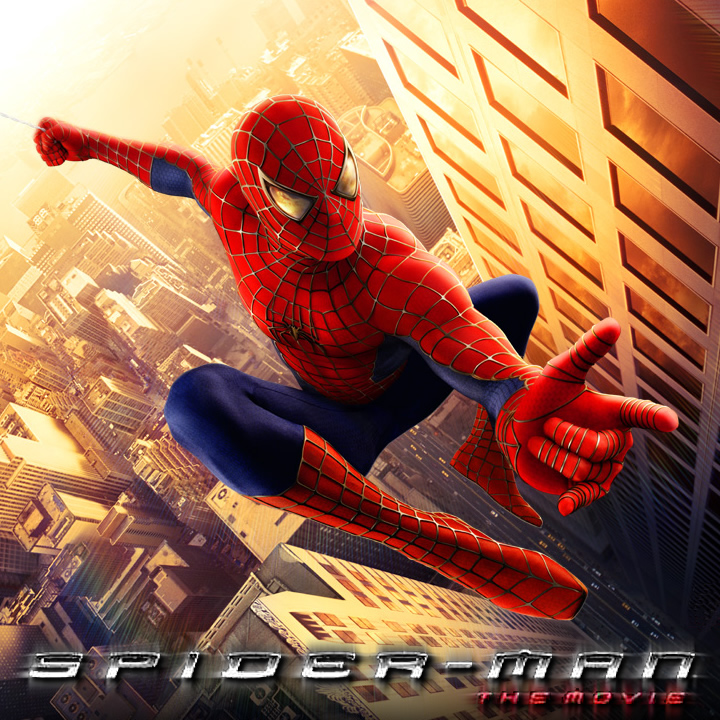
I showed my son Sam (9) Spider-Man. The following conversation occurred at the climax of the movie.
NORMAN OSBOURNE: (to Peter Parker) Peter! How could you? I was like a father to you!
PETER PARKER: I had a father. His name was Ben Parker.
SAM: Wait, his dad and his uncle had the same name?
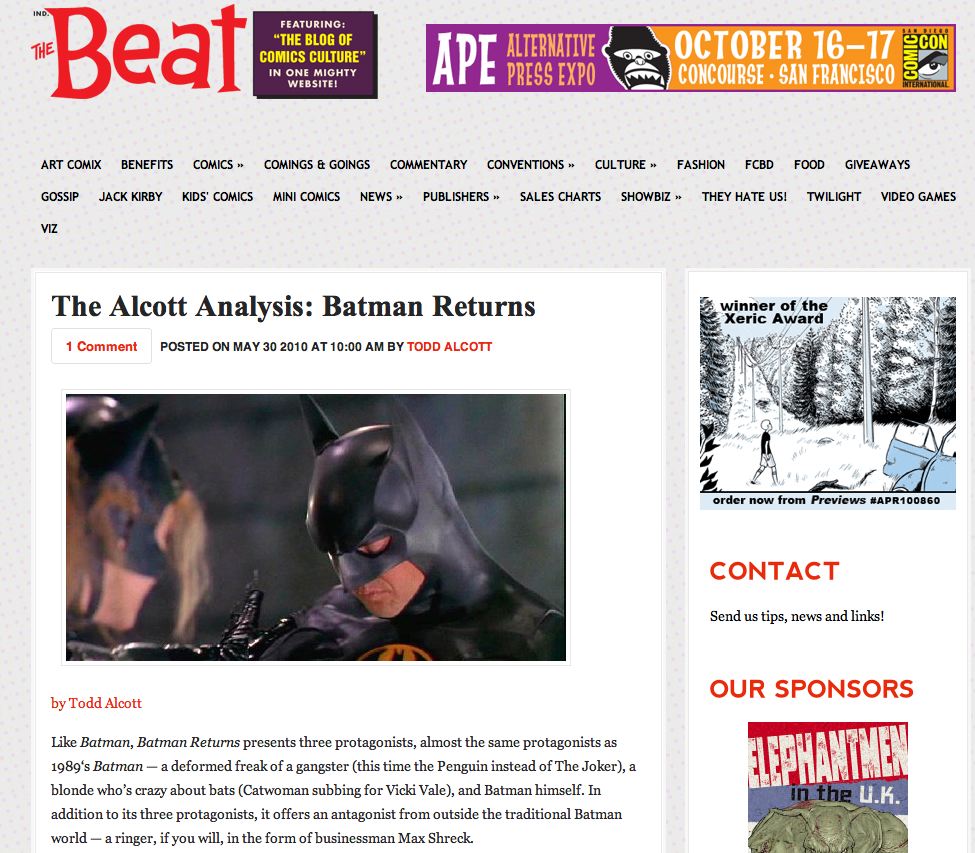
New Batman piece up at The Beat
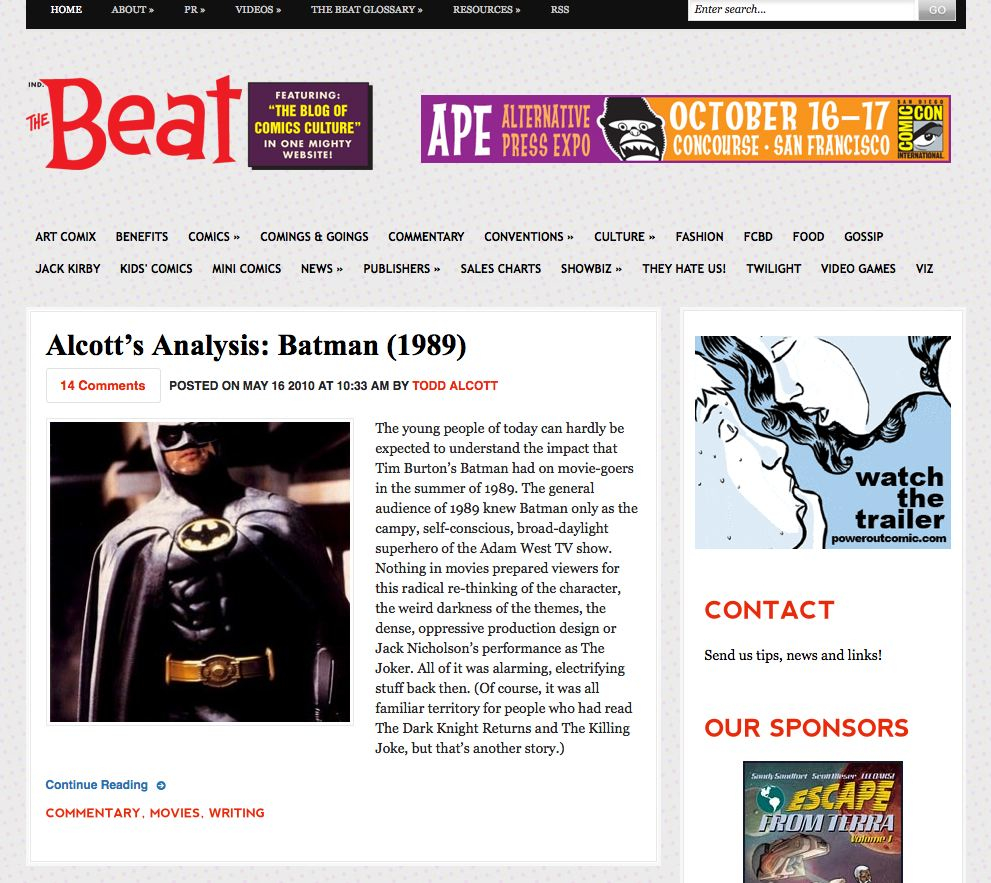
My piece on Tim Burton’s ground-breaking 1989 Batman is up at The Beat. Due to The Beat’s recent flame-discouraging policy, response has been much more sober and respectful this time around.
What Does The Beat Want?

It’s been a big internet week for me. First, I launched this new blog (if you haven’t switched your Livejournal bookmarks, do so now!) Then, out of nowhere, someone I’ve never even met made this smashing video out of a monologue I wrote 20 years ago, and it’s caught on like internet wildfire. And now, my good friend Heidi McDonald at The Beat has started re-posting some of my earlier comics-movies-related analyses, starting with my look at 1966’s Batman: The Movie.
This is the first time one of my blog pieces has been re-posted in another forum, but the reviews are in and readers are ecstatic!
“You are a complete idiot!” – vlucca
“Although I wouldn’t level the charge of “idiot” as vlucca does,I would say ‘misguided’ or “sloppy.'” – S. Chapman
“This so-called “analysis” … seems to have missed the mark entirely!” – KET
“This isn’t so much analysis as it is a badly-written review of a film that the reviewer obviously doesn’t understand or appreciate!” – John
Venture Bros: Handsome Ransom

What does Hank want? Hank wants a father. Rusty is as close to a biological father as he’ll ever get, but Rusty has no interest in acting the role of father to Hank (Dean, it turns out, is a different story). Hank loves and idolizes Brock, who is now gone, replaced by the obnoxious, overbearing Sgt Hatred. Hank states outright that Hatred is not his father, and he refers to Rusty as a "honky" (which, to be fair, he is).
Some thoughts on Watchmen

Well I liked it.
For those familiar with the book, it’s all in here, or all the parts that matter anyway. The director understands, and loves, the source material, but he hasn’t let it stand in the way of creating a cinematic narrative. A rather dense cinematic narrative at that.
For those unfamiliar with the book (and I maintain that one should never be familiar with a movie’s source material to enjoy the movie), as long as you keep in mind that Watchmen is, in essence, a detective story that pauses, often, for some very long digressions, I think you should be fine, but let me know. The people who really, really hate the movie I think get lost in its narrative ellipses, where the detective plot is put on hold for, say, a series of involved flashbacks or for a sub-plot involving a character’s sex life. Long digressions like this can make a story feel long, but I was never bored by Watchmen and was frequently thrilled, and even surprised, in spite of having re-read the book recently.
The problem with Watchmen, if it’s a problem, is that without the digressions, which are all thematically resonant and serve to deepen the story, if you cut all that stuff out, it’s just another superhero detective story. In a sense, the narrative digressions are the real "point" of the story, and the movie (like the book) uses the detective plot to deliver those digressions.
From a marketing standpoint, of course, the movie is a "tough sell" — it’s got multiple protagonists (four by my count), not a single character to "root for," a complicated plot that keeps looking backward to tell us about characters we barely know yet, a "meta" approach to its subject matter (it’s a superhero story that worries that having superheroes might not be such a good thing) and takes place in a weird alternate-universe 1985. All of which makes sense when you read the book (or it did when I first read it in 1986), but again, you tell me.
As for the learned critics who have screwed in their monocles, tucked in their ascots and sniffed in disdain at this rather ambitious piece of popular culture, describing it as trash and its audience as sociopaths, in time they will look like idiots, if they don’t already.
Superheroes: Batman Begins part 2


Yesterday I laid out the basic structure of Batman Begins. And while structure, as any screenwriter knows, is the name of the game for a successful screenplay, it is not the only thing that makes Begins such a detailed, well-considered movie.
Assuming the reader is already familiar with the structure, here are some observations I have in chronological order:
Superheroes: Batman Begins part 1


WHAT DOES THE PROTAGONIST WANT? Bruce Wayne, orphaned at eight, wants to overcome his fears and honor his father. This turns out to be rather more complicated than he suspects.
Batman Begins presents a radically new vision (for the movies, anyway — this stuff had been around the comics and the animated series for many years beforehand) of the Batman story, grounds it in a startling new sense of reality, presents not just a caped crusader and a wacky new villain but a whole wealth of good guys and bad guys, all following their stars in increasingly complex and interconnected ways, all of it bound together with the one fantastic conceit of a young billionaire who dresses up like a bat. It strongly reminds me of the Casino Royale re-boot, which brought the James Bond character to a new level of immediacy while retaining enough of the series’ fantastic hallmarks to still qualify as escapism. There is still enough silliness in Batman Begins to make it a recognizable "superhero movie" (grand, outsized villains with colorful personalities and an ambitious scheme to destroy an entire city, spectacular action sequences that teeter at the brink of believability, production design that borders upon science-fiction) but it’s presented with a sober, straightfaced earnestness that’s nothing less than shocking after the garish camp of Batman & Robin. The Dark Knight would successfully develop all of Begins‘s good ideas into an even more complex, startling vision of modern urban justice.
Superheroes: Batman & Robin


Contrary to its reputation as a garish, headache-inducing day-glo nightmare, Batman & Robin is, in fact, a sensitive, heartfelt examination of power, frailty, family, humanity’s custody of the earth, the ties that bind and the mysterious ways of the human heart.