Coen Bros: The Big Lebowski
“Your revolution is over! The bums lost!” images swiped from the excellent Coen resource “You Know, For Kids!”.


NOTE: I have gone over (not to be confused with “micturated upon”) the deeper meanings of The Big Lebowski once before — you may read my previous analysis here.
THE LITTLE GUY: The Dude is unique in the Coen universe in being a protagonist who is perfectly happy with his social standing. He does not seek money, betterment, achievement, a child, a mate, clean clothes or, really, anything besides a state of blissful intoxication. Anything he does he does because someone else is forcing him to do it. As the Stranger describes him, “he’s the laziest man in Los Angeles County, which would place him high in the running for laziest worldwide.” He’s not particularly interested in saving the kidnapped girl, recovering the stolen fortune or even defending himself from hoodlums. Even his desire to reclaim his soiled rug is something that his bellicose friend Walter puts him up to — if it were up to The Dude, his peed-on rug would be worth it just for the story to tell his bowling buddies.
(It’s also worth noting that, for all the time The Dude spends hanging out in a bowling alley, listening to bowling games of the past and fantasizing about bowling scenarios, we never actually see him bowl.)
Many dismiss, or praise, The Big Lebowski as a “shaggy dog story.” These are people with not enough time on their hands. Lebowski is a movie positively overstuffed with meanings, far too many meanings to be gleaned from a single viewing.
WHERE’S THE MONEY, LEBOWSKI? Let’s start with Lebowski’s brilliance as a detective story. Lebowski presents us with a Big Sleep-style mystery: What Happened To The Kidnapped Heiress? But the kidnapping plot, we eventually find, is a gigantic red herring. The real mystery in The Big Lebowski is Where’s The Money? This is not anidle plot-point, it is a key subtext to understanding the importance of the movie. The kidnapped girl is a worthless idiot of importance to no one, but the money, ah, the money, as Mose in Hudsucker would say, “drives that ol’ global economy and keeps big Daddy Earth a-spinnin’ on ‘roun’.” The Big Lebowski is a social critique disguised as a mystery disguised as a stoner comedy.
The key to understanding the social dynamics of The Big Lebowski is to always follow the money. So where is “the money” in The Big Lebowski? (“Where’s the money, Lebowski?” is, in fact, the movie’s first line of dialogue.) The Dude doesn’t have it — he lives in a crappy Venice bungalow and is late on his rent. His friend Walter has his own business, but doesn’t have any appreciable amount of it. Jeffrey Lebowski, despite appearances, doesn’t have it, and his wife Bunny obviously doesn’t have it. The Nihilists don’t have it and neither does Larry Sellers, even though Walter is positive he has it.
The joke is, of course, that no one has it — “the money” belonged to the first Mrs. Lebowski, who is long dead. We don’t know how Mrs. Lebowski got her money — “Capital,” the source of “the money” in The Big Lebowski, is nebulous and taken for granted. “The Money” is like “The Gold” in Eric Von Stroheim’s Greed — it’s not something to be earned, it’s almost a natural resource, something that’s just sitting around waiting for someone to figure out how to get it.
Who has any money in The Big Lebowski? Maud Lebowski, Jeffrey’s daughter, the aggressively “feminist” artist, has some money, but even that is not hers, it’s her mother’s. She hasn’t earned it and seems to be frittering it away on ugly art and an inane lifestyle (the other artist presented in Lebowski is The Dude’s landlord, with his stupefying Greek Modern Dance routine — art doesn’t seem to count for much in the Lebowski universe). The only other wealthy personage in Lebowski is Jackie Treehorn, the pornographer. So: in the world of The Big Lebowski, “Money” is represented by an embezzler, an heir and a pornographer — as harsh a critique of American capitalism as I’ve ever heard.
Everyone else is barely scraping by or actively losing money hand over fist. The indignities heaped upon The Dude in this narrative are great: his house is repeatedly broken into (“Hey, Man, this is a private residence” he lazily chides a trio of armed thugs), his possessions are smashed until nothing is left of them, his car is shot at, crashed, stolen, crashed again, peed in, bashed and finally set fire to. He is punched unconscious, drugged and hit with a coffee mug. The Rich in Lebowski get richer by soaking the Poor, and every transaction between social unequals is a heartbeat away from physical violence. Even Maud, who only wants her rug back, can’t resist using force upon The Dude in order to get what she wants.
(The other thing Maud wants, of course, is to conceive a child. This is a succinct reversal of the argument of Raising Arizona. In the earlier movie, Ed reasoned that the Arizonas [The Rich] deserved to lose a child so that she [The Poor] could have one. In Lebowski, Maud [The Rich] assumes that it is her right to use The Dude [The Poor] as a method to get her own child — in both movies, children are merely another expression of capital [or, as the Dude complains about pornographer Jackie Treehorn, “he treats objects as people, man.”)
THIS AGGRESSION WILL NOT STAND: “Aggression” is a big word in Lebowski. The Dude is, of course, the least aggressive person in the story, yet he invites aggression at every turn, from his friends, his bowling rivals, his various contacts in the mystery. The parallel is drawn to the Gulf War, and if there is a coherent critique of the Gulf War to be found in Lebowski (and I’m not sure there is) it could be better applied to our present situation in Iraq: in Lebowski, aggression is met with violent retribution — but it always falls on the wrong person. Jackie Treehorn wants his money, but his goons beat up the wrong Lebowski. The Dude’s rug is peed on, so he demands retribution from a complete stranger. Jeffrey Lebowski sends The Dude to identify the kidnappers as Jackie Treehorn’s thugs (he won’t take responsibility for The Dude’s rug, but insists that The Dude take responsibility for his missing wife), but finds they are completely different people (and gets his car shot up for his trouble). The Nihilists demand a ransom for Bunny, but cut off the toes of one of their own to prove their seriousness. Walter exacts violent retribution on Little Larry Sellers, but ends up bashing the car of a complete stranger.
This, I think, is the meaning of poor Donny’s death. In times of war, wealthy, powerful men make up their minds to be aggressive (Saddam against Kuwait, Bush against Saddam), but the people affected are always the poor and powerless, people who die without ever understanding what the true cause of the aggression was. In the case of the Gulf War, it was the Iraqi soldiers and civilians who sided with the US, only to be abandoned, in the case of Lebowski it’s poor Donny, who’s salient quality is that he never knows what the hell is going on and who dies, absurdly, of a heart attack during an attack by the Nihilists.
(This is also, I think why Walter compares Donny’s death to the troops lost in Vietnam, although Walter, to be fair, tends to compare everything to Vietnam. He compares Bunny’s kidnapping to Vietnam, he finds service in diners lacking due to his experiences in Vietnam. The Dude chides Walter for this habit, but Walter, I think, is on to something. Bunny’s “kidnapping” can be compared to Vietnam, insofar as it’s a mysterious act of aggression perpetrated by a wealthy man scheming to steal a ton of money and make a poor man pay for it.)
CRIME AND PUNISHMENT: The Big Lebowski presents the widest view of law enforcement in the Coen canon. While not as warm or good as the police in Fargo, the police in Lebowski could at least be described as cheerfully unhelpful. They laugh at The Dude’s problems for the most part, but they don’t actively seek to harm him and they are not shown to be in direct employ of the forces of evil.
That’s LA’s cops, obviously. Malibu is a different story — the sheriff in Malibu is a reactionary hothead, the fascist boot protecting the rights of a pornographer.
Jeffrey Lebowski lives, of course, in Pasadena — but we manage to get in and out of his community without a run-in with the police.
THE MELTING POT: Race and national origin always plays a significant role in the Coens movies, and Lebowski emphasizes this more than ever. Oddly, all the main characters are Polish-American. Donny is Greek, Brandt I’m going to say is a WASP, Bunny is Swedish, the Nihilists are German (as is the administrator for The Dude’s bowling league), Jesus Quintana is Hispanic (and a pedarast), the cops are racially mixed (as are Jackie Treehorn’s goons, and the casts of his porn movies), Maud’s friends are European (one might say “Eurotrash”), the poor owner of the Ferrari is Hispanic, the detective shadowing The Dude is Italian (as is Maud’s chauffeur, although Jeffrey Lebowski’s chauffeur is French). Maud’s doctor is Iranian, and The Dude gets thrown out of a cab driven by an African-American man who likes the Eagles. The only Jew visible is, of course, Walter, who isn’t really Jewish. I wonder if it means anything that the only character identified as Jewish (that is, Walter’s ex-wife) is out of town for the duration of the narrative?
What is the point of this rainbow coalition of characters? Is it merely a comment on the diversity of LA, or is the city in Lebowski meant to symbolize something bigger, the whole of the US, or even the whole of the world? Is Jesus’s florid aggression toward our heroes meant to be an analogue to Saddam’s aggression against Kuwait?
PANCAKES: Nihilist Uli Kunkel favors pancakes for a meal, just as Gaere did in Fargo. I can see no significance here except that “pancake” is a funny word. In The Ladykillers the protagonist favors waffles, which I think explains that movie’s miserable death at the box office.
Coen Bros: Fargo


Fargo is a remake of Blood Simple, insofar as they are both crime dramas without protagonists. Oh, one remembers Fargo ashaving a protagonist, but it doesn’t really. What it has is a likable main character, which is a different thing from a protagonist, and is something that Blood Simple doesn’t really have. Marge, the pregnant sheriff, is but one-third of the three-pronged narrative of Fargo, and does not show up until the beginning of Act II. Up until that point, it appears that the protagonist of Fargo is Jerry Lundergaard, the hapless, bitterly frustrated car salesman who plots to have his wife kidnapped. That would, in fact, make Marge the antagonist, the Javert to Jerry’s Jean Valjean. But, as the narrative develops, we find that Fargo is balanced between Jerry, Marge and Carl Showalter, the fuming, delusional, small-time crook whom Jerry hires to kidnap his wife.
Coen Bros: The Hudsucker Proxy

THE LITTLE GUY: No Coen Bros movie illustrates their interest in social mobility more graphically than The Hudsucker Proxy. Norville Barnes is a hick from Muncie, Indiana who rises up, up, up in the sophisticated New York corporate world, then falls down, down, down and then, miraculously (the word is not too strong) rises back up to the top.
“Up” and “Down” are not mere words in The Hudsucker Proxy — they are story elements,almost characters. The action takes place in New York City, certainly the most vertical place in America, and largely within the Hudsucker headquarters, a 45-story skyscraper (44, not counting the mezzanine). Great emphasis is placed on the verticality of the building and what it means to its inhabitants. Norville begins his work at Hudsucker in the basement mailroom, a seething, windowless dungeon filled with oppressed humanity, and ends his work at the top, where the offices are huge, unpopulated rooms with vast floor space and high windows. Waring Hudsucker (the outgoing president) starts out at the top, both metaphorically and physically, but finds the top wanting, and so jumps out the 44th-floor window (45th, not counting the mezzanine) and plunges to his death. But we see by the end of the movie that Waring Hudsucker has risen again, this time into Heaven, before descending, yet again, to help Norville out of his problem.
So “up” is good and “down” is bad. Everyone wants to be “up,” no one wants to be “down.” Except for the beatniks, of course, who live “downtown” and whose oddball coffee bar is located in a basement. That’s just like those beatniks, turning the status quo on its head and drinking carrot juice on New Year’s Eve. Buzz the Elevator Gnat gets a great thrill from taking people up to the top or sending them down to the bottom. Norville Barnes must take a dozen different rides in that elevator in his journey from the bottom to the top to the bottom and back up to the top.
“Up and down,” it seems, in the world of The Hudsucker Proxy, are heavily loaded terms, full of danger and stress and sorrow. Fortunately, there is a solution: a thing that goes round and round, specifically the hula hoop, the blockbuster idea that Norville carries around in his head and The Hudsucker Proxy‘s narrative secret weapon. His blueprint for the hoop, a simple circle drawn on a piece of scrap paper, baffles and confounds all the Hudsucker employees who behold it. No wonder: they live in New York City (the most grid-like major city on Earth), and work in a building that’s all about rising up and falling down. There’s nothing “round and round” about their lives, and Norville seems either quite stupid or stunningly insane to them for thinking of a circle (the hoop prototype is even made crimson red, to better set it off from all the squares and rectangles in the board room).
The hula hoop, like the baby in Raising Arizona, is nothing less than a holy ideal, one the “squares” (another beatnik term!) in Hudsucker Industries aren’t quite ready for. In a world of up and down, Norville thinks in terms of round and round, and that makes him inscrutable, unpredictable and dangerous. And so much of the dialog around Hudsucker Industries concerns things going up and down and round and round. The business stock falls, then rises, then falls again, then rises again, four different characters are compelled to jump out the 44th floor (45th, not counting the mezzanine), while divine, ineffable notions are expressed in terms like “the great wheel of life” or “what goes around comes around” or “the music plays and the wheel turns.”
What besides divinity could explain the actions of the lone hula hoop, the one that escapes its death in the alley of the toy store to roll purposefully out into the street, through the grid of the small town streets, to circle a child and land at his feet (upon the firmly-stated grid of the sidewalk)?
(A scientist shows up in a newsreel to tell us that the hula hoop operates on “the same principles that keep the earth spinning around and around,” and keep you from flying off into space — an instance of science vainly trying to explain the divine, as though there were a quantifiable “reason” why the Earth spins.)
(We know that the hula hoop is a divinely inspired creation because Waring Hudsucker’s halo, at the end of the movie, is also a hula hoop. He even makes a comment about how halos on angels won’t last, are simply “a fad.”)
(The hula hoop is not the only “holy spinning thing” that shows up in Coen Bros movies. There is also the hubcap/lampshade/flying-saucer in The Man Who Knew Too Much and the bowling balls in The Big Lebowski.)
In between the square and the round, quite literally, is the big clock at the top of the Hudsucker building. The clock symbolizes Time, which, it has been noted, moves on (“Tempus Fugit” is the slogan of the newsreel shown halfway through, Tidbits of Time). Yes, time does move on, as we are reminded whenever we see the enormous clock hand sweep through the office of Sidney J. Mussberger. The narrator (another Coen mainstay), Mose the Clockkeeper, does not identify himself as God but that’s the role he plays in Hudsucker. Time is money, says Mose, and money is what makes the world go around, and that, I suppose, is why the round clock is fixed in its square hole on the side of the rectangular Hudsucker building. Because Time may be round, and so is the world (at least the globe in Mussberger’s office is) but Money is square in both shape and temperament, and I guess that means Mose’s job is to square the circle and keep everything in balance, which I suppose is why the clock in The Hudsucker Proxy is so influential. When the Hudsucker clock stops, everything stops (except the snow, oddly).
(That clock wasn’t chosen at random — it bears a startling resemblance to the clock in Metropolis — another movie where down is bad and crowded, up is good and roomy, and a clock rules the world.)
(Waring Hudsucker, when he appears as an angel at the end of the movie, sings “She’ll Be Comin’ ‘Round the Mountain” as he descends from the heavens — a small point perhaps, but he’s not singing about going up a mountain or coming down a mountain, which one would think would be the natural order of things in songs about mountains.)
(Mussberger, it should be said, has his own influence over time — he makes his clacking pendulum balls [five round objects in a rectangular framework] stop on command, something Mose also accomplishes when he stops the world in Act III.)
Mose explains in the opening narration that everyone on New Year’s Eve wants to be able to grab hold of a moment and keep it, but only Norville manages to actually do such a thing, because he is, alone among characters in Hudsucker, divinely inspired. (Well, except for Buzz, who turns out, incongruously, to have his own round idea.)
IS NORVILLE A MORON? This is the question that haunts The Hudsucker Proxy and which, I submit, accounts for its lack of popularity. For the plot of Hudsucker to have maximum impact, the audience must believe, as Mussberger and streetwise reporter Amy Archer do, that Norville is a blithering idiot. Then, when it turns out he is divinely inspired, we are to look at Norville in a new light. The trouble is, the Coens have cast Tim Robbins, an actor who oozes intelligence, to play Norville. To compensate for his innate intelligence, Robbins plays the part as though wearing a neon “DOOFUS” sign on his head. When I read the script, the story of Norville amazed me and made me weep. I could see what the Coens (and Sam Raimi) were after — a comedy along the lines of Mr. Deeds Goes To Town or It’s a Wonderful Life, with a helping of His Girl Friday thrown in for good measure. Trouble is, Gary Cooper and James Stewart and Cary Grant are all long dead, and Tim Robbins, although an excellent actor, is not a Gary Cooper or a James Stewart or a Cary Grant. When I read the script I imagined Tom Hanks in the part of Norville (Hanks would, of course, catch up with the Coens in The Ladykillers) — I’m convinced the star of Big would have knocked Norville out of the park. The result of Robbins’s casting is that Norville’s actions are all in big quotation marks — we don’t see a simple guy trying to front, we see an intelligent actor trying to convince us he’s a country-born rube. The actor holds the character at arm’s length, showing him to us, commenting on him, not quite able to inhabit him.
(I should note that Robbins’s performance is a symptom of a larger problem in The Hudsucker Proxy — the Coens have lured a huge raft of talented actors and instructed them to act in the style of 30s screwball comedies — a task they all pull off with great skill [I am particularly astonished of Jennifer Jason Leigh’s jaw-dropping rendition of Rosalind Russell]. The trouble is that that style of acting was a natural outgrowth of its time, not an homage to an earlier style of acting. Watch The Lady Eve [which Hudsucker explicitly quotes a couple of times] back to back with The Hudsucker Proxy and you’ll see exactly what I mean.)
(And while I’m here, I should note that the Coens, in their script for Hudsucker, have crafted an incredible simulation of a Preston Sturges 30s screwball comedy, but then, oddly, have set the story in a Billy Wilder sort of world of 1950s business comedies. That right there, I think, accounts for people not quite being able to get a handle on Hudsucker, despite its towering achievements. And I do mean towering — this movie, with one of the greatest scripts I’ve ever read, is a bursting cornucopia of invention, wit and bravura moviemaking.)
(And while I’m at it, I should not that I am not immune from this temptation. I once wrote a romantic comedy with roles for Cary Grant and Katherine Hepburn. Imagine my chagrin when I learned they were, in a big way, not available.)
A SECOND CHANCE: Norville fails, and falls, but rises again. Waring Hudsucker falls and rises, then descends and rises again. Waring Hudsucker could not give himself a second chance, but he posthumously grants one to Norville. It seems everything in The Hudsucker Proxy happens more than once — Norville comes into Mussberger’s office to show him his idea, only to get fired and collapse on the floor. Later, Buzz comes into Norville’s office to show him his idea, only to get fired and collapse on the floor. The music plays and the wheel goes round, humanity keeps repeating the same scenes over and over. And this might be coincidence, if not for Norville discussing reincarnation with Amy — in a way, Norville is both a reincarnation of Waring Hudsucker and his second chance. He arrives at the building the instant Waring hits the street in front of it, is instantly made president, and is ultimately granted all of Hudsucker’s stock — precisely so that he need not make the same mistakes that Hudsucker did. Norville believes in reincarnation and roundness, while Mussberger can only think of up and down, squares and “when you’re dead, you stay dead.”
Failure, Waring Hudsucker notes, whether in business or in love, looks only to the past, and the future, as it says on his big clock, is now. This is The Hudsucker Proxy‘s notion of Zen — there is no future, it insists, there is only the moment, grabbing it, holding it, and living in it. Ironically, it was the Coen’s first real commercial disaster, showing them how the real world reacts to the real Norvilles who come along with their divinely inspired inventions.
(Full disclosure: this writer has a tiny role in The Hudsucker Proxy — I would call it a one-line role, but since they messed with my voice, I’m not even sure if I have the one line any more. It was a lot of fun shooting it and maybe I’ll write a piece about that some day. But not today.)
Coen Bros: Barton Fink
Barton and Charlie compare their soles.

THE LITTLE GUY: I don’t like to dwell on the symbolism of Opening Shots, but the first thing we see in Barton Fink is a lead weight descending on a rope, backstage in a Broadway theater. The weight comes down as the protagonist’s career goes up.
Barton Fink finds its protagonist at a moment of transition, socially speaking. He’s just become a success on Broadway and is quite pleased with himself, but is tempted by the opportunity to go to Hollywood and write for the movies. When he gets to Hollywood, he finds that no one knows who he is, no one has seen his play, no one cares about his ideas and he’s back at the bottom of the social order again.
(It was fantasies like Barton Fink that led me to believe that life could be good as a playwright in New York. Damn you, Barton Fink!)
Barton is solipsistic, egocentric, self-important, conceited, delusional, inward, dense and utterly humorless. He has a success on Broadway, a kitchen-sink drama about “real people,” cheered by swanky society types in white ties and ball gowns while Barton thinks he’s struck a blow for the “common man.” Meanwhile, he looks down on movies, is completely unfamiliar with the form in fact, as worthless garbage (this at the height of the studio system, the first “golden age” of Hollywood and the year of Citizen Kane). So he loves the “common man” and wants to create a “real theater” for them, while writing plays for the wealthy to coo over and disdaining popular culture.
(How self-involved is Barton? He’s so self-involved that the actor we hear reciting Barton’s lines onstage in the Broadway theater is the same actor who plays Barton, John Turturro. This play, this production, this theater, this success, it seems, is all in Barton’s head. The theater is all in Barton’s head, just as the Hotel Earle, we will find, is all in Charlie Meadows’s head.)
WHO IS BARTON FINK? Maybe Barton Fink is really just a movie about a delusional playwright who leaves New York, goes to Hollywood and gets into a mess of trouble. But I don’t think so. Symbols and indicators keep piling up and the narrative takes a sharp left turn at the end of Act II, turning Barton Fink from an off-center Hollywood comedy to something darker, creepier, harder to “get” and more cosmic. This is, in fact, the movie that, for me, moved the Coens from the “interesting filmmakers to watch” list to the “all-time great, long-term artist” list.
Barton isn’t just a playwright moving to Hollywood. He’s a “serious” playwright moving to Hollywood, a town that has a phobia of “serious,” a town which, since time immemorial, is where writers go to lose their souls. Moreover, he’s a serious playwright moving to Hollywood in late 1941, as World War II raged in Europe and American involvement was just about to begin. The signs of this are everywhere in Barton Fink, but Fink himself remains absolutely oblivious throughout. Even when he goes out to celebrate at a USO show, in a dance floor filled with uniforms, he utterly refuses to acknowledge who these soldiers and sailors are and what they’re about to go do (in Barton’s defense, the all-goyim army at the USO show recognize Barton as a bespectacled Jewish freak — and proceed to attack him).
So: Barton is a delusional, self-involved playwright lost in Hollywood, utterly oblivious to the world situation as he struggles to write a B-movie. And the movie hangs together as far as that goes, but then there is the question of Barton’s Jewishness. People bring it up all the time, and never in a favorable light. The Jews who run the studio call each other “kike” and constantly cut each other down, while the (German and Italian) detectives who come around in Act III are decidedly more ominous in their dealings with Fink. So, Barton, it seems, is a self-involved Jewish playwright who gets lost in Hollywood as World War II rages in The Old Country. (“Minsk, if you want to go all the way back,” offers studio-boss Lipnick, underlining the connection from Hollywood to New York to Eastern Europe.) He’s a Jew ignoring the Holocaust, writing self-important nonsense while his people are slaughtered by the millions. Even when Lipnick himself turns up in a colonel’s uniform and starts spouting patriotic rhetoric (“Don’t you know there’s a war on?!”), Barton remains firmly in his own head. He even stuffs his ears with cotton to drown out the sounds of the hotel as he writes his meaningless, pretentious, self-important screenplay, as blood dries on his bed’s mattress not three feet away.
If Barton is a self-involved Jew, the mosquito that keeps him up all night is that thing that would keep any Jew up all night in 1941, that niggling, inescapable sensation that something is coming for you, something that wants your blood. Perhaps it’s my imagination, but the mosquito’s buzzing seems to echo the tinny sound of a faraway air-raid siren.
Who gets Barton into this mess? His decidedly non-Jewish agent in New York, Garland Jeffries. And who does Barton aspire to be, who does he look up to? William P. Mayhew, respected Southern Novelist. And, it turns out, a complete fraud.
(Later, Barton will find himself, ironically, becoming more and more like Mayhew — a failed has-been who can’t get his scripts made, a fraud who gets his ideas from Mayhew’s muse, and an early-morning drinker.)
WHAT IS THIS HOTEL? Barton moves into this run-down hotel, the Earle. What is the Earle? There are strong indications that it’s not a “real” place. First of all, we never see anyone there besides Barton, the desk clerk and Charlie, Barton’s next-door neighbor. Secondly, Barton’s room hasn’t been touched in years — almost as though this room has been waiting here for him all his life, that he is the first and last guest ever to stay here.
Then there’s the wallpaper, which keeps falling off the walls, with icky, sticky gunk dripping from it. The same icky, sticky gunk is seen later dripping from the ears of Charlie, making a solid connection between the hotel and Charlie. Charlie mentions at one point that he can hear the couple on the other side of Barton making love, suggesting that he can, in fact, hear everything in the hotel. Later on, Charlie suggests that the hotel is, in fact, his home. All these things suggest that the hotel is a part of Charlie, that Barton, essentially, lives inside Charlie’s head.
(As the wallpaper peels off, the veneer of the mask of the hotel peels away too. It’s not for nothing that the wallpaper catches on fire as Charlie/Karl charges down the hall at the end of the movie.)
THEN WHO IS CHARLIE? Well, first off, we know by the end of the movie that Charlie isn’t Charlie, he’s Karl Mundt, a crazed killer who chops up bodies and keeps their heads. If the Earle is his home, his “head office” (a term Charlie uses in Act III: “I know what it’s like when things get balled up at the head office”), I’m going to go out on a symbolist limb here and say that Charlie is Satan and the Hotel Earle is Hell.
(“You come into my home and complain about about too much noise?” cries Charlie in disbelief, just before setting Barton free from the holocaust he’s created.)
(I might mention here that, just as Charlie is not really Charlie, Chet [the bellman] may not really be named Chet — we only have his word for that, and his business card is a blank rectangle with the word “Chet!” scrawled on it [rather like a movie screen, that blank white rectangle — another blank for projecting a fantasy].)
(The devil Charlie does not challenge his doomed to a chess match — no, he’s a regular-guy, blue-collar kind of devil — he invites Bart to a wrestling match. And soundly trounces him. To make the connection clearer for the audience, the Coens have Barton watch the dailies of a picture called Devil on the Canvas, featuring an enormous man repeatedly shouting “I will destroy him!”)
(It’s ironic that Barton first meets Charlie after he complains about Charlie making too much noise while sobbing next door — for a man who doesn’t listen, refusing to pay attention to suffering [while making it the subject of his writing, of course], he’s got a mighty sensitive ear.)
In Act III, a couple of detectives, Deutsch and Mastronetti, come looking for Mundt, and act extremely threateningly toward Barton. It cannot be a coincidence that the men looking for Satan in the Hotel Earle in 1941 are German and Italian, hate Jews, and end up being destroyed by the entity they seek, any more than it could be a coincidence that Charlie/Karl/Satan mockingly chirps “Heil Hitler” before blowing off the German’s head.
NOW THEN: If Miller’s Crossing is about hats, Barton Fink is about shoes. (And, conversely, heads.) I was watching Barton Fink a few times ago and thought “Barton is concerned about his soul, and there are all these prominent shots of shoes in the movie. Could the Coens be making a glib “soul-sole” connection? And yet, once I had made the connection myself, the whole movie fell into place. Barton moves into the Earle, which is Hell. The bellman, Chet, emerges up from a trap door in the floor, clutching a shoe, the sole toward the camera. Chet, it seems, is a demon in Charlie’s Hell whose job it is to collect souls. Later in the movie we see him moving his shoe cart down the empty hall, that empty hall of the hotel with no one in it, and yet there is a pair of shoes outside every door. The people are gone, the souls remain. At another point, Barton and Charlie get each other’s shoes (Barton finds Charlie’s too big for him). Still later, when studio-boss Lipnick wants to show his devotion to Barton’s purity, he kisses the sole of his shoe.
(Barton first discovers Charlie because he hears Charlie weeping next door, but by the end of the movie it is Barton we can hear weeping alone in his room from the empty, shoe-filled hallway.)
AND THEN THERE’S THE HEADS: The Broadway theater is all in Barton’s head, the hotel is all in Charlie/Karl’s head, Mayhew’s career is all in his head, his muse’s head is (supposedly) in a box on Barton’s nightstand, Charlie/Karl complains about things getting “balled up at the head office,” which is his code phrase for “I’m getting the overwhelming urge to kill again,” but when Mayhew’s muse’s body is discovered he insists “We have to keep our heads.” Lipnick tells Barton twice that his studio owns “Whatever rattles around that fat kike head of yours,” Charlie complains that his head is killing him, just after charging down the hallway screaming “I will show you the life of the mind!” and earlier comforts Barton by saying the extremely uncomforting homily “Where there’s a head, there’s hope.”
SO WHO’S THE GIRL? As Barton writes, a photo of a girl on a beach hangs over his desk. He often contemplates this picture, and then, magically, meets the same girl on the same beach at the end of the movie. Is the girl a siren, an unattainable mirage, there to tempt Barton ever onward onto the dangerous rocks of Hollywood? Why does he place Charlie/Karl’s picture next to hers for inspiration? Is it because, when he first heard Charlie laughing/crying in the next room, his voice seemed to come from the picture? Is the girl just another incarnation of the devil, tempting Barton toward his fate? When Barton meets her, she says “It’s a beautiful day” and Barton, typically, cannot hear her. When he asks if she’s in pictures, she says “Don’t be silly.” Barton, of course, is asking “Are you the same girl who’s in the picture over my desk?” but the girl responds as though he’s asking “Are you an actress?” By replying “Don’t be silly” is she saying that she’s not the girl in the picture, or is she saying that movies are, as Barton has suspected all along, silly? And what does it mean when Barton, while watching the dailies for Devil on the Canvas, hears the pounding sea on the soundtrack? And what does it mean when the shots from Devil on the Canvas are echoedin the USO fight? And why do the grunts and yells from Devil on the Canvas are echoed in the drainpipe the camera disappears down at the end of Act II? Do we hear the shouts from Devil on the Canvas because the pipes are within Charlie/Karl’s head, or because the pipes lead to the sea (classic symbol of chaos), where the girl sits on the beach?
ANOTHER VIEW ON BARTON’S DILEMMA: When Charlie/Karl pulls his shotgun out of his policy case, I am reminded of a lecture I once saw by David Mamet. He told the audience that the purpose of art is “not to instruct, but to delight.” An audience member raised their hand and said, in a very Barton Fink sort of way, “Yes, but doesn’t the artist have a duty to try to change the way people think?” To which Mamet said “If you want to change the way people think, art is not a very good tool for that. There is, however, an excellent tool for changing the way people think — it’s called a gun.”
ECHOES: Barton Fink, like many Coen movies, is about a non-talker lost in a sea of blabbermouths. Barton only talks when he’s feeling confident enough to do so (and then he’s a gibbering moron), but Charlie and Lipnick and Geisler are all motor-mouthed yappers.
Tony Shaloub plays Geisler, and the Coens, apparently, liked the scene in the studio commissary where Geisler counsels Barton while stuffing his face so much that they had him do the exact same scene again in The Man Who Wasn’t There.

Coen Bros: Miller’s Crossing
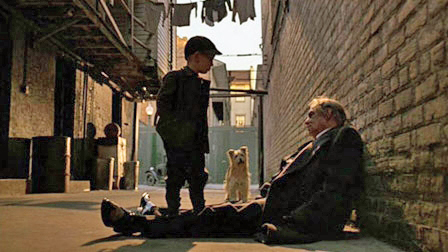
THE LITTLE GUY: For one of the few times in their movies, the Coens tell a story not about a poor man. Tom Reagan is the right-hand man (I think) of Leo, the Irish mob boss who controls whatever vaguely-east-coast city this story takes place in. So although he is not the top dog, he’s close enough to the top to make a difference in his world.
Obviously, Tom’s got secrets. He gets through life alive by not telling people what he’s thinking. His silence gives him the illusion of wisdom (an illusion Eddie the Dane sees through). The Coens need Tom to keep his secrets, even from the audience. So we watch Tom’s actions, but often their meanings are withheld from us. This withholding is, in my opinion, the root of the movie’s coldness, the reason people love The Godfather but scratch their heads in puzzlement over Miller’s Crossing. We know exactly what Michael Corleone wants, and it breaks our hearts to see him corrupted and lost. We have no idea what Tom Reagan really wants, and it keeps us outside the movie.
(The Coens’ coldness is, I think, the think that keeps me linking their careers with that of Kubrick. Absent a warm central figure to identify with, Kubrick’s movies become about systems and conditions instead of about individuals. Likewise, the Coens’ movies often are about communities and moments in time, and how individuals cannot hope to assert themselves against larger societal realities. And, with God’s help, that last sentence will be the most pretentious thing you’ll read in my analysis of the Coens’ movies.)
Tom’s problem is Verna’s brother Bernie. Bernie is causing trouble for everyone, he’s broken the rules, and he needs to be dead. Tom wants Bernie dead and Caspar wants Bernie dead. Leo doesn’t care one way or the other about Bernie but he’s keeping Bernie alive because that’s what Verna wants. So Tom wants Bernie dead, but he can’t kill Bernie himself because then he would lose Verna. So instead of killing Bernie himself he orchestrates Bernie’s capture and murder by Caspar’s men — or so he thinks, anyway.
So Tom is no saint. In a way, he’s worse than Caspar — he’ll woo Verna while plotting to murder her brother, all the while getting other people to do his dirty work for him, while getting Caspar to murder his closest allies and setting up Bernie to murder Caspar.
TOM’S HEART AND HAT: Then there’s the Bernie question. As Bernie logically points out, once Caspar and Eddie and Mink are all dead, there’s no longer any reason to kill Bernie. Then why does Tom do so? Bernie says “Look into your heart” and Tom replies “What heart?” as he puts a bullet through Bernie’s head. Verna doubts the existence of Tom’s heart as well — and maybe that’s what the movie’s about, the gradual death of Tom’s soul. Engineering Leo’s return to the throne seems to have killed something inside of Tom and he can’t live in this world any more.
The movie famously begins with a shot of Tom’s hat blowing through the woods, and so we keep careful track of Tom’s hat’s movements throughout the movie. The hat seems to be some sort of symbol of control for Tom — he’s terribly anxious without it, and every time he loses it, or even takes it off his head, it’s an indicator that he’s lost some measure of control in that scene. So when he says goodbye to Leo in the forest at the end of the movie, he takes a moment to affix his hat before looking dolefully after Leo (who is, at that moment, removing his yarmulke and putting back on his Homburg). Tom’s heart may be dead but his hat is firmly in place. Maybe the movie is really only that, a drama about the battle for control between Tom’s heart and hat.
NOW THEN: I have read analysis saying that Tom Reagan is gay, that Tom only seems to be interested in having sex with Verna, but in fact he’s really interested in having sex with Leo. He can’t have sex with Leo, so instead he has sex with Verna, Leo’s moll, in order to be closer to Leo. I don’t see a great deal of evidence to support this theory, but I will say this:
1. There are an abnormally large number of gay gangsters already outed in Miller’s Crossing. Eddie the Dane, Bernie Bernbaum and Mink Larouie are all out, and even married-with-children Johnny Caspar hints at dalliances with men in the past (it’s hard to tell sometimes in the world of Miller’s Crossing if, when someone says something about their relationship with another man, whether they talking about a friend, a lover or a business associate — the terms are often transposed and interchangeable, which makes the sexual waters of Miller’s Crossing that much more muddy). If three of the ten main characters of this gangster movie are openly gay, who’s to say that they aren’t all gay on some level? Tom and Leo certainly trade a number of meaningful looks full of big eyes and pregnant pauses — are they discussing business or dancing around the love that dare not speak its name?
2. It appears that Tom goes to extraordinarily great lengths to restore order to the universe of Miller’s Crossing — he finally kills Bernie Bernbaum (even though he doesn’t have to), gets Johnny Caspar and Eddie the Dane out of the way and single-handedly ends the gang war. Then he goes trotting over to Bernie’s funeral and is surprised to learn that Verna and Leo are going to get married — even though Verna no longer needs Leo to protect Bernie. This news, apparently, changes everything for Tom. When Leo tells him he’s marrying Verna, Tom tells Leo that they’re quits, even though Tom has moved heaven and earth to restore Leo to his throne. Is he that upset about not getting Verna, or is he upset about not getting Leo?
IS THERE A GOD?
![[info]](http://stat.livejournal.com/img/userinfo.gif)
points out in my Raising Arizona post that the Nathan Arizona Jr. is not merely a baby born to the only Jew in the movie, but also his father is a Jew who sells wooden furniture. Jesus is mentioned a number of times in Miller’s Crossing, mainly by people staring at Gabriel (!) Byrne, looking hurt and saying “Jesus, Tom.” Is Tom meant to be a Christ figure? Does he do all he does as a sacrifice to amend for his world’s sins? Is that why he turns his back on his world?
There’s also a good deal of talk in Miller’s Crossing about the nature of civilization. The gangsters constantly worry about civilization — that is, organized crime — falling apart and mere anarchy reigning in the city. (Interestingly, the gangsters all operate casinos — games of chance — while reserving their highest anxieties for the notion of chaos; that’s why all the games are fixed.) “I can’t die out here in the woods, like a dumb animal!” is part of Bernie’s extensive plea to Tom, and Caspar’s opening monologue about “etics” warns against a return to the jungle. That’s why the Hades of Miller’s Crossing is the woods — that’s what the gangsters fear the most. Not the death, necessarily, but the woods — brute animal nature. (Is this why Caspar always tells his men to “put one in the brain,” to show how the gangster’s desire for orderly civilization is constantly doing battle with his need to destroy that civilization?)
(The trees are important in Miller’s Crossing — almost as important as Tom’s hat. Even when the gangsters are not literally out in the woods, there are always pillars or balusters or some kind of strong vertical lines to indicate a metaphorical woods. And when Johnny Caspar is killed in Tom’s stairwell, we hear the same creaking-trees sound effect that we hear out in the woods.)
CRIME AND PUNISHMENT: The law enforcement agencies of Miller’s Crossing are bought and paid-for accessories — probably the bleakest view of the police in the Coen world.
THE MELTING POT: The world of Miller’s Crossing is, I’m willing to bet, the most ethnically diverse in the Coen universe. The main factions are Irish and Italian, but Eddie the Dane is, obviously, Danish (the part was originally written for Peter Stormare and called Eddie the Swede, fyi), Bernie and Verna are Jewish, as is, I’d bet, Tom’s shylock Lazar. Idiotic boxer Drop Johnson is most likely Scandinavian. I’m not sure what kind of name Mink Larouie is, it sounds like a corruption of LeRoi, which would make him French, but Steve Buscemi sounds very much like a guy from Jersey. The bartender at the Shenandoah Club sounds Scandinavian too, but I couldn’t place his accent — is he German, or even Jewish (he is close, after all, with all the Jewish bookies)? Then there is Tom’s downstairs neighbor at the Barton Arms, who seems to be German. Where, however, are the African-Americans who are playing all the jazz music? Are there none in this anonymous east-coast American city?
Is there a political allegory at work in Miller’s Crossing? The protagonist is, after all, named Reagan. Is this a movie about the US’s place in the world? If so, how to read the plot? Is this a movie about how difficult it is to be a leader in this dangerous world where protecting a Jew starts an all-out war that leads to untold deaths and non-stop political upheaval? If so, why would the Coens be making that movie?
MUSIC: Once again, there are two dominant musical worlds presented, with a third musical world representing the “outside.” Here, it’s Irish Traditional vs. Italian Opera, with Jazz Standards being the music of that symbolizes the world of people who aren’t part of the story.
Coen Bros: Raising Arizona


THE LITTLE GUY: Like most Coen Bros’ movies, Raising Arizona is about a man trying, and failing, to raise his station in life. Like the protagonist of many noirs, Hi has a wife who wants something and doesn’t care what Hi has to do to get it. In Jules Dassin’s Brute Force, Whit Bissel’s wife demands a fur, forcing him to resort to embezzlement to procure it. Ed (that is, Hi’s wife) doesn’t want a fur or a ring or anything material — she wants a baby. With the baby, she will have family, and with family, she reasons, she will have “decency,” respectability. (And, as we will see, she expects nothing less than divine salvation.)
Hi loves Ed, but he’s less comfortable about the idea of a baby and unsure about the notion of decency. But he goes through with the theft of the baby for Ed’s sake.
Hi cannot stop himself from robbing convenience stores, in spite of being spectacularly ill-suited to the task. He blames his recidivism on Ronald Reagan, but it’s really just a symptom of his immaturity — he wants to get caught because he’s not ready to face the world and its responsibilities yet. He gets himself arrested by the police because he’s already arrested emotionally.
Prison, in this movie, is a place where men go to sort out issues of emotional development — in a way, it’s a womb for babies who aren’t yet ready to face the world. Some men in prison pine for their lost childhoods, some display stunted emotional lives, others insist that criminal enterprises are their “work,” — that is, that thing that men always say they have to do before they spend time with their families.
In Reagan’s America, the rich (Nathan Arizona) get richer (have more babies) while the poor (Hi and Ed)get poorer. (Hell, the rich even get longer names.) There seem to be two kinds of people in this world — powerful, white, (usually) bespectacled old people who sit behind desks, and the weak, poor people who supplicate before them. Hi and Ed must sit before a dozen different old white men behind desks in this movie, old white men who decide whether you go free or remain in prison, get married or have a child. This societal beat-down is so harsh that, by the end of the movie, Ed, who wanted this baby badly enough to steal it, becomes convinced that she is, in fact, unworthy of having a child at all.
Hi also wants to know if it’s possible to change his nature. The kidnapped baby is a kind of prayer for the ability to evolve. Is it possible to be good, Hi worries, or is he doomed to always be bad and to suffer the privations of the spiritually poor? The news for Hi ultimately seems to be that it’s possible to change, even if only in one’s dreams, but later on in the Coen canon Bernie Bernbaum in Miller’s Crossing casually blames his inability to “be good” on his immutable nature.
CRIME AND PUNISHMENT: As in the Texas of Blood Simple, in the Arizona of Raising Arizona you’re on your own. The police are plentiful, but they are buffoons. “If you want to find an outlaw, call an outlaw,” advises the Lone Biker. “If you want to find a Dunkin’ Donuts, call a cop.”
MAGIC: Raising Arizona represents the first real flowering of the Coens’ version of Magic Realism. Hi dreams of the Lone Biker of the Apocalypse, and lo he appears. “I did not know if he was dream or vision,” says Hi, leaving out the possibility that he is, in fact, real.
It seems that the Biker starts in Hi’s imagination, but then takes on his own magic reality, complete with backstory. The Biker tells Nathan Arizona that he himself was a black-market baby (and he has the “Momma Never Loved Me” tattoo and bronzed baby shoes to prove it — the most pronounced case of arrested development in the movie), which suggests that he is, in fact, real, but then Hi discovers that he and the Biker share the same “roadrunner” tattoo, which suggests again that the Biker is a dream of Hi’s come to life.
Gale and Evelle, the two baby-faced convicts we see be literally born out of the mud outside the prison (one of them should have been named “Macduff,” from his mother’s womb untimely ripped) seem to be real enough people, but really they function as Hi’s subconscious come home to roost. No sooner has Hi committed to the responsibilities of parenthood do these two bozos show up to tempt Hi away from his family.
If Gale and Evelle are products of Hi’s subconscious past, Glen and Dot, the “decent” family Ed invites over for a picnic seem to be products of his subconscious future. This nightmare family of screeching, braying morons who spout racist humor, throw things at each other and swap spouses are what Hi worries he will one day become, and push his further away from attaining his goal.
The idea that Hi can make dreams come to life is terrifying, but it also, of course, brings us the most satisfying ending of all Coen movies — Hi’s dream at the end of the movie never fails to reduce this viewer to pools of salty tears, partly because I wish his dream to come true and partly because I’ve seen that Hi’s dreams do, in fact, have a tendency to come true.
IS THERE A GOD? In a way, the baby of Raising Arizona is a deity. He is seen as perfect and beautiful by absolutely everyone who beholds him and is pursued as a plug to fill a profound spiritual void in many of the characters’ lives. More significantly, he is often a reflection of whatever the viewer cares to see there. Nathan Arizona names him Nathan Junior, Hi and Ed tell people that they’re calling him both Hi Jr. and Ed Jr., Dot suggests several biblical names (and “Tab”) before settling on Glen, Jr., Gale and Evelle call him Gale Jr. Only the Lone Biker refrains from giving the baby a name — perhaps, as a personification of evil, he figures giving the deity a name isn’t in his best interests.
Raising Arizona ties childbirth to salvation with Hi and Ed’s character arcs as well. By the end of Act III, Ed becomes convinced that she is unworthy not just of motherhood but of salvation.
MUSIC: Bluegrass predominates. Banjo breakdowns accompany the crime scenes, recalling Bonnie and Clyde (another cockeyed family on the run from the law). But when Hi comes in from a night’s adventure, he finds Gale and Evelle up late watching opera (!) on TV (!!). The battle between bluegrass (lowbrow) and classical (highbrow) is combined in another theme, where Beethoven’s “Ode To Joy” is played on banjos.
THE MELTING POT: Hi and Ed are white, as are Gale and Evelle, as well as Dot and Glen. White trash, but still white. Smalls is harder to place, being a symbol of evil and all, but seems white enough. Nathan Arizona, it is implied, is a self-hating Jew, or at least a self-hating German — “Would you buy furniture from a store called Unpainted Huffheinz?” he barks to an FBI officer. Is it symbolic that the Holy Baby of Raising Arizona is the son of the only Jew in sight?
FAVORITE MOMENTS: Hi awakens from a nightmare to find that his newly-stolen baby has also just awoken from a nightmare. Ed ignores Hi’s distress but sings the baby back to sleep — with what the characters of O Brother Where Art Thou would call an “old timey” murder ballad.
THE COENS SEE THE FUTURE: Gale and Evelle get their insider information about potential bank scores from one Laurence Spivey, a Nixon-era political appointee who is in prison for “soliciting a state trooper.”
ECHOES: A deadly-serious echo of The Lone Biker is currently on display with Chigurh in No Country For Old Men. In case you didn’t think the Coens were aware of the parallels, they include a scene of Chigurh stopping on a Texas road to take a shot at an innocent small animal.
Like Ulysses Everett McGill in O Brother Where Art Thou, Gale and Neville’s first priority after busting out of prison is to see to their hair treatment. And like Ulysses, their empty pomade jar is a vital clue to the man tracking them.
Like Ulysses again, Hi awakes from a dream murmuring something. Ulysses murmurs “My hair!” while Hi murmurs “Merry Christmas.” I’m not sure what this means.
Evelle, Ulysses and Chigurh all stop in roadside convenience stores to have odd conversations with unhelpful old men.
Ed shares a name with Ed Crane in The Man Who Wasn’t There. I see nothing to connect the two characters, except that the Coens prefer short names for their main characters, to save on typing time.
Nathan Arizona yells at an employee named Miles over the telephone. It is improbable, but not impossible, that this is the same Miles who goes on to become a wildly successful divorce attorney in Intolerable Cruelty.
I read an essay recently that suggested that the Lone Biker symbolizes the nuclear anxiety of the 1980s. I find this a stretch, but there is a disturbing, inexplicable, undeniable reference to Dr. Strangelove in the movie: when Gale and Neville stop to pomade their hair, the graffiti on the men’s room door reads “O.P.E., P.O.E.”, a reference to the “callback code” in the Kubrick movie.
Coen Bros: Blood Simple


THE HERO’S JOURNEY: In the opening montage of Blood Simple, a voice-over from reptilian slimeball Loren Visser tells us “What I know about is Texas — and down here, you’re on your own.” That line sums up Blood Simple and, in a certain way, the whole of the Coen Bros’ work. When you watch a Coen Bros’ movie, oftentimes you’re on your own — they’re not going to tell you who to root for, they’re not going to be your guide, they’re not going to hold your hand or flatter your prejudices or spoon-feed you plot.
The idea that the Coens would choose for their first feature to create a story without a protagonist is remarkable in and of itself. That Blood Simple is riveting cinema regardless is a testament to the sheer raw talent these guys had, lo these 23 years ago. Just think! They’d never made a movie before, and yet Blood Simple positively overflows with precise, concise filmmaking, stark, innovative scene construction and bravura visual dynamism.
(In fact, due to the jigsaw-nature of the narrative, no one character ever knows completely what is going on. Ray knows the most, for a brief period of time, before getting shot to death.)
(He also has the most “heroic” sequence of the movie, the sequence where he tries to get rid of what he thinks is Marty’s dead body. The Coen’s idea of heroism is showing a guy who doesn’t have the slightest idea how to mop up a simple spill [even though he works in a bar], and who considers running Marty over in the road and beating him to death with a shovel before cowardly deciding to bury him alive and screaming.)
In most movies in this genre, the young lovers would be the protagonists. But the Coens give us a couple of real losers at the center of their story. Ray is fatally taciturn, suspicious, hard-headed, weaselly and staggeringly dumb, whereas Abby is neurotic, chatty, spoiled and equally staggeringly dumb. The Coens refuse to give them any positive qualities. They sit resolutely outside their characters, putting them through their paces and silently bearing witness to their destinies with a coldness rivaled only by Kubrick.
THE LITTLE GUY: The Coens’ movies all have a subtext of social mobility. Here, “the rich guy” (let’s call him “Capital”) is Marty, the seething, greasy Greek bar owner. Marty rules his world with an iron fist, but is also short-sighted and too angry for his own good. He thinks his money and station will allow him to get away with murder.
He’s married to Abby, although one cannot think of a good reason why. Her youth suggests she was a trophy wife, but she’s rather plain, has no noticeable education or talents. It’s safe to assume she married young for the sake of security and has come to regret her decision, and is now looking for someone else to take care of her, even if that means a step down the social ladder. Abby, of course, finishes her arc believing she has killed Marty — triumphing over Capital. The final irony of the movie is that she hasn’t killed him at all — she’s only killed Visser, a character who is more or less her equal, a lower-class man trying to get along by taking money from Marty.
Ray, Abby’s lover, works for Marty, and is looking to “rob” him of one of his assets. This may or may not raise his social standing, but it at least gives him some measure of revenge on Capital. It’s also worth noting that when Ray comes to Marty’s bar, it’s not for revenge but for his back pay — what Marty “owes” him. Ray may or may not feel that his theft of Abby is adequate compensation (although it would explain the look on his facewhen he thinks she’s been playing him for a sap on her way somewhere else) but he certainly separates his love for her from Marty’s debt to him. (In fact, he takes pains not to take Abby for granted, even after they’ve slept together — much to his chagrin.)
Visser I don’t think seeks to raise his station — he’s happy being a snake — he just wants “a little bit of money” (as Marge puts it in Fargo). (The idea that Visser would say he’s willing to murder two people for $10,000, even in 1984 dollars, is startling — was life that bad in Texas?) Visser says in the opening narration that he doesn’t care if you’re “Man of the Year,” you’re all alone in this society. Ironically, his prized personalized lighter is engraved “ELKS MAN OF THE YEAR” on the side. (Later on, Jeffrey Lebowski, another paragon of wealthy hypocrisy and corruption, would have a Time “Man of the Year” mirror in his trophy room — an odd choice, given that it is a novelty gift and not a true award.) All this being said, Visser hates Marty more than anyone in the movie. He smiles and laughs and wheezes as beetles and flies crawl on his face in Marty’s presence, but once he has his money he shoots Marty cold dead and then snarls “Who looks stupid now?” implying that Marty’s pre-eminence as society kingpin is something Visser has had quite enough of in this lifetime, thank you very much.
Meurice, the African-American bartender, is the only character who seems happy where he is — he knows Marty is an asshole, but he respects him as a businessman and even defends him to Ray. He even takes time to explain to a customer what his game-plan is — as a man who doesn’t fit in his surroundings, he’s biding his time, taking advantage of whatever benefits his incongruity provides to make a life for himself. (Later on, we see evidence that he’s renovating his house — either he’s preparing to flip it for a profit or else he’s planning on settling down.)
MUSIC: The primary musical conflict in Blood Simple is between country and soul (by which I refer to popular musical genres, although that’s certainly an interesting thematic juxtaposition). Meurice interrupts Patsy Cline to play the Four Tops on the bar jukebox — “The Same Old Song” is used three times in the movie, suggesting that the fatal mistakes the characters make are all part of an unstoppable continuum. The Four Tops also are a symbol of Meurice’s ability to exist within a corrupt system — Marty may be an asshole, but he provides swell digs for Meurice to entertain lady friends.
Mexican songs drift in from the apartment below Abby’s, suggesting “the world outside,” the people blithely going on about their lives, unaware of the turmoil and strife going on in their building. (The notion of the main characters having some sort of secret, higher knowledge while the rest of the world stumbles on will be brought up again in The Man Who Wasn’t There.)
THE MELTING POT: Marty, the controlling force, is Greek-American. Visser, the scumbag, is a drawling native white-trash Texan (in a VW bug, just to throw us off the scent). Ray and Abby, it seems, are also white southerners, although Ray has spent time in the army, so it is presumed he’s spent time outside of Texas (although not necessarily). Meurice, the only well-adjusted character in the movie, is African-American and doesn’t care what anyone thinks of him. Abby rents her new apartment from Mexicans, underscoring her shift to a new life “outside” the system.
CRIME AND PUNISHMENT: As far as we can tell, there are no law-enforcement agencies in Texas. Visser and Ray both worry about “getting caught” for the murder of Marty, but we never see a single police car or uniform. Law is abstracted to the point of invisibility.
IS JUDGMENT AT HAND? In keeping with the “you’re on your own” philosophy of the movie, there is little reference to God in Blood Simple. However, it’s worth noting that, as Ray drives down the highway with Marty in his back seat, he listens to a radio commentator talk about “The Jupiter Effect,” the end-of-the-world scenario popular in the 80s, a kind of precursor to the Y2K bug. The free-floating world-ending anxiety of the Reagan era comes into sharper focus in Raising Arizona.
MAGIC: In all Coen movies (with the exception of Fargo), the plot cannot get by on literalism alone — magic must be introduced at some point. Here, they create a bunch of fake suspense by having Abby dream about Marty showing up in her new apartment. Her dreaming of Marty is one thing, but she dreams of details she shouldn’t really know anything about.
ECHOES: In addition to the already mentioned, Visser’s blue VW bug later turns up driven by Jon Polito in The Big Lebowski.
John Getz as Ray bears a strong resemblance to Billy Bob Thornton’s Ed Crane in The Man Who Wasn’t There, complete with laconic remoteness and dangling cigarette. (In Man, Ed is, of course, married to Frances McDormand, playing another version of Abby, a not-terribly-bright woman who feels stuck in a loveless marriage. In Man, of course, she’s on her way out of the marriage in order to raise her station, not lower it.)
Visser tells Marty a bawdy story about an acquaintance who broke both of his hands. This unfortunate man’s name is Creighton, a name that would later turn up as a major character in The Man Who Wasn’t There. There is no evidence to suggest they are the same person.
Like Tom Regan in Miller’s Crossing, Visser takes great pride in his hat, and seemingly cannot do his job without it. Even after getting stabbed through the hand, he takes time to pick up his hat and put it on before he goes to take care of Abby.
The 20-minute set-piece at the center of Blood Simple will be played out in shorter form in Fargo — the victim in the back seat of the car, the desolate roadside, the suspense beat of the killer almost being caught by an oncoming vehicle.
(Marty’s blood becomes an important symbol in Blood Simple — just as Marty tries to get rid of his problems only to have them get much larger as a result of his actions, Ray tries to get rid of Marty’s blood but the stain only gets bigger — it’s like the freakin’ bathtub ring in The Cat in the Hat Comes Back. Ray tries to mop up the blood off the office floor but only makes the stain bigger. Marty bleeds so much into Ray’s back seat that the blood is still seeping upwards a day later. He vomits blood onto Ray’s shoulder, and, in Abby’s dream, he vomits blood onto her floor. Marty, we would say, won’t stop bleeding.)
The Big Lebowski


Spoilers.
The first time I saw this movie, I didn’t like it much. For a comedy it wasn’t funny enough, for a mystery it wasn’t satisfying. There was too much weirdness, not enough punch, couldn’t figure out what any of it meant. The cowboy, the dream sequences, the dotty peripheral characters, it just didn’t gel for me.
But all Coen movies are worth seeing more than once, so when it came out on video I watched it again.
It still didn’t work for me as a comedy, although it worked better. It worked better for me as a mystery, but not that much better. It seemed to me that the movie worked best as a study of an unlikely friendship, between the foggy sixties liberal and the hothead throwback Vietnam vet. I still couldn’t follow the mystery and of course it doesn’t really matter. I shrugged and gave up on it.
But, you know, there’s so much going on in it, so many details in it that stick out at weird angles. And a couple of years later I rented it again.
Suddenly, something clicked. What does the cowboy say at the beginning? “Every once in a while, there is a man who is the right man for his time.” And the characters are constantly talking about how things were in the past, and judging current events based on how they feel about the past. Round about the moment where the Dude says to Walter “Man, you’re living in the past” and Walter screams “3000 years of tradition, from Moses to Sandy Koufax, you’re goddamn right I’m living in the past!” and suddenly my hair stood on end, because a whole other layer of meaning snapped into focus.
The Big Lebowski is a movie about how nothing means anything anymore.
The cowboy, the quintessential American icon, is our narrator. He appears to be a “real” cowboy who has somehow made it out of the mists of history and legend and kept going west until he came to Venice Beach in 1991, at the time of the Gulf War. He introduces the Dude with profound words of deep meaning, as we watch the Dude shuffle around a 24-hour supermarket and pay for a quart of milk with a check. Then, even in the midst of his well-worded, carefully-considered, eloquently spoken introduction, the cowboy loses his train of thought. It’s like he can’t keep up the pretense any more. Or the 20th century has suddenly caught up with him. The icon, perhaps the soul, of America is stuck here in the late 20thcentury and he’s looking for something to hold on to. And here comes the Dude.
The Big Lebowski is, of course, a noir. And not just a noir, but an LA noir. The title is even a reference to one of the most famous LA noirs, The Big Sleep. As we quickly learn, however, the LA of Raymond Chandler, no longer exists. This LA is filled with bowling alleys, burnouts and punks, none of whom ever have the slightest idea of what the hell they’re ever talking about.
There’s a moment in the second act where the Dude goes over to Ben Gazzara’s house, and Ben is talking to him about the money, and he suddenly gets a phone call. Ben takes the call and hurriedly jots something down on a notepad. He leaves the room and the Dude darts across the room, takes a pencil and shades the paper. Why does he do that? Because he saw it in a detective movie. The Dude, at that moment, is finally thinking like a detective. A movie detective, but a detective nonetheless. And he shades the paper and what does he find? Ben Gazzara has written down not a phone number, nor a safe-combination, nor a cryptic acronym; he has scrawled the image of a man with a big dick.
Because this is a movie about how nothing means anything anymore. LA still exists, but the LA of Raymond Chandler does not. Why does it not exist? Because the noirs of the 40s took place against the backdrop of World War II. The horror and agony and anxiety of that war, which could not be expressed in the actual war films of the day, were instead expressed in the noirs of the day, the darkness and duplicity and violence of detective stories. The Big Lebowski, by contrast, pointedly takes place against the background of the Gulf War, a war which meant nothing and acheived nothing (and, history has shown, did not have a happy ending).
The fact is, nothing in the movie means anything. The Dude is hired to be the courier for a ransom, but it turns out that there is no kidnapping, there is no hostage and there is no ransom money. The Dude is cynical enough to suggest that the kidnap victim “kidnapped herself,” but he doesn’t take it far enough. The fact is, the “kidnap victim” didn’t even know any of this was happening. And who are the “real” kidnappers? Nihlists, whose cry is “We believe in nozzing!”
Why is the Dude the right man for his time? Because he is the only man who can solve the case. The Dude is a man for whom nothing already means anything. And not in some “nihlist” way, either. The Dude simply doesn’t care. The Dude, as he says to the cowboy, “abides.” The Dude takes it easy. Nothing affects him. The tumbling tumbleweed, at the beginning of the movie? We think it’s a talking tumbleweed at first. But it’s the Dude. The Dude is the one who is rootless, blowing on the breeze toward the beach.
That’s not Walter. Walter clings to everything way too much, searches desperately for everything to have meaning. No wonder he converted to Judaism, it’s the only religion that means anything to him. And the core of the movie is the scenes between, what’s this, “the mismatched buddy detectives,” Dude and Walter, one of whom skates along not paying attention and the other whom attaches far too much meaning to every new scrap of clue.
The rich man has no money. The kidnappers have no hostage. The hostage isn’t even in town. Donny’s death means nothing. No wonder Walter scrambles to find meaning, tries way too hard.
And now, tonight’s viewing, my firstof the movie since Katrina, reveals another level. The Big Lebowski’s rant to the Dude about the rug, “Let me get this straight, every time a rug is urinated upon in this city, I am to pay compensation?” introduces a political thrust to the narrative. The Dude’s rug has been ruined because of the Big Lebowski’s chicanery, but he feels no responsibility. Instead, the Big Lebowski lectures the Dude about personal responsibility, thrift and hard work. Keep in mind, this movie was released two years before Bush II was elected.
Then, this leitmotif keeps coming around, “fucking you in the ass.” People keep threatening to fuck the Dude and Walter in the ass. This always comes down to people of means using force and violence to make the lives of the poor worse, sending goons into the Dude’s house, over and over, to wreck the place. Walter, for one, has had enough, and when it appears that a 15-year-old kid has “fucked him in the ass,” he goes out into a street and demolishes what turns out to be an innocent stranger’s car while screaming, over and over at the top of his lungs, “This is what happens when you fuck a stranger in the ass!” He’s certainly angry at the kid, but in a way he’s angry about the ass-fucking that he’s getting every day from the Big Lebowskis of the world.
Finally, at Donny’s funeral, he’s had enough. He’s not going to pay $182 for an urn. He’s not going to get fucked in the ass again. He’s going to put his friend’s (okay, he wasn’t that much of a friend) ashes into a Folger’s coffee can and dump his ashes into the Pacific (although, of course, he misses) before he gets fucked in the ass again.
And the Dude and Walter go back to bowling. They are even, miraculously, still in the finals, despite the death of their partner. The Dude abides.
This movie, for me, went from being pale and unpersuasive to standing as the Coen’s densest, most intricate, most interesting and, in a way, most profound movie.

Raising Arizona
It just occurred to me, twenty years too late, that this is a heist picture.
It has always baffled me in terms of its structure, always remaining a little bit outside of the Coens repetoire, unclassifiable, even though it’s always been one of my top three Coen films. It’s clearly a comedy, sure, but what is it structurally? It’s not a domestic comedy, although it contains elements of that, and it’s not a noir, although it contains elements of that too.
No, it’s a heist picture. The baby is the Maltese Falcon, the thing everyone’s after, the thing that will change the lives of everyone who touches it, the “stuff that dreams are made of.”
It’s got all the elements of a classic heist picture: corrupt cops, three-time losers, escaped convicts, desperate criminals, crosses, double-crosses, snitches, betrayers, hotheads, even a shotgun-wielding maniac.
Now I realize that the place the Coens started was, “Hey, what if we did a heist picture, and instead of suitcase full of diamonds (or Ving Rhames’s soul), it was a baby?”
For whatever reason, when the ending comes along and Nicolas Cage goes into his dream, and we see little Nathan Jr. growing up, it always makes me sob like a little girl.
The Man Who Wasn’t There
Continuing in a Coen mode.
Not much to say about this movie. It is simply the Coen’s most heartfelt, most straightforward, least ironic, most elegant, most gorgeous movie. Another terrific script, approaching the noir genre from the simplest, most ordinary point of view possible, finding a lyrical, poetic, absurd, tragic story about a man whose ambition is to stop cutting hair and go into dry cleaning. Billy Bob Thorton’s greatest performance in a long line of great performances, everyone’s work here is subtle, humanist and deeply felt. I have no great discoveries to announce or witty remarks to make about this one.
Now, if only the Kaminoans were in it.
Wait, maybe they ARE.
UPDATE: This movie has the most accomplished actors in the smallest parts. John Michael Higgins shows up for one scene as a doctor, Christopher McDonald shows up as a tarmacadam salesman, and most incredibly, Brooke Smith is wordless and unrecognizable as a sobbing prisoner in the women’s prison.
Man, and Scarlett Johansen is great in this too.