Spielberg: Saving Private Ryan part 4

Act IV of Saving Private Ryan is its shortest and most quiet. It contains only one brief battle scene and a large chunk of "meet the cast." It goes from 1:44:00 to 2:07:00 and, like the previous two acts, has three sections, which I will call Meeting Ryan, Preparing for Battle and Edith Piaf.
Spielberg: Saving Private Ryan part 3

Act III of Saving Private Ryan lasts from 1:13:30 and goes until 1:40:00. Like Act II, it’s divided into three sections, which I will call The Plane(*), The Radar Station and Steamboat Willie.
Spielberg: Saving Private Ryan part 2

In all the excitement of Act I of Saving Private Ryan, I forgot to ask the all-important question: What does the protagonist want?
In Act I, of course, Capt Miller "wants" nothing more than "to take out that pillbox." To do this, he must risk his own life and the lives of dozens of his men, his metaphorical brothers and sons. It’s a first act not unlike the first acts of the Indiana Jones movies, a brilliantly-staged succession of purely physical actions — how does one retrieve a golden idol from a booby-trapped temple, how does one get from a Shanghai nightclub to an Indian village overnight, how does one take out a heavily-fortified pillbox from an inferior position.
This may be why some people dislike the opening of Ryan — narratively, all the 25-minute battle sequence does is show how Capt Miller took that pillbox. It could have been disposed of in a five-minute title sequence. Miller could then get his marching orders regarding Ryan by minute 10, the movie could have been an act, and a good half-hour, shorter. If it is not advancing the story of the saving of Private Ryan, what is that superlative opening sequence doing there?
Some further thoughts on Sarah Palin

I realize now that I’ve misinterpreted the nomination of Sarah Palin. When the story first broke, I was horrified and insulted that McCain would think so little of his honor and his country to nominate someone so vastly unqualified for the job. The idea that McCain, 72, feeble and approaching senility, would put this coarse, dim-witted monster a heartbeat away from the presidency was the final blow to my respect for him.
At the time, it seemed like Sarah Palin was McCain’s attempt to gather votes from disaffected Clinton supporters, and in that regard she was an insult of the highest degree, the notion that Clinton supporters would be so stupid as to vote for any woman, regardless of her neanderthal policies. Since then, partly though the courtesy of some of my readers here, I’ve learned that the purpose of nominating Palin was not primarily to lure Clintonites but to energize the Republican base, the evangelicals and fundamentalists, the anti-choice, anti-science, anti-compassion hard-liners whose only argument with Bush/Cheney is that they didn’t pursue their agenda strongly enough.
I now understand that, to a liberal, Sarah Palin is a crippling nightmare because she stands an excellent chance of becoming president, but to the Republican base, she’s an electrifying dream — because she stands an excellent chance of becoming president. McCain isn’t "throwing the base a bone" by nominating one of them to a powerless office, he’s extending hope to the base, who strongly disliked him before but will now come out and vote for him in droves in the hope that McCain will, in fact, die and office and give them the president they really want. To the majority of the country, McCain’s message is "You better hope I stay alive in office," but his message to "the crazies" (Rove’s term, not mine) is "Hey, you never know, I’m an old, old man."
Spielberg: Saving Private Ryan part 1

The more I look at it, the more I feel Saving Private Ryan is Steven Spielberg’s best movie. It’s not fun like Raiders, not fun like Jaws for that matter, and perhaps a tad less startlingly original than Close Encounters. It’s more emotionally devastating than Schindler or E.T., and less manipulative than both — it earns its sucker-punches several dozen times over. It’s a little earnest and occasionally leaden in its use of irony, but the execution — oh my lord, the execution. Conceptually, as a work of cinema there is little new, but Spielberg pushes his work as a director into ever-more sophisticated and surprising areas. The movie’s philosophy is simple — deceptively so — and presents a vision of wartime sacrifice and patriotism of unusual depth and complexity. Hold on, this is going to be really long.
Fairies and Fantasy: Eragon

I watched Eragon with Sam (7) and Kit (5) tonight, and, now that I know that there are untold legion of fantasy-movie fans within my readership, I have a question:
Why wasn’t this movie a bigger hit?
Some thoughts on Sarah Palin

I have read many takes on Palin this weekend, but this one sums them up best.
In Cindi McCain’s interview with George Stephanopolous she now-famously mentions that Palin has foreign policy experience because Alaska is near Russia. Stepping to the side of this face-palming stupidity, I was more intrigued by her initial reaction to the question of Palin’s experience (you have to watch the short video clip to hear it), which was an emphatic "She is heavily experienced," followed by a pause, then, "in, in what she has done." And I thought, well, jeez, I’m "heavily experienced" in, in what I’ve done, how come I’m not on the GOP ticket?
This I think gives a longer view of the situation.
It honestly looks to me that Rove/McCain made up a list of all the qualities they needed in a VP pick, in order to pander to whatever demographics they thought would bite, including "creationist," "anti-science," "in the pocket of Big Oil," "young," "female," "rabidly pro-life," etc, and fed that list into a computer, and Sarah Palin’s name came out. Just like with the Bush administration, qualification for the job was never considered.
I know I have a few conservative readers out there. I’m curious, are any of you overjoyed at this choice? Did any of you, when you heard the news, say "Awright! We’ve got this thing all sewed up! Get ready for Hurrican Palin! Ya-hooo!" Does this make any sense to you at all? Step forward, I would honestly like to hear your thoughts.
Spielberg: Amistad part 2

Amistad has five acts with a free/captive theme running through. In Act I, Cinque frees his fellows and is then taken captive, in Act II, a number of people conspire to free Cinque, only to have the judge deciding the case replaced by the president. In Act III it is proven, through much diligence and hard work, that Cinque was captured and held illegally, but in Act IV the president acts once again, throwing out the court’s decision and forcing the case to the Supreme Court, where Cinque’s case finally triumphs. In 1997, the idea of a president gaming the court system, obstructing due process in order to achieve the verdict he desires in the face of a clear-cut injustice, was one an audience could cheerfully smirk at — oh, that wacky Martin Van Buren, what a jerk, what a loser. Ahem.
What does Spielberg do instead? He gives us a man in a situation. No, wait, he makes it even simpler. He gives us a nail, some fingers, and some eyes. The fingers and eyes belong to Cinque, we will learn, and we come upon him in his decisive moment. We discover Cinque as he is engaged in the easily-described physical task of removing the nail that attaches his chains to the deck of the ship. But wait, no, for the first few minutes we don’t even know Cinque is on a ship, there’s just him and the nail — his eyes, his fingers, his chains and the nail. This is great cinema, people. The lighting tells us it’s night, in a thunderstorm, and the sound eventually tells us it’s a ship, but all we get at first is the eyes, the fingers, the chains and the nail. The scene states Cinque’s problem in the simplest, most immediately physical terms possible: he is in chains and he’s nailed to the deck of a ship. Who would watch a movie about a man nailed to the deck of a ship and not want the man to free himself?
Once Cinque gets that long, long nail out, he undoes his chains, frees his fellow captives and leads a mutiny on board the Amistad (how ironic that amistad is almost amity, the island from Jaws? Both words mean “friendship”). The mutiny is fiercely ugly and violent — Spielberg does not hold back on Cinque’s rage — and the nail of the previous scene is replaced with a sword in the second. Spielberg seems to be saying that the simple action of removing a nail can develop, in the blink of an eye, into armed insurrection against an unjust state.
Spielberg makes an interesting choice in this opening sequence: the mutiny is carried out in a barrage of foreign languages, Mende (which is what Cinque speaks) vs Spanish (which is what the ship’s crew speaks). Spielberg makes the decision to subtitle the Spanish lines but leaves the Mende untranslated. So suddenly, the protagonist we so dearly identified with is made harsh and unknowable, while we’re allowed in on the thoughts of the Spanish-speaking crew. I’m guessing Spielberg’s goal is not to distance us from Cinque but to keep the scene historically accurate (the sequence is, in large part, about the miscommunication between the crew and the captives), to give us a sense of the times, where there might be Africans and Spanish and English and Americans all in the same waters, or even all on the same ship. But the result is distancing — we’re outside of the protagonist.
Still, the opening 17 minutes are stunning, and completely without any meaningful dialogue. The opening is what Spielberg does best, pure action describing a straightforward process: how does one kill a shark from a sinking boat, how does one welcome a fleet of flying saucers, how does one clear a city of its Jews, how does one go from being a bound captive to being the captain of a hijacked vessel? And then what does one do, once that vessel in in one’s control, but one has no sailing experience? This sequence, and the one in Act III describing Cinque’s kidnapping and transport, his journey through the slave trade, form the heart of Amistad and are its most successful passages.
Later on, when Cinque and his fellows are behind bars, we are treated to subtitles for their lines, as they give comic interpretations of white New England culture. Now Spielberg wants us on Cinque’s side again, wants us to see dour, prissy New Haven as Cinque sees it. This helps us identify with Cinque again, but it also presents the cliche of the “noble savage,” the innocent who knows more than the civilized. This problem comes up several times in Amistad, as Spielberg grants us and witholds from us subtitles for Cinque’s lines as he sees fit. In one scene we’ll be in his head, but in the next scene he’s opaque and unknowable, a genuine savage.
The other cliche that runs through Amistad is the “noble white liberal” performing the task of freeing the oppressed black man. Just as Cry Freedom tells the story of Steven Biko through the eyes of a white journalist and Mississippi Burning tells the story of the civil rights movement through the eyes of a pair of white FBI agents, Amistad spends a lot of its time worrying about the travails of the well-meaning white people who want Cinque to go free. Cinque gets demoted from “protagonist” to “inspiration,” and narrowly escapes becoming a “symbol.” Spielberg tries to get around this cliche by tempering it with complication — the lawyer isn’t an idealist, he’s just a property-rights lawyer doing his job, the ex-president is a cranky old man, the crusading Christian is more concerned with his political agenda than with the life of his client — but it makes the narrative work harder than it needs to and, again, distances us from the protagonist.
Amistad‘s genre is the courtroom drama, a form given to long speeches and dialogue-heavy confrontations, things that aren’t a natural fit for Spielberg, even more so when his protagonist cannot speak. After the pure action of the slave-trade scenes, the next most effective sequences are the ones dealing directly with Baldwin’s attempts to communicate with Cinque. In order to win Cinque’s case, Baldwin needs to know him, and as Cinque comes into focus, a fully dimensional human being appears, neither noble savage nor innocent victim, but a specific individual, different from his fellows but worlds away from his captors, placed into a ridiculous, unwinnable situation. As Cinque comes into focus to us, Cinque’s situation comes into focus for him. By Act V he reveals himself, through his interpreter, to be savvy, highly intelligent and articulate. He shows that he understands the legal process, the nature of the trial and the use of metaphor — but he still has to sit out the climax of his own movie while an old white man makes a flowery speech on his behalf.
Spielberg: Amistad part 1

WHAT DOES THE PROTAGONIST WANT? Cinque, the protagonist of Amistad, has a desire as basic as it gets: he’s been kidnapped and sold into slavery, and he would prefer that not be the case. Because this is a Spielberg movie, Cinque’s desire is expressed as a single-minded desire to get back to Africa and see his family again.
Because of a number of narrative choices Spielberg has made, some of them stemming from the nature of the story itself, Cinque is rendered into passivity, even paralysis — he’s held prisoner throughout most of the narrative, in chains most of the time he’s imprisoned. He cannot speak for himself due to a severe language barrier. Spielberg knows that a passive protagonist makes for a weak narrative, so he assigns a kind of tag-team of minor protagonists who undertake the job of fighting on Cinque’s behalf. A number of these minor protagonists are assigned significant screentime, and some of them are interesting, but their stories are all in support of the story of the primary, paralyzed protagonist. This is a bold, risky choice to make, and a brand-new strategy for Spielberg. Unfortunately, it doesn’t work. When Amistad connects, it is always with scenes involving primary protagonist Cinque and his personal struggle for freedom. When it bogs down and gets diffuse, it’s when it’s focusing on its minor protagonists.
The structure of Amistad goes like this:
ACT II (28:00-1:00:00) Tappan and Theodore Joadson, a freed slave who works with him, go to Washington to see ex-president John Quincy Adams, who is in his declining years. Tappan and Joadson ask Adams to take up Cinque’s cause and he refuses. Tappan and Joadson, out of options, go back to Baldwin, who suggests that the case cannot be one as a moral crusade, but has a strong basis as a straight property dispute. Baldwin tries to find out where exactly Cinque and his fellows are from and gets nowhere fast. After a little detective work, Baldwin and Joadson find that while the Amistad is a ship from Cuba, Cinque and the others are from Africa, transferred after a sale from a illegal slave-trade ship. It seems like the case is all wrapped up when president Martin Van Buren, under pressure from southern forces, replaces the court’s judge with his own hand-picked choice.
ACT III (1:00:00-1:34:00) Joadson goes to ask Adams for help again, and Adams again refuses, but gives him some advice anyway — to find out Cinque’s story and present that to the court. Baldwin and Joadson locate a black sailor who speaks Cinque’s language and learns his story. We learn that Cinque was the village hero, who killed a lion single-handedly. The centerpiece of the movie is a fifteen-minute setpiece illustrating Cinque’s journey from contented village hero in Africa to wild-eyed mutineer in New Haven. This story is recounted to the court with its new judge, at the end of which Cinque stands up and says, in halting English, “Give us free!”
ACT IV (1:34:00-2:00:00) With their judge seemingly disposed against them, Cinque and his fellows start to give up hope. His best friend becomes a Christian, and Tappan admits that Cinque might be better for the cause of Abolition if he’s killed. Then, surprisingly, the new judge finds for Cinque and there is much rejoicing. Ordinarily, this would be an act break all in itself, but there is more story to be told: Van Buren is, again, pressured by the South to get the desired result, and Van Buren has the court’s verdict appealed to the Supreme Court. Cinque is enraged, wants to know what kind of place America is, where ideals are espoused but not practiced. Baldwin appeals to Adams again, and this time he takes the case.
ACT V: Cinque and Adams prepare their case for the Supreme Court. Adams, who has lived all his life in his father’s famous shadow, sees the case as a chance to make his own mark on American history. Adams delivers a long speech to the Supreme Court, the court, against long odss, agrees with him, and Cinque and his fellows go free and venture back to Africa. In case the movie had not been heavy enough, subtitles inform us that Cinque returned to his village to find that, in his absence, his family had been sold into slavery.
There is a lot of excellent filmmaking in Amistad, and yet there’s also something oddly stodgy and club-footed about it, and I keep coming back to this central problem of its paralyzed protagonist and its tag-team structure. Every time Cinque is allowed to speak for himself the movie comes alive, but when the movie stops to examine the central issue from other points of view it gets subdued and sancitmonious. It almost seems as though Spielberg, who triumphed so brilliantly with his Holocaust movie, felt a need to treat his Slavery movie with kid gloves. Wartime Poland in Schindler is a lively, complicated place with good people in all camps and a lot of moral ambiguity. The bad guys in Amistad are bad, bad, bad, sneering racists and glowering autocrats, childish leaders and gimlet-eyed power seekers. Joadson is an interesting character, but he’s also a passive protagonist, he’s either tagging along with Tappan, or tagging along with Baldwin or getting told off by Adams. Baldwin is an interesting character and the most Spielbergian of the bunch, a real “stand-it-on-its-head” kind of character, a pragmatist in a story of ideals, but his story conks out at the end of the end of Act IV. Adams is an interesting character but he’s used as some kind of secret weapon: “If only we could get John Quincy Adams to try this case, by god, we couldn’t lose!” From the moment he takes the case we know the outcome is in the bag, and the climax of the movie drags as a result.
And yet, I can see the rationale for the decisions made. Spielberg figured out that the way to make a Holocaust movie is to make it not about the Suffering Jews but about a guy who wants to open an enamelware factory. In Amistad he makes his protagonist a Suffering Slave and then he’s got nowhere to go; it’s endemic to the character’s situation that he’s unable to act. It’s as though he’d made Schindler’s List from Good Jew Stern’s point of view.
That’s enough for now, tomorrow I’ll go through the narrative in detail and sort out some of these issues.
Wadpaw in Maakies!
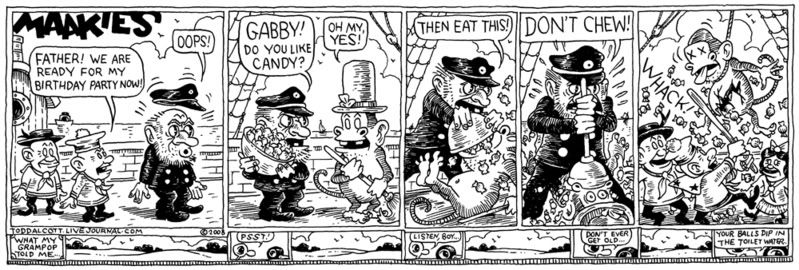
In my ongoing attempts to dominate all media, I am proud to announce that I have succeeded in landing a gag in world-class cartoonist Tony Millionaire’s Maakies.
How, the reader may ask, does one accomplish this feat?
It probably helps if you know Tony, whom I met through a number of acquaintances, including
![[info]](http://p-stat.livejournal.com/img/userinfo.gif)
and Snake n Bacon creator Michael Kupperman (if you don’t know Snake n Bacon, you will — it, along with the Maakies-derived Drinky Crow Show, is set to become yet another [adult swim] show starring the voice of
).
I was nodding acquaintances foryears with Tony before I discovered his “for kids” comic book Sock Monkey. At the time I was riding high off my kids’ movie success Antz and all anyone in Hollywood wanted to know from me was what kind of kids’ movie I wanted to write next. If you’re unfamiliar with it, I advise you to get thee hence to your nearest Sock Monkey collection — the stories are sweet, tender, funny, weird, scary and painfully well-rendered. I immediately saw the commercial potential of a Sock Monkey movie, saw it as a kind of 19th-century Toy Story, contacted Tony and put together a full treatment. Tony and I and an enthusiastic young Canadian director toured all the studios and gave the pitch our best efforts, but Hollywood somehow did not “get” Sock Monkey and we all went our separate ways.
Since then, every now and then I will get an email from Tony saying something like “Quick! My strip is due in six hours and I need an idea!” Not a natural gag writer, I will respond to these emails with some meticulously worked-out concept that sounds great to me but is completely wrong for Maakies. The other day I woke up to find another one of these emails in the inbox and this time took a different tack: I simply thought of the most horrible, saddest, most pathetic examples of bodily harm that could befall a creature, and then tried to think of a gag to work around it. Prolapsed intestines, self-inflicted gunshot wounds, vehicular manslaughter, crablice — and the idea above.