some thoughts on Green Lantern

The big news in Hollywood this weekend is that Green Lantern “failed,” bringing in “only” $52.6 million. “Only,” here, refers to gross-to-expectation ratio.
The reviews were scathing, and when I took my son Sam, 10, to see it on Saturday afternoon, I was fully expecting to see a movie that is thin, noisy, incoherent, poorly plotted, silly and preposterous.
I was pleasantly surprised to find that the movie is none of those things. Rather, it’s entertaining, fast-moving, articulate, and very faithful to its source material. If you are curious about the character and concept of Green Lantern, you will find no better introduction than this movie.
Is it perfect? No, it’s not. But, for some reason inherent to the genre, I find that very few superhero movies are. A movie like the original Spider-Man, for instance, I kind of have to push through the plot and character problems and take it for what it is before I can enjoy it, and then it’s very enjoyable. I can’t think of a single superhero movie, except perhaps The Dark Knight, that really stands up to simple tests of plot, character, motivation, chronology, plausibility, etc.
(Having worked on a number of superhero projects, I speak from experience — they’re really hard to get right, to keep all the elements in line and all the balls up in the air. A contemporary working screenwriter can only watch The Dark Knight from a position of awe.)
Why did the critics hate Green Lantern? I can’t say for sure, but I think it’s a matter of fashion. Marvel has done extremely well for itself presenting a brand of “grounded” superheroes, superheroes who work within a realistic, nuts-and-bolts world that people can recognize. “Grounded,” in fact, has become a buzzword around Hollywood, a town that loves buzzwords, that clings to buzzwords like magical talismans. Iron Man is “grounded,” and so now all movies, especially fantasy movies, must also be “grounded.”
Green Lantern, on the other hand, is not “grounded.” It asks us to buy, before the movie even starts, the concept of an intergalactic police force staffed by goofy-looking aliens and overseen by a bunch of ancient blue guys with see-through skulls who watch over the entire universe.
To a Green Lantern fan, this “buy” is easy — well of course the Green Lantern Corps exists, that’s what the whole thing is about. But to the average non-geek moviegoer, the response is, most likely, “Are you kidding me?”
Think about this:
Nine years ago, The Onion ran this editorial: “When You Are Ready to Have a Serious Conversation about Green Lantern, You Have My E-Mail address.” The piece, a classic, not only perfectly captures a certain type of comics fan, but also perfectly reflects what the average walking-around Joe knows about Green Lantern, which is: who cares?
Now, as if by magic, there is a $200 million movie based on Green Lantern, with a huge marketing campaign and all its attendant pomp and flourish.
(The Onion, not a publication to drop the ball, does it again with this lovely bit of video reporting.)
The fact is, Green Lantern is a hard character for the average moviegoer to “get.”
Why? Because Green Lantern isn’t a character, it’s a job. There is no audience response to the phrase “Green Lantern” because there isn’t any specific guy who is Green Lantern. Clark Kent is Superman, and Bruce Wayne is Batman, Tony Stark is Iron Man, but no one in particular is Green Lantern. My own son, who has no trouble with the concept, only really knows John Stewart as Green Lantern from Bruce Timm’s brilliant Justice League shows. It’s like WB made a $200 million movie called Intergalactic Beat Cop. Who would see that movie, without knowing who the character was? They didn’t make a movie called Hal Jordan: Green Lantern, they made a movie called Green Lantern and showed, on all the marketing, that this is a movie about a job, a job with thousands of other employees, with a headquarters in outer space.
That, in my opinion, is why Green Lantern underperformed this weekend. In order to sell the Green Lantern concept, you have to get the audience to understand that this is not a movie about “Peter Parker, who gets bitten by a radioactive spider and thus becomes Spider-Man.” Rather, you have to get the audience to buy the idea that there is a job, out there, somewhere, called Green Lantern, and this is the story of Hal Jordan, who gets called to fill an opening in that job.
That doesn’t sound like that much for an audience to buy, but that is what happened — the idea that Green Lantern isn’t a guy but a job make Green Lantern a tough sell for civilians. I should know, I’ve encountered this exact same problem in my own life. Sitting down to discuss superheroes with non-initiates, everyone knows who Batman is, everyone knows who Superman is, everyone knows who Wonder Woman is, everyone knows who Spider-Man is, but when you bring up Green Lantern, they draw a blank — there is no character there. And when it comes time to part with $35 for a 3D movie, the average couple will go for something they “know” over something they do not.
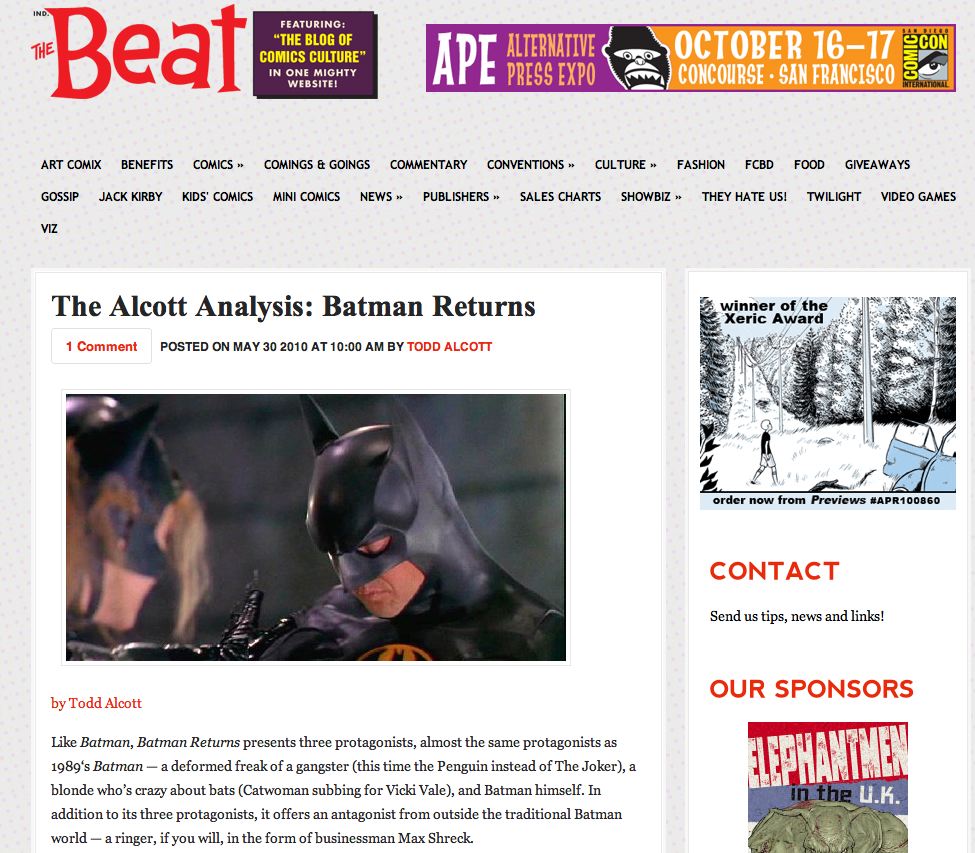
New Batman piece up at The Beat
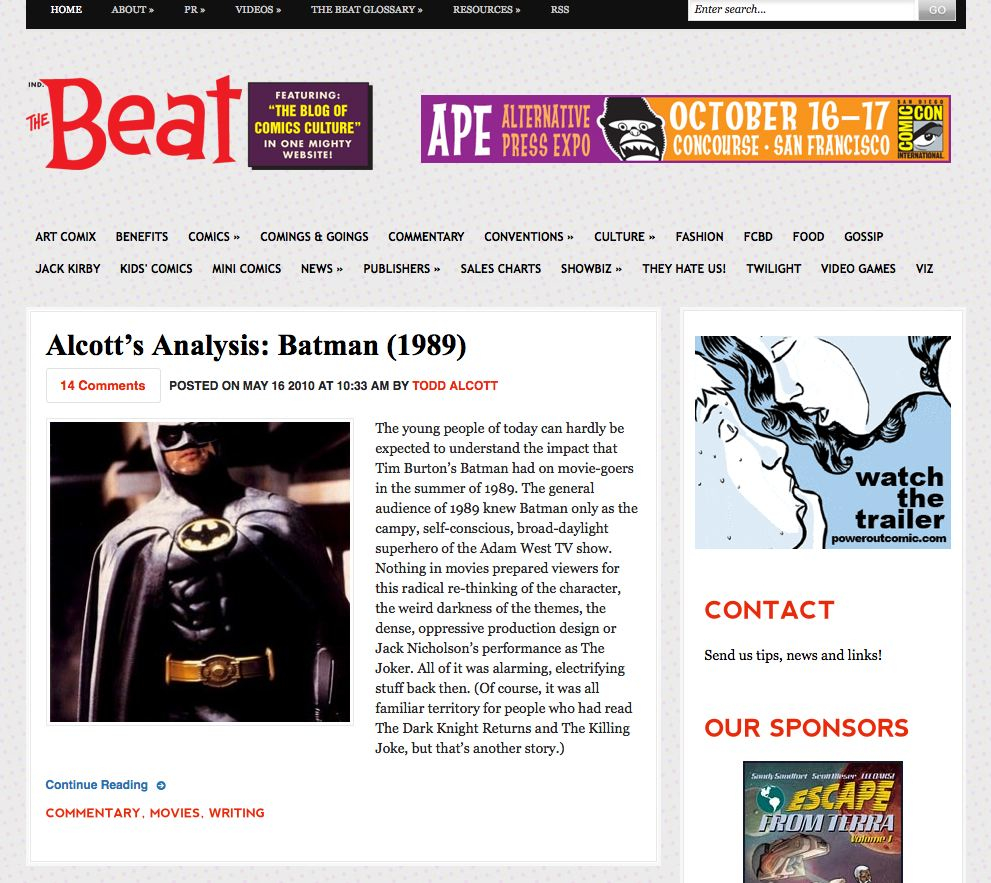
My piece on Tim Burton’s ground-breaking 1989 Batman is up at The Beat. Due to The Beat’s recent flame-discouraging policy, response has been much more sober and respectful this time around.
What Does The Beat Want?

It’s been a big internet week for me. First, I launched this new blog (if you haven’t switched your Livejournal bookmarks, do so now!) Then, out of nowhere, someone I’ve never even met made this smashing video out of a monologue I wrote 20 years ago, and it’s caught on like internet wildfire. And now, my good friend Heidi McDonald at The Beat has started re-posting some of my earlier comics-movies-related analyses, starting with my look at 1966’s Batman: The Movie.
This is the first time one of my blog pieces has been re-posted in another forum, but the reviews are in and readers are ecstatic!
“You are a complete idiot!” – vlucca
“Although I wouldn’t level the charge of “idiot” as vlucca does,I would say ‘misguided’ or “sloppy.'” – S. Chapman
“This so-called “analysis” … seems to have missed the mark entirely!” – KET
“This isn’t so much analysis as it is a badly-written review of a film that the reviewer obviously doesn’t understand or appreciate!” – John
Superheroes: Batman (1989) part 1

Batman has an interesting agenda: the screenplay wants to keep its title character mysterious and elusive for as long as possible. Both Batman and Bruce Wayne are presented as cold, remote and unreachable. "Why won’t you let me in?" asks Vicki Vale, as well she might. Bruce Wayne takes a long time to emerge as a protagonist in Batman, and Batman takes even longer. For the longest time, Bruce/Batman is pursued, tangled with and drawn out, with the effect being to turn him into a kind of mythological figure, or even a fetish object.
Superheroes: Batman (1966)

(For those interested, my earlier thoughts on Batman can be found here.)
WHO IS BRUCE WAYNE? Bruce Wayne is tall, handsome, wealthy and dumb as a post. He lives with his ward, Dick Grayson, who is shorter, not quite as good looking, and also dumb as a post. Wayne refers to himself as a "capitalist" for the benefit of a woman he believes to be a Russian journalist, but as far as the narrative is concerned, Wayne is born rich, a playboy, and does nothing with his life but bear the name of the Wayne Foundation — a wealthy, carefree philanthropist. There is no mention anywhere of the murder of Bruce’s parents when he was eight years old, no mention of any demons or psychological issues that might compel a man to dress up like a bat to go out and fight crime. Like a lot of things in Batman, Bruce Wayne dresses up like a bat to go out and fight crime because the plot demands it.
Dark Knight postscript

Over the summer, I saw The Dark Knight three times in the theaters, and came away stunned and baffled each time — it elevates the superhero genre so much, in so many different ways, it makes Batman Begins look like Batman Forever and it makes the 1989 Batman look like the 1966 Batman. It solves many of the problems inherent in the genre and places the characters in a complex continuum, instead of a hermetically-sealed corporate product. In many ways it is still as broad and "comic-booky" as any superhero movie, but by taking its characters seriously as human beings and thinking their actions through on a broad social level it succeeds in creating cinematic characters that breathe and speak to us. It is also a god-damn freakin’ plot machine, a script so complex and ambitious that I can only sit and wonder at it. Ideas in movies are easy, but plot is hard, and superhero plots are some of the hardest of all, which is why no one — until The Dark Knight — has managed to pull it off. And then, to have the movie be about the hero’s failure instead of his triumph, and then to have it go on to be the biggest movie in the history of the genre, well, that’s some kind of amazing thing.
In August, I had a meeting with a producer who has had some experience producing Batman movies. The Dark Knight was still the number one movie in theaters that day, and conversation naturally turned to it.
ME: So — The Dark Knight.
PRODUCER: I know.
ME: Right?
PRODUCER: I know. It’s amazing. I know.
ME: So. You tell me. You make this kind of movie. You tell me. How?
PRODUCER: How what?
ME: How does a movie like that get made? In this environment, where anything complicated or challenging or pessimistic or visionary get ironed out to appeal to the broadest possible market, how does a movie like that get made? That’s an expensive movie with a lot of moving parts — the producers, the cast, the special effects, the location shooting — how does a picture like that get made, and end up that good?
PRODUCER: Because Christopher Nolan gets no notes.
(pause)
ME: What do you mean?
PRODUCER: I mean, the studio gives him no notes. None. Zero.
ME: The director gets no notes?
PRODUCER: None.
ME: So, you’re telling me, Christopher Nolan and his brother write the script —
PRODUCER: And then they shoot it. And the studio gives them no notes. They’ve given them the project, they trust their vision, and they let them shoot it the way they want. And that’s how a movie like that gets made.
The Dark Knight part 4

At the end of Act III, Bruce, despite his best efforts and his bravest sacrifices, has pretty much screwed up everything in Gotham City. In the act of cleaning up the Mob, he’s created the Joker, and in the act of making his act legitimate (shades of Michael Corleone) he’s created Two-Face. By upsetting the status quo, he’s gotten his girlfriend killed and turned her new boyfriend insane. In Act IV, he will do his best to defeat the Joker — and fail, forcing him to face the consequences of the decisions he’s made.
The Dark Knight part 3

At the end of Act II, Bruce Wayne was ready to reveal himself to be Batman, only to have his decision yoinked away from him by Harvey Dent. At the beginning of Act III, Bruce is forced to continue on as Batman in order to capture the Joker, the key representative of the new breed of criminal class Bruce has created by trying to clean up Gotham. Although there is some question as to whether Bruce’s heart is really into giving up Batman — which Rachel will address later in Act III.
The Dark Knight part 2

At the end of Act I, Bruce Wayne, in his Batman persona, has snatched Mob banker Lau from Hong Kong and delivered him to Jim Gordon. He’s done his job, justice has prevailed, the cops and the lawyers are united against the forces of the underworld and everything in perfect in Batworld.
But of course, it’s not — Lau’s capture is only the beginning. Bruce, in his desire to upset the status quo and rewrite the rules of (out)law and (dis)order in Gotham City creates a wildly unstable new environment, and by the end of Act II, Bruce will be forced to abandon his Batman persona and sacrifice himself, yet again, for the city he loves — that is, until Harvey Dent steals his thunder and turns, in the public eye, from White Knight to Dark Knight.